
Research Peptide Codes and Nicknames Explained: RTA, GLP-3, MS40, KL80, BBG70, Wolverine and More
Reviewed by Oscar Reyes, PhD, Synthesis Lead at Apexion BioLabs · Scientific review of the chemistry and analytical content
Quick answer
What are peptide codes?
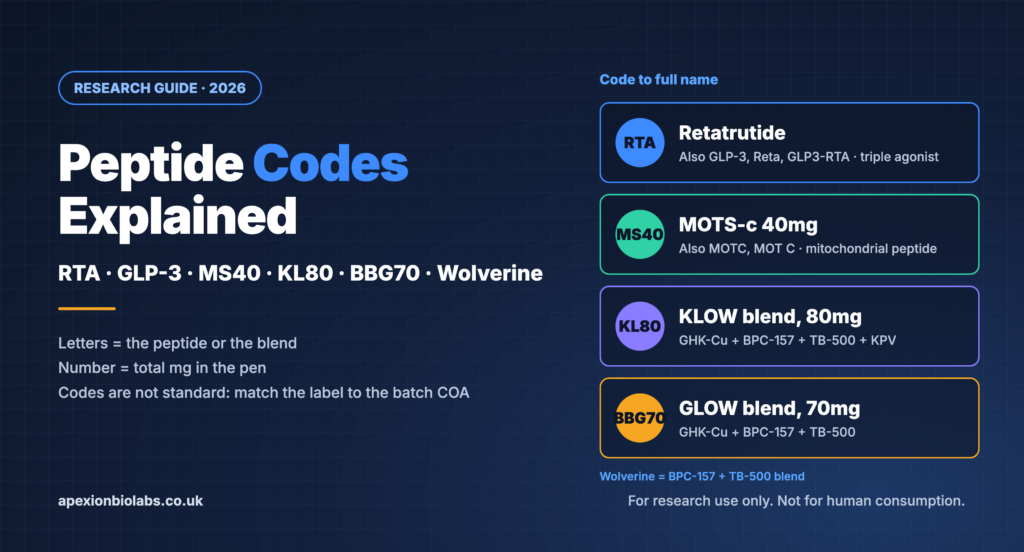
Peptide codes are shorthand. The letters point to the peptide (or blend), and the number is the total milligrams of material in the pen or vial.
- RTA, Reta, GLP-3: Retatrutide. GLP-3 is a nickname, since no hormone by that name exists.
- MOTC, MS40: MOTS-c, 40mg.
- KL80: KLOW blend, 80mg in total.
- BBG70: GLOW blend, 70mg in total.
- Wolverine: BPC-157 + TB-500 blend.
- Codes are not standardised, so always match the full name and strength on the label to the batch certificate of analysis (COA).
A colleague forwards a photo of a pen labelled “MS40” and asks what it is. Is it a product code, a strength, or a peptide you’ve never heard of? That small moment is where most mix-ups with peptide codes begin. Suppliers shorten names to fit a label, communities invent nicknames, and drug developers’ internal codes outlive the trial. Before long, one molecule has five names, and two different blends can share one.
This guide decodes the shorthand you’ll meet most often, then explains where the codes come from, what the numbers mean, and how to confirm what a pen contains before it goes anywhere near a study.
Every compound named on this page is supplied by Apexion for laboratory research only, under its research use notice. Nothing here describes human or veterinary use.
Peptide Code Lookup Table
Every full name and blend total below was checked against the live Apexion product pages on 17 November 2026. The “what it is” column describes the molecule only.
| Code | Also written as | Full name | What it is | Product | Guide |
|---|---|---|---|---|---|
| BBG70 | GLOW 70, GLO 70 | GLOW blend (GHK-Cu + BPC-157 + TB-500) | Three-peptide blend, 70mg total | GLOW 70mg | What is GLOW peptide |
| Cagri | cagri | Cagrilintide | Long-acting amylin analogue | Cagrilintide 10mg | What is cagrilintide |
| CJC/IPA | CJC ipa | CJC-1295 (no DAC) + ipamorelin | Two-peptide blend, 20mg total | CJC-1295 (no DAC) + Ipamorelin | What is CJC-1295 + ipamorelin |
| GHK-Cu | Copper peptide | Glycyl-histidyl-lysine copper complex | Copper-binding tripeptide | GHK-Cu | GHK-Cu UK |
| GLP-3 | GLP3, GLP3-RTA | Retatrutide (nickname) | Nickname; not a real hormone | GLP3-RTA 20mg | Retatrutide UK |
| KL80 | KLOW 80, claw, kylo | KLOW blend (GHK-Cu + BPC-157 + TB-500 + KPV) | Four-peptide blend, 80mg total | KLOW 80mg | What is KLOW peptide |
| KPV | Lys-Pro-Val | KPV tripeptide | Three-amino-acid fragment of alpha-MSH | KPV 10mg | KPV peptide UK |
| MS40 | MOTC, MOT C | MOTS-c, 40mg | 16-amino-acid mitochondrial-derived peptide | MOTS-c 40mg | What MOTS-c is |
| MT2 | MT-II | Melanotan II | Cyclic alpha-MSH analogue | MT2 (Melanotan II) 10mg | No guide yet |
| MTP-131 | Elamipretide, Bendavia | SS-31 | Tetrapeptide that targets the inner mitochondrial membrane | SS-31 30mg | SS-31 UK |
| NAD+ | NAD | Nicotinamide adenine dinucleotide | Coenzyme, not a peptide | NAD+ 500mg | NAD+ UK |
| PT-141 | Bremelanotide | PT-141 | Cyclic heptapeptide acting on melanocortin receptors | PT-141 10mg | PT-141 overview |
| RTA | Reta | Retatrutide | GIP, GLP-1 and glucagon receptor triple agonist | GLP3-RTA 40mg | Retatrutide UK legal status |
| TA1 | Thymosin Alpha-1 | Thymosin alpha-1 | 28-amino-acid thymic peptide | Thymosin Alpha-1 20mg | Thymosin Alpha-1 UK |
| TB4 / TB-500 | Thymosin beta-4 fragment | TB-500 | Synthetic seven-amino-acid fragment of thymosin beta-4 | TB-500 10mg | TB-500 peptide UK |
| Tesa / TSM20 | TSM 20 | Tesamorelin, 20mg | Synthetic GHRH analogue | Tesamorelin 20mg | Tesamorelin UK |
| Wolverine | Wolverine blend/pen | BPC-157 + TB-500 | Two-peptide blend, 20mg or 40mg total | BPC-157 + TB-500 (Wolverine Blend) 20mg | BPC-157 vs TB-500 |
| 5A1MQ | 5-Amino-1MQ | 5-amino-1-methylquinolinium | Small molecule, not a peptide | 5-Amino-1MQ 50mg | 5-Amino-1MQ overview |
Why Do Research Peptides Have Codes and Nicknames?
Research peptides carry codes because four different groups shorten their names for four different reasons, and none of them coordinates. One molecule ends up written five ways, while one code can mean two different products.
- Supplier label codes (MS40, TSM20, KL80): A pen label has room for a few characters, so the name and strength get compressed into one tag. MOTS-c 40mg becomes MS40.
- Community nicknames (Wolverine, GLP-3): Forum users and social media coin memorable names that travel faster than the chemistry. Retatrutide even picked up “ratatouille” as an online code name, according to Marie Claire’s August 2026 feature.
- Drug-development codes (MTP-131, LY3437943): Pharmaceutical companies tag a candidate with an internal code years before it has a generic name, and the code lingers.
- Misspellings: “Claw”, “kylo” and “rita” are typing slips that have hardened into search terms.
None of this is standardised. The US Food and Drug Administration wrote in its July 2026 briefing document for the Pharmacy Compounding Advisory Committee that “TB-500 is a common name and not a United States Adopted Name” and that it had “encountered multiple salts, and derivatives, including different active moieties, sold commercially under the same common name.” The same goes for every code in the table above: a code that means one strength or blend at Apexion may mean something else elsewhere.
What Do the Numbers in Peptide Codes Mean?
The number in a peptide code is the total milligrams of material in the pen or vial. MS40 is 40mg of MOTS-c. TSM20 is 20mg of tesamorelin. For a blend, the number is the combined total of every peptide inside, so KL80 is 80mg made up of four components, and BBG70 is 70mg across three.
| Blend | Code | Components | Total |
|---|---|---|---|
| GLOW | BBG70, GLOW 70 | GHK-Cu 50mg + BPC-157 10mg + TB-500 10mg | 70mg |
| KLOW | KL80, KLOW 80 | GHK-Cu 50mg + BPC-157 10mg + TB-500 10mg + KPV 10mg | 80mg |
| Wolverine 20mg | Wolverine blend | BPC-157 10mg + TB-500 10mg | 20mg |
| Wolverine 40mg | Wolverine 40 | BPC-157 20mg + TB-500 20mg | 40mg |
| Recovery blend | No code | BPC-157 10mg + TB-500 10mg + KPV 10mg | 30mg |
| CJC/IPA | CJC ipa 20 | CJC-1295 (no DAC) 10mg + Ipamorelin 10mg | 20mg |
The number describes how much material is in the product and nothing more; it carries no information about how the material is handled in a study.
Single-Peptide Codes Explained
Most codes point to one molecule. These are the ones UK searchers ask about most.
What Is RTA (Reta) Peptide?
RTA and “Reta” are short for retatrutide, a 39-amino-acid synthetic peptide that acts on three receptors at once: GIP, GLP-1, and glucagon, as a 2024 structural study in Nature Communications mapped out. Eli Lilly developed it under the code LY3437943 and reported in July 2026 that it had met its endpoints in further Phase 3 trials. It remains investigational, with no licence anywhere. Apexion lists its research pen as GLP3-RTA, so you’ll see the code and the name side by side on one label.
What Is GLP-3? Is It a Real Hormone?
No. GLP-3 is another name for retatrutide, and no hormone, receptor, or drug class called GLP-3 exists. The gut makes two glucagon-like peptides, GLP-1 and GLP-2, both cut from the same parent protein. The “3” counts the three receptors retatrutide activates, or the three “generations” people see in semaglutide, tirzepatide, and retatrutide. Healthline describes it the same way: a popular nickname earned by activating receptors for three hormones.
What Is MOTC / MS40?
MOTC, MOT C, and MS40 all mean MOTS-c, a 16-amino-acid peptide encoded in mitochondrial DNA rather than in the cell nucleus. The “40” in MS40 is the pen strength. Apexion’s MOTS-c 40mg pen matches that code directly, and a 30mg version is listed separately, so the number on the label is the one to trust.
What Is Tesa / TSM20?
Tesa, TSM20, and TSM 20 all refer to tesamorelin, a synthetic 44-amino-acid analogue of growth hormone-releasing hormone (GHRH). Tesamorelin 20mg is the pen that TSM20 describes.
What Does CJC/IPA Mean (and What Is “No DAC”)?
CJC/IPA is a two-peptide blend of CJC-1295 and ipamorelin. “No DAC” changes the molecule. DAC stands for drug affinity complex, a chemical group attached to CJC-1295 that binds blood proteins and keeps the peptide circulating far longer. CJC-1295 without DAC is the shorter-acting 29-amino-acid version, also called modified GRF (1-29). Apexion’s CJC-1295 (no DAC) + Ipamorelin pen carries 10mg of each, and its blend report confirmed the DAC form was not detected.
What Is MTP-131?
MTP-131 is an old development code for elamipretide, the same four-amino-acid molecule sold for research as SS-31. PubChem lists SS-31, MTP-131, and Bendavia as synonyms of one entry. A paper that says MTP-131 and a catalogue that says SS-31 are describing one tetrapeptide, which Apexion lists as SS-31 30mg.
TA1 vs TB4: Two Different Thymosins
TA1 and TB4 share a word and little else. TA1 is thymosin alpha-1, a 28-amino-acid peptide first isolated from thymus tissue. TB4 means thymosin beta-4, a 43-amino-acid protein, but on a research label “TB4” or “TB-500” almost always means the synthetic seven-amino-acid fragment (Ac-LKKTETQ) taken from residues 17 to 23 of that protein. The two share no sequence, so Thymosin Alpha-1 20mg and TB-500 10mg are unrelated molecules that happen to share a surname.
Cagri, MT2 and PT-141
Cagri is cagrilintide, a long-acting analogue of the hormone amylin, developed by Novo Nordisk under the codes NN9838, AM833 and NNC0174-0833 (AdisInsight). MT2 or MT-II is Melanotan II, a cyclic analogue of alpha-MSH. PT-141 is the development code that stuck for bremelanotide, a cyclic heptapeptide acting on melanocortin receptors. Almost every catalogue still lists it under the code, including Apexion’s PT-141 10mg.
Peptide Blend Names: KLOW, GLOW and Wolverine
Blend names confuse more than single-peptide codes, because one name stands for several molecules. The quickest way to tell GLOW, KLOW and Wolverine apart is to count the peptides.
| Blend | Codes | Peptides inside | Total | Product |
|---|---|---|---|---|
| GLOW | BBG70, GLOW 70, GLO | GHK-Cu, BPC-157, TB-500 | 70mg | GLOW 70mg |
| KLOW | KL80, KLOW 80, claw, kylo | GHK-Cu, BPC-157, TB-500, KPV | 80mg | KLOW 80mg |
| Wolverine | Wolverine blend, Wolverine pen | BPC-157, TB-500 | 20mg or 40mg | BPC-157 + TB-500 (Wolverine Blend) 40mg |
What Is the Wolverine Peptide Blend?
The Wolverine blend is BPC-157 plus TB-500 in one pen, in equal amounts. The name is borrowed from the comic-book character and is marketing shorthand; it describes no research finding and no property of the two peptides. On the bench, it is a synthetic 15-amino-acid peptide beside a seven-amino-acid thymosin beta-4 fragment, which is the contrast every BPC-157 vs TB-500 comparison turns on.
What Is KL80 / KLOW 80?
KL80 is the KLOW blend, 80mg in total: GHK-Cu 50mg, BPC-157 10mg, TB-500 10mg and KPV 10mg. The K stands for KPV, the only difference between KLOW and GLOW. “Claw” and “kylo” are misspellings of the same product, and the what is KLOW peptide question has a longer answer than a code can give.
What Is BBG70 / GLOW 70?
BBG70 is the GLOW blend, 70mg in total: GHK-Cu 50mg, BPC-157 10mg and TB-500 10mg. Anyone asking what GLOW peptide is beyond the code will find each component taken in turn there.
Development Codes and Scientific Names
Development codes are the strings a pharmaceutical company assigns before a molecule has a generic name. They linger, so a 2026 catalogue can still carry a code coined a decade earlier. Each status below was checked on 17 November 2026.
| Development code | Name | Developer | Status |
|---|---|---|---|
| LY3437943 | Retatrutide | Eli Lilly | Investigational; Phase 3 TRIUMPH results reported in 2026 |
| NN9838 (also AM833, NNC0174-0833) | Cagrilintide | Novo Nordisk | Investigational; the CagriSema combination is under FDA review |
| MTP-131, Bendavia | Elamipretide (SS-31) | Stealth BioTherapeutics | Approved in the US as Forzinity in September 2025, for one rare genetic condition |
| PT-141 | Bremelanotide | Palatin Technologies | Approved in the US as Vyleesi in June 2019 |
A licensed medicine and a research material that share a sequence are still two different products; the approval belongs to the finished drug, and the research pen stands on its own batch documentation.
Common Misspellings
Search engines forgive these slips; order forms don’t:
- Claw, kylo, clow: KLOW
- Glo, glow 70: GLOW
- Mot c, motc, mots c: MOTS-c
- Rita, reta, ratatouille: Retatrutide
- Tesa, tesamoralin: Tesamorelin
- TB4, thymosin beta: TB-500 (the fragment)
How to Check What’s Actually in a Product
Match the full name and strength printed on the label to the batch COA, never to the code. A certificate of analysis names the compound, the batch number and the measured content, and for a blend it should name every component with its own amount. If the label says KLOW 80mg, the COA should account for four peptides that add up to 80mg.
The label is the weak link. A 2025 study of UK fitness-forum discussions by Turnock and Hearne, covering 493 threads and close to 15,000 posts, found users warning each other about a seller offering white powder “labelled GHK-CU”, when GHK-Cu is blue. The same paper notes that much of the product reaching UK buyers is relabelled by wholesalers, and it cites Swiss testing of 146 seized peptide samples in which only 66 percent contained the labelled substance. In August 2026, Dr Terry Dubrow, a plastic surgeon and obesity medicine specialist, told Marie Claire about an independent lab analysis of ten products sold as retatrutide: “Two samples out of the 10 didn’t have any reta in them. Three of the 10 had double doses of reta.”
Apexion pens are made to order in the UK with a batch number on every pen, and a COA is published to the product page when independent testing on that batch is complete. At the time of writing most product pages show testing in progress, with the Recovery Blend certificate already on file. Reading how to read a peptide certificate of analysis line by line is half the check; how to verify a research peptide batch against the pen in front of you is the other half.
Frequently Asked Questions
GLP-3 is a nickname for retatrutide, a 39-amino-acid peptide that acts on the GIP, GLP-1, and glucagon receptors. No hormone or drug class called GLP-3 exists; the name counts the three receptors it activates.
RTA, or Reta, is shorthand for retatrutide, Eli Lilly’s investigational triple receptor agonist, developed under the code LY3437943. On research labels, it also appears as GLP-3, GLP3, or GLP3-RTA, all describing the same single-chain peptide.
Wolverine is a nickname for a two-peptide research blend of BPC-157 and TB-500 in equal amounts, supplied as a 20mg or 40mg pen. The name is marketing shorthand borrowed from the comic character.
KL80 is the KLOW blend at 80mg total. It contains GHK-Cu 50mg, BPC-157 10mg, TB-500 10mg and KPV 10mg in one pen. The K marks the KPV, the one component that GLOW does not contain.
MS40 is a label code for MOTS-c at 40mg. MOTS-c is a 16-amino-acid peptide encoded in mitochondrial DNA. The letters compress the peptide name, and the number is the total milligrams in the pen; MOTC and MOT C are the same molecule.
BBG70 is a code for the GLOW blend at 70mg total: GHK-Cu 50mg, BPC-157 10mg and TB-500 10mg in a single pen. It is also written GLOW 70 or GLO 70, and it differs from KLOW only by the absence of KPV.
MTP-131 is a former development code for elamipretide, a four-amino-acid peptide that targets the inner mitochondrial membrane. It is the same molecule sold for research as SS-31, formerly called Bendavia, and licensed in the US as Forzinity.
CJC/IPA is a blend of CJC-1295 and ipamorelin. “No DAC” means the CJC-1295 is the 29-amino-acid version without the drug affinity complex, the group that extends the long-acting form’s time in circulation. Apexion’s pen contains 10mg of each.
The Bottom Line
Peptide codes compress a name and a strength into a few characters, and that convenience causes the mix-ups. RTA and GLP-3 are retatrutide, MS40 is MOTS-c 40mg, KL80 is KLOW, BBG70 is GLOW, and Wolverine is BPC-157 with TB-500. Use the code as a pointer, read the full name and total milligrams on the label, then confirm both against the batch COA before the material enters a study. Every product above is supplied for laboratory research use only.
Sources
- U.S. Food and Drug Administration, Pharmacy Compounding Advisory Committee briefing document on TB-500 and other bulk drug substances (July 2026)
- Turnock, L. and Hearne, E., Liverpool John Moores University, Novel wellbeing and repair peptide use in the UK: netnographic findings (2025)
- Nature Communications, structural study of retatrutide at the GLP-1, GIP and glucagon receptors (2024)
- Eli Lilly press release on the TRIUMPH Phase 3 retatrutide results (July 2026)
- AdisInsight drug profile for cagrilintide, listing the NN9838, AM833 and NNC0174-0833 codes
- PubChem compound record for elamipretide, with the SS-31, MTP-131 and Bendavia synonyms
- U.S. Food and Drug Administration approval letter for Vyleesi (bremelanotide), NDA 210557 (June 2019)