
Retatrutide UK: Legal Status, Research & Trial Timeline (2026)
Reviewed by Oscar Reyes, PhD, Synthesis Lead at Apexion BioLabs · Scientific review of the chemistry and analytical content
Quick answer
Is Retatrutide legal in the UK?
No. Retatrutide (LY3437943) is an investigational triple receptor agonist from Eli Lilly that has finished its first wave of Phase 3 trials but has not been approved anywhere. The MHRA said in July 2026 that it “has not been authorised for use in the UK”. For anyone checking Retatrutide UK access, it isn’t prescribable through the NHS or privately.
- Acts on GLP-1, GIP and glucagon receptors
- Human evidence comes from Phase 1, 2 and 3 trials, with Phase 3 data still unpublished in full
- The only legitimate route for people is an authorised clinical trial
Retatrutide is a single lab-made peptide that switches on three hormone receptors at once, and by the summer of 2026 it had four positive Phase 3 readouts and still no licence anywhere. That contrast explains most of the confusion. On 23 July 2026, Eli Lilly announced two more positive Phase 3 readouts. The next day, the UK medicines regulator warned the public that anyone selling it here is breaking the law.
Both facts are true because medicines reach people in a fixed order: trials, then a regulator’s decision, then NHS appraisal. Retatrutide is between the first and second steps, and this guide follows it through each one, from the molecule to the likely UK timeline. This article is general information about an investigational compound, not medical advice.
Apexion supplies research materials strictly for laboratory use, not for human or veterinary use. Full terms are in our Research Use Notice.
What Is Retatrutide?
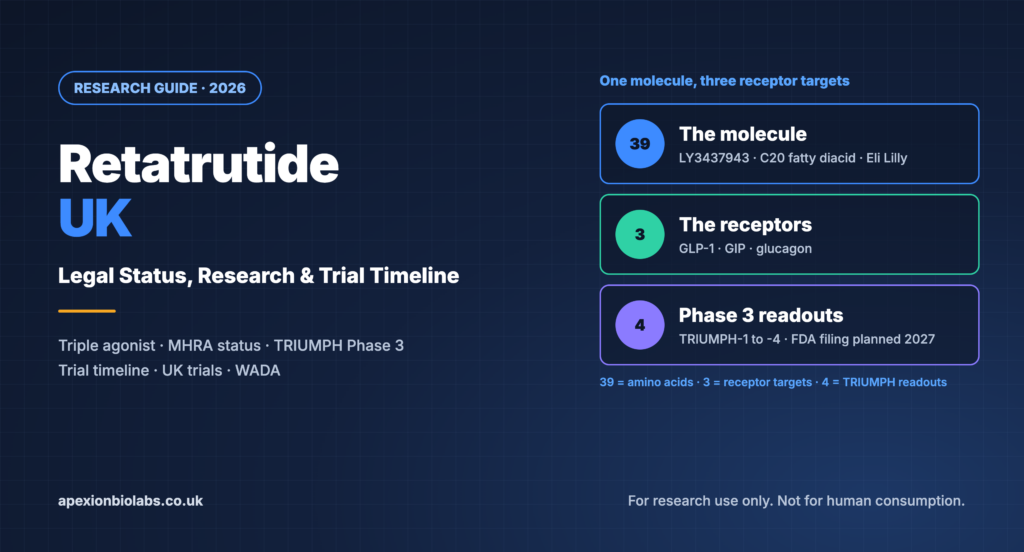
Retatrutide is an investigational triple hormone receptor agonist, a peptide given as a once-weekly injection in trials, developed by Eli Lilly under the code LY3437943. It’s one molecule that activates three hormone receptors (GLP-1, GIP, and glucagon), which is why researchers call it a “triple agonist” and parts of the media have nicknamed it “triple G”. No regulator has approved it for any use.
Lilly describes it as “a single molecule that activates the body’s receptors for glucose-dependent insulinotropic polypeptide (GIP), glucagon-like peptide-1 (GLP-1), and glucagon” in its July 2026 Phase 3 announcement.
Retatrutide at a glance
| Field | Detail |
|---|---|
| Names | Retatrutide; LY3437943; “triple G” (media nickname) |
| Developer | Eli Lilly and Company |
| Class | Triple hormone receptor agonist (GLP-1 / GIP / glucagon) |
| Molecule type | Synthetic 39-amino-acid peptide with a C20 fatty-acid side chain |
| Half-life in trials | About 6 days (Urva 2022) |
| Studied as | Once-weekly subcutaneous injection (in trials) |
| Trial stage | Phase 3 (TRIUMPH, TRANSCEND-T2D) |
| UK status | Not authorised (MHRA, 24 Jul 2026) |
| US status | Not FDA-approved; Lilly plans to submit in Q1 2027 |
| Last checked | 4 November 2026 |
Is Retatrutide a Peptide?
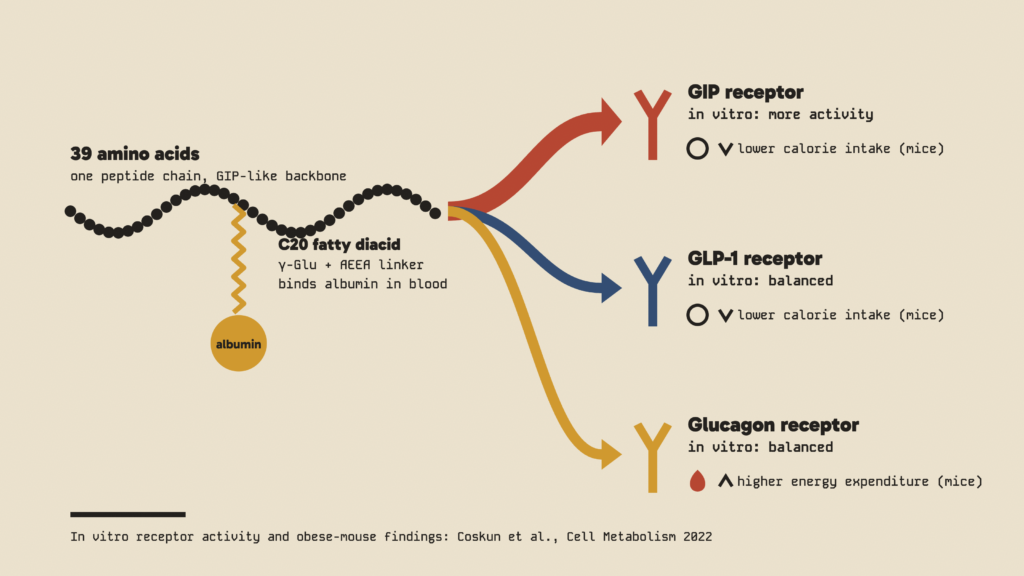
Yes, and a fairly large one, a synthetic chain of 39 amino acids built on a GIP-like backbone. A fatty-acid chain is attached to one residue, and that lipid lets the molecule bind albumin in the blood. The Phase 1b trial measured a half-life of approximately 6 days (Urva et al., 2022, The Lancet), which is why trials give it once a week.
What Is Retatrutide Made Of?
Chemically, it’s amino acids plus a lipid. Most residues are the standard ones found in proteins, but a few are non-natural, such as 2-aminoisobutyric acid (Aib), which slows breakdown by enzymes. A linker joins the peptide to a C20 fatty diacid, as described in Lilly’s registered trial protocol.
How Does Retatrutide Work?
In lab studies and early human trials, Retatrutide activates three receptors that normally respond to three different gut and pancreatic hormones:
- GLP-1 and GIP receptors are involved in insulin release after meals and in appetite signalling.
- The glucagon receptor is studied for its role in energy expenditure and liver fat.
- All three in one molecule is what separates it from earlier compounds, which target one or two.
GLP-1 is released by the gut after eating. It prompts insulin release when glucose is high and signals satiety to the brain. Semaglutide is built on it.
GIP is the other incretin, also amplifying insulin release after meals. Retatrutide’s backbone is modelled on it.
Glucagon usually works in the opposite direction to insulin: it tells the liver to release stored glucose. It also raises energy expenditure and fat oxidation, which is what draws researchers to it.
Lilly’s discovery paper reported that in cell assays, Retatrutide “shows balanced GCGR and GLP-1R activity but more GIPR activity” (Coskun et al., 2022, Cell Metabolism). In obese mice, the same team found the glucagon arm added extra energy expenditure on top of the lower calorie intake driven by the GIP and GLP-1 arms.
Is it a fat burner, then? No. It’s a receptor agonist studied in obesity and type 2 diabetes trials, and its activity at each receptor is measured in assays and controlled studies.
Is Retatrutide Legal in the UK?
No. Retatrutide has no UK marketing authorisation. On 24 July 2026, the MHRA said it “has not been authorised for use in the UK, meaning anyone selling this product is doing so illegally.” It can’t be prescribed, neither the NHS nor private clinics can supply it, and the only lawful route for people is an approved clinical trial.
What the MHRA Said (July 2026)
The statement came in the MHRA’s summer campaign on weight-loss medicines bought online, No summer shortcut for safe weight loss, published 24 July 2026:
“It has not been authorised for use in the UK, meaning anyone selling this product is doing so illegally.”
The release added that these products “haven’t been tested for safety, quality or effectiveness”. Lilly’s July release agrees, calling Retatrutide “an investigational molecule that cannot be legally sold or marketed for human use.”
The warning followed a year of seizures. On 4 September 2026, the BBC reported that vials sold as reta were turning up in UK gyms, beauty salons and on social media, and that the MHRA had found more than 2,000 unlicensed Retatrutide pens in a raid on an illegal factory in Northampton.
What “Research Use Only” Means, and What It Doesn’t
A Research Use Only (RUO) label describes a material’s intended use: laboratory work such as assays and analytical method development. What it doesn’t do:
- It doesn’t turn a product into an authorised medicine.
- It doesn’t permit use in people or animals.
- It doesn’t override the MHRA’s position on Retatrutide.
Under the Human Medicines Regulations 2012 (regulation 46), a medicinal product can only be sold or supplied once it has a marketing authorisation. Whether something counts as a medicinal product depends on how it’s presented and what it’s for, not on the label alone. Our Research Use Only policy sets out how we apply this.
Can You Get Retatrutide on the NHS or Private Prescription?
No. A UK prescription, NHS or private, needs an authorised medicine, and Retatrutide has none. NICE hasn’t issued guidance on it either, since appraisals normally follow an MHRA licence. Clinics listing it online are describing a pipeline drug.
Are Peptides Legal in the UK?
In short, a peptide becomes a medicine in law when it’s presented or supplied for use in people, and then it needs a licence. Most research compounds follow the same test, which is why peptides are legal in the UK for laboratory work but can’t be sold as unlicensed medicines.
UK legal position checked 4 November 2026 against GOV.UK/MHRA.
What Does the Research on Retatrutide Show?
Retatrutide has been studied in cells, in obese mice, and in Phase 1, Phase 2 and Phase 3 human trials. The early-phase papers were published between 2022 and 2024. Phase 3 TRIUMPH trials began in 2023, and four had reported top-line data by July 2026. No regulator has yet reviewed a full marketing application.
Preclinical Studies (Animal and Cell)
The groundwork is in Coskun et al. (2022). In vitro, the team mapped activity at each human receptor. In diet-induced obese mice, they reported lower body weight and better glycaemic control, and showed through receptor studies that glucagon-receptor activity raised energy expenditure in the animals. The same paper included a first-in-human single-dose study, where the pharmacokinetics supported once-weekly dosing.
Phase 1 and Phase 2 Human Trials
The early human trials, by design and primary endpoint:
| Study type | Paper | Who was studied | Length | Primary endpoint |
|---|---|---|---|---|
| Cell assays + obese mice | Coskun 2022, Cell Metabolism | Human receptors in vitro; diet-induced obese mice | Preclinical | Receptor activity, body weight, energy expenditure |
| Phase 1 (single dose) | Coskun 2022, Cell Metabolism | Healthy participants | Single dose, followed to day 43 | Safety, tolerability, pharmacokinetics |
| Phase 1b | Urva 2022, The Lancet | 72 adults with type 2 diabetes (4 US centres) | 12 weeks | Safety and tolerability |
| Phase 2 (obesity) | Jastreboff 2023, NEJM | 338 adults with obesity or overweight | 48 weeks | Body-weight change at 24 weeks |
| Phase 2 (type 2 diabetes) | Rosenstock 2023, The Lancet | 281 adults with type 2 diabetes | 36 weeks | HbA1c change at 24 weeks |
| Phase 2a substudy (MASLD) | Sanyal 2024, Nature Medicine | Participants with excess liver fat from the obesity trial | 48 weeks | Liver fat (MRI) at 24 weeks |
The Phase 2 obesity trial reported a mean change in body weight of −24.2% at 48 weeks in the 12 mg group, against −2.1% with placebo (Jastreboff et al., 2023, NEJM). The Phase 2 diabetes trial reported HbA1c changes at 24 weeks of up to −1.99% from baseline, measured against placebo and dulaglutide (Rosenstock et al., 2023, The Lancet). A Phase 2a substudy then used MRI to measure liver fat in participants with metabolic dysfunction-associated steatotic liver disease (Sanyal et al., 2024, Nature Medicine), the clearest human test yet of the glucagon arm.
The Phase 3 TRIUMPH Programme
TRIUMPH is the registration programme Lilly will base its applications on. The initial four trials began in 2023 and enrolled more than 5,800 participants, according to Lilly. A parallel TRANSCEND-T2D programme studies type 2 diabetes.
| Trial | Registry ID | Population studied | Length | Status/readout |
|---|---|---|---|---|
| TRIUMPH-1 | NCT05929066 | Adults with obesity or overweight, without diabetes | 80 weeks (+ extension) | Completed; met primary endpoints (Lilly, 21 May 2026) |
| TRIUMPH-2 | NCT05929079 | Obesity or overweight + type 2 diabetes | 80 weeks | Completed; met primary endpoint (Lilly, 23 Jul 2026) |
| TRIUMPH-3 | NCT05882045 | Severe obesity + established cardiovascular disease | 80 weeks | Completed; met primary endpoint (Lilly, 23 Jul 2026) |
| TRIUMPH-4 | NCT05931367 | Obesity or overweight + knee osteoarthritis | 68 weeks | Completed; top-line reported by Lilly (Dec 2025) |
| TRANSCEND-T2D-3 | NCT06297603 | Type 2 diabetes + moderate or severe kidney impairment | See registry | Active, not recruiting |
“We now have the clinical data package to support global submissions for Retatrutide,” said Kenneth Custer, PhD, president of Lilly Cardiometabolic Health, in the July 2026 release. Full Phase 3 papers are still to come; the figures so far are company top-line data.
A 2025 review in Biomolecules put the next step plainly: “additional phase 3 clinical trials are crucial to further evaluate the drug’s safety and long-term effects” (Katsi et al., 2025).
These trials enrol screened participants, use pharmaceutical-grade material, and follow a written protocol under medical supervision. None of what they report carries over to unauthorised products of unknown content.
Adverse Events Reported in Clinical Trials
Trial publications report mainly gastrointestinal events in participants (nausea, diarrhoea, vomiting and constipation) and dose-related increases in heart rate, a pattern similar to the GLP-1 class. Most GI events were mild to moderate. Long-term data will come from the full Phase 3 papers and the outcomes trials still running.
What each trial stage recorded:
- Phase 1b and Phase 2: GI disorders were the most frequent events in Urva 2022 and Rosenstock 2023. In the obesity trial, heart-rate increases were dose-dependent, peaked at 24 weeks, and declined afterwards (Jastreboff 2023).
- Trial design: protocols started low and stepped up every few weeks to manage GI events, and the Phase 2 obesity trial reported fewer GI events with a lower starting dose.
- Phase 3 top-line: Lilly listed diarrhoea, nausea, constipation, decreased appetite and vomiting as the most common events in TRIUMPH-2, and reported dysaesthesia (altered skin sensation) more often in the Retatrutide arms than with placebo in TRIUMPH-2 and TRIUMPH-3 (Lilly, July 2026).
Products sold outside trials have none of these checks, so their content, purity and sterility are unknown.
Retatrutide vs Tirzepatide vs Semaglutide: What’s the Difference?
The difference is the receptors each one targets:
- Semaglutide (Ozempic, Wegovy) targets GLP-1 only.
- Tirzepatide (Mounjaro) targets GLP-1 and GIP.
- Retatrutide adds the glucagon receptor to those two.
Tirzepatide and semaglutide are authorised UK medicines. Retatrutide isn’t.
| Retatrutide | Tirzepatide | Semaglutide | |
|---|---|---|---|
| Receptor targets | GLP-1 + GIP + glucagon | GLP-1 + GIP | GLP-1 |
| Developer | Eli Lilly | Eli Lilly | Novo Nordisk |
| Brand names | None | Mounjaro | Ozempic, Wegovy |
| UK status | Not authorised | Authorised (MHRA) | Authorised (MHRA) |
| Stage | Phase 3 | Approved | Approved |
Each generation added a receptor, and Retatrutide’s glucagon arm brings an energy-expenditure signal while the incretin arms offset glucagon’s push on blood glucose.
Is Retatrutide better than Mounjaro? No head-to-head trial against tirzepatide has been published. Lilly is running a Phase 3 open-label trial against semaglutide in adults with type 2 diabetes (NCT06260722), which is listed as active and not recruiting.
Is Retatrutide the Same as Ozempic?
No. Ozempic is semaglutide, a GLP-1 receptor agonist made by Novo Nordisk and licensed in the UK for type 2 diabetes. Retatrutide is a different molecule from a different company, acting on three receptors instead of one, and it has no licence.
When Will Retatrutide Be Available in the UK?
There’s no confirmed date for Retatrutide UK availability. The sequence runs like this: Lilly completes Phase 3 and applies to regulators, the MHRA reviews the application and decides, and then NICE appraises it for NHS use. Lilly has said it plans to submit to the FDA in Q1 2027. Any UK launch date you see online is an estimate.
| Date | Milestone | Source |
|---|---|---|
| Sep 2022 | Preclinical + Phase 1 single-dose study published | Coskun 2022 |
| Oct 2022 | Phase 1b in type 2 diabetes published | Urva 2022 |
| Jun 2023 | Phase 2 obesity and type 2 diabetes trials published | NEJM; The Lancet |
| May 2023 | First Phase 3 TRIUMPH trial starts | ClinicalTrials.gov |
| Dec 2025 | TRIUMPH-4 top-line | Lilly |
| 21 May 2026 | TRIUMPH-1 top-line | Lilly |
| 23 Jul 2026 | TRIUMPH-2 and TRIUMPH-3 top-line | Lilly |
| 24 Jul 2026 | MHRA: not authorised in the UK | GOV.UK |
| Q1 2027 (planned) | US application to the FDA | Lilly |
| TBC | MHRA application and decision | Lilly / MHRA |
| TBC | NICE appraisal for NHS use | NICE |
Lilly says it is completing the chemistry, manufacturing and controls package for the US application. UK timing hasn’t been announced, so the MHRA and NICE rows stay “TBC”.
Can You Join a Retatrutide Clinical Trial in the UK?
UK sites have run several Retatrutide trials, including TRIUMPH-1. NIHR’s Be Part of Research lists UK studies with eligibility and contact details, and an authorised trial is the only way people receive Retatrutide legally.
Most of the UK-based studies have finished enrolling. In a registry check on 4 November 2026, the one Retatrutide study with UK sites still recruiting was a Phase 3 master protocol in liver disease (MASLD) that also includes tirzepatide (NCT07165028).
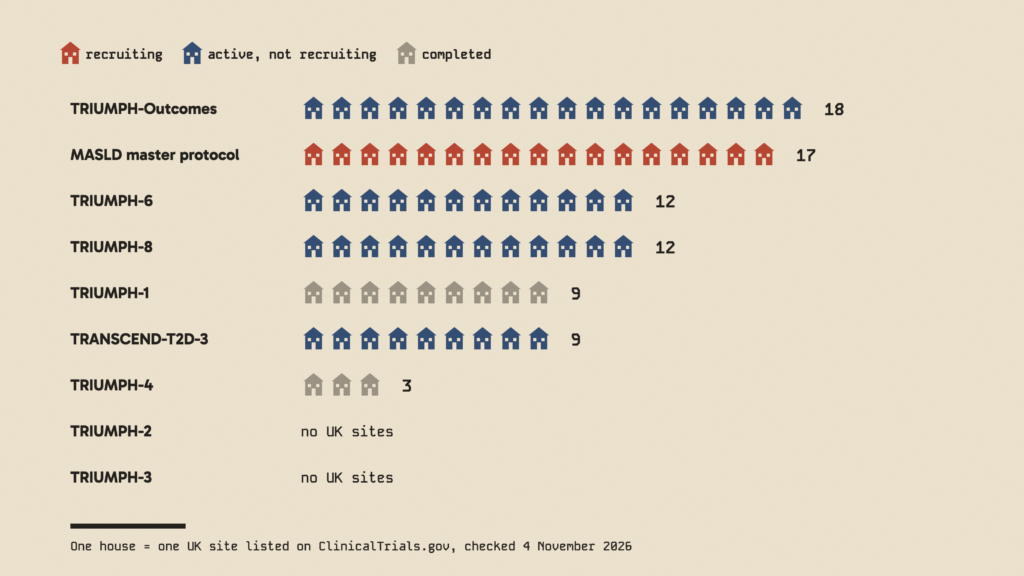
New studies appear on Be Part of Research and ClinicalTrials.gov, each with its sites and contact team.
Is Retatrutide Banned in Sport?
Retatrutide doesn’t appear by name on WADA’s Prohibited List. Sport Integrity Australia’s substance page states that “Retatrutide is not listed on the Prohibited List” (Sport Integrity Australia), and GLP-1 agonists are not prohibited, though semaglutide and tirzepatide are on WADA’s Monitoring Program.
The list does include section S0, which covers pharmacological substances with no human approval that aren’t addressed elsewhere. WADA published the 2027 Prohibited List in September 2026, and it takes effect on 1 January 2027. UKAD is the body that applies the list to UK sport.
How Laboratories Verify Retatrutide Research Material
Start with the Certificate of Analysis (COA) issued for that exact batch. It should give an HPLC purity figure, say how it was measured, and show a mass from LC-MS that agrees with Retatrutide’s expected molecular weight. A long, lipidated peptide has more places for synthesis errors, so the mass check is especially useful here.
A COA checklist for any Retatrutide batch:
- Lot number: the same on the COA and on the container.
- HPLC purity with the column, gradient, and detection wavelength stated.
- LC-MS mass consistent with the 39-residue lipidated structure.
- Named laboratory and test date, recent enough to cover the batch.
- Storage conditions stated for the batch.
Knowing how to read a peptide COA makes each of these fields quicker to check, and the same steps used to verify a research peptide batch apply to Retatrutide. Freeze-dried material is normally stored chilled, sealed against moisture and shielded from light, in line with its COA and standard peptide storage and handling practice.
Frequently Asked Questions
No. The regulator’s July 2026 statement is direct: Retatrutide “has not been authorised for use in the UK, meaning anyone selling this product is doing so illegally.” People can only receive it lawfully through an approved clinical trial.
No date has been set. Lilly plans its US submission for Q1 2027. A UK route needs an MHRA application and decision first, then a NICE appraisal before NHS use. Any specific UK date online is speculation.
Yes. It’s a synthetic 39-amino-acid peptide with a C20 fatty-acid chain attached through a linker. Albumin binding gives it a half-life of about six days in trial participants.
No. Ozempic (semaglutide) targets one receptor, GLP-1. Mounjaro (tirzepatide) targets two, GLP-1 and GIP. Retatrutide targets those two plus glucagon. Both Ozempic and Mounjaro are licensed UK medicines; Retatrutide is still investigational.
Only if the MHRA authorises it and NICE then recommends it for NHS use. NICE weighs clinical and cost evidence and decides which groups, if any, qualify.
Eli Lilly and Company, the Indianapolis-based maker of tirzepatide (Mounjaro). Its development code, LY3437943, still appears in trial registrations.
Concluding
Retatrutide is a triple receptor agonist with four Phase 3 readouts behind it and a US filing planned for early 2027. In the UK, it isn’t authorised, the MHRA has warned that anyone selling it is acting illegally, and the only legitimate route for people is a clinical trial. The next real UK signal will be an MHRA application, announced by Lilly or on GOV.UK.
This article is general information about an investigational compound, not medical advice. Apexion supplies research materials strictly for laboratory use; not for human or veterinary use. Read our Medical Disclaimer.
Sources
- MHRA (GOV.UK), No summer shortcut for safe weight loss, 24 July 2026
- Eli Lilly, TRIUMPH-2 and TRIUMPH-3 top-line release, 23 July 2026
- Eli Lilly, TRIUMPH-1 top-line release, 21 May 2026
- Coskun T et al., Cell Metabolism, 2022. doi:10.1016/j.cmet.2022.07.013
- Urva S et al., The Lancet, 2022. doi:10.1016/S0140-6736(22)02033-5
- Jastreboff AM et al., NEJM, 2023. doi:10.1056/NEJMoa2301972
- Rosenstock J et al., The Lancet, 2023. doi:10.1016/S0140-6736(23)01053-X
- Sanyal AJ et al., Nature Medicine, 2024. PMC11271400
- Katsi V et al., Biomolecules, 2025. PMC12190491
- ClinicalTrials.gov (TRIUMPH, TRANSCEND-T2D), checked 4 November 2026
- NIHR Be Part of Research
- BBC News, How hunger for a new weight-loss drug is feeding an industry of fakes, 4 September 2026
- Human Medicines Regulations 2012, regulation 46
- WADA Prohibited List; Sport Integrity Australia, Retatrutide; UKAD