
How to Verify a Research Peptide Batch: COA, HPLC & LC-MS Checklist

Quick answer
To verify a research peptide batch, match the product label and lot number to its Certificate of Analysis, review the batch-specific HPLC purity and LC-MS identity evidence, confirm the documentation is complete and attributable, then record the item in the laboratory inventory. A COA should always be reviewed alongside the physical product it represents.
How to Verify a Research Peptide Batch?
A product claim on its own does not establish research quality. Quality comes from documentation you can link back to the exact batch in your hands. That link, from the physical item to its paperwork, is the whole point of batch verification.
A practical check has a few clear steps. You confirm the product label, match the batch or lot number, review the COA, look over the analytical methods behind the results, and log the item in your own records. Each step connects one piece of evidence to the next.
This guide is written for research-material documentation and quality-control workflow. It does not give medical advice, dosing information, administration guidance, or any clinical claim. Where product-specific instructions, the supplied documentation, or your laboratory’s SOP say something different from this general guide, those take priority every time.
Before you review a batch, it helps to understand the document itself, so it is worth getting familiar with how to read a peptide Certificate of Analysis first.
What Is Research Peptide Batch Verification?
Research peptide batch verification is the process of confirming that the physical peptide product, its label, its lot or batch number, and its analytical documentation all refer to the same identifiable material. It helps researchers keep traceability before material is assigned to a research workflow.
A batch, or lot, is one identifiable unit of production or supply. The batch number is the thread that ties a pen or vial to its COA and to your inventory record. Follow that thread and every piece of paper points back to the same physical item.
Verification covers more than purity. A good check also confirms product identity, shows that the document actually belongs to this product, records how and when the item arrived, and keeps storage accountable. Purity is one field on the page among several that carry weight.
There is one firm rule to carry through the rest of this guide. A COA that does not match the physical product, exactly, should not be treated as supporting documentation for that product.
Core principle: No matching lot number means no confirmed link between the document and the product.
The Apexion Five-Point Batch Verification Check
The Apexion Five-Point Batch Verification Check gives researchers a simple process for confirming product identity, batch documentation, analytical evidence and traceability before research use.
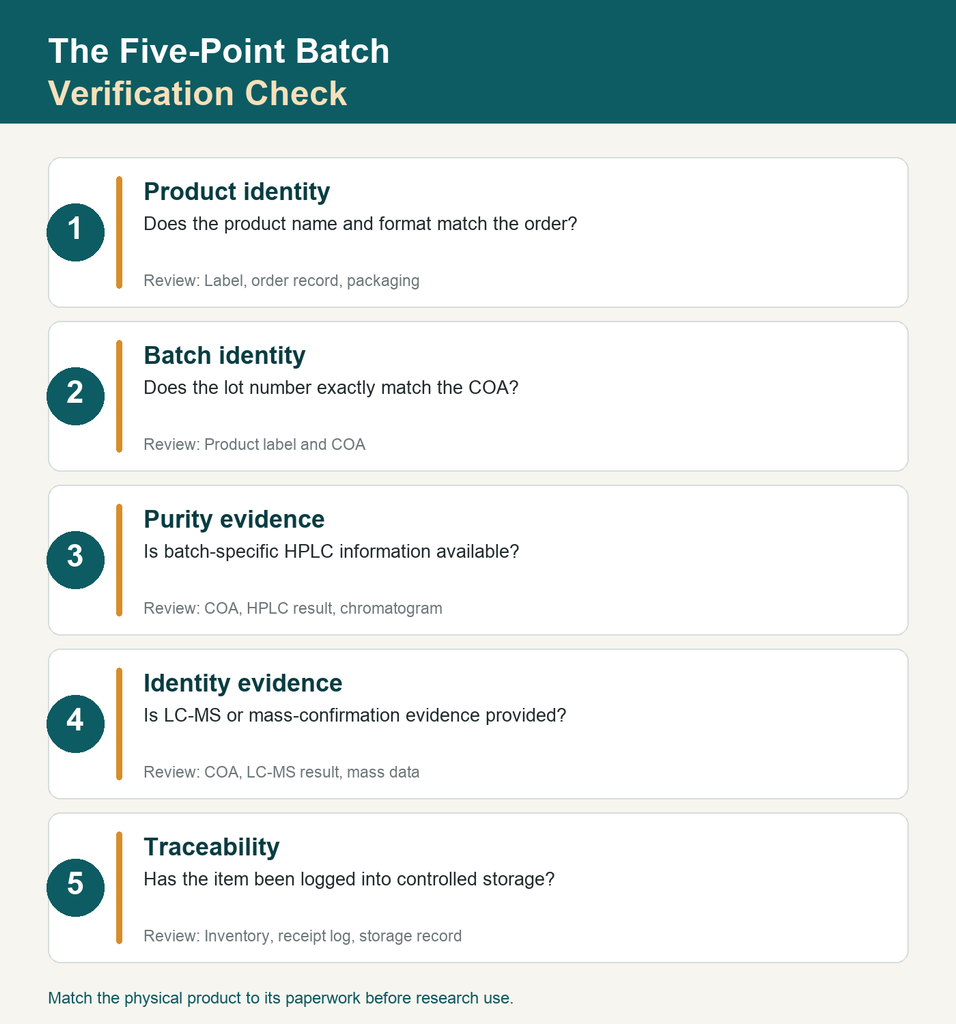
| Check | Question to ask | Evidence to review |
| 1. Product identity | Does the product name and format match the order? | Product label, order record, packaging |
| 2. Batch identity | Does the lot number exactly match the COA? | Product label and COA |
| 3. Purity evidence | Is batch-specific HPLC information available? | COA, HPLC result, chromatogram where supplied |
| 4. Identity evidence | Is LC-MS or mass-confirmation evidence provided where applicable? | COA, LC-MS result, mass data |
| 5. Traceability | Has the item been logged and assigned to controlled storage? | Inventory record, receipt log, storage record |
This five-point check works alongside product-specific instructions and your own quality procedures, and defers to them where they differ. Think of it as a simple frame for connecting the supplied product to its documentation and your internal research records.
How Do You Match a Peptide Label to a COA?
Match the exact lot or batch number printed on the physical peptide label to the lot or batch number on the Certificate of Analysis. The product name, the presentation and any relevant label details should also line up with the documentation.
Check the product name
The product name on the physical pen or vial should agree with the name on the COA. Watch for small naming differences that point to a different presentation, concentration, blend, or product version. A little formatting variation can happen, yet the underlying product identity should stay clear at a glance.
If you are matching a multi-compound label, take extra care: a blend such as CJC-1295 with no DAC + Ipamorelin 10mg names two compounds, and both should read consistently across the label, order record and COA.
Match the batch or lot number exactly
The lot number is the single most important traceability field. It should match character for character wherever possible. A similarly named COA still belongs to a different item if the batch number differs, so treat each one on its own.
Where a batch and its paperwork do not agree, record the discrepancy before the product is assigned to any work. The same discipline applies to any single-compound item, for example a BPC-157, where one label maps to one COA.
Confirm the product presentation
| Field | What to check |
| Product format | Reconstituted research vial or pre-filled research pen |
| Product name | Consistent on label, order record and COA |
| Batch/lot number | Exact match between physical product and COA |
| Strength or concentration | Match where displayed on both records |
| Quantity or presentation | No unexplained difference from the order |
| Storage instruction | Consistent with supplied product guidance |
| COA document reference | Retained in the batch inventory record |
What if the lot number does not match?
If the product lot number and the COA lot number are different, do not treat that COA as documentation for the item. Set the product aside under your laboratory’s quality process, then request clarification with the relevant product and document details to hand. A mismatch is a prompt to pause and ask, and the check has done its job by catching it.
How Do You Check HPLC Purity on a Peptide COA?
HPLC information on a peptide COA shows the reported purity profile of the tested batch. Review the batch number, the stated method, the reported purity result, the test date, and the supporting chromatogram where one is supplied.
What HPLC tells you
High-performance liquid chromatography separates the components in a sample. The output helps you see the share tied to the main peptide component against other detectable components. Read the reported percentage as one part of a complete, batch-specific analytical record, and let it sit in context with the rest of the page. Purity is one field on the page among several that matter.
What to look for on the COA
- Clearly stated peptide or material name
- Exact batch or lot number
- HPLC method or method reference
- Reported purity value
- Test date or report date
- Testing laboratory or report issuer
- Chromatogram, if supplied
- A clear connection between the report and the physical batch
Why a Chromatogram Can Add Context
A chromatogram gives you a visual read of the separation result. It adds useful context beyond a single purity percentage, and it can show how clean the separation looks. Read it against the stated method and the supplier documentation. A chromatogram supports the purity picture, though molecular identity is confirmed elsewhere, and that is where LC-MS evidence becomes relevant.
For a fuller explanation of chromatograms, purity figures and analytical terms, see our guide on how to read a peptide Certificate of Analysis, which covers HPLC, LC-MS, purity and batch verification in more depth.
How Does LC-MS Help Verify Peptide Identity?
LC-MS supports peptide identity verification by pairing chromatographic separation with mass-spectrometric measurement. Researchers should look for batch-linked observed mass information that agrees with the stated peptide identity.
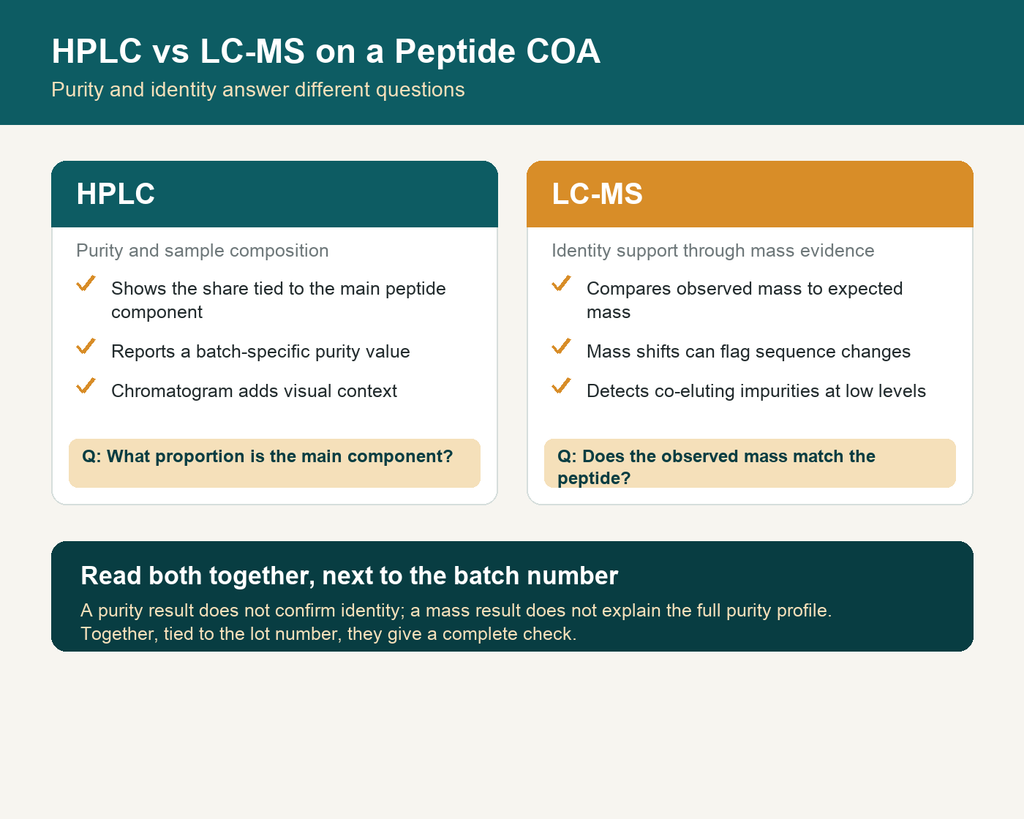
HPLC and LC-MS have different roles
| Analytical method | Main verification role | Key question it helps answer |
| HPLC | Purity and sample composition | What share of the tested sample is tied to the main component? |
| LC-MS | Identity support through mass evidence | Is the observed mass-related result consistent with the stated peptide? |
| COA review | Batch-level documentation | Does this analytical information relate to the physical lot received? |
The two methods answer different questions and read best together. Work published in *The AAPS Journal* (Zeng and colleagues, 2015) notes that combined liquid chromatography and high-resolution mass spectrometry “are capable of detecting and identifying co-eluting impurities at low levels,” which is context an HPLC purity figure alone may not surface. Reviewing both is how you build a fuller documentation check, and it pairs naturally with a well-documented item such as a Tesamorelin, where the COA carries both result types.
What to look for in LC-MS documentation
- Product or peptide name
- Batch or lot number
- Method reference, if included
- Observed mass-related result
- Expected mass reference, where reported
- A clear test date or report date
- Testing source or laboratory reference
Avoid confusing expected data with observed data
An expected molecular weight is a reference value, a number you would predict from the sequence. Stronger identity documentation shows the actual observed result from testing and links that result to the specific product batch.
The same paper explains why the observed figure carries weight: “changes to the primary amino acid sequence due to degradation, truncation, insertion, substitution, or deletions typically result in detectable mass shifts.” An observed mass that lines up with the expected value is doing real work.
Why purity and identity should be reviewed together
A purity result on its own does not confirm exact molecular identity. A mass result on its own does not explain the full purity profile. Read both together, next to the batch number, and you get a more complete documentation check than either gives alone. This matters for identity-led compounds such as GHK-Cu, where the observed mass supports the stated peptide.
What Should a Complete Peptide COA Include?
A complete peptide COA should let you identify the tested material, connect it to a specific batch, understand the analytical methods used, and read the reported results in context. Each field earns its place by answering one of those needs.
| COA field | Why it matters |
| Product or peptide name | Identifies the stated material |
| Batch or lot number | Connects the COA to the physical product |
| COA or report number | Supports document control |
| Issue date or test date | Provides document timing context |
| HPLC result | Provides batch-specific purity information |
| HPLC method reference | Clarifies the analytical basis |
| LC-MS or mass data | Supports peptide identity verification where applicable |
| Observed versus expected values | Helps separate test results from reference values |
| Testing laboratory or issuer | Shows who generated or issued the documentation |
| Signature, approval or report-control information | Supports document traceability where available |
What a COA can confirm
- Batch-linked analytical information
- Reported purity data
- Identity-supporting mass information where included
- The testing or documentation source
- Batch-specific quality documentation at the time of testing
What a COA cannot confirm by itself
- Storage conditions after delivery
- Internal laboratory handling after receipt
- Whether the material was assigned to the correct research protocol
- Whether a label was later damaged, changed, or separated from the batch
- Whether generic online storage claims apply to that specific product
How Should You Document a Research Peptide Batch?
Document a research peptide batch by creating an inventory record that links the physical item, its batch number, COA, receipt condition, storage location and any relevant handling events. One record, one batch, all the details in a single place.
Good records also reflect a wider quality principle. The ICH Q7 GMP guideline states that “a system should be in place by which the distribution of each batch … can be readily determined to permit its recall.” Your inventory record is the lab-side version of that idea: it keeps each batch findable long after it arrives.
Minimum batch-record template
| Record field | What to document |
| Internal sample ID | Unique laboratory inventory identifier |
| Product name | Full product name on the label |
| Product presentation | Pre-filled research pen or reconstituted vial |
| Batch or lot number | Exact identifier from the product |
| COA reference | COA number, file name or controlled location |
| Date received | Date material entered laboratory control |
| Received by | Name or initials of the responsible person |
| Condition at receipt | Package, label and container condition |
| Storage instruction | Product-specific stated condition |
| Storage location | Unit, shelf, cabinet or controlled location |
| Handling event | Any movement, issue or noted deviation |
| Research record reference | Optional internal study, assay or protocol ID |
Why storage records matter for reconstituted peptide products
Reconstituted products arrive in a prepared solution format, which can simplify your workflow by removing a separate in-lab reconstitution stage. That convenience still sits alongside controlled storage and batch traceability, both of which stay just as important. The storage record builds a post-receipt history for the same batch named on the COA, so the paper trail continues past the front door. Clear records also keep results consistent across researchers, research sessions and inventory checks. A format such as MOTS-c benefits from a storage line in the record from the day it arrives.
For storage-focused guidance, read our guide on reconstituted peptide storage and handling for research, which covers stability, temperature and batch documentation.
What Are the Red Flags on a Peptide COA?
A peptide COA may need clarification when it cannot be reliably connected to the physical product, lacks basic analytical detail, or includes information that is incomplete, inconsistent or hard to attribute to a specific batch.
| Potential red flag | Why it matters | Appropriate next step |
| Lot number does not match the label | The COA may relate to a different item | Set aside the product and request clarification |
| No lot or batch identifier | The document cannot be tied to a physical product | Ask for batch-specific documentation |
| Product name is unclear or inconsistent | Material identity may be uncertain | Verify product and document details |
| Purity figure lacks method context | The analytical basis is unclear | Request the method or supporting report |
| Only expected mass is listed | Reference data may appear without observed test data | Request batch-linked LC-MS evidence |
| Testing source is not identified | The document is hard to attribute | Request laboratory or report-issuer information |
| Label is damaged or incomplete | Product-to-document traceability may be affected | Record the issue and seek clarification |
| Storage instruction is missing | Controlled handling is harder to plan | Obtain product-specific guidance before use |
A red flag does not prove a product is unsuitable on its own. It signals that further batch-specific clarification is worth having before the material is assigned to a research workflow. Ask the question, get the answer, then decide.
How Do Pre-Reconstituted Pens and Vials Affect Batch Verification?
Pre-reconstituted peptide pens and vials can simplify research handling by supplying the product in solution. The same batch-verification controls still apply: product-label review, lot-to-COA matching, storage confirmation and inventory documentation.
Verification principles remain the same
| Verification point | Pre-filled research pen | Reconstituted research vial |
| Product identity | Confirm product name and presentation | Confirm product name and presentation |
| Batch check | Match pen label to COA lot number | Match vial label to COA lot number |
| Analytical documentation | Review HPLC and LC-MS data where provided | Review HPLC and LC-MS data where provided |
| Storage record | Log product-specific storage location | Log product-specific storage location |
| Handling record | Document relevant movement or deviations | Document relevant movement or deviations |
The format changes the workflow, standards stay the same
The format changes how a research product is handled at the bench. It keeps every documentation standard in place: transparent paperwork, batch-level evidence and controlled storage records stay the same across both presentations. Learn more about format differences in our peptide pens vs vials for research comparison.
How to Use This Guide Responsibly
This guide sets out a general framework for verifying research-material documentation. Product labels, batch COAs, supplied handling instructions and laboratory SOPs take priority wherever they carry more specific information.
- Read analytical data within the limits of the reported method.
- Treat batch documentation as support for a quality workflow, and keep protocol design, laboratory controls and research-method validation as separate responsibilities.
- Rely on product-specific documentation for shelf-life questions, ahead of generic online claims.
- Record any storage, packaging, labelling or document issue before the material moves into active research.
Clear, honest documentation is what search engines and AI answer systems reward too, because it stays accurate and genuinely useful. For a related compound comparison, our BPC-157 vs TB-500 research overview shows how identity and documentation questions play out across two specific peptides.
Frequently Asked Questions
How do I match a peptide COA to a vial or pen?
Match the exact batch or lot number on the physical product to the lot number listed on the COA. Then confirm that the product name, format and any relevant stated details are consistent across both.
What is the difference between HPLC purity and LC-MS identity verification?
HPLC reports the purity profile of a tested batch, showing the share tied to the main component. LC-MS provides mass-related evidence that supports peptide identity. Reading both together gives a more complete documentation check.
Can a COA confirm how a peptide was stored after delivery?
No, a COA carries analytical information tied to the tested batch. A receiving record and a storage log document the product after it enters laboratory control, which is where post-delivery history lives.
What should I do if a peptide lot number does not match the COA?
Do not treat that COA as documentation for the item. Set the product aside under your quality process, then request batch-specific clarification before any research use.
Should a peptide COA include a chromatogram?
Where supplied, a chromatogram adds useful context to a reported HPLC purity result. The key requirement is that the analytical information links clearly to the relevant batch.
Do pre-reconstituted peptide products still need batch verification?
Yes, a pre-reconstituted presentation simplifies the workflow, and it keeps the need to verify the physical label, lot number, COA and storage documentation fully in place.
What should be included in a peptide batch record?
Include the product name, format, lot number, COA reference, date received, receipt condition, storage instruction, storage location, responsible person, and any relevant handling or deviation notes.
Conclusion
Reliable research peptide documentation rests on one simple idea: the product, the batch number, the COA and the inventory record should all point to the same identifiable material. Review the lot-level analytical evidence, confirm that the label and COA line up, and keep a controlled storage record. Do that on every batch and your workflow becomes clearer, more consistent and easier to trace.
Browse our research peptides and review the relevant batch documentation and product-specific handling information before assigning material to a research workflow.