
How to Read a Peptide Certificate of Analysis: HPLC, LC-MS, Purity and Batch Verification

A peptide Certificate of Analysis (COA) is a batch-specific analytical record. To assess it, first match the lot number to the supplied material, then review the HPLC chromatogram and purity result, compare the expected and observed mass in the LC-MS data, and check whether the report names the method, laboratory and test date. A COA supports quality documentation, but it does not automatically prove potency, sterility or suitability for any particular use.
Why a purity number is not enough
A COA is evidence attached to one specific tested batch. Read it that way, and a single headline figure stops carrying the whole story.
The same “99% pure” claim means very different things depending on what sits behind it. A percentage that arrives with no stated method, chromatogram, mass-spectrometry result or laboratory name is a marketing line. The same percentage backed by a dated chromatogram, an observed mass and a named lab is documentation you can actually check.
HPLC and LC-MS do two different jobs, and you need both. HPLC (high-performance liquid chromatography) separates the components in a sample and estimates chromatographic purity. LC-MS (liquid chromatography paired with mass spectrometry) measures mass data that supports identity, which tells you whether the main component is the peptide you ordered. Purity answers “how much of the signal is one thing.” Identity answers “is that thing the right thing.” One without the other leaves a gap.
This guide walks through reading a COA for research materials only. A peptide purity test by HPLC is only one part of that picture, and we test every batch by HPLC in-house and publish the result, so the aim here is simple: help you read any COA, ours or anyone’s, with a clear eye. If you want to see how we document a live batch, our high-purity research peptides pages show the format.
What Is a Peptide Certificate of Analysis?
A peptide Certificate of Analysis is a document that reports analytical findings for a defined peptide batch. It commonly lists the product identity, the batch or lot number, the test methods used, the reported purity, mass-spectrometry findings, the test dates and the laboratory details. Its value depends on whether those records trace back to the exact material in front of you.
What a peptide COA may confirm
- The name and stated identity of the tested peptide.
- The link to a specific lot or batch.
- The reported HPLC purity under the stated analytical method.
- Mass-based identity evidence from LC-MS or MS.
- Selected extra results, but only when they are specifically reported with data.
What a peptide COA does not automatically confirm
- Biological activity or potency.
- Net peptide content, unless a suitable quantitative content or assay result is stated.
- Sterility, endotoxin status, microbial condition or residual-solvent status, unless actual method-specific results are included.
- Stability after the report’s test date.
- Human suitability, safety, dosing or any therapeutic outcome.
Keep five ideas separate in your head as you read: purity, identity, content, activity and sterility. Many pages fold all of these into the purity percentage, which is where confusion starts. HPLC and MS are complementary tests with distinct scopes. A high purity figure describes the chromatographic signal; it says nothing on its own about how much net peptide is in the vial, whether the material is sterile, or whether it will behave as expected in a given experiment.
Why Must a COA Match the Exact Batch?
A COA is only directly relevant when its batch or lot number matches the peptide vial, the outer packaging and the supplier record exactly. Different production batches can return different analytical results, so a generic report, or a report from another lot, does not verify the material you are actually holding.
“Lot” and “batch” are usually used to mean the same thing: one defined quantity of material made in a single run under the same conditions. A report created for a previous synthesis, or for a different run of the same peptide, describes that run. It does not stand in for the batch on your bench, even when the product name is identical.
Here is what should line up before you trust the rest of the page: the product name, the strength or material description, the batch number, the physical form (such as lyophilised powder), the test date and the certificate or report reference. When all of those agree across the vial, the box and the COA, you have traceability. When one disagrees, you have a question to ask.
There are a few normal ways to verify a match: a vendor batch portal, a QR code that links to the batch COA, a report number you can quote to support, or a direct confirmation from the supplier. Transparency and traceability matter more than any single testing arrangement. A supplier who can pull the matching batch record on request is giving you something you can check.
Quick check: If the vial says ABX-BPC-2608-01 and the COA says ABX-BPC-2607-04, treat the report as documentation for another batch until the supplier provides the matching batch record.
You can see how we keep this traceable across our range of research peptides in the UK, where each product is documented as its own batch-specific record.
How Do You Verify a Peptide COA? A Seven-Step Checklist
Verify a peptide COA by matching the batch number, confirming the stated identity and material form, reviewing the HPLC trace and purity result, cross-checking the LC-MS mass data, checking the report date and laboratory details, reviewing any relevant supplementary tests, and confirming that the document can be independently traced.
- Match the batch or lot number exactly. Compare the vial label, the outer packaging, the invoice or shipping paperwork where available, and the COA. This is a character-by-character check. A single wrong digit points to a different batch.
- Confirm the peptide identity and material form. Check the name, the stated sequence or modification where shown, the molecular formula and mass, and the salt or counter-ion form. A COA for the free peptide and one for a salt form can list different masses for the same molecule.
- Check the report is batch-specific and dated. Look for the batch number, a report number, the analysis date, a release date if included, the laboratory name, and a signatory or reviewer. A report with no date and no lab is hard to stand behind.
- Review the HPLC chromatogram and reported purity. Look for a dominant target peak, visible integration, disclosed minor peaks, the purity result, and enough method context to understand it. A number with no chromatogram tells you less than a chromatogram with a number.
- Review the LC-MS peptide identity evidence. Compare the expected mass with the observed mass. Raw mass-to-charge (m/z) values can look different from the molecular mass because peptide ions often carry more than one charge, so read the lab’s stated convention before calling a mismatch.
- Assess supplementary tests only where reported. Water content, residual solvents, counter-ion content, endotoxin and microbial results should each carry a method, a unit, a value and a sample or batch identifier. A word like “passed” with no data is not a result.
- Verify the record beyond a screenshot. Use a batch-verification portal, a QR route, a laboratory report number, or a direct supplier confirmation. Peptide batch verification shows up again and again in how researchers vet peptide COAs, so treat a checkable record as the baseline you should expect.
In one sentence, when you verify peptide COA data, the most useful report traces to your exact batch, explains how purity was measured, supports identity with mass data, and gives enough laboratory detail to check the record.
How to Read the Identity and Traceability Section of a Peptide COA
Before you read a single purity percentage, confirm that the certificate identifies the exact material, batch and analytical record. If those details are missing or do not match the supplied item, the rest of the COA carries limited evidential weight.
Product name and stated peptide identity
The report should name the compound clearly, and where relevant, show the sequence, analogue or modification. Similar names are a real trap in this field: a fragment, an acetylated version and a full-length parent peptide can read almost the same at a glance while being different molecules with different masses. Our BPC-157 research overview walks through one such pair, where a BPC-157 10 mg record and a TB-500 10 mg record each need their own batch-specific data. The sample name on the test record should match the product record you are checking.
Molecular formula, expected mass and peptide form
The theoretical mass, calculated from the stated composition, is your identity reference point for the MS section later. Two things trip people up here. First, molecular mass and reported m/z are not always the same number, because of charge states. Second, the salt or counter-ion form changes the mass: a peptide supplied as a trifluoroacetate (TFA) salt weighs more than the free peptide. And “10 mg of material” is not the same as “10 mg of net peptide” unless a content or assay result specifically says so, since salt, water and counter-ions all add mass.
Batch number, COA number and report dates
Four fields do four jobs, and it helps to read them separately:
- Batch number: the production or material identifier.
- COA or report number: the document identifier.
- Analysis date: when the testing happened.
- Release date: when the record was approved, if it is included.
A retest or expiry date should be read exactly as written. It is a stated date on a document, and it does not guarantee the material stays unchanged.
Storage and sample condition
Storage instructions give handling context, such as keeping lyophilised material cold and dry. The physical format is important here too, and our guide on peptide pens vs vials for research covers how presentation affects handling and documentation. A storage line describes what is recommended; it is not proof of how the vial was actually handled after it left the lab. Appearance can be informative, and an off colour or a collapsed cake is worth noticing, but appearance alone cannot prove identity or purity.
| COA field | What it tells you | What to verify |
| Product name | The material described in the report | It matches the product label and listing |
| Batch/lot number | Which specific batch was tested | Exact match to vial and packaging |
| COA/report number | A unique document reference | It is present and usable for verification |
| Analysis date | When the tested sample was analysed | It is visible and plausible for the batch |
| Expected molecular mass | The reference value for MS review | It fits the named peptide and reported form |
| Sample form | How the material is described, such as lyophilised powder | It is consistent with the product information |
| Storage statement | The recommended storage conditions | It is specific, with real conditions stated |
How Do You Read an HPLC Chromatogram on a Peptide COA?
An HPLC chromatogram shows detector response over time as the components of a peptide sample separate on a column. On a peptide chromatogram, look for a dominant target peak, the reported HPLC peptide purity calculation, visible minor peaks, clear integration, and enough method context (such as the detector wavelength) to understand how the result was produced.
What HPLC measures in peptide analysis
HPLC separates compounds by how strongly they interact with the column’s stationary phase and the liquid mobile phase moving through it. As each component leaves the column at a different time, the detector draws a chromatogram. For peptides, laboratories commonly use reversed-phase HPLC (RP-HPLC), usually on a C18 column with a water and acetonitrile gradient, though exact conditions vary by peptide and lab. According to Creative Proteomics, peptide RP-HPLC typically uses UV detection at 210 to 220 nm, the range where the peptide backbone absorbs. HPLC here gives you separation and a purity-related result. It does not make a claim about biological activity.
What the axes and peaks mean
- X-axis: retention time, how long a component takes to leave the column.
- Y-axis: detector response, how much signal the detector sees.
- A peak: the signal from a component eluting at its retention time.
- The main peak: the candidate signal for your target peptide.
- Minor peaks: possible impurities, related substances or other detected components, depending on the method.
How HPLC purity is commonly calculated
Most peptide COAs report purity by area normalisation. In plain terms:
HPLC area purity (%) = (area of the main peak ÷ total area of all integrated peaks) × 100.
The result is the share of the detected, integrated signal that belongs to the main peak under the stated conditions. Detector response can vary by compound and by wavelength, so this is a proportion of what the detector saw, measured the way the method defines it. That figure should not be read across as net peptide content, potency, biological activity, sterility or general safety. It is a chromatographic proportion, no more and no less.
| Feature | What to look for | Why it matters |
| Main peak | A clear, dominant peak at a stated retention time | Supports the reported primary component |
| Minor peaks | Visible and integrated secondary signals | Shows whether impurity-related peaks are disclosed |
| Peak area | The percentage tied to the main peak | The basis of the reported HPLC purity |
| Baseline | A stable baseline before and after the peaks | Heavy noise or drift complicates interpretation |
| Peak shape | A reasonably defined peak | Broad, split or tailing peaks may need context |
| Peak integration | Clear boundaries and labelled values | Shows how the percentage was calculated |
| Method details | Wavelength, column, gradient or sample conditions | Helps you judge what the result represents |
Why a large main peak is not the whole story
Two components can sometimes leave the column at almost the same time and stack into one apparent peak, a problem called co-elution. Different substances also do not all respond equally to a UV detector, so a small peak by area is not always a small amount by mass. And if a chromatogram is cropped, or shown with no integration marks, you simply cannot verify how the number was built. This is exactly why mass-spectrometry identity evidence belongs next to the HPLC data.
Why retention time alone does not prove identity
Retention time is a useful context, but it changes with the column, the mobile-phase mix, the gradient, the temperature, the flow rate and even the instrument. Two labs running the same peptide can report different retention times and both be correct. So a matching retention time supports identity; it does not prove it by itself. For that, you read the LC-MS section.
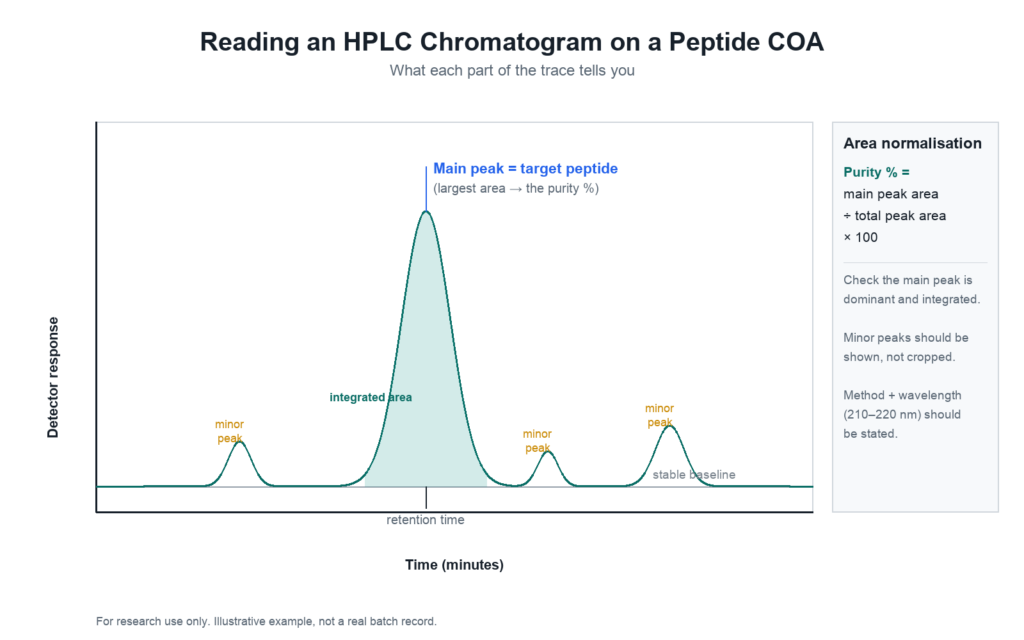
Figure 1. An example HPLC chromatogram on a peptide COA, showing the main peak, minor peaks, retention time, baseline and integrated area. Illustrative only.
What Does LC-MS Confirm on a Peptide COA?
LC-MS supports peptide identity by separating the components chromatographically and then measuring their mass-to-charge values. A good COA compares the expected peptide mass with an observed or deconvoluted mass result. This complements the HPLC purity figure, because a purity result alone does not confirm that the dominant peak is the intended peptide.
How LC-MS complements HPLC
HPLC separates the material and describes how it behaves on the column. Mass spectrometry measures the mass of the ions produced from it. LC-MS joins the two, putting mass data against the separated component as it elutes. Read together, they cover each other’s blind spots: HPLC supports the purity picture, and MS supports the molecular identity. This pairing matters because UV-HPLC is partly blind on its own. Salts, water and components that do not absorb UV light at the chosen wavelength can be near-invisible to the detector, so a purity percentage needs mass data (and, where relevant, water and counter-ion results) to sit alongside it.
Expected mass versus observed mass
The theoretical or expected mass is calculated from the peptide’s stated composition. The observed mass is what the instrument reports, often as an average or deconvoluted value. A clear report states which convention it is using, because comparing an average mass to a monoisotopic one, or an m/z to a molecular mass, can look like a mismatch when nothing is wrong. Method and calibration context help here, without needing to turn the COA into a textbook.
Why raw m/z may look different from the peptide mass
Electrospray ionisation, the technique commonly used, can put more than one charge on a single peptide. The raw spectrum then shows mass-to-charge (m/z) values, which read lower than the intact neutral mass. A peptide of around 3,000 Da might appear as a +2 or +3 ion at a much lower m/z. A deconvoluted value takes those multiple charge-state signals and works back to one estimated molecular mass. So before you conclude that an observed mass is wrong, check whether you are reading a raw m/z or a deconvoluted mass, and read the lab’s stated convention.
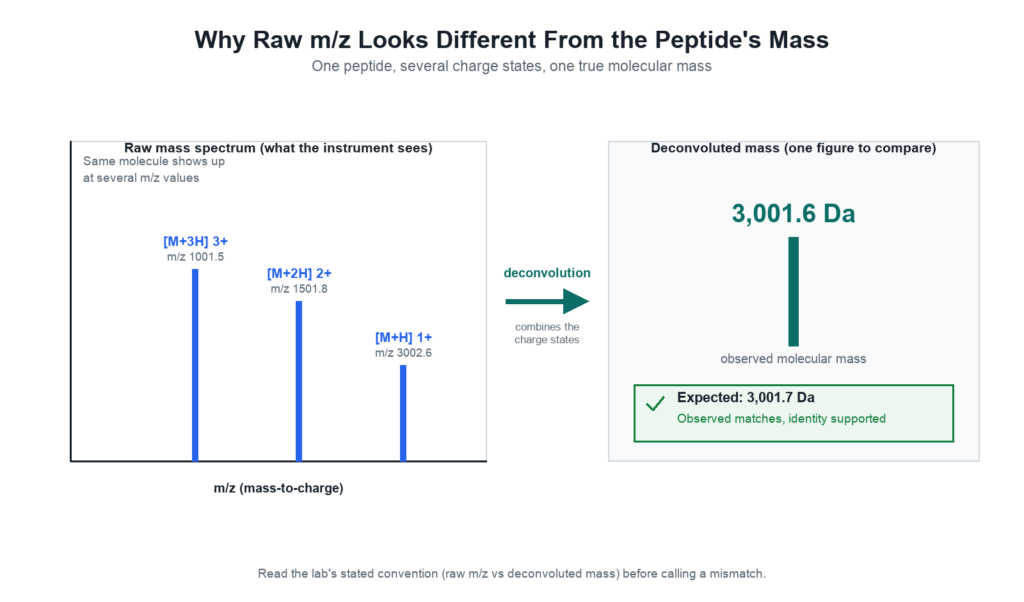
Figure 2. One peptide appears at several m/z values from different charge states; deconvolution resolves these to a single molecular mass to compare against the expected value.
What MS does not establish on its own
A correct mass is strong identity evidence, but it does not prove full chromatographic purity by itself. It may not separate every related impurity, isomer or co-eluting compound, and a loose mass tolerance can hide real problems. A tolerance quoted at roughly ±0.1% on a 3,000 Da peptide allows about ±3 Da of wiggle room, which is wide enough to mask a truncated sequence or a swapped residue. Full sequence confirmation, where it is needed, uses additional methods and reporting; do not assume it from a single mass match.
| Question | HPLC can help address | LC-MS can help address |
| Is there a dominant chromatographic component? | Yes | Sometimes, when paired with LC separation |
| What proportion of the integrated signal is the main peak? | Yes | Not usually the primary purity metric |
| Does the main material have a mass consistent with the named peptide? | Not by itself | Yes, through observed or deconvoluted mass |
| Does the result prove biological activity? | No | No |
| Does the result prove sterility or human suitability? | No | No |
Which Additional Peptide COA Tests Matter?
Extra results can strengthen a peptide COA when they are relevant to the material and clearly documented. Depending on the report, these may include water content, residual solvents, counter-ion content, endotoxin or microbial testing. Each result should name the method, the unit, the value and the tested batch. A broad claim with no data is not the same as an analytical result.
| Test or field | What it may help assess | What a useful entry includes |
| Water content | Moisture in the tested material | Method, numerical result, units and batch identity |
| Residual solvents | Solvents that may remain after production | Listed analytes, result, units, method and any limit |
| Counter-ion content | The salt or counter-ion tied to the material form | Named counter-ion, method and basis of expression |
| Endotoxin | Bacterial endotoxin measurement, if performed | Method, numerical result, units, batch reference |
| Microbial test | Microbial status, if performed | Method, result, detection threshold and batch identity |
| Net peptide content / assay | The amount of stated peptide, if measured | Method, units, stated reference basis and result |
| Appearance | The visual description at testing | A clear sample description, though not a substitute for data |
There is a wider point behind these entries. Credible analytical methods are built on principles that regulators lean on: specificity, accuracy, precision, detection and quantitation limits, linearity and range. You do not need to master validation science to use a COA. It helps, though, to see why a real report is more than one number: a value means something when the method behind it is sound and stated.
This is also where documented thresholds add useful perspective. The internationally agreed ICH Q3A(R2) guideline, applied in the UK through the Medicines and Healthcare products Regulatory Agency (MHRA), sets reference points for a new drug substance: an impurity above about 0.10% generally warrants identification, and one above about 0.15% needs qualification. Those are dose-dependent, pharmaceutical-manufacturing benchmarks, and research materials sit in a different context, so read them as a sense of scale for what “an impurity worth naming” can mean.
How to Check Whether a Peptide COA Is Credible
A polished PDF is not automatically a verifiable COA. Credibility comes from a specific batch connection, identifiable analytical methods, traceable report details, and an honest description of what the testing does and does not show.
Green flags on a peptide COA
- The batch or lot number matches your material exactly.
- The product name, material form and report reference are clearly stated.
- A named laboratory or analytical organisation appears on the report.
- Both an analysis date and a report date are present.
- The HPLC chromatogram is shown with integration and method details.
- Expected and observed MS data are given together.
- Any extra tests carry methods, units and numerical results.
- There is a batch-verification route or a supplier support process.
- The claims carefully separate purity, identity, content and sterility.
Red flags on a peptide COA
- A generic document with no lot or batch number.
- A report batch that differs from the vial or packaging.
- A headline purity claim with no chromatogram, method or date.
- Words like “tested” or “verified” with no numerical data behind them.
- An unnamed laboratory, or no report or certificate number.
- The same certificate reused across visibly different products or batches.
- A claim that 99% purity proves safety, dosing accuracy, sterility or performance.
- Endotoxin, residual-solvent or microbial claims with no method, result or unit.
One practical tell sits on top of that list. Suspiciously round purity numbers, such as an exact 99.00%, are unusual from real instruments, which tend to produce values with decimal detail like 98.73%. A round figure proves nothing by itself, though it is a fair prompt to ask for the chromatogram behind it.
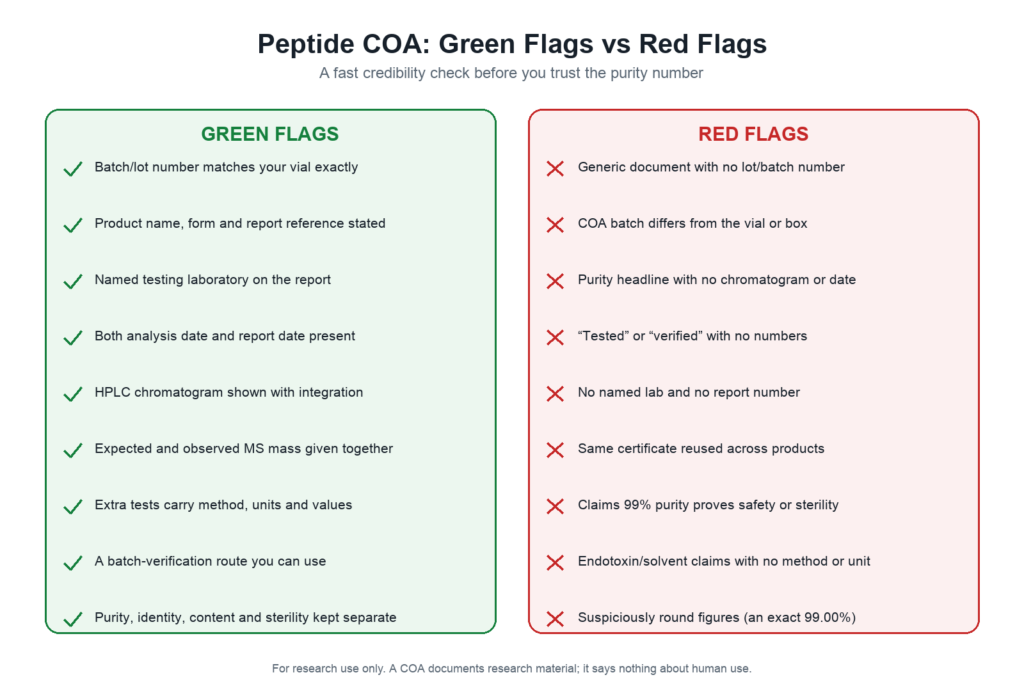
Figure 3. A fast green-flag / red-flag credibility check for any peptide COA.
Common Mistakes When Reading a Peptide COA
Treating the highest purity percentage as the only thing that matters. A 99.2% figure with no chromatogram is weaker evidence than a 98.4% figure with a full, dated, integrated trace and matching mass data.
Ignoring a batch-number mismatch. If the COA batch and the vial batch differ, the report describes other material until the supplier provides the matching record.
Confusing HPLC purity with content. Area purity is a proportion of the detected signal. It is not a measure of how many milligrams of net peptide sit in the vial; that needs a content or assay result.
Treating retention time as identity proof. Retention time supports identity but shifts with the method and instrument, so it cannot stand alone.
Misreading a raw m/z as the full molecular mass. Multiply charged ions show lower m/z values; the deconvoluted mass is the figure to compare against the theoretical mass.
Assuming missing tests have passed. A test that is not on the report was not shown to you. Silence is not a result.
Treating “third-party tested” as meaningful on its own. The phrase means little without a named lab, a method and a traceable report you can actually check.
Making human-use or therapeutic assumptions from research documentation. A COA is a description of research material. It says nothing about human suitability, safety or outcomes.
Example: How to Review a Peptide COA Step by Step
The example below shows how one COA should be read as a connected evidence set: the batch match first, then identity, HPLC purity, LC-MS mass data, supplementary tests and traceability. It is illustrative and does not represent a real product, batch or laboratory report.
| COA detail | Fictional example | What to check |
| Product name | Example Peptide X, 10 mg | Does it match the labelled product? |
| Batch number | ABL-EPX-260816 | Does it match the vial, packaging and supplier record? |
| COA number | COA-EPX-816-01 | Is it a unique, traceable document reference? |
| HPLC result | 98.7% area purity | Are the chromatogram, integration and method supplied? |
| HPLC data | One dominant peak plus minor integrated peaks | Are the baseline, peaks and integration visible? |
| Expected mass | 1,234.56 Da | Is the value compatible with the product identity and form? |
| Observed MS data | Deconvoluted mass reported near the expected value | Does the report state the mass convention and method? |
| Water content | Numerical result with method and units | Is the sample or batch identified? |
| Analysis date | 14 August 2026 | Is it visible and logically linked to this batch? |
| Verification | Supplier batch-record lookup | Can the record be traced beyond a generic PDF? |
Reading it in order:
- Step one, the batch. ABL-EPX-260816 on the COA has to equal the batch printed on the vial and box, character for character, before anything else counts.
- Step two, identity: the name and form match the listing, and the expected mass of 1,234.56 Da becomes the reference for the MS check.
- Step three is HPLC purity. The 98.7% figure is only as good as the trace behind it, so you look for one dominant peak, disclosed minor peaks and clear integration, with the method noted.
- Step four is the mass data: the report gives a deconvoluted value near 1,234.56 Da and says so, which is why it lines up with the theoretical mass; a raw m/z would read lower.
- Step five is the supplementary result. The water-content entry lists a method, a number and units, tied to this batch, so it reads as a real measurement.
- Step six, the date: 14 August 2026 sits logically with this batch and is recent enough to stay relevant.
- Step seven, traceability: because the batch record can be looked up with the supplier, the whole document can be checked against a source you can reach.
In this hypothetical example, the report is more credible because the material, batch, HPLC record, mass data and document reference all connect. Even so, the record should not be read as proof of biological activity, sterility, human suitability or performance in any specific experiment.
Peptide COA FAQ
What is a peptide Certificate of Analysis?
A peptide COA is an analytical document tied to a defined material batch. It commonly records the product identity, the batch number, the methods used, the reported purity, mass-spectrometry information, dates and laboratory details. The exact data varies between reports, so a COA is only as useful as its traceability and method transparency allow.
Does HPLC purity prove peptide identity?
No, HPLC purity describes the chromatographic signal assigned to the main integrated peak under a stated method. It helps you judge sample composition, but it does not confirm on its own that the main peak is the intended peptide. LC-MS or MS mass data provides the complementary identity evidence you need.
Why is the batch number important on a peptide COA?
The batch number links the analytical report to one specific manufactured lot. If it does not match the vial or packaging exactly, the COA may describe a different sample or synthesis run. In that case it should not be treated as direct verification of the material you actually received.
What should I look for in an HPLC chromatogram?
Look for a dominant main peak, visible minor peaks, clear integration, a reported purity value, and method context such as detector wavelength, retention time or chromatographic conditions. A purity percentage with no chromatogram and no method behind it is far less informative than a transparent, fully shown trace.
What does LC-MS show on a peptide COA?
LC-MS combines chromatographic separation with mass-spectrometry data. It supports identity by comparing an expected peptide mass with the observed or deconvoluted result. Raw mass-to-charge values can look different from the full molecular mass, because peptide ions produced by electrospray ionisation often carry more than one charge.
Does a COA prove sterility or suitability for human use?
No, a standard COA does not prove sterility, endotoxin status, safety, biological activity or suitability for human use. Each of those needs its own specific testing, a documented scope and appropriate regulatory evaluation. A purity and identity record covers documentation quality for research material, nothing further.
Is 99% HPLC purity always better than 98%?
Not automatically. The method, the traceability, the chromatogram quality, the identity evidence and the type of impurities present all shape what a figure means. A stated percentage should be read in context, alongside the trace and the mass data, as one part of a complete quality picture.