
Are Peptides Legal in the UK? A 2026 Research Guide

Peptides spent much of 2026 in the headlines. The BBC ran a feature on the “wellness peptide craze” in March, and The Guardian followed in April by asking what the evidence says. One question got far less airtime than the science: are peptides legal in the UK, and who’s allowed to buy, sell or own them?
The answer depends on the peptide and on how it’s sold. This guide covers buying, selling, possession, importing, sport and drug testing, then runs eight well-known compounds past each rule.
This article is general information, not legal advice. Apexion products are supplied strictly for laboratory research use only and are Research Use Only.
Quick answer: are peptides legal in the UK? Most research peptides are legal to buy, sell and possess in the UK as laboratory research materials. They aren’t licensed medicines, so nobody can legally sell, supply or advertise them for human use. A few peptide hormones, including somatropin (HGH) and HCG, are Class C controlled drugs, and many peptides are banned in sport.
Key facts
- Research peptides aren’t banned in the UK, though most have no MHRA licence as a medicine.
- Selling or advertising a peptide for human use without a marketing authorisation breaks the Human Medicines Regulations 2012.
- “Research use only” means laboratory work and doesn’t cover personal use.
- Somatropin (HGH), somatrem and HCG are Class C drugs under the Misuse of Drugs Act 1971.
- The WADA Prohibited List bans many peptides at all times, and UK Anti-Doping (UKAD) enforces it here.
What Counts as a “Peptide” Under UK Law?
UK law has no single rule for “peptides”. A peptide is a short chain of amino acids, and the same molecule can be regulated as a medicine, a cosmetic ingredient or a research chemical. Which law applies depends on how the product is presented and what it’s for.
| Category | Examples | Rules that apply |
|---|---|---|
| Licensed medicine | Insulin, semaglutide (Wegovy), tirzepatide (Mounjaro) | MHRA marketing authorisation; most are prescription-only |
| Cosmetic ingredient | Copper tripeptide-1 (GHK-Cu) in face serums or other topicals | UK cosmetics rules; for use on the skin |
| Research material | BPC-157, TB-500 and MOTS-c supplied to labs | Sold for laboratory work, with no claims about human use |
The dividing line is written into the Human Medicines Regulations 2012. Regulation 2 treats a product as a medicine if it’s “presented as having properties of preventing or treating disease in human beings”, or if people use it to change how the body works.
In practice, a product page or a social media caption can turn a research chemical into an unlicensed medicine overnight. The chemistry stays the same, but the legal category changes.
Which UK Laws Apply to Peptides?
Four UK frameworks cover peptides. The Human Medicines Regulations 2012 govern medicines, the Misuse of Drugs Act 1971 controls a short list of peptide hormones, the Psychoactive Substances Act 2016 covers mind-altering products, and UK cosmetics law covers skincare. The MHRA enforces medicines law, and WADA and UKAD set the rules for sport.
To check any single compound, run it through four questions. We call this the Four-Checkpoint Test:
- Licensed? Does it hold a UK marketing authorisation as a medicine?
- Controlled? Is it listed under the Misuse of Drugs Act 1971?
- Claims? Is anyone selling it with health, dosing or body-change promises?
- Sport? Is it on the WADA Prohibited List?
Human Medicines Regulations 2012
These regulations (SI 2012/1916) are the main UK law for anything sold as a medicine. Three rules do most of the work:
- Regulation 46: nobody may sell or supply a medicinal product without a marketing authorisation.
- Prescription-only medicines: these can only be supplied against a valid prescription.
- Regulations 279 and 284: no advertising a medicine that has no authorisation, and no advertising prescription-only medicines to the public.
Regulation 46 reaches stockholders too. Keeping an unauthorised medicine is an offence when the person knows, or has reason to believe, it’s meant to be sold or supplied to someone else.
Misuse of Drugs Act 1971
Most research peptides aren’t controlled substances. The exceptions are a handful of peptide hormones listed in Class C alongside anabolic steroids. Schedule 2, Part III of the Act names chorionic gonadotrophin (HCG), non-human chorionic gonadotrophin, somatotropin, somatrem and somatropin.
Supplying these hormones without authority is an offence, and so is importing them without a Home Office licence. The Misuse of Drugs Regulations 2001 exempt possession when they’re in the form of a medicinal product. As a result, the law treats owning one very differently from selling it.
Psychoactive Substances Act 2016
The 2016 Act bans producing or supplying substances for their mind-altering effects, the products once sold as “legal highs”. It rarely touches research peptides. Schedule 1 exempts controlled drugs and medicinal products outright, so a peptide sold with health claims falls under medicines law, and a Class C hormone falls under the Misuse of Drugs Act.
UK Cosmetics Regulation
Peptide skincare follows its own route. Copper peptide serums, usually listed as copper tripeptide-1 on the label, are cosmetics under UK law. Before sale, the brand needs a UK Responsible Person, a product safety report and a notification through the government’s cosmetics portal. For the lab science behind the molecule, see our GHK-Cu research overview.
The MHRA’s Role
The Medicines and Healthcare products Regulatory Agency (MHRA) licenses medicines and acts against unlicensed ones. None of the research peptides in this guide are MHRA-approved.
The MHRA’s Criminal Enforcement Unit works with Border Force, the police and internet companies. In 2025, it seized almost 20 million doses of illegally traded medicines, valued at nearly £45 million, and disrupted more than 1,500 websites and social media accounts. In April 2026, it opened inquiries into UK clinics making medical claims about peptide injections.
Is It Legal to Buy Peptides in the UK?
Yes, you can legally buy most peptides in the UK as research materials, and owning them isn’t a criminal offence. The Class C peptide hormones, such as somatropin and HCG, are the exception, because the law controls how they’re supplied and imported. Buying a peptide legally doesn’t make it approved for human use.
The BBC’s March report called this a legal and regulatory grey area. Anyone can own a vial of BPC-157, yet no one can legally market it as a treatment.
The MHRA warns people against using unlicensed products, because nobody has assessed them for safety, quality or effectiveness.
Is It Legal to Sell Peptides in the UK?
Yes, selling peptides for laboratory research is legal in the UK. Selling, supplying or advertising them for human use without a marketing authorisation breaks the Human Medicines Regulations 2012, because the product then counts as an unlicensed medicine. So the same vial can be a lawful research sale or an illegal medicine sale, depending on how it’s marketed.
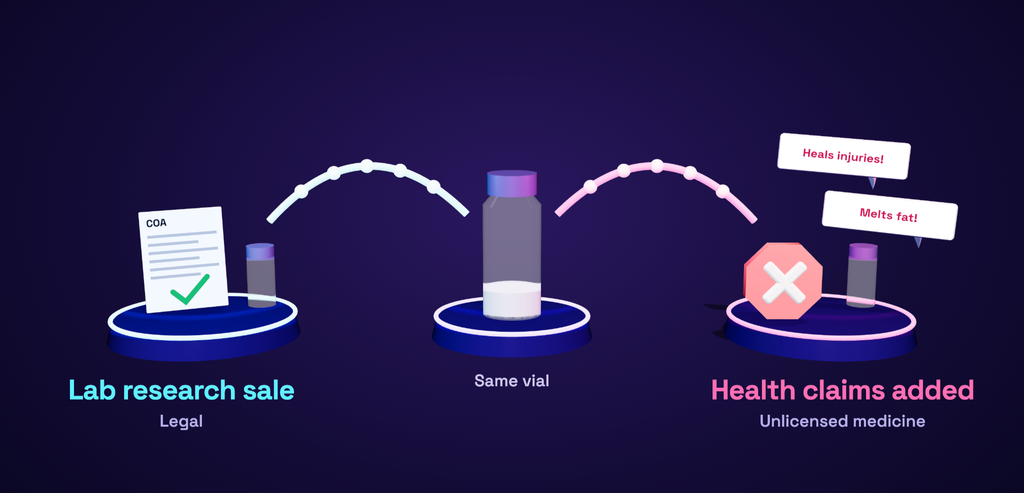
Things that make a sale unlawful:
- Health, healing, anti-ageing or weight-loss claims
- Dosing instructions or “how to use” guides
- Before-and-after photos or results stories
- Marketing aimed at consumers for self-use
Things a compliant research supplier does:
- Labels products research use only (RUO) and keeps every description to identity, purity and storage.
- Makes no therapeutic claims anywhere, including on social media.
- Publishes batch documents, such as a certificate of analysis for each lot.
- Age-gates the website and asks buyers to confirm a research purpose.
- Applies written terms of sale that set out permitted use.
You can see how we apply this in our Research Use Only policy and our terms of sale.
What Does “Research Use Only” Mean on Peptides?
“Research use only” (RUO) means a product is supplied for laboratory research, such as in-vitro, analytical or preclinical work. It isn’t approved or intended for use in people or animals, or for diagnosing or treating anything. The label tells you who the product is for and how the supplier may sell it.
An RUO label only protects a sale when the marketing matches it. The MHRA’s Lynda Scammell said in April 2026, “We disregard claims that products are for ‘research purposes'” when they’re used to dodge medicines regulations.
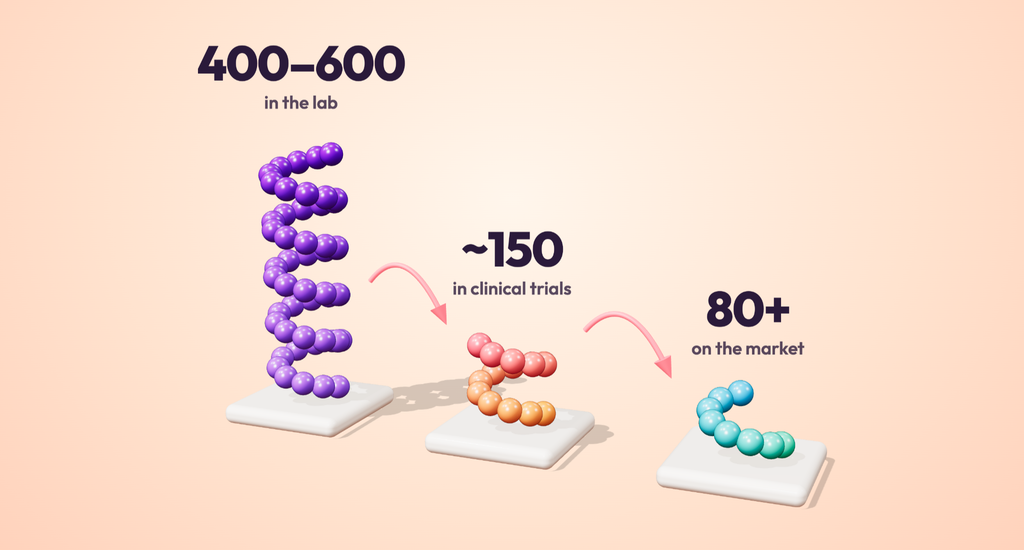
New medicines begin with research-grade peptides. Stanford Medicine counts about 100 peptide therapeutics approved by the FDA, and Professor Katrin Svensson says peptides for conditions such as Alzheimer’s disease are now a realistic possibility. A 2021 review in Nature Reviews Drug Discovery counted hundreds more candidates in preclinical and clinical testing.
A good research reagent supplier gives you:
- A batch or lot number on every product
- A certificate of analysis (COA) for that batch
- The testing method, usually HPLC and sometimes LC-MS
- Storage guidance for the material
Every Apexion batch comes with a COA confirming identity and purity, which you can open by scanning the QR code or entering the batch number on our Apexion batch verification page. Our guides explain how to read a peptide certificate of analysis and how to verify a research peptide batch.
Can You Import Peptides Into the UK?
Yes, research peptides can be imported into the UK for genuine research. Border Force can stop, hold or seize parcels that look like unlicensed medicines or controlled drugs. Class C peptide hormones such as somatropin need a Home Office licence to import.
Ordering from overseas brings three common problems:
- Customs delays or seizure, which can hold up a research project for weeks
- No UK accountability if the order is wrong, damaged or never arrives
- Certificates you can’t check, with no way to link the document to the vial in your hand
Our guide on how to evaluate a UK research peptide supplier covers the checks that separate a traceable supplier from a risky one.
Are Peptides Prescription-Only in the UK?
Licensed peptide medicines such as semaglutide (Wegovy, Ozempic) and tirzepatide (Mounjaro) are prescription-only medicines in the UK. Research peptides aren’t medicines, so no prescription route exists for them, and they can’t replace prescribed treatment. Your GP or a registered pharmacy is the route to licensed care.
A few compounds sold as research peptides have been approved abroad but hold no UK licence:
- Tesamorelin: approved by the US FDA as Egrifta in 2010. Read more in our Tesamorelin research overview.
- Bremelanotide: approved by the FDA as Vyleesi in 2019.
Licensed peptide medicines are available on the NHS. The NHS began offering Mounjaro through GP practices for weight management in 2025, subject to clinical eligibility. Research peptides have no NHS route at all.
UK Legal Status of Common Research Peptides
None of the research peptides below holds a UK marketing authorisation, and none is a controlled drug. Sport is where the rules tighten: seven of the eight are named on, or covered by, the 2026 WADA Prohibited List. Somatropin is included at the bottom for comparison.
| Peptide | UK marketing authorisation? | Controlled drug? | Banned by WADA (2026)? |
|---|---|---|---|
| BPC-157 | No | No | Yes, S0 (named as a non-approved substance) |
| TB-500 | No | No | Yes, S2 (thymosin-β4 derivative) |
| GHK-Cu | No (allowed in topical cosmetics) | No | Not named on the list |
| CJC-1295 | No | No | Yes, S2 (GHRH analogue) |
| Ipamorelin | No | No | Yes, S2 (GH secretagogue) |
| Tesamorelin | No (approved in the US) | No | Yes, S2 (GHRH analogue) |
| MOTS-c | No | No | Yes, S4.4 (named as an AMPK activator) |
| Retatrutide | No (Phase 3 complete; Eli Lilly plans a US filing in early 2027) | No | Covered by S0 while unapproved |
| Somatropin (HGH), for comparison | Yes, as licensed brands | Yes, Class C | Yes, S2 |
Statuses checked against legislation.gov.uk and the WADA list on 26 September 2026.
Batch documents: BPC-157 10mg specification & COA · TB-500 10mg specification & COA · GHK-Cu 50mg specification & COA · CJC-1295/Ipamorelin 10mg specification & COA · MOTS-c 40mg specification & COA
Is BPC-157 legal in the UK?
Yes. BPC-157 is legal to buy and possess in the UK as a research material. It isn’t a controlled drug and holds no marketing authorisation, so it can’t be sold for human use. WADA names it in section S0, which bans it for athletes at all times. Our BPC-157 vs TB-500 research overview compares the two in the lab. For its full legal status, the research and how to check a batch, see our full BPC-157 UK guide.
Is CJC-1295 legal in the UK?
Yes, as a research material. CJC-1295 is an analogue of growth hormone-releasing hormone (GHRH), and it isn’t listed under the Misuse of Drugs Act. It holds no UK licence and is banned in sport under WADA’s S2. Researchers often study it alongside ipamorelin, and our CJC-1295 vs Ipamorelin guide explains why.
Are Peptides Banned in Sport?
Yes, many are. The WADA Prohibited List bans peptide hormones, growth factors and growth hormone secretagogues under section S2, and unapproved substances such as BPC-157 under S0. Both bans apply in and out of competition. UK Anti-Doping (UKAD) enforces the list for athletes in the UK.
Three sections of the 2026 list catch most research peptides:
- S0, non-approved substances: any drug with no human approval anywhere, including compounds still in clinical trials. BPC-157 is named here.
- S2, peptide hormones and growth factors: TB-500, CJC-1295, ipamorelin, tesamorelin and somatropin. The 2026 list added pegmolesatide as a new example.
- S4.4, metabolic modulators: MOTS-c is named as an AMPK activator.
Anti-doping works on strict liability. An athlete is responsible for anything found in their sample, however it got there.
Will Peptides Show Up on a Drug Test?
A standard workplace drug test usually won’t screen for peptides. Those panels look for drugs such as cannabis, cocaine, opiates and amphetamines. Anti-doping tests run by WADA-accredited laboratories use targeted methods, including mass spectrometry, that can detect many banned peptides and their breakdown products.
WADA funds ongoing research into detecting small peptide hormones, so the range of detectable compounds grows each year. The British Army runs its own Compulsory Drug Testing programme, covered in the FAQ below.
Are Peptides the Same as Steroids?
No. Peptides are short chains of amino acids, the same building blocks that make up proteins. Anabolic steroids are synthetic relatives of testosterone, built on a four-ring carbon structure. UK law treats them differently too: anabolic steroids are Class C drugs, while most research peptides aren’t controlled.
| Peptides | Anabolic steroids | |
|---|---|---|
| Structure | Short amino-acid chains | Four fused carbon rings |
| Examples | BPC-157, GHK-Cu, insulin | Nandrolone, stanozolol |
| UK legal status | Mostly uncontrolled; a few hormones are Class C | Class C |
How to Stay Compliant When Buying Research Peptides in the UK
A compliant purchase comes down to buying from the right supplier and keeping your paperwork in order. Run through this checklist before you order:
- Buy from a UK supplier that labels every product research use only.
- Check for a batch-specific COA that shows the testing method (HPLC or LC-MS) and names the lab.
- Match the batch number on the product to the COA. Our guide shows how to verify a research peptide batch.
- Avoid sellers making health, weight-loss or dosing claims. A seller willing to break medicines law gives you little reason to trust its testing.
- Store and handle materials to lab guidance. See our notes on peptide storage and handling and on pre-filled pens vs vials.
For a deeper supplier check, read how to evaluate a UK research peptide supplier, or browse UK research peptides with batch documents attached.
Frequently Asked Questions
Yes, research peptides are sold legally in the UK by suppliers that label them for laboratory use. Licensed peptide medicines, such as semaglutide and tirzepatide, are available on prescription from a GP or a registered pharmacy. Class C peptide hormones like somatropin can only be supplied legally through licensed medical channels.
Yes, for laboratory research. A supplier can legally sell research peptides with clear RUO labelling, batch documents and no health claims. Selling or advertising a peptide for human use without a marketing authorisation breaks the Human Medicines Regulations 2012, and the MHRA can remove websites, seize stock and prosecute.
Yes, BPC-157 is legal to buy and own in the UK as a research material. It isn’t a controlled drug under the Misuse of Drugs Act 1971. It has no UK marketing authorisation, so it can’t be sold for human use, and WADA bans it for athletes under section S0.
Some are. The MHRA has licensed peptide medicines such as insulin, semaglutide and tirzepatide after reviewing their safety and effectiveness. Research peptides, including BPC-157, TB-500 and MOTS-c, have no MHRA approval. The MHRA only approves medicines, so a research supplier can’t claim MHRA approval for its products.
No, importing research peptides for genuine research is legal. Border Force can seize parcels that look like unlicensed medicines, and importing Class C peptide hormones such as somatropin or HCG needs a Home Office licence. Buying from a UK supplier avoids customs holds and keeps the paperwork traceable.
No. The UK has no blanket ban on peptides. Most research peptides are legal to buy and own, licensed peptide medicines are available on prescription, and copper peptides appear in everyday skincare. The restrictions cover human-use marketing of unlicensed products, a short list of Class C hormones, and sport.
Rules vary by country. In the US, the FDA has approved tesamorelin and bremelanotide, while unapproved peptides can’t be sold as drugs. EU law requires a marketing authorisation before any medicine is sold. Australia’s TGA made BPC-157 a prescription-only (Schedule 4) substance in 2024. The UK permits research sales and controls human-use marketing.
The British Army states a zero-tolerance policy on substance misuse, including anabolic steroids, and runs Compulsory Drug Testing for serving personnel. Class C peptide hormones such as somatropin fall under the same controlled-drug rules. Service personnel should check any product with their chain of command or medical officer first.
The Bottom Line
Most peptides are legal to buy, own and sell in the UK as research materials. None of the research compounds in this guide is licensed for human use, a handful of peptide hormones are Class C drugs, and many peptides are banned in sport. The safest purchase comes from a supplier that publishes its batch testing and makes no health claims.
Browse Apexion’s batch-verified research range or see how Apexion batch verification works.
Apexion products are supplied strictly for laboratory research use only and are Research Use Only.