
Peptide Pens UK: A Guide to Pre-Filled Research Pens (2026)
Quick answer
What is a pre-filled peptide pen?
A pre-filled research pen is a sealed glass cartridge holding a peptide that’s already dissolved at a stated concentration, inside a pen-shaped housing. It replaces a vial of freeze-dried powder for laboratory work. In the UK, pens can be sold as research materials, but supplying or presenting them for human use is unlawful.
- The same peptide as a vial, supplied ready-dissolved in solution
- Needs batch paperwork for both the peptide and the fill
- Research use only: not a medicine or a medical device
Search “peptide pens UK” and the results page turns into a car boot sale. Empty reusable pen bodies from Amazon and eBay appear in the same scroll as pre-filled cartridges from research suppliers, and the AI answer at the top blends the two. No wonder buyers get confused about what they’re looking at, and about where the legal lines fall.
This guide pulls the format apart piece by piece: what’s inside a research pen, how one gets made, the paperwork it should arrive with, how long it keeps, the UK legal position, and the warning signs on a listing.
Apexion supplies pre-filled pens for laboratory research use only. This guide doesn’t cover using a pen, because research pens aren’t for human use.
What Is a Pre-Filled Peptide Pen?
A pre-filled peptide pen is a research peptide supplied as a ready-made solution in a sealed glass cartridge, held inside a pen-shaped housing. The peptide is the same compound a lab would buy as powder in a vial. Only the physical state and the container differ, so a pen is best judged as packaging around a known amount of peptide.
Think of the housing as the box and the cartridge as the bottle. The science is in the liquid: which peptide it is, how pure it is, and how much of it is dissolved in each millilitre. A pre-filled pen of BPC-157 or KPV carries exactly the compound named on the label, already in solution.
What’s in a pre-filled research pen
| Part | What it is | What to check |
|---|---|---|
| Peptide | The research compound (e.g. BPC-157) | Batch COA: identity (LC-MS) and purity (HPLC) |
| Solvent | The liquid it’s dissolved in | Stated on the label or COA |
| Concentration | Amount of peptide per mL | Stated total mg and fill volume |
| Cartridge | Sealed glass container | Intact seal, and a batch/lot label |
| Housing | The pen-shaped outer body | Not a medical device, and no dosing claims |
The housing carries the least scientific weight of the five, yet it causes the most confusion. Licensed pen devices are designed and tested to ISO 11608, the international standard series for medical pen systems. A research pen housing is a holder for a laboratory material and makes no claim to that standard.
Pre-Filled Pens vs Lyophilised Vials: The Short Version
A pen and a vial hold the same compound in different states. Vials carry freeze-dried (lyophilised) powder, which keeps for longer and needs mixing before lab work. Pens carry a solution prepared by the supplier, so the shelf life is shorter and the handling steps are fewer. Three contrasts cover most of it:
- State: dry cake in the vial, dissolved peptide in the cartridge
- Stability: powder holds up for longer; a solution starts ageing from the day it’s made
- Handling steps: a vial needs a measured solvent added in the lab, while a pen arrives at a stated concentration
The full technical comparison is in peptide pens vs vials.
How Are Research Peptide Pens Made?
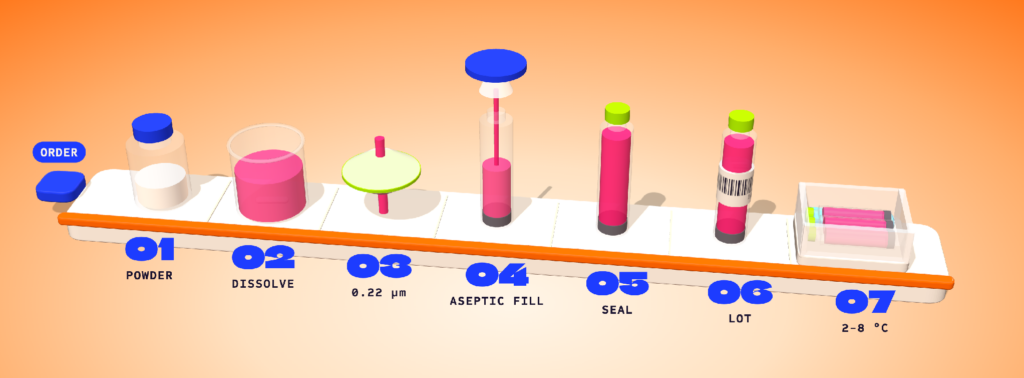
Research pens start as lyophilised peptide. The powder is weighed, dissolved to a target concentration, filtered, and filled into glass cartridges under clean conditions, then sealed and labelled. The quality of the fill carries as much weight as the purity of the powder, since a pure peptide can still end up in a poorly filled cartridge.
At lab level, the route from powder to pen runs in seven steps:
- Batch of lyophilised peptide. The starting material, with its own batch COA.
- Dissolved to a stated concentration. A weighed amount goes into a measured volume of solvent.
- Filtered. The solution passes through a sterilising-grade membrane to remove particles and microbes.
- Filled aseptically. Cartridges are filled in a controlled clean area, so nothing new gets in.
- Sealed. Each cartridge is closed before it leaves the clean area.
- Labelled with the lot number. The lot ties the cartridge back to its batch records.
- Kept in cold storage. The finished pens stay chilled until dispatch.
Timing is the other variable. Some sellers fill large runs and hold them in stock for months. Apexion prepares each pen after the order is placed, so the solution is freshly made at the point of dispatch.
What Documentation Should a Peptide Pen Come With?
A peptide pen should come with a batch COA for the peptide, confirming its identity and purity, plus details of the fill: concentration, volume, lot number and preparation date. A COA for the powder on its own doesn’t prove what’s in the cartridge, so ask for both halves of the record.
Documentation checklist
| Document or detail | What it proves |
|---|---|
| Batch COA (HPLC + LC-MS) | Confirms the peptide’s identity and purity |
| Lot number on the pen | Links the pen to its COA |
| Stated concentration and volume | Confirms how much peptide is in the cartridge |
| Preparation date | Solutions have a limited life |
| Storage instructions | Peptides in solution need cold storage |
| Lab name and test date | Makes the COA traceable |
The lot number does the heavy lifting here. Without it, a perfect certificate could belong to any batch at all. Each Apexion batch has its own COA covering identity, purity (typically ≥98% by HPLC) and batch details, and scanning the QR code on the pen or entering the batch number brings up the documents for that exact lot.
New to certificates? How to read a peptide COA walks through every line of one, and a second walkthrough shows how to verify a research peptide batch against the lab’s own records. The Apexion batch verification page shows how our own lookup works.
How Long Do Pre-Filled Peptide Pens Last?
A peptide in solution breaks down faster than the same peptide as freeze-dried powder, so pens have a shorter shelf life than vials. Peptide solutions are typically kept refrigerated at 2-8°C and away from light. The date and storage guidance on the batch label are the ones to follow, since stability varies from peptide to peptide.
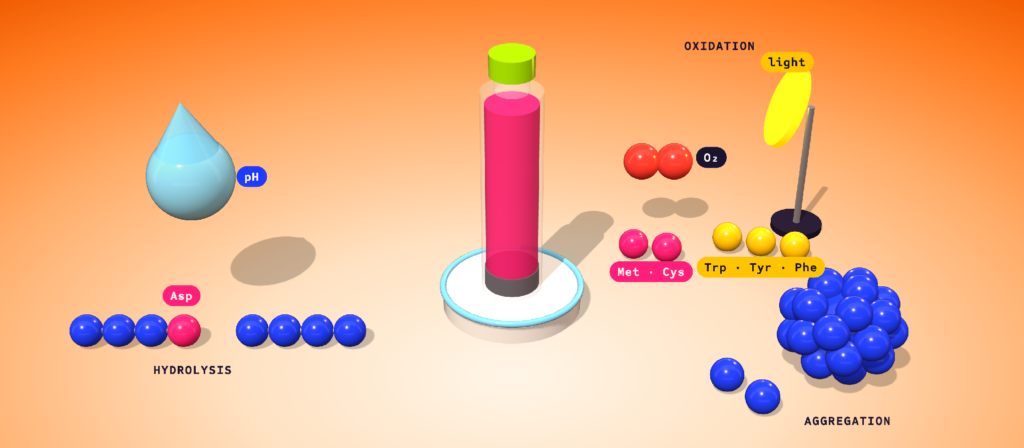
Water opens three routes to breakdown that a dry powder mostly avoids:
- Hydrolysis: water slowly cuts the bonds that hold the peptide chain together.
- Oxidation: oxygen and light change sensitive amino acids, which alters the molecule.
- Aggregation: peptide molecules clump together and drop out of the solution.
Warmth speeds up all three, and repeated temperature swings make it worse. The solution’s chemistry plays a part too. A 2023 review in Pharmaceutics by Nugrahadi, Schöneich and colleagues names “pH optimization and selecting the appropriate type of buffer” as the leading ways to keep peptides stable in water. A stated solvent on the label is a good sign the supplier has thought about it.
The cold chain covers two moments: dispatch and receipt. Pens should leave chilled and go straight back into a fridge when they arrive. Steve Todd, a Good Distribution Practice inspector at the MHRA, sets out the receipt step in advice on refrigerated stock: deliveries should be “checked in as a matter of priority and placed in a pharmaceutical refrigerator.” Fridge placement, light and labelling on the bench are covered in our peptide storage and handling notes.
Are Peptide Pens Legal in the UK?
Yes, with conditions. The UK position comes down to four points:
- Buying empty pen hardware is legal.
- Research peptides supplied in pens can be sold as laboratory materials.
- Supplying, advertising or presenting a pen for human use without a marketing authorisation is unlawful.
- Importing prescription-only medicines can lead to the parcel being seized.
Pen legal status
| Situation | UK position |
|---|---|
| Empty pen hardware | Legal to buy and sell |
| Pre-filled pen sold as a research material, with no human-use claims | Legal as a research material |
| Pen sold or promoted for human use (dosing, injection or weight-loss claims) | Unlawful without a marketing authorisation (Human Medicines Regulations 2012) |
| Pen containing the active ingredient of a licensed medicine (e.g. tirzepatide), bought without a prescription | A prescription-only medicine; Border Force can seize it |
The rules come from the Human Medicines Regulations 2012. Regulation 2 defines a medicinal product in two “limbs”: one covers how a product is presented, and the other covers what it does. Meeting either limb is enough to make it a medicine, and any medicine must hold a marketing authorisation before it can be sold.
Compound-by-compound status is set out in are peptides legal in the UK, and the terms Apexion sells under are in our Research Use Only policy.
Why Presentation Counts
MHRA Guidance Note 8, the agency’s guide to what counts as a medicine, says a product can become a medicine through presentation alone. The MHRA weighs labels, packaging, graphics, websites, social media, testimonials and “the product form… and the way it is to be used”. Needles in the box, dosing cards and “ready to use” wording all fall under presentation.
Are Peptide Pens Safe?
Research pens aren’t approved for human use, so no safety assessment exists for human use. For laboratory handling, the useful safety questions are about quality: was the solution filled under sterile conditions, is it free from contamination, and has the peptide started to break down?
Each of those questions has a document behind it. Sterility depends on the filtration and aseptic fill described above. Contamination covers microbes, bacterial endotoxin and visible particles, and a clear solution with an intact seal is the first check. Breakdown shows up as a drop in purity on HPLC over time, which is why the preparation date belongs on the label. A pen that can answer all three on paper is a well-documented research material.
Red Flags When Buying Peptide Pens
Be wary of any pen sold with signs of human use, or sold without batch paperwork. Either one tells you the seller is working outside the research-material route, and under Guidance Note 8 the first can turn the product into an unlicensed medicine. Watch for:
- Needles or injection kits packed with the pen
- “Clicks-per-mg” charts or dosing cards in the box or on the listing
- Marketing language such as “ready to use”, “convenient dosing”, “beauty pen”, or weight-loss and anti-ageing claims
- Missing paperwork: no batch COA, or a COA with no lot number
- Missing fill details: no stated concentration or preparation date
- Unclear origin: shipped from overseas with no UK traceability
One flag is reason enough to ask questions before ordering. Two or more usually means the listing is aimed at the wrong buyer. The checklist in how to evaluate a research peptide supplier expands these into a fuller scorecard.
Frequently Asked Questions
A peptide pen is a format for supplying research peptides already in solution for laboratory work. The peptide arrives dissolved at a stated concentration in a sealed glass cartridge, so a lab receives a known amount without mixing powder first. Research pens are sold for in vitro and laboratory study only.
Empty pen hardware is legal to buy, and pre-filled research pens can be sold as laboratory materials. Selling, advertising or presenting a pen for human use without a marketing authorisation is an offence under the Human Medicines Regulations 2012. Pens holding the active ingredient of a prescription-only medicine can be seized at the border by Border Force.
Yes. A pre-filled pen and a vial hold the same compound with the same sequence. The vial holds it as freeze-dried powder, and the pen holds it dissolved in a solvent at a stated concentration. The difference is physical state, which affects shelf life and handling steps, while the molecule itself stays identical.
A pre-filled pen keeps for less time than a lyophilised vial, because peptides in solution break down through hydrolysis, oxidation and aggregation. Peptide solutions are typically stored at 2-8°C and protected from light. Follow the preparation date and storage guidance printed for that batch, since stability differs between peptides.
A peptide pen’s COA should confirm identity (usually LC-MS) and purity (HPLC) for the batch, list the lot number, name the testing lab and give a test date. Alongside it, the pen should state its concentration, fill volume and preparation date. The lot number on the pen must match the certificate.
No. Research pens carry no UKCA or CE marking as medical devices and aren’t placed on the market for any medical purpose. Licensed medical pens are built to the ISO 11608 standard series and sold with a licensed medicine. A research pen housing is packaging for a laboratory material and isn’t for human use.
The Bottom Line
A pen is a format for a familiar compound. Judge it by the paperwork, meaning a batch COA tied to the lot on the cartridge, a stated concentration and a preparation date, and by how it’s stored and shipped. Under UK law, presentation is what decides a pen’s status. Every Apexion pen is made to order, for laboratory research only.
Browse Apexion’s pre-filled research pens
Sources
- MHRA. Guidance Note 8: A guide to what is a medicinal product, gov.uk.
- The Human Medicines Regulations 2012 (SI 2012/1916), legislation.gov.uk.
- ISO. ISO 11608-1:2022, device standard for medical pen systems.
- Nugrahadi PP, Hinrichs WLJ, Frijlink HW, Schöneich C, Avanti C. Designing Formulation Strategies for Enhanced Stability of Therapeutic Peptides in Aqueous Solutions: A Review. Pharmaceutics, 2023.
- Todd S. Refrigerated medicinal products part 1: receipt and storage. MHRA Inspectorate blog.