
How to Evaluate a Research Peptide Supplier: COAs, Testing and Batch Traceability

Quick answer
Evaluate a research peptide supplier by checking whether it provides batch-specific Certificates of Analysis, clearly identifies lot numbers, reports HPLC purity and LC-MS identity data where applicable, explains storage requirements, and gives researchers a way to connect the documentation to the physical product received. Transparent, traceable evidence is more useful than broad quality claims.
How to Evaluate a Research Peptide Supplier?
To test a reliable research peptide supplier, rely on verifiable facts rather than claims. Prioritize the documents like COA provided. A strong quality system connects the product label, batch number, test documents, storage advice, and your own records. Together, these details confirm that your product matches the specific batch tested.
This guide gives an educational framework for evaluating research materials and their documentation. It makes no medical claims and gives no dosing, administration or therapeutic guidance. Where a product-specific document or your laboratory’s SOP offers more specific direction, follow that first.
There is a useful global benchmark for why documents beat claims: established Good Manufacturing Practice (GMP) standards (such as those referenced by the FDA in 21 CFR 211.84 and mirrored in UK/EU GMP guidelines) accept a supplier’s report of analysis only when the buyer also runs its own identity test and validates the supplier’s results over time. Evidence you can verify is the standard worth applying.
What Should You Check Before Choosing a Research Peptide Supplier?
Before choosing a research peptide supplier, check six areas: research-use, batch-specific COAs, HPLC purity data, LC-MS identity evidence, identifiable documentation sources, and clear product-storage and traceability information.
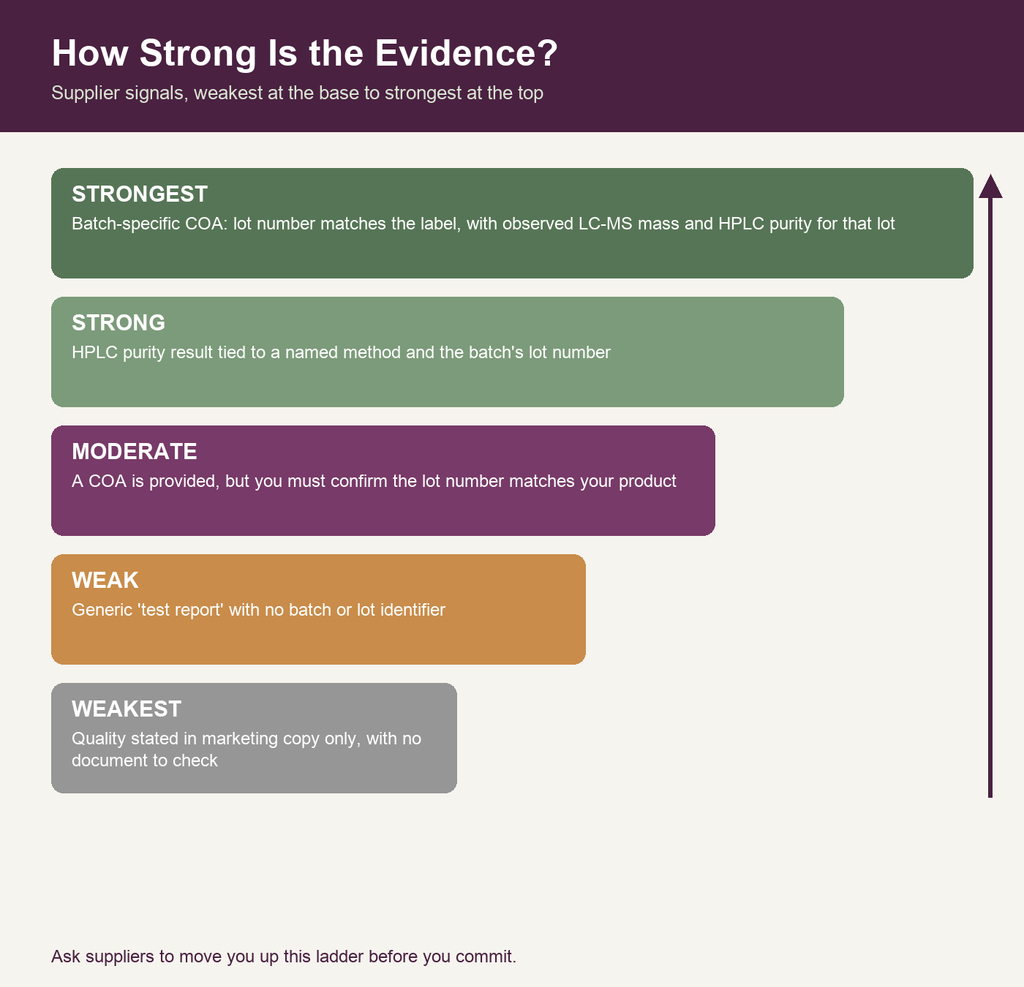
Here is the six-point checklist in full:
1. Research-use positioning: Does the supplier clearly describe the material as for laboratory research only?
2. Batch-specific COAs: Can documentation be matched to a unique lot or batch number?
3. HPLC documentation: Is the purity method and batch result clearly stated?
4. LC-MS documentation: Is mass-related identity evidence available where applicable?
5. Document traceability: Is the issuing laboratory or report source identifiable?
6. Storage and handling information: Are format-specific instructions available for the supplied product?
Treat the six as a set. A strong result on one point supports the others, and a gap on any single point is a prompt to ask the supplier for more detail before you decide.
Does the Supplier Provide Batch-Specific Peptide COAs?
A useful peptide COA should identify the specific batch or lot tested and let researchers match that number to the label on the physical product. A generic certificate with no batch identifier cannot reliably document the exact material you received.
What Is a Batch-Specific COA?
A COA is a document that reports analytical information for a specified material batch, such as PT-141. The lot or batch number is the field that connects the physical product to that report, so it turns a general certificate into evidence for one exact item. Keep the COA with your receipt and inventory records, so the document and the product stay together from the day they arrive.
How Do You Match a COA to a Peptide Product?
Work through a simple, repeatable process:
1. Locate the lot or batch number on the product label.
2. Find the lot or batch number listed on the COA.
3. Confirm the two identifiers match exactly.
4. Confirm the product name and format are consistent across both.
5. File the COA in your internal batch or inventory record.
For a fuller walkthrough of the document itself, read our guide on how to read a peptide Certificate of Analysis.
What If the Lot Number Does Not Match the COA?
If a product’s, like BPC-157, lot number does not match the COA, treat the document as unconfirmed for that item. Set the product aside in line with your laboratory procedures, then request batch-specific clarification before you assign it to any research. A mismatch is a question to resolve, and catching it early is the check doing its job.
How Do HPLC Results Help Verify Peptide Purity?
HPLC results help you assess the reported purity profile of a tested peptide batch by separating the detectable components in the sample. Review the stated HPLC result alongside the batch number, the method information, the test date, and the chromatogram where one is supplied.
What Does HPLC Show on a Peptide COA?
High-performance liquid chromatography separates the components within a test sample. It gives a reported result tied to the main component under the stated test method, so the figure carries meaning when the method sits next to it. Read purity figures together with the method and batch details. A purity percentage on its own is one useful data point within a broader verification process.
What Should HPLC Documentation Include?
| HPLC item | Why it matters |
| Product name | Identifies the stated material |
| Lot/batch number | Links the test result to the physical product |
| Method or method reference | Shows how the result was generated |
| Reported purity result | Provides the stated batch-level result |
| Test/report date | Adds documentation context |
| Chromatogram, if available | Adds visual context to the separation result |
| Testing source | Supports document traceability |
Is a High Purity Figure Enough on Its Own?
A reported purity figure is one part of a broader batch-verification process. Read it alongside product identity, lot matching, LC-MS information where available, and the product’s storage and handling record. Confident verification tends to draw on several lines of evidence at once, which is why a single number sits within a fuller picture.
How Does LC-MS Help Confirm Peptide Identity?
LC-MS combines chromatographic separation with mass-spectrometric analysis, and it can provide evidence that the tested material has mass-related characteristics consistent with the stated peptide identity. It complements HPLC because identity evidence and purity evidence answer different questions.
What Is the Difference Between HPLC and LC-MS?
| Method | Main role | Question it helps answer |
| HPLC | Purity profile | What proportion of the tested sample is tied to the main component? |
| LC-MS | Identity support | Does observed mass-related data align with the stated peptide identity? |
| COA and batch check | Traceability | Does the analytical report relate to the exact product batch received? |
Reading purity and identity together reflects how careful characterisation actually works. Research in *Pharmaceutical Research* (McCarthy and colleagues, 2023) explains that “this enhanced characterization often requires multiple orthogonal techniques to confidently understand, verify, and quantify the characteristics” of a peptide reference standard. In plain terms, more than one method, read side by side, builds a more confident picture than any single result.
What LC-MS Information Should Researchers Look For?
- Product or peptide name
- Batch or lot number
- Method or report reference
- Observed mass-related result
- Expected mass reference, where reported
- Test date or report date
- Testing laboratory or report issuer
Why Do Observed and Expected Mass Values Matter?
An expected molecular weight is a reference value, a number you can predict from the sequence. A batch-specific analytical report tells you more when it also identifies an observed result generated from testing the stated batch. When the observed value lines up with the expected one, the report is showing a real measurement from the stated batch, which a predicted value on its own cannot give you.
Can You Identify Who Produced the Peptide Test Documentation?
Research peptide documentation should identify the laboratory, analytical provider or report issuer responsible for the test record. Clear authorship, report identifiers and test dates make it easier to judge whether a document can be attributed to a specific batch.
What Makes Test Documentation Traceable?
- A named testing laboratory, report issuer, or responsible analytical source
- A report number, COA number, or document-control reference
- A test date and an issue date
- A named product with its batch or lot number
- An analytical method reference
- Clear, readable results
Why Is an Identifiable Report Source Important?
A named source tells researchers where a report came from, and it gives the supplier a clear point of contact for documentation questions. It forms one link in a transparent evidence chain, and it helps you separate batch-linked documentation from broad marketing statements. The aim is a document you can attribute and follow up, so questions about a batch have somewhere to go.
There is a wider principle at work here. Quality systems treat a supplier’s paperwork as a starting point that a buyer confirms over time. This approach aligns with established Good Manufacturing Practice (GMP) standards, including those referenced in UK and EU guidance, which emphasize that a supplier’s Certificate of Analysis is only reliable when the buyer periodically verifies the supplier’s results through their own independent identity testing.
Applied to a research setting, the takeaway is simple. A named, attributable report gives you something to validate, while an anonymous certificate gives you very little to work with.
How Do You Verify a Peptide Product Label Against Its Documentation?
Verify a peptide product label by matching the product name, the research format, the lot number, the relevant stated concentration or strength, and the storage instructions against the order documentation and the associated COA.
| Field | Physical product label | Supporting documentation | What should match |
| Product name | Label on pen or vial | COA and order record | Clear product identity |
| Format | Reconstituted vial or research pen | Product description or record | Same stated presentation |
| Lot/batch number | Product label | COA | Exact match |
| Concentration/strength | Product label where stated | Product record or COA where shown | No unexplained difference |
| Storage instruction | Packaging or product document | Storage guide or product documentation | Same relevant handling direction |
| COA reference | Batch file | Controlled document record | Clear traceability link |
What Should You Do If the Label Is Unclear?
If a label is damaged, incomplete or inconsistent with the associated documentation, record the issue and seek clarification before you add the product to an active research workflow. A short note now keeps your records clean and your batch traceable later.
What Storage and Handling Information Should a Research Peptide Supplier Provide?
A research peptide supplier should provide product-specific storage and handling information that reflects the supplied presentation, whether that is a reconstituted vial or a pre-filled research pen. Follow the product label, the accompanying documentation and your laboratory SOP, and rely on those ahead of generic online shelf-life claims.
What Should a Storage Instruction Cover?
- Product format and presentation
- Temperature or controlled-storage requirement
- Light-protection guidance where applicable
- Container-handling requirements
- Guidance for delivery receipt and prompt storage
- The relevant batch or documentation reference
- A clear instruction to follow product-specific information
Why Does Reconstituted Format Need Product-Specific Guidance?
Reconstituted products arrive as prepared solutions, so their handling begins at receipt, with storage control and documentation from day one. The right storage conditions depend on the specific product formulation and the supplied instructions, which is why product-specific guidance carries more weight than a general rule. For a deeper look, read our guide on reconstituted peptide storage and handling for research.
How Do Research Peptide Pens and Vials Affect Supplier Evaluation?
Peptide pens and vials can change the practical research workflow, and both formats should be evaluated with the same quality-documentation controls: clear labels, batch-specific COAs, analytical evidence, product-specific storage instructions and traceable inventory records.
| Supplier-evaluation factor | Pre-filled research pen | Reconstituted research vial |
| Product presentation | Prepared solution in a controlled pen format | Prepared solution in a vial format |
| Documentation check | Match label and lot number to COA | Match label and lot number to COA |
| Storage requirement | Follow product-specific information | Follow product-specific information |
| Batch record | Log receipt, location and condition | Log receipt, location and condition |
| Core standard | Traceable documentation | Traceable documentation |
Does Format Change Batch-Verification Standards?
Product format affects the handling workflow at the bench, and it keeps the need for lot-level traceability and evidence-based documentation exactly the same. For a fuller comparison, see our guide on peptide pens vs vials for research.
What Are the Main Red Flags When Choosing a Research Peptide Supplier?
The main supplier-evaluation red flags are missing batch identifiers, documentation that cannot be connected to a physical product, unexplained label discrepancies, missing analytical method details, and unclear storage or report-source information.
| Red flag | Why it requires clarification | Responsible next step |
| No batch or lot number on the COA | Cannot link the document to a physical product | Request batch-specific documentation |
| Lot number differs from product label | May indicate the COA is for a different item | Set aside and request clarification |
| No HPLC method or result context | Purity claim lacks an analytical basis | Request the supporting analytical information |
| Only expected mass information | May not show observed batch testing | Request LC-MS evidence where relevant |
| Testing source is unclear | Report origin cannot be assessed | Ask who generated or issued the documentation |
| Product label is incomplete | Weakens traceability | Record the issue and seek confirmation |
| No storage information | Prevents controlled handling | Request product-specific instructions |
| Outcome-heavy claims with little documentation | Shifts attention away from verifiable evidence | Prioritise documents and traceability |
A single red flag does not condemn a supplier. It marks a point that deserves a clear answer, and how readily a supplier provides that answer is itself useful evidence.
- A supplier who returns a batch-specific COA, names the testing source and explains the method within a reasonable time is showing you a working documentation system.
- Slow, vague or deflecting replies to a straightforward batch question tell you something too, and they are worth noting in your evaluation record alongside the documents themselves.
What Is Our Six-Point Supplier Documentation Check?
Our Six-Point Supplier Documentation Check is a research-focused framework for reviewing whether a supplier gives enough information to verify a product batch before research use.
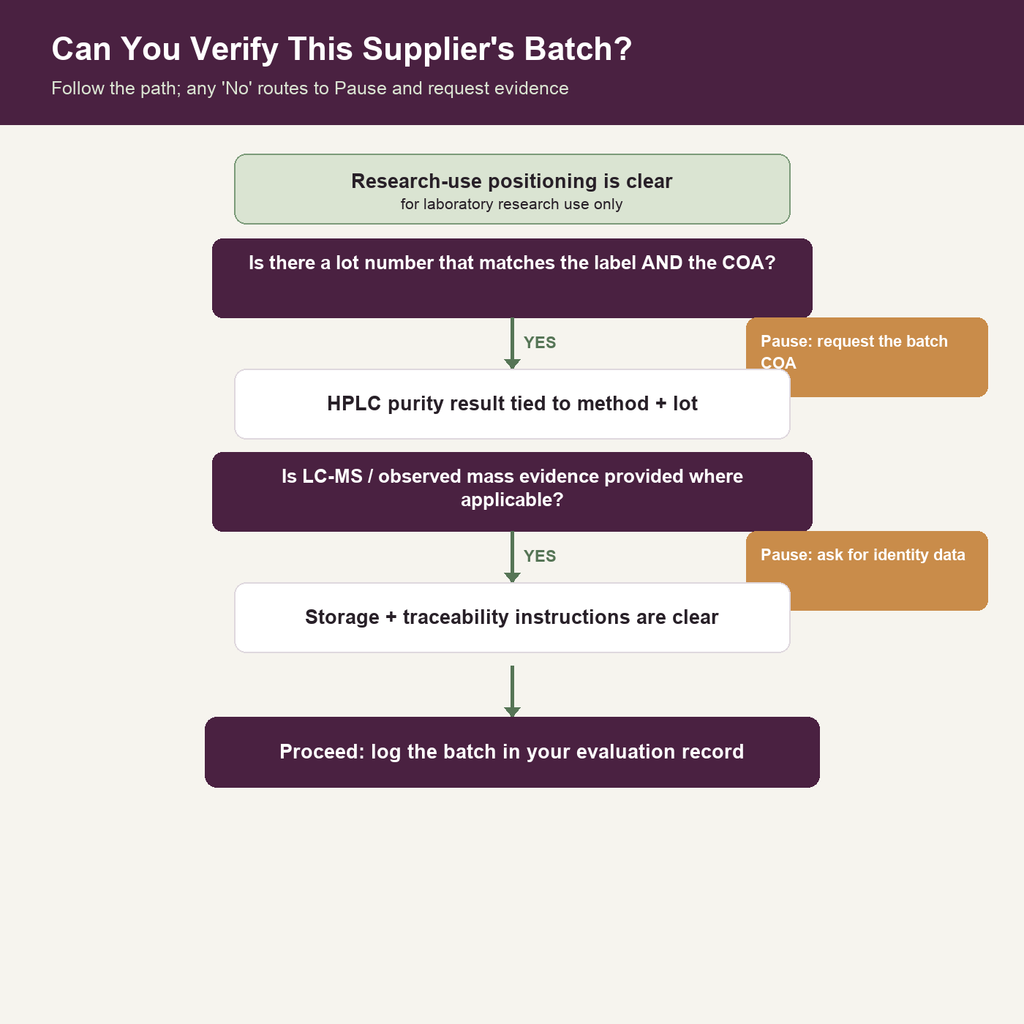
1. Research-use clarity: Is the material clearly presented for laboratory research use?
2. Product identity: Does the label clearly identify the product and presentation?
3. Batch traceability: Is there a unique lot number that can be matched to the COA?
4. Purity evidence: Is batch-specific HPLC documentation provided?
5. Identity evidence: Is LC-MS or relevant mass documentation provided where applicable?
6. Handling documentation: Are storage, receipt and traceability instructions clear?
A supplier is best judged by the quality and traceability of the documentation researchers can review, and clear evidence carries more weight than a broad quality claim.
How Should Researchers Document a Supplier Evaluation?
Researchers can document a supplier evaluation by recording the supplier name, the product, the batch number, the COA reference, the analytical-document status, the storage instructions, and any clarification requests before assigning materials to a research workflow.
| Record field | Example purpose |
| Supplier name | Identifies the source reviewed |
| Product name and format | Identifies the research material |
| Lot/batch number | Links the physical item to documentation |
| COA reference | Retains the analytical report |
| HPLC review status | Records whether purity documentation was reviewed |
| LC-MS review status | Records identity-document review where applicable |
| Storage instruction | Documents supplied handling requirements |
| Date reviewed | Creates an auditable review point |
| Reviewer initials | Identifies who completed the check |
| Notes or clarification request | Records unresolved document issues |
Once a batch is on your shelf, the next step is confirming it item by item. Our guide on how to verify a research peptide batch covers the COA, HPLC and LC-MS checklist in detail.
Frequently Asked Questions About Research Peptide Suppliers
What Should a Research Peptide Supplier Provide?
A research peptide supplier should provide product-specific information and documentation that lets researchers verify product identity, batch traceability, analytical results and handling requirements. The clearer and more traceable that evidence is, the easier the supplier is to evaluate.
Is a Certificate of Analysis Enough to Evaluate a Peptide Supplier?
A COA is an important part of supplier evaluation. Read it together with the physical label, the lot number, HPLC and LC-MS data where applicable, the storage information, and the supplier’s ability to explain the documentation.
How Can I Tell Whether a Peptide COA Is Batch-Specific?
Look for a unique lot or batch number on the COA, then confirm it matches the exact lot number printed on the physical product label. That match is what ties the report to your specific item.
Why Are Both HPLC and LC-MS Relevant?
HPLC provides reported purity information for a tested batch, while LC-MS can provide mass-related evidence consistent with the stated peptide identity. Read together, they support a broader verification process than either gives alone.
What Should I Do If the COA Lot Number Does Not Match the Product Label?
Treat the COA as unconfirmed for that product. Record the discrepancy and request batch-specific clarification before you assign the product to research.
Do Pre-filled Peptide Pens and Vials Need the Same Documentation?
Yes, both formats should carry clear labels, batch-specific documentation, relevant analytical evidence and product-specific storage information.
Can Generic Online Storage Rules Replace the Supplier’s Instructions?
Follow the specific product label, the supplied documentation and your laboratory’s SOP, because storage needs can vary by product format and formulation. Treat general online rules as background only.
Conclusion
Choosing a research peptide vendor should begin with evidence you can check: an identifiable product, a matching batch number, a batch-specific COA, clear analytical documentation and product-specific handling information. A traceable documentation process helps researchers build a more controlled workflow, from supplier selection through batch receipt and storage.
Take a look at our research peptides and review the relevant product information and batch documentation before assigning material to a research workflow.