
Is GHK-Cu Legal in the UK? What the GHK-Cu Peptide Is and What Research Shows
Reviewed by Oscar Reyes, PhD, Synthesis Lead at Apexion BioLabs · Scientific review of the chemistry and analytical content
Quick answer
Is GHK-Cu legal in the UK?
Yes, within limits. GHK-Cu isn’t a controlled drug. It isn’t a licensed medicine either, so nobody can sell it to treat or prevent anything.
- As a cosmetic: It’s allowed in topical products under the ingredient name copper tripeptide-1.
- As a lab material: It’s sold for research use only, not for use in people.
- What it is: A natural tripeptide (glycine, histidine, lysine) carrying one copper ion.
- Evidence: Mostly lab and animal studies. Human data comes from small topical cosmetic studies.
There’s an odd thing about GHK-Cu. The copper peptide in a high-street serum and the powder on a lab bench are the exact same molecule, yet UK law treats them as two different products. So is GHK-Cu legal in the UK? Yes, as long as you know which rulebook applies, and there are three of them.
The story starts in 1973, when biochemist Loren Pickart pulled the GHK peptide out of human plasma and wrote it up in Nature New Biology. Five decades of cell, animal, and small skin studies followed. The interest hasn’t cooled either: NPR reported in September 2026 that a US FDA advisory panel plans to look at the evidence for GHK-Cu in February 2027.
Below, you’ll get the legal picture first, then what the GHK-Cu peptide is, how researchers think it works, and what each type of study really measured.
Research use only: Apexion supplies GHK-Cu for in-vitro laboratory work, never for human or veterinary use. Apexion’s research use notice and purchase disclaimer set the terms of supply.
What Is GHK-Cu?
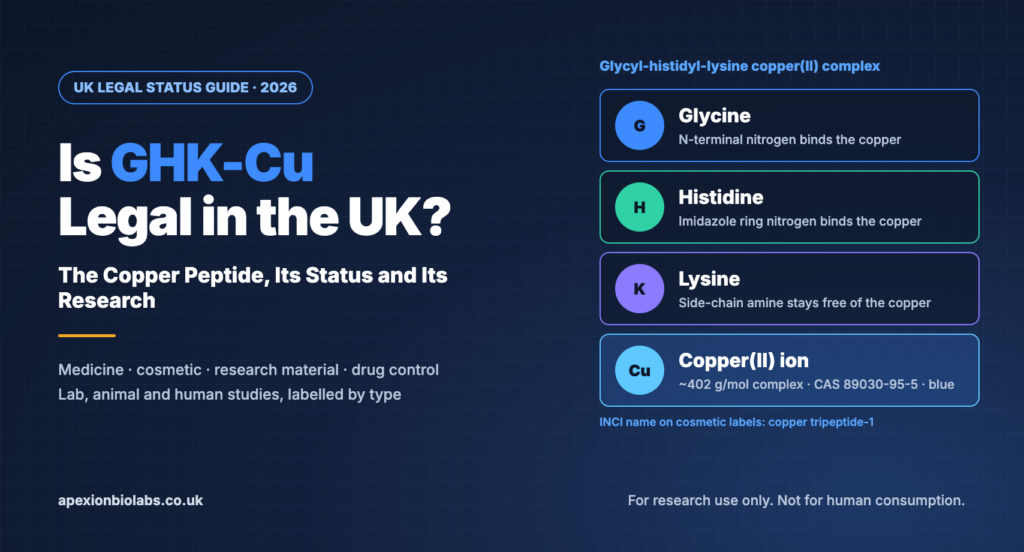
GHK-Cu is a tiny peptide, just three amino acids long (glycine, histidine, and lysine), wrapped around one copper(II) ion. The plain peptide, GHK, occurs naturally and has been found in human plasma, saliva, and urine. Once copper locks on, you get the blue complex that nearly every published study uses.
| Property | Detail |
|---|---|
| Full name | Glycyl-L-histidyl-L-lysine copper(II) |
| Sequence | Gly-His-Lys |
| Copper | One copper(II) ion per peptide |
| Molecular formula | C14H22CuN6O4 (about 402 g/mol) |
| CAS number | 89030-95-5 (PubChem CID 71587328) |
| Cosmetic (INCI) name | Copper tripeptide-1 |
| Other names | Cu-GHK, prezatide copper |
| Appearance | Blue to violet powder (plain GHK is white) |
Why the blue? Copper(II) absorbs red and orange light, so what reaches your eye is blue. If a batch labelled GHK-Cu comes out white, the copper isn’t there.
The copper grip is tight. Nitrogen atoms from the glycine end and the histidine ring lock the ion in place, so the complex stays together in solution.
GHK vs GHK-Cu vs Other Copper Peptides
Take the copper away, and you’re left with GHK, about 340 g/mol and white. Put it back, and you get GHK-Cu, roughly 61 mass units heavier, which a mass spectrometer picks up straight away.
Then there’s AHK-Cu, a lab-made cousin where alanine takes glycine’s place. Keep that one in mind, because it comes up again in the hair research. On a skincare label, “copper peptides” can mean GHK-Cu alone or a mix of several, so the INCI name copper tripeptide-1 is the one that pins down GHK-Cu.
Is GHK-Cu Legal in the UK?
Short version: yes, GHK-Cu is legal in the UK, but which law applies depends on how it’s sold. Here are the four routes, each checked against the primary source on 14 November 2026.
| Route | UK status | Law | Source | Checked |
|---|---|---|---|---|
| As a medicine | Not licensed by the MHRA; can’t be sold with treatment or prevention claims | Human Medicines Regulations 2012 | legislation.gov.uk, reg. 2 / MHRA products | 14 Nov 2026 |
| As a cosmetic | Allowed in topical products as copper tripeptide-1 | Cosmetic Products Regulation (as retained in GB) | legislation.gov.uk / OPSS | 14 Nov 2026 |
| As a research material | Sold for research use only, not for human use | General product law, plus medicines law if health claims are made | No single register | 14 Nov 2026 |
| Drug control | Not listed | Misuse of Drugs Act 1971 | legislation.gov.uk, Sch. 2 | 14 Nov 2026 |
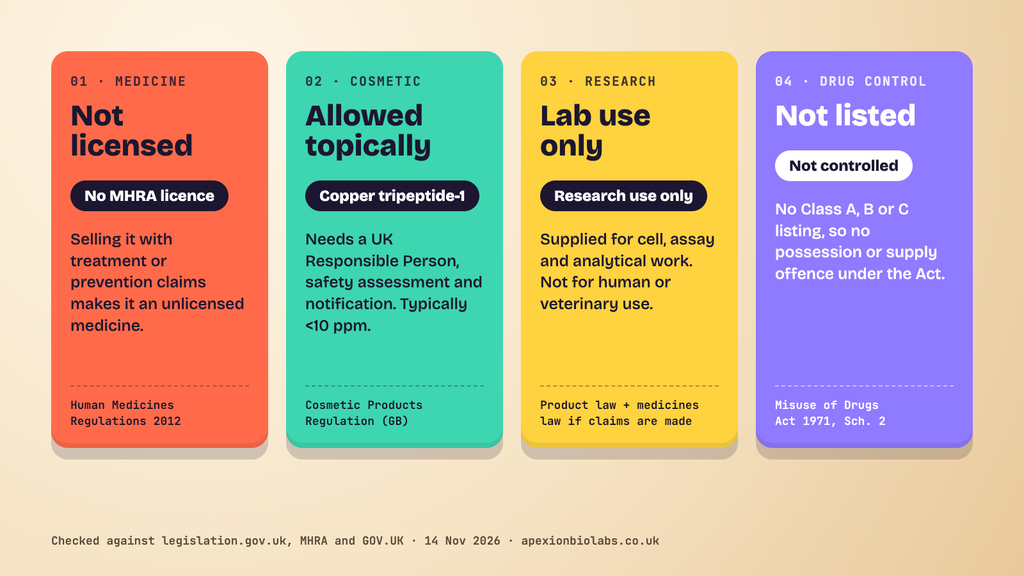
So the molecule itself isn’t banned. What decides the rules is the product around it: the claims on the label, the format, and who it’s sold to.
Is GHK-Cu a controlled drug in the UK?
No. The Misuse of Drugs Act sorts controlled drugs into Classes A, B and C, and Schedule 2 doesn’t name GHK-Cu, copper tripeptide-1 or any copper peptide. That means no possession or supply offence applies to it under that Act.
Is GHK-Cu a licensed medicine?
No. Search the MHRA products database, and you won’t find a licensed GHK-Cu product. Here’s the bit people miss. Under the Human Medicines Regulations, a product becomes a medicine by presentation: if a seller says it treats or prevents a disease, the law treats it as a medicine, whatever’s inside. Without a licence, that seller is marketing an unlicensed medicine, and the MHRA can act on it.
Copper Tripeptide-1: GHK-Cu in UK Cosmetics
In skincare, GHK-Cu goes by its INCI name, copper tripeptide-1, and it’s listed as a skin-conditioning ingredient. Before any serum reaches a UK shelf, GOV.UK guidance asks for a UK Responsible Person, a signed safety assessment and a product notification. The amounts are tiny, too. The Cosmetic Ingredient Review panel reported in 2018 that tripeptide-1 ingredients, copper tripeptide-1 included, are typically used below 10 parts per million.
Research-Use-Only GHK-Cu
“Research use only” means the material is supplied for lab work: cell cultures, assays, analytical testing. The label doesn’t make anything legal for personal use, and it doesn’t let a seller hint at human benefits. The same presentation test shapes the UK legal status of research peptides across the board.
Can GHK-Cu Be Prescribed in the UK?
There’s no licensed GHK-Cu medicine in the UK, so there’s nothing on the MHRA list for a prescriber to pick. In the UK, research-grade GHK-Cu is lab material.
Is GHK-Cu Approved Anywhere?
Not as a medicine. The US FDA hasn’t approved it. According to NPR, an FDA advisory panel will meet in February 2027 to review the evidence for GHK-Cu as an injectable, alongside other peptides. A panel review is advice to the FDA, not an approval.
Is GHK-Cu on the WADA Prohibited List?
GHK-Cu isn’t named on the WADA Prohibited List, either the 2026 list or the 2027 list that takes effect on 1 January 2027. The list does have a catch-all class, S0, for substances with no government approval for human therapeutic use.
The 2027 update adds a warning about peptides. France’s anti-doping agency AFLD summed it up on 29 September 2026: named peptides are only examples, and the list isn’t exhaustive. Since GHK-Cu has no medicine approval anywhere, it fits the group S0 describes.
How Does GHK-Cu Work?
Researchers describe four routes, and they overlap. Each one below carries its study-type label, because none of them has been mapped in people yet.
Copper Delivery and Enzyme Activity (in vitro)
Plenty of enzymes can’t work without copper. The one GHK-Cu papers keep coming back to is lysyl oxidase, which cross-links collagen and elastin into a sturdy mesh. Pickart’s team proposed long ago that GHK helps cells take up copper, and cell studies still treat it as a copper courier.
Fibroblast and Extracellular Matrix Research (in vitro / animal)
Fibroblasts build the extracellular matrix, the protein scaffolding between cells. Back in 1988, Maquart and colleagues reported that GHK-Cu raised collagen synthesis in fibroblast cultures. Later work also tracked the enzymes that break down old matrix, so researchers study GHK-Cu on both the building and the clearing side.
Gene-Expression Research (cell-line data)
That famous “4,000 genes” number comes from Pickart’s 2015 review. The data behind it is the Broad Institute’s Connectivity Map, a record of how cultured human cell lines respond to compounds. The 2018 follow-up reports that 31.2% of genes changed their activity by 50% or more. Keep in mind these are signals in dishes of cells, which tell researchers where to look next.
Antioxidant and Anti-Inflammatory Pathways (in vitro / animal)
Loose copper can drive harmful redox reactions. Bound inside GHK, that activity is switched off, which is why antioxidant researchers got interested. Cell and animal studies have linked GHK-Cu to lower oxidative-stress markers and to changes in inflammatory messengers such as IL-6 and TNF-α.
What Has GHK-Cu Been Studied For?
Most GHK-Cu research comes from cell cultures and animal models. Human work is limited to small topical studies. This table shows where each research area stands, by study type.
| Research area | In vitro | Animal | Human |
|---|---|---|---|
| Collagen and matrix | Fibroblast cultures (Maquart 1988) | Rabbit and rat skin models (Pickart 2018) | Small topical cream studies (Pickart 2015) |
| Wound models | Skin-cell culture work (Pickart 2015) | Rabbit and rat wounds (Pickart 2018) | Topical gel trial recruiting (NCT07437586) |
| Gene expression | Connectivity Map cell lines (Pickart 2018) | Ageing-mouse brain tissue (Mazzola 2026 preprint) | None registered (ClinicalTrials.gov) |
| Inflammation | Macrophages (Mao 2025) | Mouse colitis model (Mao 2025) | None registered (ClinicalTrials.gov) |
| Hair follicles | AHK-Cu on follicles and papilla cells (Pyo 2007) | None found (PubMed search, Nov 2026) | GHK in multi-ingredient formulas (Lee 2016) |
Wound Models (animal)
Wound models came first. The 2018 review gathers rabbit studies on wound contraction and rat studies using GHK-loaded collagen dressings and ischaemic open wounds. Researchers measured closure speed, new blood-vessel growth, and what the repaired tissue was made of, all within those species.
Skin and Matrix Research (in vitro / small human topical studies)
Skin is where GHK-Cu made its name. In the lab, teams measure collagen content and fibroblast activity. Pickart’s 2015 review also points to plasma levels: about 200 ng/mL of GHK at age 20, dropping to around 80 ng/mL by age 60. On the human side, the best-known study is a 12-week facial cream study in 71 women, reported by Leyden and colleagues in 2002 as a conference abstract.
Hair-Follicle Research (in vitro / small human topical studies)
Hair research exists, but read the labels carefully. The much-quoted 2007 follicle study by Pyo and colleagues tested AHK-Cu, the alanine cousin, on human follicles and dermal papilla cells. A 2016 trial by Lee and colleagues gave 45 men with pattern hair loss a topical complex of 5-aminolevulinic acid and GHK for six months, measuring hair count, length, and thickness. A 2026 systematic review in the Journal of Drugs in Dermatology pooled 14 human peptide trials and included GHK-containing formulas. None of these tested GHK-Cu on its own.
Emerging Research Areas (animal / in vitro)
Newer studies have moved well beyond skin. Mao and colleagues (2025) used a mouse colitis model plus cultured cells to look at inflammatory cytokines and gut tight-junction proteins. A University of Washington group added a May 2026 preprint in middle-aged mice, comparing two delivery routes and the gene-activity patterns each produced in the brain.
Are There Human Trials of GHK-Cu?
Yes, but they’re small and topical. Published human work covers creams and serums on the face, eye area, or thigh, mostly in a few dozen women over 8 to 12 weeks. Examples from the reviews include the 2002 Leyden eye-cream study in 41 women and a 2005 Finkley study in 67 women aged 50 to 59.
What’s new is a registered Phase 2 trial. NCT07437586 is testing a 0.1% GHK-Cu gel on acute skin wounds against a plain gel, applied for 14 days. It started recruiting in February 2026 and plans to enrol 60 people.
What you won’t find on ClinicalTrials.gov is a medicine trial of injected GHK-Cu.
Dermatologist Dr David Goldberg of the Icahn School of Medicine at Mount Sinai told NPR that, for the topical research, “The science behind this is very solid.”
How Strong Is the Evidence? Where the Claims Go Too Far
The research runs deep in cells and animals and thin in people. Most of the hype you’ll see online comes from taking a lab result and turning it into a promise. Four common claims show how that happens.
- “Resets 4,000 genes”: That number describes activity changes in cultured cell lines. It points to more lab work. It doesn’t describe what happens in a person.
- “Levels drop from 200 to 80 ng/mL”: The 2015 review gives these figures but doesn’t cite the original measurements, so you can’t go back and check the raw data.
- “Regrows hair”: The best-known follicle paper tested AHK-Cu, a different molecule. The human hair trials used GHK inside mixed formulas.
- “Proven in human trials”: The human studies are small, short, and topical. They tell you about creams on skin and nothing about any other route.
Pickart and Margolina put it well in 2018, writing that “new studies are still revealing an even broader scope of GHK’s biological effects.” That’s a field still being mapped.
Cosmetic GHK-Cu vs Research-Grade GHK-Cu
Same molecule, two different products. A serum is a finished cosmetic formula, with copper tripeptide-1 making up a few parts per million alongside water, thickeners, and preservatives. Research-grade GHK-Cu is the single compound at high purity, supplied as lyophilised (freeze-dried) powder or in a pre-filled research pen.
| Cosmetic serum or cream | Research-grade GHK-Cu | |
|---|---|---|
| Ingredient name | Copper tripeptide-1 (INCI) | GHK-Cu, CAS 89030-95-5 |
| Form | Finished topical formula | Lyophilised powder or pre-filled research pen |
| Concentration | Typically below 10 ppm (CIR 2018) | High-purity single compound |
| Rules | GB Cosmetic Products Regulation, enforced by OPSS | Research use only; medicines law if health claims are made |
| Paperwork | Safety report and ingredient label | Batch certificate of analysis (COA) |
GHK-Cu also anchors two research blends. It makes up 50mg of the 70mg GLOW peptide blend, alongside BPC-157 and TB-500.
Add KPV to those three, and you get the four-peptide KLOW peptide blend. That single extra compound is the whole KLOW vs GLOW difference.
What Adverse Findings Are Reported in GHK-Cu Studies?
Reported findings come from three places, and each is a different type of study.
- Cosmetic safety review: The CIR panel (2018) assessed copper tripeptide-1 at cosmetic concentrations and recorded negative results in the safety tests it reviewed.
- Topical human studies: Lee’s 2016 hair trial recorded no adverse events in any of its three groups. The facial and eye studies were small and short, so they could only pick up common local reactions.
- Animal and cell work: These studies measure tissue responses in their own models. They don’t produce human adverse-event data.
Two questions are still open. Nobody has run controlled studies at copper loads far above cosmetic levels, and long-term controlled data covers topical use only.
How to Verify Research-Grade GHK-Cu
A good certificate of analysis (COA) for GHK-Cu proves three things: what the material is, how pure it is, and that it belongs to the batch in your hand. Because copper is part of the molecule, the identity check has to confirm the complex itself.
- Identity by MS: A measured mass of about 402 for GHK-Cu, or about 340 if the copper is missing.
- Purity by HPLC: A percentage, with the method named.
- Copper content: Reported where the lab measures it.
- Batch number: It must match the label.
Apexion’s GHK-Cu 50mg research pen is typically ≥98% HPLC-verified, and pens are made fresh for each order, so the batch COA follows the order.
Those four lines only help once you know how to read a peptide certificate of analysis. The steps to verify a research peptide batch are the same for GHK-Cu as for any other compound.
How Should GHK-Cu Be Stored?
Keep dry GHK-Cu sealed, cold, dry, and away from light, at −20 °C for long-term storage. Once dissolved, copper complexes react to pH, and a solution that’s too acidic or too alkaline can loosen the copper’s grip. That’s why reconstituted peptide storage and handling follows its own set of rules.
Frequently Asked Questions
Yes. Copper tripeptide-1 cosmetics are lawful under the GB cosmetics rules if they make no medical claims, and research-grade GHK-Cu is lawful lab material. It isn’t a controlled drug, and no GHK-Cu medicine has a UK licence.
No. Schedule 2 of the Misuse of Drugs Act 1971 doesn’t list GHK-Cu or any copper peptide, so it falls outside Classes A, B and C.
Yes. Copper tripeptide-1 is the INCI name used on cosmetic labels, and PubChem lists it as a synonym of GHK-Cu (CAS 89030-95-5).
Yes, in topical products that meet the GB Cosmetic Products Regulation: a UK Responsible Person, a safety assessment, a product notification, and no medical claims.
No. Neither the MHRA nor the US FDA has approved it. An FDA advisory panel is due to review the injectable evidence in February 2027.
It isn’t named on the 2026 or 2027 list. The S0 class covers substances with no human therapeutic approval, and the 2027 list warns that named peptides are only examples.
Lab teams study it in fibroblast and collagen work, wound models in rabbits and rats, gene-expression analysis of cell lines, and animal inflammation models.
The copper(II) ion absorbs red and orange light, so the complex looks blue to violet. Plain GHK without copper is white.
The Bottom Line
GHK-Cu is legal in the UK, under three separate sets of rules. As a cosmetic, it’s copper tripeptide-1 at parts-per-million levels. As a research material, it’s lab-only. As a medicine, it has no licence, so no one can sell it with health claims. The science is rich in cells and animals and still thin in people, with one Phase 2 topical trial now recruiting. For lab work, start with batch-documented material and a COA that confirms the copper complex.
References
Sources checked: 14 November 2026
- Pickart L, Thaler MM. Nature New Biology. 1973;243:85-87 (PMID 4349963)
- Maquart FX, et al. FEBS Letters. 1988 (PMID 3169264)
- Pickart L, et al. BioMed Research International. 2015 (PMC4508379)
- Pickart L, Margolina A. International Journal of Molecular Sciences. 2018 (PMC6073405)
- Pyo HK, et al. Archives of Pharmacal Research. 2007 (PMID 17703734)
- Lee WJ, et al. Annals of Dermatology. 2016 (PMC4969472)
- Joerg L, et al. Journal of Drugs in Dermatology. 2026 (PMID 42976838)
- Mao S, et al. Frontiers in Pharmacology. 2025 (doi:10.3389/fphar.2025.1551843)
- Mazzola J, et al. Research Square preprint. 2026 (PMID 42245779)
- Johnson W, et al. (Cosmetic Ingredient Review). International Journal of Toxicology. 2018 (doi:10.1177/1091581818807863)
- ClinicalTrials.gov: NCT07437586
- PubChem: CID 71587328
- legislation.gov.uk: Misuse of Drugs Act 1971
- legislation.gov.uk: Human Medicines Regulations 2012
- legislation.gov.uk: Cosmetic Products Regulation
- MHRA: Products database
- GOV.UK: Making cosmetic products available in Great Britain
- WADA: Prohibited List
- AFLD: 2027 list publication
- NPR: Copper peptides, skin ageing and safety, 7 September 2026
All Apexion products are supplied strictly for laboratory research use only and are not for human or veterinary use. They are not medicines, supplements or food. This article is general information, not medical or legal advice. Read the research use notice and purchase disclaimer.