
What Is GLOW Peptide? The GHK-Cu, BPC-157 & TB-500 Blend Explained
Reviewed by Oscar Reyes, PhD, Synthesis Lead at Apexion BioLabs · Scientific review of the chemistry and analytical content
Quick answer
What is GLOW peptide?
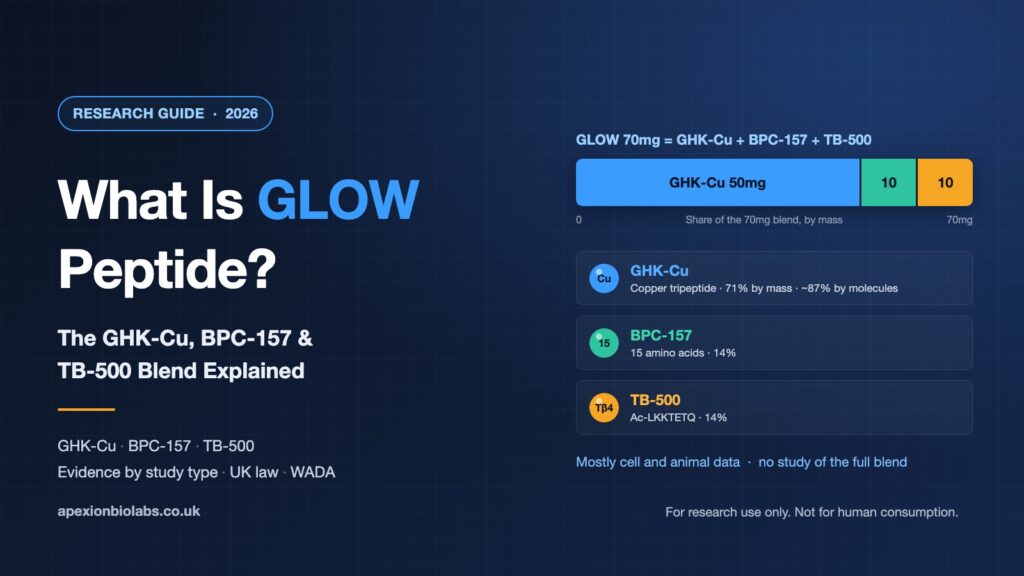
GLOW is a 70mg research blend of three peptides: GHK-Cu 50mg, BPC-157 10 mg, and TB-500 10mg, premixed in one container. Each component carries its own laboratory and animal record, and no published study has tested the blend itself.
- Other names: Suppliers sell the same blend as GLOW 70, GLOW blend, GLOW stack and BBG70. GLOW 50 is used in two different ways, so the label settles it.
- Status: No UK marketing authorisation, and nothing to do with the cosmetic “glow” serums that share the word.
- Apexion supplies GLOW 70mg as a pre-filled research pen with batch details on the listing.
- Whatever the label says, the certificate decides which formula is in the container.
Research use only: GLOW is supplied for in-vitro and animal laboratory work, never for human or veterinary use. Read the Apexion research use notice and purchase disclaimer.
Five of every seven milligrams in a GLOW blend belong to one compound, GHK-Cu, the copper peptide that tints the whole mix blue. BPC-157 and TB-500 share the remaining 20mg equally, both arriving from tendon and cell-migration literature rather than anything cosmetic. That colour is the quickest way to tell a research blend from the “glow” serums on a beauty counter, which share one ingredient at a fraction of the strength.
So what is GLOW peptide in practice? A fixed three-peptide research blend giving a laboratory one batch, one batch number and one certificate in place of three separate powders. This guide covers each component, which names point at the same formula, the study type behind every finding, how GLOW compares with KLOW and Wolverine, and where it stands in UK law.
What Is GLOW Peptide?
GLOW combines GHK-Cu, BPC-157 and TB-500 at 50:10:10 mg, 70mg in total. It is sold as lyophilised powder in a vial or, at Apexion, as a pre-filled research pen prepared fresh for each order. The copper in GHK-Cu gives it its blue colour, and no component carries a UK medicine licence.
| Key fact | GLOW |
|---|---|
| Components | GHK-Cu 50mg · BPC-157 10mg · TB-500 10mg |
| Ratio by weight | 5 : 1 : 1, or 71% / 14% / 14% |
| Total | 70mg |
| Form | Lyophilised powder, or a pre-filled research pen |
| Colour | Blue, from the copper in GHK-Cu |
| UK status | Research use only; no UK marketing authorisation |
Why fix three peptides into one blend at all? For a laboratory, the answer is mostly bookkeeping: one batch reference, one certificate covering all three compounds, and fewer weighing steps than three separate powders. The ratio also stays identical from one order to the next, which keeps this week’s experiment comparable with the last.
The three were chosen because their separate literature overlaps. GHK-Cu, BPC-157 and TB-500 all appear in cell-migration and tissue-model work, which is why they turn up together in research catalogues rather than as an arbitrary mix. Add a fourth peptide, KPV, and the blend becomes KLOW.
GLOW 70, GLOW 50, BBG70: What the Names Mean
The same formula travels under at least five names, and one of them is genuinely ambiguous. Suppliers rarely explain the difference, so the table below sets out what each label is used for and how confident you can be about it.
| Name | What suppliers use it for | Note |
|---|---|---|
| GLOW, GLOW blend, GLOW stack | GHK-Cu 50 + BPC-157 10 + TB-500 10 mg | The standard blend. “Stack” is sometimes used for three separate vials sold together |
| GLOW 70, GLOW70, GLOW-70 | The same blend, named after its 70mg total | Consistent across suppliers |
| GLOW 50, GLOW50 | Used two ways | One supplier lists a genuinely different 50mg formula at 35/5/10; another uses it as a synonym for the 70mg blend. Check the certificate |
| BBG70 | The same 70mg blend of BPC-157, TB-500 and GHK-Cu | No supplier explains “BBG”. The obvious reading is BPC, Beta-4 and GHK-Cu, which remains unconfirmed |
| KLOW, KLOW 80 | GLOW plus KPV 10mg, for 80mg | A fourth peptide, so what is KLOW peptide is a different formula |
GLOW 50 is the one to slow down on. Across supplier listings, it points to two different things: a 50mg blend with its own ratio of roughly 35mg GHK-Cu, 10mg TB-500 and 5mg BPC-157, and the ordinary 70mg blend under a shortened name. The two cannot be compared milligram for milligram without both certificates.
BBG70 has a cleaner answer. Multiple suppliers list it against the identical 50/10/10 composition, so it is the same blend under a different code. What none publish is what the letters mean. Reading them as BPC-157, Beta-4 and GHK-Cu fits the composition, but no supplier documentation confirms it, so treat that expansion as a reasonable guess.
Research-compound threads land in the same place. A discussion on the r/ScienceBioTechnology subreddit summarises GLOW as three peptides in one vial, GHK-Cu, BPC-157 and TB-500, and calls it the same base as KLOW without the added KPV. Community wording tracks the supplier listings, a reasonable sign the composition is settled even where the naming is not.
Two further labels circulate, GLOW 80 and 140mg pens. No supplier publishes a composition for either that can be checked, so this guide leaves them out rather than guess.
Whatever the label says, the certificate decides. A blend certificate should list all three components separately, which is covered in the batch section below.
What’s in the GLOW Blend?
GLOW draws on three research families: a copper-binding tripeptide, a 15-amino-acid sequence and a seven-residue protein fragment, each studied alone for years before anyone combined them. Dr Christopher Mendias of the Hospital for Special Surgery and his co-author Tariq Awan describe peptides as occupying “a unique pharmacological niche between small-molecule drugs and large proteins” in a 2026 Sports Medicine review, and GLOW spans most of that range.
| Component | Amount | Share | Studied for |
|---|---|---|---|
| GHK-Cu | 50mg | 71% | Collagen and matrix work in fibroblasts; gene-expression data |
| BPC-157 | 10mg | 14% | Angiogenesis and tendon fibroblast models |
| TB-500 (Ac-LKKTETQ) | 10mg | 14% | Actin binding and cell-migration models |
GHK-Cu (50mg)
GHK-Cu is glycine, histidine and lysine bound to one copper(II) ion. Loren Pickart’s laboratory identified GHK in human plasma in 1973, and the copper complex has gathered more papers since than almost any other copper peptide. It takes the largest share partly because its molecules are the smallest: counted by molecule rather than mass, it makes up roughly 87% of GLOW. That copper also turns the solution blue. Copper transport and fibroblast activity dominate the GHK-Cu research literature.
BPC-157 (10mg)
BPC-157 is a synthetic 15-residue peptide, a pentadecapeptide, whose sequence was first reported as part of a larger protein found in gastric juice. Almost all of its literature uses rats and cell cultures, with angiogenesis and tendon fibroblast migration as the recurring themes. The BPC-157 UK guide sets those models out study by study.
TB-500 (10mg)
TB-500 is a short synthetic piece of thymosin beta-4: seven residues, Ac-LKKTETQ, about 889 g/mol. That stretch is the actin-binding region of the full 43-amino-acid protein, which is why its research centres on actin dynamics and cell migration. The distinction carries weight, because findings for full-length thymosin beta-4 belong to a different molecule: the phase 1 human safety work used the full recombinant protein, not the fragment. The TB-500 peptide UK guide keeps the two apart.
What Does Each GLOW Component Do in Research?
Each peptide has been studied separately, in its own models, and the study types differ sharply between them. The table below separates laboratory work from animal work from anything done in people.
| Component | In vitro | Animal | Human | Main research areas |
|---|---|---|---|---|
| GHK-Cu | Yes: fibroblasts, cell lines | Yes: wound models | Small topical cosmetic studies only (2015 review) | Copper binding, collagen, gene expression |
| BPC-157 | Yes | Yes: mostly rats; 35 of 36 studies preclinical (2025 review) | 3 small studies, 30 people, certainty rated very low (2026 review) | Angiogenesis, tendon and gut models |
| TB-500 | Yes: motif work | Yes: rats | None for the fragment; thymosin beta-4 trials used a different molecule | Actin binding, cell migration |
A 2026 scoping review from UCLA’s orthopaedic surgery department examined six popular peptides, all three GLOW components among them. Tewari and colleagues found that 67% of the publications they identified used preclinical animal models, and that in those models “each compound demonstrated unique mechanisms”. Different mechanisms are the reason a laboratory might put the three into one model, and also the reason every finding has to stay attached to its own compound.
The human column is where the three diverge most. GHK-Cu’s human record is a handful of small topical cosmetic studies, run on skin rather than as a research blend. For BPC-157, an October 2026 systematic review by Poolton and colleagues at the University of Nottingham searched four databases for any human study and found three, covering 30 participants in total, with the certainty of that evidence rated very low. For the TB-500 fragment, the column is empty.
Read the table by column rather than by row. A “yes” under in vitro and a “yes” under animal are two different standards of evidence, and neither carries across to the blend, which has never been tested as one.
Has the GLOW Blend Itself Been Studied?
No. A PubMed search found no published study testing GHK-Cu, BPC-157 and TB-500 together in any model. Every paper pairing those names turned out to be a review article discussing the peptides one at a time.
Two of the three have at least been put in the same experiment. Biçer and colleagues ran a 2026 rat tendon study with four arms: BPC-157 on its own, TB-500 on its own, the pair, and a control. Pairing them produced no advantage over either peptide alone, which is the single most useful data point in any BPC-157 vs TB-500 comparison.
Testing a three-peptide blend properly is a larger job than it sounds. A full factorial design needs a control, a group for each peptide alone, one for each pair and one for all three: eight groups before a study can say whether the combination adds anything beyond its parts. Nothing published comes close.
That leaves three limitations for anyone reading claims about GLOW:
- No blend data: Findings for each peptide describe that peptide alone, in its own model.
- Untested ratio: The 50:10:10 ratio comes from product design, and no study has compared it against any other ratio.
- Unknown interaction: Nobody has published how the three behave together, chemically or biologically.
GLOW Peptide vs Cosmetic “Glow” Skincare Peptides
Search for “glow peptide”, and the results arrive in two unrelated piles: research blends in vials and pens, and serums and lip balms. They share a word and one ingredient, and very little else.
Strength is the clearest divider. The Cosmetic Ingredient Review panel reported in 2018 that copper tripeptide-1, the cosmetic name for GHK-Cu, typically appears in cosmetics below 10 parts per million. A GLOW pen carries the peptide at research concentration, orders of magnitude above that.
The rules follow the product. A serum sold in Great Britain needs a UK Responsible Person, a safety assessment and notification to the Office for Product Safety and Standards before sale, and may make cosmetic claims only. Research-grade GLOW makes no claims about people at all, and is not supplied for use on skin. BPC-157 and TB-500 have no history as cosmetic ingredients either, so the overlap really is one compound at two very different concentrations.
GLOW vs KLOW vs Wolverine: What’s the Difference?
These three are nested blends built from the same core, so “better” is the wrong comparison. A KLOW vs GLOW comparison turns on a single peptide; set Wolverine beside them, and the difference widens to two. Wolverine is BPC-157 plus TB-500. GLOW wraps GHK-Cu around that pair. KLOW then layers KPV on top of GLOW. The total climbs from 20mg to 70mg to 80mg as each layer goes on, and each blend suits a different model.
| Blend | Components | Total | What’s added | Apexion product |
|---|---|---|---|---|
| Wolverine | BPC-157 10mg + TB-500 10mg | 20mg | Base pair | BPC-157 + TB-500 (Wolverine Blend) 20mg |
| GLOW 70 | Wolverine + GHK-Cu 50mg | 70mg | GHK-Cu | GLOW 70mg |
| KLOW 80 | GLOW + KPV 10 mg | 80mg | KPV | KLOW 80mg |
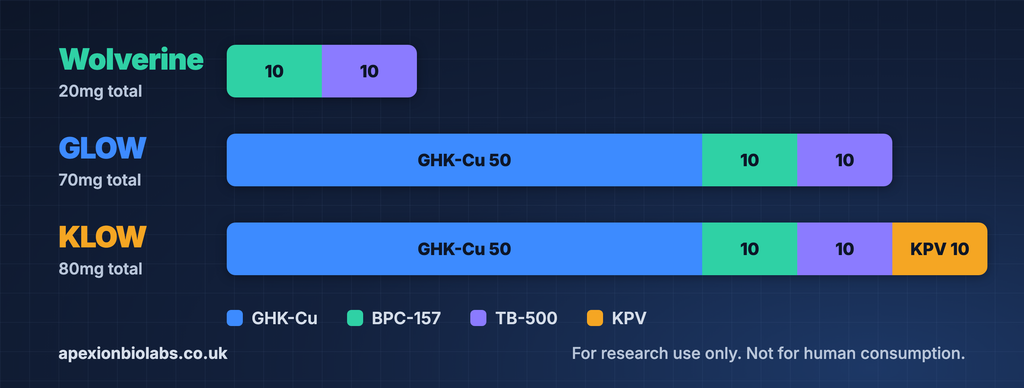
KPV is the only ingredient separating KLOW from GLOW: a three-amino-acid fragment, Lys-Pro-Val, from the tail of alpha-MSH. KPV peptide research runs largely in inflammatory-signalling models, a fourth literature again from the other three. That extra peptide takes the total to 80mg, so a KLOW peptide certificate has to prove four components rather than three.
Is GLOW Peptide Legal in the UK?
Yes, as laboratory material. None of GHK-Cu, BPC-157 or TB-500 appears on a controlled-drug schedule, and none carries a UK marketing authorisation, which is what rules GLOW out of being marketed as a medicine.
| UK law or guidance | How it applies to GLOW |
|---|---|
| Human Medicines Regulations 2012 | No component carries a marketing authorisation; presenting GLOW as treating or preventing disease makes it a medicine |
| Misuse of Drugs Act 1971 | None of the three peptides is listed |
| GB Cosmetic Products Regulation | Applies to topical GHK-Cu (copper tripeptide-1) products only |
| MHRA Guidance Note 8 | Sets the presentation and function tests MHRA uses for borderline products |
Verified: November 2026.
Is GLOW GHK-Cu legal?
GHK-Cu itself appears in two separate legal worlds. As copper tripeptide-1 it is an established cosmetic ingredient, regulated under the GB Cosmetic Products Regulation when it goes into a serum or cream. As a research compound it is unscheduled and unlicensed, which is the status it carries inside GLOW. Neither route gives the blend a medicine licence, so GLOW as a whole stays a research product.
Can you legally buy research peptides in the UK?
On regulatory status, yes. None of the three is a controlled drug, so supply and purchase for laboratory use are not restricted the way a scheduled substance would be. What the law does restrict is presentation. MHRA treats any product “presented as having properties of preventing or treating disease in human beings” as a medicine, whatever it contains, so health claims turn a research blend into an unlicensed medicine. The explainer on whether peptides are legal in the UK applies the same tests to other compounds.
Is GLOW on the WADA Prohibited List?
Two of the three components are named. On WADA’s 2027 Prohibited List, which takes effect on 1 January 2027, BPC-157 appears under class S0 for non-approved substances, and TB-500 is named under class S2 alongside thymosin beta-4. The 2027 edition goes further than its predecessor: USADA’s advisory records that “peptides” in general are now named as prohibited substances in the S0 class. GHK-Cu has no entry of its own, but a blend containing BPC-157 and TB-500 contains prohibited substances.
GLOW Formats: Pre-Filled Research Pen vs Vial
GLOW arrives in two formats: lyophilised powder in a sealed vial, or a pre-filled research pen. Apexion supplies the 70mg blend as a pen only, made fresh for each order, shipped cold chain and labelled with a batch number, on its GLOW 70mg listing. Handling and traceability are where a peptide pen vs vial choice bites: a pen is handled as supplied, a vial can be portioned where procedures allow.
Storage is identical whichever format you receive. Apexion’s documentation for the GLOW pen gives −20 °C for long-term storage and a cool, stable 2 to 8 °C out of direct light for shorter spells. The reconstituted peptide storage and handling guide covers both formats and what happens after a temperature excursion.
How to Verify a GLOW Batch
A GLOW certificate has to prove three peptides, so it carries more than a single-peptide report. One combined purity figure cannot show the balance between the three, and it can hide one component running low.
What the certificate should show:
- HPLC: Three separate peaks, each with its own purity figure.
- Mass identity: A result for each peptide, at roughly 402, 1,419 and 889 g/mol.
- Copper: Confirmation that GHK-Cu is present as the copper complex rather than free GHK.
- Lot number: Matching the number printed on the pen or vial.
That last line is the one that catches mislabelled blends. Where a product is sold as GLOW 50, BBG70 or anything else, the certificate tells you which formula is actually in the container. Every Apexion GLOW research pen is made to order, and its batch certificate follows with the order, matched by batch number or QR code. Reading how to read a peptide certificate of analysis first makes those fields quicker to check, and a full research peptide batch check begins with the lot number on the label.
Frequently Asked Questions
Yes. GLOW 70 is the ordinary blend named after its 70mg total: GHK-Cu 50mg, BPC-157 10 mg, and TB-500 10mg. GLOW, GLOW blend and GLOW 70 all point to the same formula, though “stack” occasionally means three separate vials sold together.
No supplier explains it. BBG70 is listed against the same 50/10/10 composition as GLOW, so the “70” is the milligram total. Reading “BBG” as BPC-157, Beta-4 and GHK-Cu fits the ingredients, but no supplier documentation confirms it.
Sometimes. One supplier lists a genuinely different 50mg formula at roughly 35mg GHK-Cu, 10mg TB-500 and 5mg BPC-157; another uses GLOW 50 for the standard 70mg blend. Only the certificate confirms which one has arrived.
The copper. GHK-Cu is a copper(II) complex, and copper ions in solution give a blue tint. Because GHK-Cu makes up 50 of the blend’s 70mg, that colour carries through the whole mix.
GHK-Cu is by far the smallest of the three molecules, at roughly 402 g/mol against 1,419 for BPC-157 and 889 for TB-500, so an equal mass gives many more molecules. Counted that way, GHK-Cu makes up about 87% of GLOW.
GHK-Cu is not a controlled drug, and as copper tripeptide-1, it is an established cosmetic ingredient. Inside GLOW, it is an unlicensed research compound, so the blend has no UK marketing authorisation.
No. No published study has tested the three-peptide blend in any model. The human evidence that exists belongs to individual components: small topical cosmetic studies for GHK-Cu, and three small studies covering 30 people for BPC-157, rated very low certainty.
One peptide. KLOW is GLOW plus 10mg of KPV, a three-residue alpha-MSH fragment studied in inflammatory-signalling models, taking the total from 70mg to 80mg.
The Bottom Line
GLOW is a fixed 5:1:1 blend of GHK-Cu, BPC-157 and TB-500, and every finding behind it belongs to one peptide studied on its own. The blend itself has no published data, the names it travels under are inconsistent, and GLOW 50 can mean two different formulas depending on the supplier. All of which makes the paperwork the most useful thing a researcher can check: a certificate proving all three components separately, including the copper complex, and findings kept tied to the single peptide and model they came from.
Sources
Sources checked: 14 November 2026.
- Pickart L, Vasquez-Soltero JM, Margolina A. BioMed Research International. 2015 (PMC4508379)
- Vasireddi N, et al. HSS Journal. 2025 (PMID 40756949)
- Poolton JT, Minett J, Kazmi A. Acta Orthopaedica Belgica. 2026 (PMID 42885452)
- Tewari K, et al. American Journal of Sports Medicine. 2026 (PMID 42578445)
- Mendias CL, Awan TM. Sports Medicine. 2026 (doi:10.1007/s40279-026-02437-0)
- Biçer et al. Joint Diseases and Related Surgery. 2026 (study record)
- Johnson W, et al. International Journal of Toxicology. 2018 (doi:10.1177/1091581818807863)
- MHRA, borderline products guidance and Guidance Note 8
- legislation.gov.uk: Human Medicines Regulations 2012; Misuse of Drugs Act 1971
- WADA, 2027 Prohibited List, and USADA’s 2027 advisory
Every Apexion product is supplied for laboratory research use only, is not for human or veterinary use, and is not intended to diagnose, treat or prevent any condition. Apexion’s research use notice and purchase disclaimer state those terms in full.