
TB-500 Peptide UK: Research Overview and Legal Status (2026)
Reviewed by Oscar Reyes, PhD, Synthesis Lead at Apexion BioLabs · Scientific review of the chemistry and analytical content
Quick answer
What is TB-500 peptide?
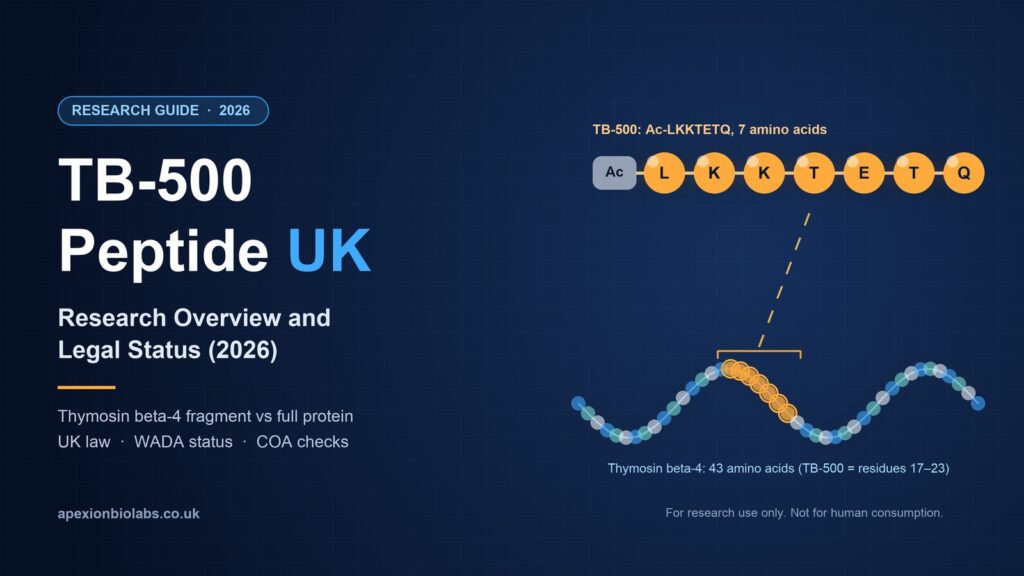
TB-500 is a synthetic 7-amino-acid fragment, Ac-LKKTETQ, copied from the part of thymosin beta-4 that binds actin. Scientists study it in cell and animal tissue-repair models. Most human trials so far have used full-length thymosin beta-4, and the first trial of the fragment only began in 2026. No regulator has approved it, and in the UK it’s a research material only.
- TB-500 is a fragment, not full-length thymosin beta-4
- The evidence is mostly cell and animal work
- UK: uncontrolled and unlicensed, supplied for research use only; WADA names it under S2
A search for “TB-500 peptide UK” brings up page after page of shop listings. Many of them use “TB-500” and “thymosin beta-4” as if they meant the same thing. They don’t. One is a 7-residue fragment and the other a 43-residue protein, and that mix-up runs right through the research, the trials and even some product labels.
This guide untangles it. We cover what TB-500 is, how it differs from its parent protein, how it behaves in lab models, what the research and trials show, UK law, sport and racing rules, and how a certificate reveals which molecule you’ve actually got. Each result carries two labels, the model and the compound tested, so you always know whether a result belongs to TB-500 or to full thymosin beta-4.
Apexion sells TB-500 to laboratories as a research reagent. It is never intended for people or animals, and this page offers no medical advice. Conditions of sale: Research Use Only notice.
What Is TB-500 Peptide?
TB-500 is a synthetic chain of seven amino acids, leucine-lysine-lysine-threonine-glutamate-threonine-glutamine, and the leucine at its start carries an acetyl cap. It mirrors residues 17 to 23 of thymosin beta-4, the stretch that grips actin. In short, TB-500 takes the protein’s best-known working part and leaves the other 36 residues behind.
The name started life as a product label, not a scientific term. When Hong Kong Jockey Club chemists analysed a veterinary preparation sold as TB-500 in 2012, they found its key ingredient was LKKTETQ “with artificial acetylation of the N-terminus”. Anti-doping chemists confirmed the same fragment that year, and the definition stuck.
| Identifier | Value |
|---|---|
| Name | TB-500 (thymosin beta-4 fragment 17 to 23, acetylated) |
| Sequence | Ac-LKKTETQ (Ac-Leu-Lys-Lys-Thr-Glu-Thr-Gln) |
| Length | 7 amino acids |
| Formula | C38H68N10O14 (PubChem CID 62707662) |
| Molecular weight | ~889.0 g/mol |
| Source protein | Thymosin beta-4, 43 amino acids |
| CAS number | No single number is consistently assigned to the fragment; 77591-33-4 belongs to full-length thymosin beta-4 |
| Form at Apexion | Pre-filled 10mg research pen, filled to order in Britain |
| UK position | Sold for research; unlicensed and absent from drug schedules |
For lot-level identity data, open the TB-500 10mg specification and COA.
When Was Thymosin Beta-4 Discovered?
Thymosin beta-4 came out of thymus research in the United States. Allan Goldstein’s group had been separating a calf-thymus extract known as thymosin fraction 5, and in 1981 Low, Hu and Goldstein published the complete amino-acid sequence of bovine thymosin beta-4 in PNAS.
Its link to actin came a decade later. In 1991, Daniel Safer and colleagues showed that thymosin beta-4 was the same molecule as an actin-sequestering peptide they’d been studying. Later work narrowed that activity down to the LKKTETQ stretch.
TB-500 vs Thymosin Beta-4: What’s the Difference?
Thymosin beta-4 is a natural protein of 43 amino acids, weighing about 4,963 g/mol and made by most mammalian cell types, whereas TB-500 reproduces just seven of those amino acids, weighing about 889 g/mol. One is a whole protein, the other a single motif from it.
| Feature | TB-500 | Thymosin beta-4 |
|---|---|---|
| Origin | Synthetic fragment | Natural protein, also made synthetically or recombinantly |
| Length | 7 amino acids | 43 amino acids |
| Molecular weight | ~889 g/mol | ~4,963 g/mol (PubChem CID 45382195) |
| CAS | Not consistently assigned | 77591-33-4 |
| Human trials | One Phase 1/2 study, recruiting since 2026 | Several, mainly as eye drops (RGN-259) |
| WADA listing | Named as a derivative under S2 | Named under S2 |
Thymosin beta-4 isn’t the only peptide researchers compare TB-500 with. Our BPC-157 vs TB-500 comparison covers the other common pairing.
How Does TB-500 Work?
In lab models, the LKKTETQ motif binds G-actin, the loose single units that cells assemble into their actin scaffolding. That binding shapes how cells change shape and move. Animal studies of thymosin beta-4 also link it to blood-vessel formation and to inflammatory signalling.
Here’s what has been seen, and where:
- G-actin binding (biochemical studies, thymosin beta-4). Thymosin beta-4 holds single actin units so they can’t join growing filaments, which lets a cell keep a ready supply for rapid rebuilding. Safer’s 1991 work established this role.
- Cell movement (cell studies, both compounds). Philp and colleagues (FASEB Journal, 2003) tested full thymosin beta-4 against its fragments in endothelial cell migration assays. The seven-amino-acid actin motif and the full protein “display near-identical activity”, while peptides missing any part of the motif were inactive.
- Blood-vessel formation (cell and tissue assays, both compounds). The same paper found the motif essential for vessel sprouting in chick aortic rings, a classic angiogenesis assay.
- Inflammatory signalling (cell studies, thymosin beta-4). In cultured eye-surface cells, Sosne and colleagues (2007) reported that thymosin beta-4 dampened NF-κB, a switch for inflammatory genes.
One 2024 finding adds a twist. A team at the Korea Institute of Science and Technology tracked how TB-500 breaks down in rats and in lab enzyme systems. In their fibroblast migration assay, a shorter breakdown product, Ac-LKKTE, was active while the parent peptide wasn’t. The authors suggest some activity credited to TB-500 may come from its metabolite. That’s a single cell study, and it’s a reason every result needs its exact compound named.
What Is TB-500 Studied For?
TB-500 and thymosin beta-4 are research tools for studying how cells move, attach and rebuild their structure. Cell cultures and animal tissue-repair models make up the bulk of it. Human data come almost entirely from full-length thymosin beta-4.
Here are the areas, with model and compound for each:
- Dermal repair models (animal, thymosin beta-4). Malinda and colleagues (1999) studied dermal repair models in rats, tracking how new tissue formed over time.
- Cardiac tissue models (mice, thymosin beta-4). Bock-Marquette and colleagues (Nature, 2004) found thymosin beta-4 formed a complex with the enzyme integrin-linked kinase and activated the survival kinase Akt in mouse cardiac cells.
- Eye-surface studies (humans, thymosin beta-4). The longest-running human programme uses thymosin beta-4 eye drops, coded RGN-259, covered in the research section below.
- Tendon and muscle models (animal, mostly thymosin beta-4). These are the thinnest area. A 2026 scoping review found tendon, ligament and muscle studies “comparatively sparse”.
What Does TB-500 Do in Lab and Animal Studies?
In cell studies, the TB-500 motif binds actin and matches full thymosin beta-4 in endothelial migration and vessel-sprouting assays (Philp 2003). In rats, TB-500 is broken down quickly into shorter pieces, which a 2024 study measured in urine for up to 72 hours. Animal tissue-repair studies have mostly used the full protein, so they say little about the fragment on its own.
What Does the Research on TB-500 Actually Show?
There’s plenty of cell and animal data, but most of it is on full thymosin beta-4. Human trials have largely tested the full protein too, mainly RegeneRx’s RGN-259 eye drops. A trial of the TB-500 fragment itself opened in 2026 and hasn’t reported.
The clearest map of the field comes from a 2026 scoping review in Applied Sciences by McGuire, Hughes, Maak and Cushman. Searching PubMed, Europe PMC and ClinicalTrials.gov through March 2026, the authors concluded that “most studies evaluated TB4 rather than TB-500.” They also noted the literature “supports the popular interest in several repair-related pathways” while remaining largely preclinical.
| Research area | Model | Compound tested | Reported finding | Level of evidence |
|---|---|---|---|---|
| Actin binding | Biochemical | Thymosin beta-4 | Holds single actin units (Safer 1991) | Preclinical |
| Cell migration and vessel sprouting | Cells, chick aortic rings | Both | Motif matched full protein (Philp 2003) | Preclinical |
| Metabolism | Rats, enzyme systems | TB-500 | Rapid breakdown; one metabolite active in cells (Rahaman 2024) | Preclinical |
| Cardiac tissue | Mice | Thymosin beta-4 | ILK and Akt activation (Bock-Marquette 2004) | Preclinical |
| Eye surface | Humans | Thymosin beta-4 (RGN-259) | Phase 2 and 3 trials; Phase 3 still recruiting | Human trials, protein only |
| Cardiovascular biomarkers | Humans | TB-500 | Phase 1/2 study recruiting | Human trial, no results |
The RegeneRx programme. RegeneRx and its partner ReGenTree have run several trials of RGN-259, a thymosin beta-4 eye drop, including Phase 3 ARISE studies such as NCT02597803 and NCT03937882. Another Phase 3 study, NCT05555589, was still listed as recruiting in October 2026. A second formulation, RGN-352, was planned for cardiac research, but its Phase 2 study (NCT01311518) was withdrawn before enrolling anyone. None has led to an approval.
The first fragment trial. Hudson Biotech registered a randomised, placebo-controlled Phase 1/2 study of TB-500 itself, NCT07487363, described as “Thymosin Beta 4 17-23 Fragment”. Enrolment of adult volunteers opened in February 2026, and the study tracks cardiovascular blood biomarkers.
Why animal results don’t transfer neatly. Most of the positive animal work used the full protein, not the fragment. Animal models also run under controlled diets, genetics and housing. And the 2024 metabolism study shows the fragment is broken down fast, so what reaches a tissue may not be TB-500 at all.
Is TB-500 Legal in the UK?
Yes, provided it’s handled as a lab reagent. TB-500 appears on no controlled drug schedule, and no MHRA licence has been issued for it, so British law forbids selling or promoting it for people to take.
Three laws set the limits (checked October 2026):
| Legislation | Scope | TB-500’s position |
|---|---|---|
| Human Medicines Regulations 2012 | Regulation 2 sets the medicinal-product test; regulation 46 bans selling or supplying unlicensed medicines | With no marketing authorisation, it may not be marketed as a medicine |
| Misuse of Drugs Act 1971 | Lists class A, B and C drugs | Absent from every class |
| Psychoactive Substances Act 2016 | Targets substances that change mood or mental functioning | No such effect on record |
The subtler rule appears in MHRA Guidance Note 8. The MHRA can treat a product as a medicine purely because of how it’s presented. That covers claims on a website, testimonials, social posts and even a product name. A “TB-500” listing that promises any effect in people is presenting a medicine, research label or not.
The MHRA is actively watching this market. In April 2026 it opened an investigation into UK clinics promoting unregulated peptides. Our guide are peptides legal in the UK puts TB-500 alongside other common peptides.
Can You Buy TB-500 in the UK?
British research suppliers carry it under research-use-only terms. No pharmacy stocks it, since it holds no medicine licence. Imports are a separate risk: Border Force can seize unlicensed medicines arriving from abroad. Our conditions of sale: see the Research Use Only notice.
Do You Need a Prescription for TB-500?
No prescription route exists for TB-500 in the UK, through the NHS or privately. Prescribing requires a licensed product or a recognised route for unlicensed medicines, and TB-500 fits neither. Research suppliers deal with laboratories.
Do US Rule Changes Affect TB-500 in the UK?
No. On 23 July 2026, an advisory committee to the US FDA backed, by eight votes to six, a proposal to add BPC-157, KPV and TB-500 to the list of substances American compounding pharmacies may use, PharmExec reported. That recommendation doesn’t bind the agency, and TB-500 still holds no FDA approval. UK law is set by the MHRA and Parliament, so a US committee vote changes nothing here.
Is TB-500 Banned in Sport?
Yes. WADA’s Prohibited List places thymosin-β4 and its derivatives, naming TB-500 as an example, in class S2 under growth factors and growth factor modulators. S2 bans have no off-season, and the 2027 list, which applies from 1 January 2027, carries the same class.
In Britain, UK Anti-Doping (UKAD) enforces it, and the full text is on WADA’s Prohibited List page.
Anti-doping labs have researched how to find it. The Korea Institute of Science and Technology’s doping control centre mapped its breakdown products for testing, and its short-lived pieces are what labs look for.
Racing runs a parallel system. The Hong Kong Jockey Club’s laboratory published a method for detecting TB-500 in horse urine and plasma back in 2012. In Britain, racing’s prohibited-substance rules are set separately by the British Horseracing Authority.
TB-500 vs BPC-157
TB-500 and BPC-157 are often mentioned together, but they’re unrelated. TB-500 comes from a natural actin-binding protein. BPC-157 is a synthetic 15-residue peptide drawn from a longer natural protein, and the two share no sequence at all. In lab models they’re studied through different pathways: actin handling for TB-500, and growth-factor and nitric-oxide signalling for BPC-157.
For the full side-by-side, see BPC-157 vs TB-500, and for BPC-157 alone, the BPC-157 UK guide. Apexion also lists the BPC-157 and TB-500 20mg blend and the KLOW mix. For how multi-peptide research materials are documented, see peptide stacks explained.
How to Verify Research-Grade TB-500
Look first at the mass on the batch COA, because it reveals which molecule the pen holds. A reading near 889 means the TB-500 fragment. A reading near 4,963 means full-length thymosin beta-4. Anything else needs an explanation before the batch goes near an experiment.
The raw LC-MS spectrum adds a second check. Electrospray gives each molecule one or more extra protons, and every charge state lands at a predictable position on the mass-to-charge scale. A small peptide like the fragment shows just one or two peaks. A 43-residue protein spreads into a ladder of several. So the shape of the spectrum, not just the headline number, tells the two apart.
| Item | Pass if |
|---|---|
| Lot match | Certificate and pen carry one code |
| HPLC purity | A percentage with its column and detector |
| LC-MS mass | Near 889 (fragment) or 4,963 (full protein), matching what’s sold |
| Stated sequence | Ac-LKKTETQ for TB-500 |
| Salt form | Acetate or TFA stated, because counter-ions change the weighed mass |
| Lab and date | Independent lab named; report dated |
A sequence, formula and mass that all point to the same molecule is the sign of a consistent batch. If any one of them disagrees, ask the supplier which molecule the pen holds.
Two guides go further: how to read a peptide certificate of analysis and how to verify a research peptide batch. Any lot code can be entered on the batch verification page.
How Should TB-500 Be Stored?
Keep dry powder chilled, sealed and shielded from light, with −20 °C the norm for long storage. Pre-filled pens are refrigerated, following the batch sheet’s storage note. Its two lysines and glutamine make it water-loving, so keeping moisture out of powder stocks protects the batch. The storage and handling guide gives the complete routine, while the pen vs vial comparison weighs up the two formats.
Frequently Asked Questions
Yes, for laboratory research. No drug schedule names TB-500, and it has never been licensed by the MHRA, so British suppliers may sell it to laboratories on research-use-only terms. Selling it for people to take, or attaching health claims, would bring it under the 2012 Regulations as an unlicensed medicine.
They’re different molecules. Thymosin beta-4 is a natural 43-amino-acid protein of about 4,963 g/mol. TB-500 is a synthetic 7-amino-acid fragment of it, Ac-LKKTETQ, at about 889 g/mol. Some products labelled TB-500 contain the full protein, so the mass printed on a batch certificate is what settles the question.
Barely. Most human trials, including the RGN-259 eye-drop studies, tested full-length thymosin beta-4. The first registered trial of the TB-500 fragment itself, NCT07487363, opened to volunteers in February 2026, with no results posted yet. Placebo-controlled evidence on the fragment depends on that study.
WADA places thymosin beta-4 and its derivatives, including TB-500, in class S2 under growth factors and growth factor modulators. Substances in S2 are prohibited at all times. Anti-doping and racing laboratories have published methods to detect TB-500 and its breakdown products in urine and plasma.
Neither. TB-500 is a short peptide chain of seven amino acids, with none of the ring structure that defines a steroid. Its parent protein was first described as a thymic hormone in the 1980s, but thymosin beta-4 is now understood mainly as an actin-binding protein made by many cell types.
By mass. LC-MS gives about 889 for the TB-500 fragment and about 4,963 for full thymosin beta-4. The spectrum shape helps too: the fragment shows one or two peaks, while the protein shows a ladder of charge states. HPLC alone can’t confirm identity, so a good COA lists both.
The Bottom Line
TB-500 is a 7-residue synthetic copy of thymosin beta-4’s actin-binding motif. Most published research and almost every human trial used the full protein, and the first trial of the fragment is still recruiting. Under British law it remains an unlicensed, unscheduled reagent, and it appears on WADA’s banned list. The batch certificate should always confirm which molecule you have. Apexion sells it only to labs, for research.
View the TB-500 10mg specification and COA.
Disclaimer: We publish this overview for research education. TB-500 from Apexion is a laboratory reagent, never a medicine, supplement or food, and must never be used on a person or an animal. Nothing above is medical or legal advice. Legal and regulatory points reflect our October 2026 review and may change. Full terms: Research Use Only notice.
Sources
Research
- Low TL, Hu SK, Goldstein AL. PNAS, 1981. PMC319967
- Safer D, et al. Journal of Biological Chemistry, 1991. PubMed 1999398
- Malinda KM, et al. Journal of Investigative Dermatology, 1999. PubMed 10469335
- Philp D, et al. FASEB Journal, 2003. PubMed 14500546
- Bock-Marquette I, et al. Nature, 2004. PubMed 15565145
- Sosne G, et al. Experimental Eye Research, 2007. PMC2211446
- Rahaman KA, et al. Journal of Chromatography B, 2024. PubMed 38382158
- McGuire F, Hughes E, Maak T, Cushman DM. Applied Sciences, 2026. doi:10.3390/app16126202
- PubChem: TB-500, CID 62707662 and thymosin beta-4, CID 45382195
Doping detection
- Ho EN, et al. Journal of Chromatography A, 2012. PubMed 23084823
- Esposito S, et al. Drug Testing and Analysis, 2012. PubMed 22962027
Trials
- RGN-259: NCT02597803, NCT03937882, NCT05555589
- RGN-352: NCT01311518
- TB-500 fragment: NCT07487363