
Tesamorelin Research Overview: Mechanism, Classification and Key Considerations

Quick answer
Tesamorelin is a synthetic, stabilized analog of growth hormone-releasing hormone (GHRH) studied for its interaction with GHRH receptors on the pituitary gland. It has an approved clinical indication in some markets for a specific, narrow population, but we supply it strictly as a non-clinical research compound for laboratory use only.
Tesamorelin Research Overview
Tesamorelin is a full-length analog of human GHRH, built to hold together longer than the natural hormone. That single design choice is what makes it interesting to researchers, and it is where this overview starts.
It is worth being upfront about its status. In some jurisdictions Tesamorelin has an approved pharmaceutical indication, specifically for reducing visceral fat in adults with HIV-associated lipodystrophy. This guide covers research classification and mechanism only. It does not cover clinical use, dosing or off-label application of any kind, and the approval above belongs to a specific medicine, in a specific population, in specific markets.
Our product is a separate thing. It is research-grade material for laboratory use, and it is not the approved pharmaceutical formulation. It is not intended for human use. Throughout this Tesamorelin research guide, we focus on mechanism, classification, regulatory context and documentation, and we hedge clearly wherever the popular story runs ahead of the evidence.
What Is Tesamorelin? Classification and Origin
Tesamorelin is a synthetic peptide analog of human growth hormone-releasing hormone (GHRH), structurally stabilized to resist rapid enzymatic degradation while keeping its ability to bind GHRH receptors.
Structural Stabilization
Natural GHRH has a very short biological half-life. Enzymes in the body break it down within minutes, which limits how long it can signal. Tesamorelin answers that with a small structural addition: a trans-3-hexenoic acid group attached at the N-terminus.
That group protects the molecule from rapid breakdown, and it does so while leaving the receptor-binding end free to work. The result is a full-length GHRH sequence that holds up longer than the natural hormone.
| Attribute | Tesamorelin |
|---|---|
| Classification | Full-length, stabilized GHRH analog |
| Structural feature | N-terminal modification for enzymatic stability |
| Molecular weight | ~5135.9 g/mol |
| CAS reference | 218949-48-5 |
| Regulatory status (some markets) | Approved for a narrow clinical indication; not approved for general population use |
How Does Tesamorelin Work? Proposed Mechanism
Tesamorelin binds to GHRH receptors on pituitary somatotroph cells. That binding activates intracellular cAMP and PKA signaling, which leads to the pulsatile release of growth hormone, and growth hormone in turn raises IGF-1 levels.
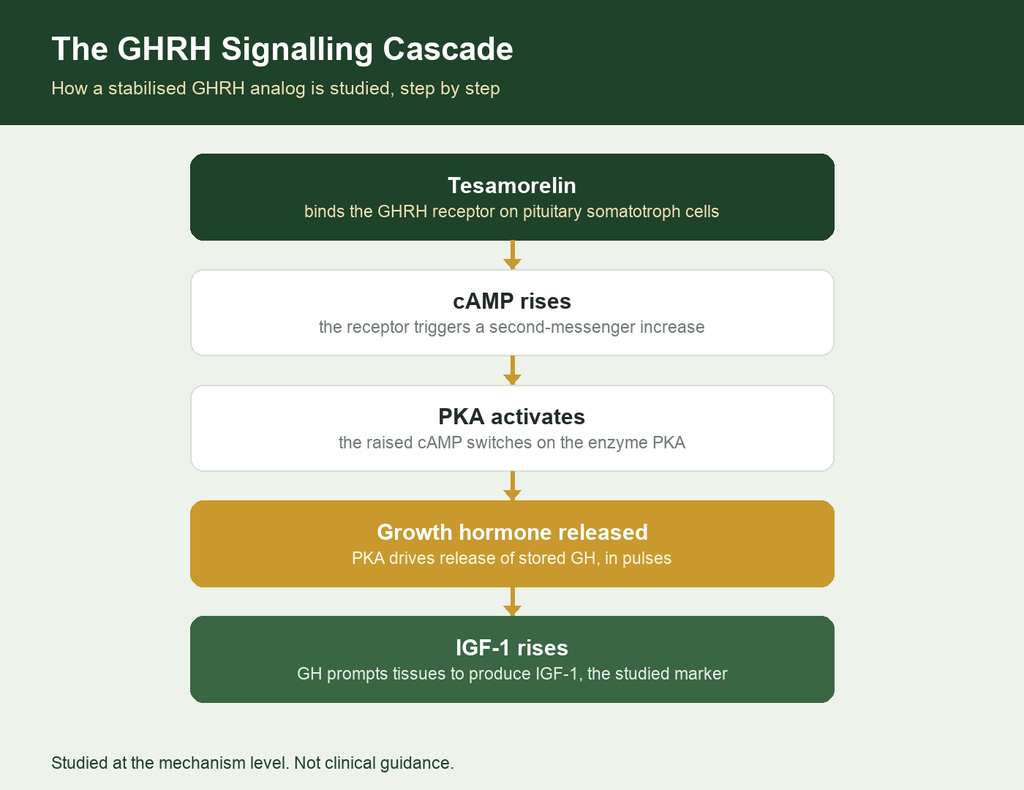
The steps run in order.
- Tesamorelin docks onto the GHRH receptor, the cell responds by raising cAMP, cAMP activates the enzyme PKA, and PKA drives the release of stored growth hormone from the cell.
- Existing literature references IGF-1 as the key downstream marker, since growth hormone prompts the liver and other tissues to produce it, and IGF-1 is easier to measure steadily than the short, pulsing bursts of growth hormone itself.
- That is why research reports in this area tend to track IGF-1 as the readout for GHRH-pathway activity. This mirrors the way natural GHRH signals, with one practical difference: the stabilised structure gives Tesamorelin a longer active window.
- The pivotal trial work by Falutz and colleagues (New England Journal of Medicine, 2007), which studied 412 patients, described exactly this class of molecule as a growth hormone-releasing factor acting through that GHRH pathway.
What Is Tesamorelin’s Regulatory and Research Status?
Tesamorelin has an approved pharmaceutical indication in some markets, specifically for reducing visceral fat in adults with HIV-associated lipodystrophy, a narrow population studied in controlled clinical trials.
This approval does not extend to general weight loss, anti-aging or off-label use, and our product is supplied strictly as a non-clinical research compound, not the approved pharmaceutical formulation.
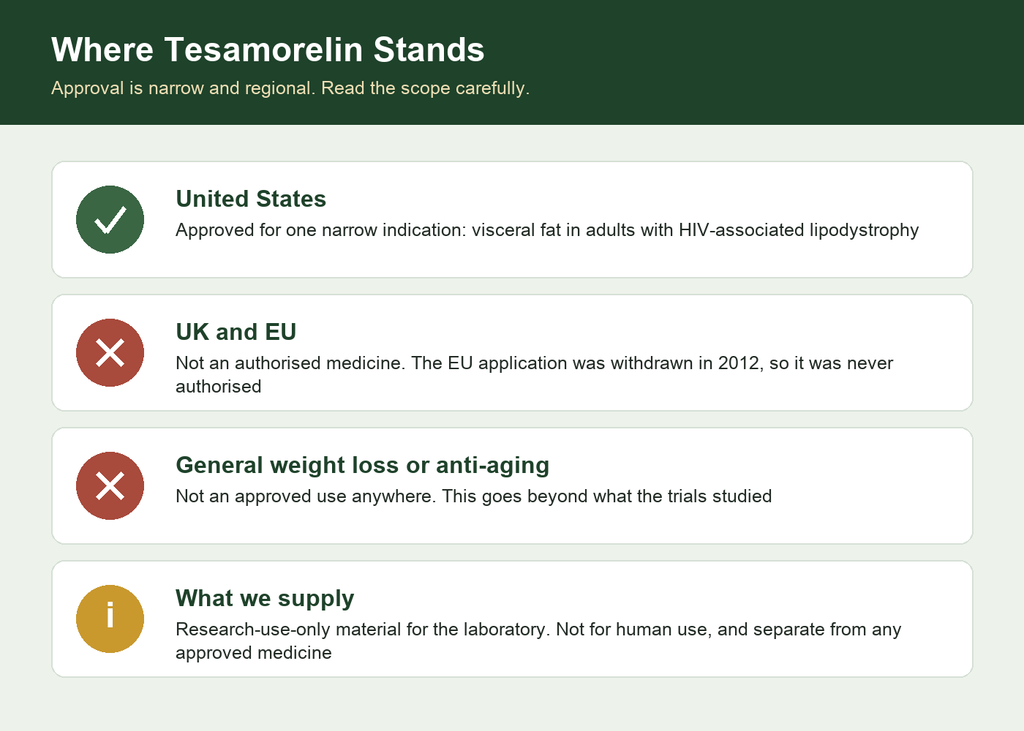
The approved indication is narrow and trial-specific. It came from controlled trials in one defined patient group, and the evidence supports that group. Stretching it into a general “fat loss” or “anti-aging” story, the way many ranking pages do, goes well beyond what those trials showed. The studied population had a specific clinical picture, the endpoint was a specific measure of visceral fat, and the trials ran for defined periods. Read outside those bounds, the same data no longer carries the same weight.
The regional picture matters too, and it is often glossed over. In the United States, Tesamorelin holds an approved indication under a brand-name medicine. In the UK and the European Union, the position is different: the EU marketing-authorisation application for the branded product was withdrawn in 2012, after the CHMP “considers that the provided data do not allow it to conclude on a positive benefit-risk balance.” So it was never authorised as a medicine in the EU, and it is not an authorised medicine in the UK either.
That context makes our own position simple to state. The material we supply is for laboratory research use only. It is not for human use, self-administration or any clinical purpose, and it is separate from any approved medicine in any market.
Tesamorelin vs CJC-1295: How Do They Compare?
Tesamorelin and CJC-1295 are both GHRH receptor analogs, and they take different structural routes to get there. Tesamorelin is a full-length, independently stabilized molecule. CJC-1295 (No DAC) is a truncated GHRH fragment, also called Mod GRF 1-29, which relies on its own structural modification for a shorter research-signaling duration.
| Factor | Tesamorelin | CJC-1295 (No DAC) |
|---|---|---|
| Classification | Full-length, stabilized GHRH analog | Truncated GHRH fragment (Mod GRF 1-29) |
| Structural basis | N-terminal enzymatic-stability modification | Shortened amino-acid sequence without DAC extension |
| Molecular weight | ~5135.9 g/mol | ~3367.88 g/mol (as supplied in our blend) |
| Regulatory status | Approved for a narrow clinical indication in some markets | No approved pharmaceutical indication |
| Research classification | GHRH receptor analog | GHRH receptor analog |
Both belong to the same broad GHRH-analog research family. For a closer look at the fragment side of that family and how it pairs with a ghrelin-receptor agonist, see our overview of CJC-1295 vs Ipamorelin.
What Is Tesamorelin Studied for in Research Settings?
Tesamorelin has been studied most extensively in clinical trials examining visceral adipose tissue reduction in a specific patient population, with GHRH receptor activity and IGF-1 elevation as the primary studied mechanisms.
Its best-documented trial evidence relates to visceral fat reduction in that one approved population, and that is where the strongest data sits. Falutz and colleagues reported that the growth hormone-releasing factor selectively reduced visceral adipose tissue in the studied HIV group, by roughly 15% over 26 weeks, without a matching change in general body weight. Broader interest in body composition and metabolic questions does exist in the wider literature, and it should stay separate from confirmed, general-population outcomes.
Falutz and colleagues also noted that the visceral-fat reduction came without a matching drop in subcutaneous fat or overall body weight, which is a reminder that the effect studied was specific and targeted, and not a broad change across the body. This section summarises published research classification, and it is not usage guidance.
Research note: Tesamorelin’s strongest clinical evidence is specific to a narrow, studied population. Claims extending its effects to general weight loss or anti-aging in the broader population are not supported by the same level of evidence and should be treated cautiously.
How Should Tesamorelin Purity and Identity Be Verified?
Tesamorelin batch verification should include matching the lot number on the product label to its Certificate of Analysis, reviewing the HPLC purity result, and confirming that the LC-MS or mass data aligns with Tesamorelin’s expected molecular weight of approximately 5135.9 g/mol.
| Check | What to confirm |
|---|---|
| Product identity | Label states “Tesamorelin” and matches the order record |
| Batch/lot number | Matches exactly between product and COA |
| HPLC purity | Reported result and method are stated on the COA |
| LC-MS identity | Observed mass data is consistent with ~5135.9 g/mol |
| CAS reference | Matches 218949-48-5 where stated |
For the general process behind these checks, start with our guide on how to read a peptide Certificate of Analysis, then work through the step-by-step lot-matching and HPLC/LC-MS review in our guide on how to verify a research peptide batch. One point specific to Tesamorelin: at roughly 5135.9 g/mol it is a larger molecule than many research peptides, so the mass data on the COA is a genuinely useful identity anchor to confirm.
How Should Tesamorelin Be Stored and Handled in Research?
Tesamorelin should be stored according to its product-specific instructions, with attention to temperature control, light protection and keeping repeated freeze-thaw cycles to a minimum, following the same general handling principles as other reconstituted research peptides.
The basics are familiar: store it promptly after receipt, keep the container tightly sealed, and handle it as little as necessary. We supply Tesamorelin in a Premium vial-based presentation, and the product-specific storage instructions supplied with it take priority over any general guidance.
There is one extra reason to follow those instructions precisely here. As a larger, full-length peptide at around 5135.9 g/mol, Tesamorelin is more structurally complex than short fragments, so it earns careful, product-specific handling, because assumptions carried over from smaller GHRH-analog products can mislead.
For the two presentation types, see our comparison of peptide pens vs vials for research, and for temperature and receipt handling read our guide on reconstituted peptide storage and handling for research.
FAQs
Tesamorelin is a synthetic, stabilized analog of growth hormone-releasing hormone (GHRH) studied for its interaction with pituitary GHRH receptors. It has an approved pharmaceutical indication in some markets for a narrow clinical population.
No, Tesamorelin’s approved indication is specific to reducing visceral fat in adults with HIV-associated lipodystrophy. That approval does not extend to general-population weight loss, anti-aging or off-label use.
Tesamorelin is a full-length, independently stabilized GHRH analog, while CJC-1295 (No DAC) is a truncated GHRH fragment. Both are studied as GHRH receptor analogs, and they differ in structure, molecular weight and regulatory status.
No, we supply Tesamorelin strictly as a non-clinical research compound for laboratory use. It is not formulated, tested or intended as the approved pharmaceutical product.
Match the batch or lot number on the product label to its Certificate of Analysis, review the HPLC purity result and method, and confirm the LC-MS or mass data is consistent with Tesamorelin’s expected molecular weight of approximately 5135.9 g/mol.
Tesamorelin is studied most for its role in reducing visceral adipose tissue in a specific clinical-trial population, with GHRH receptor activity and IGF-1 elevation as the primary studied mechanisms. Broader research interest exists and is less robustly evidenced.
The general reconstituted-peptide principles apply: temperature control, light protection and minimal freeze-thaw cycles. As a larger, full-length peptide, it should be handled according to its specific product instructions, since assumptions based on shorter fragments like CJC-1295 may not transfer.
How Does Tesamorelin Fit Into Our Research Peptide Range?
Tesamorelin is part of our Premium research compound tier, supplied with batch-specific analytical documentation. It sits alongside our other single-compound research materials, each one documented so the paperwork can be matched to the physical product.
The framing holds across the range: everything is supplied for laboratory research, and everything comes with documentation you can check. For Tesamorelin that means a COA you can match to the lot number and mass data you can confirm against its molecular weight. You can review the Tesamorelin and its documentation directly, and for a related copper-peptide overview see our guide on GHK-Cu.
Conclusion
Tesamorelin remains one of the more clinically documented GHRH analogs, with a narrow approved indication supported by controlled-trial data in the United States and a distinct structural profile next to fragments like CJC-1295. Its UK and EU status is different, since the branded product was never authorised there. As with any research compound, meaningful work depends on verifying batch-specific purity and identity documentation and following correct storage practices after receipt.
Check out our research peptides and review the relevant batch documentation and handling information before assigning material to a research workflow.