
GHK-Cu UK: What It Is, Legal Status and Research (2026)

Quick answer
What is GHK-Cu peptide?
GHK-Cu (glycyl-L-histidyl-L-lysine copper) is a naturally occurring copper-binding tripeptide, originally isolated from human plasma. Scientists study it in collagen, wound-repair and gene-expression research. In the UK, topical GHK-Cu serums are sold as cosmetics. Research-grade GHK-Cu is a laboratory material, and neither one is a licensed medicine.
- Three amino acids bound to one copper(II) ion
- Cosmetic serums and research material are regulated differently
- Repair evidence comes mainly from animal and cell work, while human data is mostly topical
For most of its 50-year history, GHK-Cu was a quiet line on skincare labels. Then on 7 September 2026, NPR reported that copper peptides had jumped from face creams to syringes, with the research trailing well behind. Suddenly a small blue peptide had a lot of new attention.
That attention raised fair questions. What exactly is GHK-Cu? Is it legal here? And is the serum on a chemist’s shelf the same thing a laboratory orders?
This guide takes them in order: what GHK-Cu is, how it’s studied, what the evidence shows, how cosmetic and research-grade products differ, its UK legal and anti-doping status, what’s known about safety, and what a good batch certificate shows.
Apexion supplies GHK-Cu strictly for laboratory research. It is not a medicine or a cosmetic product and is not for human or veterinary use. This is general information, not medical or legal advice.
What Is GHK-Cu?
GHK-Cu is the tripeptide glycyl-L-histidyl-L-lysine (Gly-His-Lys) holding a single copper(II) ion. Loren Pickart, a biochemist, isolated GHK from plasma samples in 1973, and the cosmetics industry later gave the copper form the ingredient name copper tripeptide-1. Today it turns up in two very different places: skincare formulas and laboratory research catalogues.
It began with a puzzle in a culture dish. Pickart saw that plasma from younger people pushed aged liver tissue to act more like young tissue, and he tracked the effect down to a peptide only three amino acids long. Later work showed where it comes from. GHK is cut out of SPARC, a larger matrix protein, as surrounding tissue breaks down.
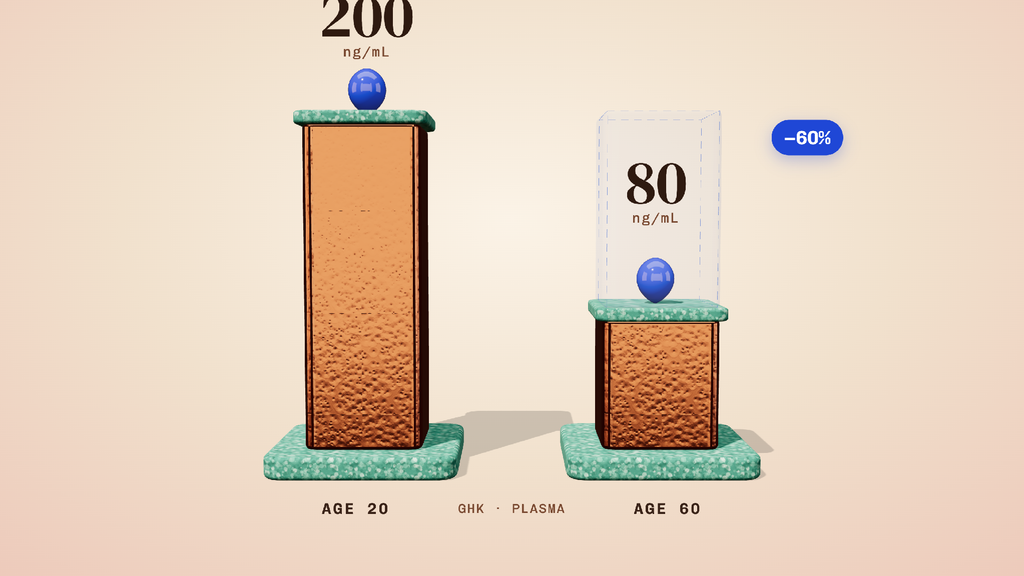
Studies also report that plasma levels fall with age. Pickart’s 2018 review, written with co-author Anna Margolina, records a drop of roughly 60% between the ages of 20 and 60. That figure describes what was measured in plasma samples, and on its own it says nothing about what the decline means.
The copper is what you see first. Copper(II) gives GHK-Cu its deep blue to violet colour, and the peptide holds the ion tightly through nitrogen atoms on its glycine and histidine. Pickart’s group has called that grip on copper(II) “the most distinctive feature of GHK” in a 2015 review.
| Property | Detail |
|---|---|
| Full name | Glycyl-L-histidyl-L-lysine copper(II) |
| Other names | Copper tripeptide-1 (INCI cosmetic ingredient name), prezatide copper, Cu-GHK |
| Sequence | Gly-His-Lys |
| Molecular weight | GHK ~340.4 g/mol · GHK-Cu ~402.9 g/mol |
| CAS number | GHK 49557-75-7 · GHK-Cu 89030-95-5 |
| Appearance | Blue to violet |
| Research form | Lyophilised (freeze-dried) powder; Apexion supplies a pre-filled 50mg research pen |
| Storage | Cold, dry and dark |
Batch details for Apexion’s material are on the GHK-Cu 50mg specification and COA page.
How Does GHK-Cu Work?
The full mechanism hasn’t been mapped yet. Research points to four overlapping routes: carrying copper to copper-dependent enzymes, effects on fibroblasts and the extracellular matrix in cell models, broad changes in gene expression, and antioxidant pathways. Nearly all of it was gathered in cell cultures and lab animals.
Copper Delivery and Enzyme Cofactor Activity
Copper is a working part of several enzymes. The one GHK-Cu research keeps coming back to is lysyl oxidase, the enzyme that ties collagen and elastin fibres together with chemical cross-links. Without copper, it can’t do that job.
In 1980, Pickart’s group proposed that GHK acts by helping cells take up copper. That idea still anchors most mechanism studies, which treat the peptide as a carrier that hands copper to enzymes like lysyl oxidase.
Fibroblast and Extracellular Matrix Research
Fibroblasts are the cells that build the extracellular matrix, the protein scaffolding between cells. In fibroblast cultures, GHK-Cu has been linked to higher output of collagen, elastin and glycosaminoglycans. It’s also linked to decorin, a small proteoglycan that helps collagen fibres line up neatly.
The same body of work records effects on metalloproteinases, the enzymes that break matrix down. So the peptide is studied on both sides of matrix turnover, the building and the clearing.
Gene-Expression Research
The biggest number in GHK research comes from data mining. Pickart’s team turned to the Connectivity Map, a Broad Institute database of gene-activity profiles for more than 1,300 compounds tested on cultured cell lines.
In the 2015 review, they described GHK as capable of “up- and downregulating at least 4,000 human genes.” That count comes from their analysis of expression data. It points to where effects might be, and each listed gene would need separate lab work to confirm what changes. The authors see that as work in progress: “With time, we will be able to analyze the huge amount of data.”
Antioxidant and Anti-Inflammatory Pathways
Loose copper can set off harmful redox chemistry. The 2015 review notes that copper bound to GHK has its redox activity silenced, which is why antioxidant researchers pay attention to it. Cell and animal studies have linked GHK-Cu to lower markers of oxidative stress and to changes in inflammatory signalling molecules in those models.
What Does the Research on GHK-Cu Show?
GHK-Cu has five decades of lab and animal research behind it. Human studies are mostly small topical cosmetic trials. There’s essentially no controlled data on injecting it, which is the gap NPR highlighted in September 2026.
| Research area | Model | Evidence level |
|---|---|---|
| Wound healing and tissue repair | Rat, rabbit, cell culture | Preclinical: many studies |
| Collagen and extracellular matrix | Fibroblast cultures | Preclinical |
| Skin appearance (topical) | Small human cosmetic studies | Limited: short, small trials |
| Hair follicles | Cell studies, small studies | Very limited |
| Gene expression | Computational and cell data | Early-stage |
| Injected GHK-Cu in humans | None | No controlled trials |
The people closest to the molecule expect the list to grow. In their 2018 review, Pickart and Margolina wrote that “new studies are still revealing an even broader scope of GHK’s biological effects.”
Wound-Healing and Tissue-Repair Models
Animal wound models are the oldest strand of the research. Studies in rats, rabbits and pigs have measured how fast wounds close, how many new blood vessels form and what the new tissue is made of. The 2018 review gathers this work and adds connective-tissue models beyond skin.
Dermal and Extracellular Matrix Research
Skin is where GHK-Cu made its name. Lab studies measure collagen content, matrix organisation and fibroblast behaviour in skin-cell cultures. On the human side, a handful of short cosmetic trials have tested topical serums and creams, usually with small groups and often with industry funding.
Emerging Research Areas
Newer work has moved beyond skin. Warren Ladiges’s lab at the University of Washington has studied GHK in ageing mice, including a May 2026 preprint that compared two delivery routes and found each produced its own pattern of gene activity in the hippocampus. Hair-follicle signalling and lung fibroblast studies form smaller strands. All of it is early, and all of it is animal or cell based.
Cosmetic GHK-Cu vs Research-Grade GHK-Cu: What’s the Difference?
It’s the same molecule in two very different products. Serums and creams are cosmetics under the GB Cosmetic Products Regulation, with GHK-Cu listed as copper tripeptide-1 at a low concentration inside a formula. Research-grade GHK-Cu is a high-purity single compound for laboratory work, supplied with a batch-specific COA.
| Cosmetic serum or cream | Research-grade GHK-Cu | |
|---|---|---|
| Regulated as | Cosmetic (GB Cosmetic Products Regulation) | Laboratory research material |
| Form | Ready-made topical formula | Lyophilised powder in a vial, or a pre-filled research pen |
| Concentration | Low, part of a formula | High-purity single compound |
| Paperwork | Ingredients label (INCI) | Batch-specific COA (HPLC, LC-MS) |
| Claims allowed | Cosmetic claims only, no medical claims | No human-use claims at all |
| Where it’s sold | High street, Holland & Barrett, Amazon | Research suppliers |
The cosmetic route comes with its own checks. Government guidance on cosmetics in Great Britain says every product needs a UK-based Responsible Person, a safety assessment by a qualified assessor and a notification to the Office for Product Safety and Standards (OPSS) before sale. Labels and adverts “must not imply they have characteristics or functions which they do not have.”
So if you’ve searched for GHK-Cu at Holland and Barrett, the copper peptide serums you’ll find on the high street belong firmly on the cosmetic side of the table. Research-grade material is made for the bench, and its paperwork shows it: a lot number, a purity percentage from HPLC and a measured mass.
Is GHK-Cu Legal in the UK?
Yes, GHK-Cu is legal in the UK in both of its main forms. Cosmetic products containing it are legal under cosmetics law as long as they make no medical claims, and research-grade GHK-Cu can be bought legally as laboratory material. It isn’t a controlled drug, and it isn’t an MHRA-licensed medicine.
- Cosmetic products: legal under the GB Cosmetic Products Regulation, with no claims to treat or prevent anything
- Research-grade material: lawful to purchase and keep for laboratory work
- Medicines law: GHK-Cu holds no MHRA licence, which rules out marketing it for treating any condition
- Controlled drugs: GHK-Cu doesn’t appear in the schedules of the Misuse of Drugs Act 1971
Our explainer are peptides legal in the UK compares the rules across other compounds. Apexion’s own terms of supply are in our Research Use Only policy.
Is GHK-Cu on the WADA Prohibited List?
GHK-Cu isn’t named on WADA’s 2026 Prohibited List. It isn’t named on the 2027 list either, which WADA approved on 10 September 2026.
The 2027 wording still tightens things. From 1 January 2027, the S0 class for non-approved substances lists “peptides” among its examples, and WADA’s explanatory note says a peptide can be prohibited without a named entry. GHK-Cu has no approval as a medicine from the MHRA, the EMA or the US FDA, so S0 can apply to it.
Is GHK-Cu Safe?
Topical cosmetic use at low concentrations has a long history, and every GB cosmetic needs a safety assessment before sale. For injected or high-concentration use, published human safety data is close to nonexistent, which is the gap NPR’s September report focused on.
Three questions remain open:
- Copper load: every GHK-Cu molecule carries a copper ion, so copper adds up at high exposure, and those limits haven’t been studied in controlled trials
- Long-term exposure: no long-term controlled studies exist outside topical cosmetic use
- Contamination: untested products can carry impurities, or contain something other than GHK-Cu, and only batch testing shows which
Regulators have started looking at the evidence. NPR reported that a US FDA advisory panel planned to review injectable GHK-Cu, among other peptides, in February 2027.
GHK-Cu vs Other Copper Peptides
GHK-Cu is the reference copper peptide. It has the longest research record, and newer copper peptides are usually measured against it. Relatives such as AHK-Cu change a single amino acid, while “copper peptides” on a cosmetic label can mean GHK-Cu alone or a mix of several.
- GHK-Cu (Gly-His-Lys + Cu): naturally occurring, first found in plasma, backed by the largest number of papers
- AHK-Cu (Ala-His-Lys + Cu): a synthetic cousin that swaps glycine for alanine, studied mainly in hair-follicle cell models
- Copper tripeptide-1: the INCI label name for GHK-Cu inside cosmetic formulas
- Research blends: KLOW and GLOW both use GHK-Cu as their largest ingredient, with BPC-157 and TB-500 alongside it. KLOW also contains the tripeptide KPV
GHK vs GHK-Cu: What’s the Difference?
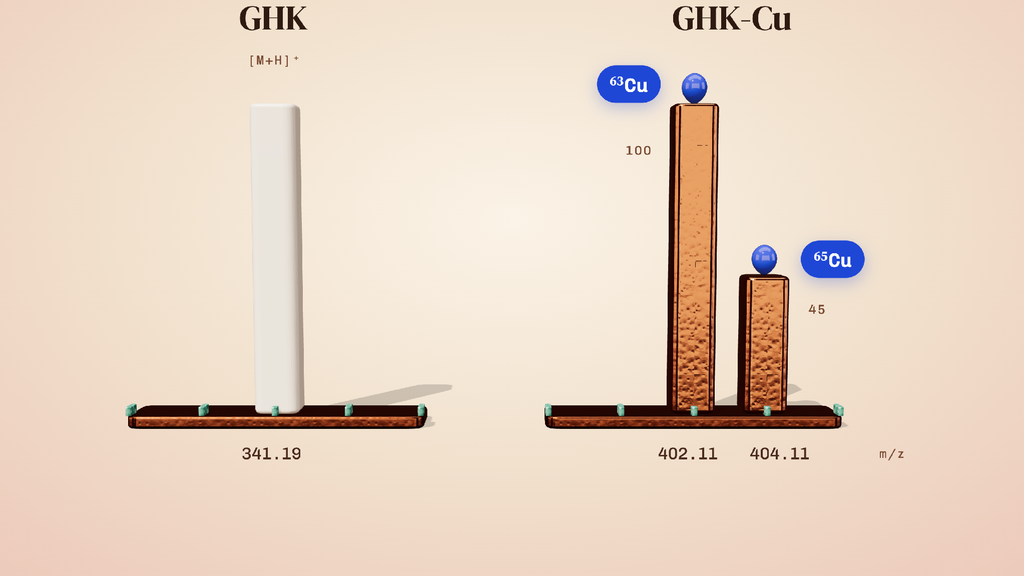
Take the copper away and you’re left with GHK, the bare tripeptide, which is a white powder. Add copper(II) and it becomes GHK-Cu, and the colour turns blue. On LC-MS the two read at different masses, about 340 for GHK and about 403 for GHK-Cu, so a COA should state which form it measured.
A report that shows only the free-peptide mass on a GHK-Cu product leaves the copper unconfirmed. A copper content figure, or the blue colour of the material, closes that gap.
How to Verify Research-Grade GHK-Cu
The batch-specific COA comes first. Check that its lot number matches the product, that purity by HPLC appears alongside the method used, and that the LC-MS result names whether GHK or GHK-Cu was measured. Then confirm who ran the test, when, and that the material shows the expected blue colour.
- ☐ COA lot number and product label match
- ☐ HPLC purity is given, with the method stated
- ☐ LC-MS mass is given, with the form named (GHK ~340.4 g/mol, GHK-Cu ~402.9 g/mol)
- ☐ Copper content is reported, where the lab measures it
- ☐ The report names the lab that ran it and the date
- ☐ The material is blue to violet
The walkthrough on how to read a peptide COA explains each line of a certificate, and the steps to verify a research peptide batch apply to any compound. Each Apexion pen carries a batch number and QR code that lead to its COA, explained step by step on Apexion batch verification.
How Should GHK-Cu Be Stored?
Lyophilised GHK-Cu keeps best in a sealed container somewhere cold, dark and dry. Moisture and light are the two main threats, and copper-bound peptides can oxidise more readily once in solution. Apexion’s pens follow the same logic: keep them cool and out of warm spots and bright light, with −20 °C for long-term storage. More handling notes for every format are on the peptide storage and handling page.
Frequently Asked Questions
GHK-Cu holds copper(II) tightly, and research looks at it as a carrier that passes copper to enzymes like lysyl oxidase. In fibroblast cultures it’s tied to collagen, elastin and decorin output, and Connectivity Map analyses tie it to thousands of gene-activity changes. Nearly all of this work uses cultured cells or animals.
Yes. Cosmetic products containing GHK-Cu, listed as copper tripeptide-1, are legal under the GB Cosmetic Products Regulation if they make no medical claims. Research-grade GHK-Cu can be bought legally as laboratory material. GHK-Cu isn’t a controlled drug or an MHRA-licensed medicine, so nobody can sell it for treating anything.
It’s the same molecule in a different product. A serum is a finished cosmetic with GHK-Cu at a low level among many ingredients, sold under cosmetics law. Research-grade GHK-Cu is a high-purity single compound with a batch COA, made for laboratory work. The two follow different rules and serve different users.
Topical cosmetic use at low concentrations has a long track record, and every GB cosmetic needs a safety assessment. For injected or high-concentration use, there are no controlled human safety studies. Copper load, long-term exposure and contamination in untested products remain open questions, which is why batch testing comes first for any research material.
The colour comes from the bound copper(II) ion. Copper(II) compounds absorb orange and red wavelengths, which leaves blue and violet for the eye to pick up. GHK on its own, with no copper attached, is white. That makes colour a quick first sign that the copper is in place.
Yes. GHK-Cu is the largest component of both blends, at 50mg each. GLOW (70mg) pairs it with 10mg each of BPC-157 and TB-500. KLOW (80mg) has the same trio with 10mg of KPV added. Our KLOW vs GLOW guide sets both blends out in one table.
The Bottom Line
GHK-Cu is one of the best-studied copper peptides, backed by five decades of cell and animal work plus a small set of topical human trials. Cosmetic serums and research-grade material share a molecule and little else. They follow different UK rules and carry different paperwork, so batch-verified material is the place to start for lab work.
Apexion supplies GHK-Cu on its own as a 50mg research pen (see the GHK-Cu 50mg specification and COA). It’s also the largest ingredient in two blends, covered on the GLOW 70mg specification and COA and KLOW 80mg specification and COA pages. Read KLOW vs GLOW for the differences between them, and peptide stacks explained for how multi-peptide blends are put together.
All Apexion products are supplied for laboratory research use only and are not for human or veterinary use. This is general information, not medical or legal advice.
Sources
- Pickart L, Thaler MM. Nature New Biology, 1973; 243: 85-87 (original GHK paper).
- Pickart L, Vasquez-Soltero JM, Margolina A. BioMed Research International, 2015; 648108. PMID 26236730.
- Pickart L, Margolina A. International Journal of Molecular Sciences, 2018; 19(7): 1987. PMID 29986520.
- Dou Y, Lee A, Zhu L, Morton J, Ladiges W. Aging Pathobiology and Therapeutics, 2020; 2(1): 58-61. PMID 35083444.
- Mazzola J et al. Research Square preprint, May 2026. PMID 42245779.
- NPR, 7 September 2026.
- GOV.UK. Making cosmetic products available to consumers in Great Britain.
- WADA. 2027 Prohibited List and Explanatory Note (September 2026).
- PubChem CIDs 73587 (GHK) and 71587328 (GHK-Cu).