
5-Amino-1MQ: Research Overview and UK Legal Status (2026)
Reviewed by Oscar Reyes, PhD, Synthesis Lead at Apexion BioLabs · Scientific review of the chemistry and analytical content
Quick answer
What is 5-Amino-1MQ?
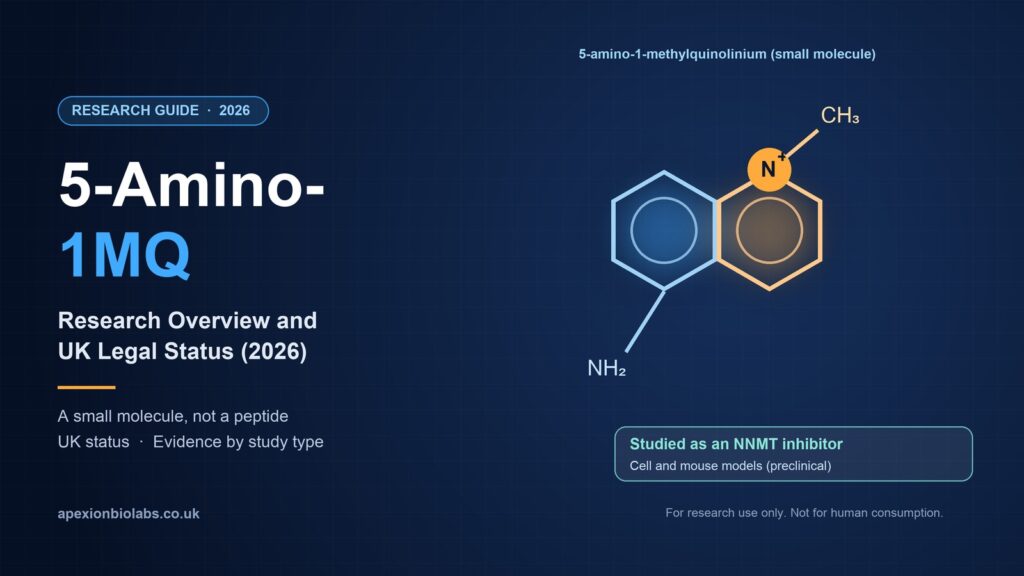
5-Amino-1MQ (5-amino-1-methylquinolinium) is a small synthetic molecule that blocks an enzyme called NNMT. Researchers have studied it in cell cultures and in mice, mainly for fat-cell metabolism and muscle ageing. It has never been tested in a registered human trial, and it remains unapproved everywhere.
- A quinolinium compound, built without any amino acids
- Every published finding comes from cell or animal work
- UK: uncontrolled, unlicensed and supplied for research only
Half a dozen papers make up most of the published record on 5-Amino-1MQ, and nearly all of them come from one lab in Galveston, Texas. For a compound with this much online attention, that’s a strikingly short reading list.
What the papers lack in number, they make up for in focus. They all chase one enzyme, NNMT, which operates where NAD+ recycling meets the cell’s methylation machinery. We’ll follow that enzyme from the chemistry to the mouse data, tag every result with its model (enzyme assay, cell culture or mouse) and finish with UK law as it stood in October 2026.
5-Amino-1MQ from Apexion is a laboratory research material, unsuitable for human or veterinary use. Nothing here counts as medical advice; read the Research Use Only notice for every condition of supply.
What Is 5-Amino-1MQ?
5-Amino-1MQ is a quinolinium compound: a pair of fused aromatic rings with a methyl attached to the ring’s nitrogen atom and an -NH2 group at carbon 5. That nitrogen holds a fixed positive charge, yet the molecule still passes through cell membranes. Charged molecules rarely manage that, which is why it’s popular for cell experiments.
The name spells out the structure. “1MQ” is 1-methylquinolinium, the parent scaffold, and “5-amino” marks the added amine. That one change made the difference in the lab: in the 2018 permeability tests, the parent 1-MQ and the NNMT product 1-MNA showed no passive movement across an artificial membrane, while 5-Amino-1MQ crossed readily.
It came out of a University of Texas Medical Branch programme led by Stanley Watowich. Harshini Neelakantan and colleagues first described the methylquinolinium series in a 2017 structure-activity study in the Journal of Medicinal Chemistry. The team’s 2018 Biochemical Pharmacology paper then reported that amine-substituted versions crossed membranes well in two lab models and inhibited NNMT selectively.
PubChem (CID 950107) supplies the identifiers below:
| Field | Detail |
|---|---|
| Name | 5-amino-1-methylquinolinium (5-Amino-1MQ) |
| Type | Quinolinium small molecule |
| Cation | C10H11N2+ · ~159.2 g/mol |
| Common salt | Iodide, C10H11IN2 · ~286.1 g/mol |
| CAS | 685079-15-6 (cation) · 42464-96-0 (iodide) |
| Apexion format | 5-Amino-1MQ 50mg, a pre-filled 50mg research pen, made to order in the UK and prepared for laboratory handling |
| UK status | Research material; not controlled, no medicine licence |
Is 5-Amino-1MQ a Peptide?
No. Every peptide is made of amino-acid residues held together by peptide bonds, and 5-Amino-1MQ contains neither. It’s one rigid ring system weighing about 159 g/mol as the cation.
Peptide shops in the UK list it because the metabolism labs that buy mitochondrial peptides order it too. The contrast with MOTS-c, a real peptide, is stark:
| Feature | 5-Amino-1MQ | MOTS-c |
|---|---|---|
| Chemical class | Small molecule | Peptide |
| Structure | Fused quinoline rings | 16-residue amino-acid chain |
| Mass | ~159 g/mol (cation) | ~2,175 g/mol |
| Made by | Organic synthesis | Solid-phase peptide synthesis |
| Target studied | The enzyme NNMT | AMPK signalling |
Our MOTS-c Peptide UK overview covers the peptide side.
How Does 5-Amino-1MQ Work? The NNMT Pathway
NNMT (nicotinamide N-methyltransferase) takes a methyl group from SAM (S-adenosylmethionine, the chief methyl donor in cells) and attaches it to nicotinamide. The product, 1-methylnicotinamide (1-MNA), leaves the cell’s recycling loop. 5-Amino-1MQ blocks NNMT, so in lab models more nicotinamide and SAM stay available.
That single reaction connects two busy systems: NAD+ recycling and cellular methylation. Here’s how the research chain fits together, and the model tested at each step:
- NNMT rises in obese mice (mouse, gene knockdown). Kraus and colleagues (2014) in Nature reported higher NNMT in fat and liver tissue of obese mice. Reducing NNMT with antisense knockdown raised energy expenditure. This study used no 5-Amino-1MQ.
- Blocking NNMT spares nicotinamide (biochemistry). With the methylation route closed, nicotinamide can return to the salvage pathway that rebuilds NAD+.
- NAD+ and SAM rise in treated fat cells (in vitro). In cultured adipocytes, the 2018 Neelakantan study found that the inhibitors lowered 1-MNA, raised intracellular NAD+ and SAM, and suppressed lipogenesis (fat building).
- Links to SIRT1 and energy use (mouse). Kraus’s team described NNMT as a regulator of NAD+-dependent SIRT1 signalling, and their knockdown mice burned more energy.
On selectivity, the 2018 paper reported that the methylquinolinium compounds didn’t inhibit related SAM-dependent methyltransferases or enzymes of the NAD+ salvage pathway in enzyme assays. In those assays, 5-Amino-1MQ blocked NNMT at around 1 µM (its IC50, the concentration that halves enzyme activity). The team suggested the quinolinium ring docks in NNMT’s nicotinamide-binding pocket, which would explain why enzymes built around the SAM site were left alone.
Is 5-Amino-1MQ the Same as NAD+?
No. NAD+ is a natural coenzyme present in all cells, while 5-Amino-1MQ is a synthetic enzyme inhibitor. The link is indirect: by blocking NNMT, 5-Amino-1MQ affects how much nicotinamide cells can recycle into NAD+. Inside the cell, nicotinamide reaches a fork. NAMPT can send it back into the salvage pathway towards NMN and then NAD+, or NNMT can methylate it into 1-MNA, which cells excrete. Closing the NNMT branch leaves more nicotinamide for the NAMPT branch, which matches the higher NAD+ seen in treated fat cells. Our MOTS-c vs SS-31 vs NAD+ comparison covers NAD+ in more detail.
What Is 5-Amino-1MQ Studied For?
Work on 5-Amino-1MQ and its target clusters into four areas, and only the first three involve the compound itself:
- Fat-cell metabolism (in vitro). Studies in 3T3-L1 adipocytes, a standard mouse fat-cell line, measure 1-MNA, NAD+, SAM and lipogenesis after NNMT inhibition.
- Diet-induced obesity (mouse). Mice kept on a high-fat diet are used to track body composition, fat tissue and blood lipids during treatment.
- Muscle stem-cell ageing (aged mice). A 2019 study by Neelakantan and colleagues gave an NNMT inhibitor to 24-month-old mice after a controlled muscle injury and measured muscle stem-cell activity and fibre regrowth. Treated mice showed more stem-cell division and fusion, larger regrowing fibres and stronger muscle contraction than controls. The same paper repeated parts of the work in C2C12 muscle cells.
- NNMT in cancer and heart research (reviews, context only). A 2013 Nature Chemical Biology study by Ulanovskaya and colleagues described NNMT as a “metabolic methylation sink” in cancer cells. A 2025 Biomolecules review examined NNMT in cardiovascular research. Neither tested 5-Amino-1MQ.
5-Amino-1MQ in Obesity Research: What Mouse Studies Show
Three mouse studies from the same research group carry this topic. Each measured body composition, tissue weights and blood markers in mice kept on controlled diets, so the readouts are physical measurements taken in animals:
- Neelakantan 2018: diet-induced obese mice given an NNMT inhibitor showed lower body weight and white fat mass, smaller fat cells and lower plasma cholesterol than untreated controls. Food intake didn’t change.
- Sampson 2021 in Scientific Reports: obese mice switched to a lean diet were compared with and without NNMT inhibition, and the combined group reached a body composition close to that of lean-diet control mice.
- Babula 2024 in Diabetes, Obesity and Metabolism: a 28-day study in diet-induced obese mice tracked body composition, liver tissue and blood markers. The team also mapped how the compound spread through mouse plasma and tissues.
All three are mouse studies. No human data exist for any of these measures.
What Does the Research on 5-Amino-1MQ Actually Show?
The published evidence is a small set of enzyme, cell and mouse studies, almost all from one University of Texas research group. Those studies consistently report NNMT inhibition and metabolic changes in mice. No study has given 5-Amino-1MQ to people, so its effects in humans are unknown.
| Study | Year | Model | What was measured | Evidence level |
|---|---|---|---|---|
| Kraus et al. | 2014 | Mice (NNMT knockdown) | NNMT levels, energy expenditure, SAM and NAD+ | Animal; no 5-Amino-1MQ |
| Neelakantan et al. | 2017 | Enzyme assays | Potency across quinolinium analogues | Biochemical |
| Neelakantan et al. | 2018 | Membrane models, adipocytes, obese mice | Permeability, selectivity, metabolites, body composition | In vitro + animal |
| Neelakantan et al. | 2019 | Aged mice, C2C12 cells | Muscle stem-cell activity, fibre size, contractile force | Animal + in vitro |
| Sampson et al. | 2021 | Obese mice on a lean diet | Body composition, liver fat, fat-tissue metabolites | Animal |
| Babula et al. | 2024 | Obese mice | Body composition, glucose handling, liver tissue, tissue distribution | Animal |
Three things limit how far mouse results travel:
- Metabolic rate. Mice burn energy many times faster per gram of body weight than humans do, which changes how metabolic interventions play out.
- Diet models. Diet-induced obesity in young mice develops over weeks and differs from human weight gain over years.
- Exposure. Mouse pharmacokinetics can’t predict how the compound would behave in people, and no human pharmacokinetic study exists.
Replication is the other open question. Five of the six studies above share senior authors, and the 2021 paper discloses that Watowich founded Ridgeline Therapeutics, where Neelakantan works. Independent labs haven’t yet published matching 5-Amino-1MQ results, which is normal for a young compound and is the next step the field needs.
Has 5-Amino-1MQ Been Tested in Humans?
No. A ClinicalTrials.gov search for “5-amino-1MQ”, “5-amino-1-methylquinolinium” and “NNMT inhibitor” returned no registered studies as of our 17 October 2026 search. That means there’s no human safety, tolerability or pharmacokinetic data for the compound.
That absence covers the basics researchers would want first: how the compound is absorbed, how long it stays in circulation, how it’s broken down and cleared, and whether it interacts with other substances. The only distribution data so far come from the 2024 mouse study, which tracked the compound in mouse plasma, fat, muscle and liver. Those figures describe mice and can’t be scaled to people.
For context, cancer-biology reviews flag NNMT’s role in some tumour cells as an open research question, since the enzyme reshapes methylation in those cells. That work concerns the enzyme itself and doesn’t involve 5-Amino-1MQ.
The compound holds no approval from the MHRA, the US FDA or the European Medicines Agency.
Is 5-Amino-1MQ Legal in the UK?
Yes, so long as it’s sold and held as lab research material. As of October 2026, 5-Amino-1MQ is absent from controlled-drug schedules, it has never held a UK medicine licence, and no seller may present it for human use. Its status rests on three pieces of law and one MHRA guidance note.
| Law or guidance | What it covers | Position for 5-Amino-1MQ |
|---|---|---|
| Human Medicines Regulations 2012 | Licensing and supply of medicines | No marketing authorisation; can’t be marketed as medicinal |
| MHRA Guidance Note 8 (August 2026) | When a product is classed as a medicine | Claims made for a product can make it medicinal by “presentation” |
| Misuse of Drugs Act 1971 | Controlled drugs | Not listed |
| Psychoactive Substances Act 2016 | Substances that act on the central nervous system | No published work describes it as psychoactive |
No UK law names 5-Amino-1MQ directly. Its status rests on the lists it’s absent from and on how it’s offered for sale. Guidance Note 8 is the reason research suppliers stick to identity, purity and storage details in their listings: a seller that adds health claims risks turning the same compound into an unlicensed medicine in law. The rules across research compounds are set out in Are Peptides Legal in the UK?
Can You Buy 5-Amino-1MQ in the UK?
Yes. UK research suppliers sell it under research-use-only conditions. It isn’t stocked by pharmacies, and there’s no prescription route, because no licensed product contains it. Capsules or other formats marketed for consumption fall outside research supply. Our Research Use Only notice explains the conditions of sale.
Is 5-Amino-1MQ FDA Approved?
No. Neither the FDA (US), the MHRA (UK) nor the EMA (EU) has approved 5-Amino-1MQ. No approved medicine anywhere contains it, and no company has registered a human trial.
Is 5-Amino-1MQ Banned in Sport?
5-Amino-1MQ isn’t named on the WADA Prohibited List. The list’s S0 section, “Non-Approved Substances”, covers any pharmacological substance not addressed elsewhere on the list that no national health regulator has cleared for therapeutic use in humans. Such substances are banned in and out of competition. The list is applied in the UK by UK Anti-Doping.
How to Verify Research-Grade 5-Amino-1MQ
The COA (certificate of analysis) for a batch ought to confirm identity, purity and the exact salt form of the lot in hand. Salt form deserves special attention with this compound, because it changes both the molecular weight and how much active cation each milligram holds.
| What to check | Why |
|---|---|
| Lot number | Ties the report to the item received |
| HPLC purity, with method | Shows the share of the main compound |
| MS identity near 159.2 | Confirms the cation; the counter-ion separates in the spectrometer |
| ¹H-NMR (ideal) | Confirms the ring structure and methyl position |
| Salt form stated | Iodide or chloride changes the weight per mole |
| Independent lab and date | Lets you trace and verify the result |
Mass spectrometry for this compound is simpler than for a peptide. Run in positive mode, the cation appears as one main signal near m/z 159.09 with no added proton, and the iodide doesn’t show up in that spectrum at all. NMR adds a second check, because the N-methyl group and the ring protons give a distinctive pattern that a mislabelled quinoline wouldn’t match.
Walk away from any listing that shows dosing charts, fat-loss claims or capsules marketed for consumption. The same goes for a certificate with no lot number, or one that gives this non-peptide an amino-acid “sequence”.
Batches from Apexion are tracked, with purity typically ≥98% by HPLC, and results for this compound go up on its product page as soon as they’re verified. To check a lot yourself, use the batch verification guide, the quality assurance page or the Quality and Batch Verification hub. For format differences, see Peptide Pen vs Vial.
How Should 5-Amino-1MQ Be Stored?
As a solid, 5-Amino-1MQ keeps best cool, dry and dark, with −20 °C for long-term holding. Sigma-Aldrich’s iodide product sheet gives −20 °C and describes the powder as faint red to dark brown, so colour on its own isn’t a sign of a problem. Aromatic amines can darken with light and air over time, which is why dark, sealed storage is the default. Pens should be refrigerated and handled according to the batch sheet. Cold-chain basics are in our research storage and handling guide.
Frequently Asked Questions
No. 5-Amino-1MQ is a quinolinium small molecule built from fused aromatic rings, with no amino acids or peptide bonds. Peptide shops in the UK carry it since metabolism labs buy it alongside peptides like MOTS-c.
No. NAD+ is a natural coenzyme found in every cell. 5-Amino-1MQ is a synthetic inhibitor of the enzyme NNMT. In lab models, blocking NNMT leaves more nicotinamide available for recycling into NAD+, and that’s where the connection ends.
NNMT (nicotinamide N-methyltransferase) transfers a methyl from SAM to nicotinamide, which yields 1-methylnicotinamide (1-MNA). The reaction pulls nicotinamide out of NAD+ recycling and spends SAM, the universal methyl supplier in cells, which ties NNMT to both energy metabolism and methylation.
No. As of 17 October 2026, ClinicalTrials.gov lists no human study of 5-Amino-1MQ. All published data come from enzyme assays, cultured cells and mice, so there is no human safety or pharmacokinetic information.
Yes, as a laboratory research material from UK research suppliers, sold on research-use-only terms. It’s uncontrolled, lacks a medicine licence, and can’t legally be supplied for use in people. Pharmacies don’t stock it, and no prescription route exists.
5-Amino-1MQ is a cation, so it’s always supplied with a counter-ion, usually iodide. The iodide salt weighs about 286 g/mol against about 159 g/mol for the cation alone, so 1 mg of the salt holds roughly 56% cation. Concentration calculations depend on which form the certificate uses.
The Bottom Line
5-Amino-1MQ is a membrane-permeable quinolinium molecule that inhibits NNMT. Its evidence base is a tight cluster of enzyme, cell and mouse studies, mostly from one group, and it has never been tested in a registered human trial. In the UK it’s lawful to hold as a research material, uncontrolled and unlicensed.
Researchers can review the 5-Amino-1MQ 50mg specification and batch documentation before ordering.
For laboratory research use only. Not for human or veterinary use. Apexion Biolabs sells 5-Amino-1MQ solely for bench and analytical studies. This overview is educational, offers no medical advice and includes no dosing or administration information. Conditions of sale are in the Research Use Only notice.
Sources
- Neelakantan H et al. (2017). Structure-activity relationship for small molecule inhibitors of nicotinamide N-methyltransferase. Journal of Medicinal Chemistry.
- Neelakantan H et al. (2018). Selective and membrane-permeable small molecule inhibitors of NNMT. Biochemical Pharmacology.
- Neelakantan H et al. (2019). Biochemical Pharmacology, NNMT inhibitor and aged muscle stem cells in mice.
- Sampson CM et al. (2021). Scientific Reports, NNMT inhibition with a reduced-calorie diet in mice.
- Babula et al. (2024). Diabetes, Obesity and Metabolism, NNMT inhibition in diet-induced obese mice.
- Kraus D et al. (2014). Nicotinamide N-methyltransferase knockdown in mice. Nature.
- Ulanovskaya OA et al. (2013). NNMT and the metabolic methylation sink. Nature Chemical Biology.
- Liu JR et al. (2021). Review of NNMT in metabolic research. BioMed Research International (PMC8337113).
- Jawaria et al. (2025). Review of NNMT in cardiovascular research. Biomolecules (PMC12467181).
- PubChem: 5-Amino-1-methylquinolinium, CID 950107.
- ClinicalTrials.gov search, “5-amino-1MQ” (checked 17 October 2026).
- Human Medicines Regulations 2012.
- MHRA Guidance Note 8 (August 2026).
- Misuse of Drugs Act 1971.
- Psychoactive Substances Act 2016.
- World Anti-Doping Agency: 2026 Prohibited List.
- UK Anti-Doping.