
Is MOTS-c Legal in the UK? What the MOTS-c Peptide Is and What Research Shows
Reviewed by Oscar Reyes, PhD, Synthesis Lead at Apexion BioLabs · Scientific review of the chemistry and analytical content
Quick answer
Is MOTS-c legal in the UK?
- Legal in the UK? Yes, as a research material. MOTS-c isn’t listed under the Misuse of Drugs Act 1971, the Psychoactive Substances Act 2016 doesn’t reach it, and it isn’t a licensed medicine. It’s sold as research-use-only lab material.
- Sport: WADA bans it at all times under S4.4.1, the AMPK activator group of the 2026 list.
- What it is: A 16-amino-acid peptide coded in mitochondrial DNA (the MT-RNR1 gene), first described in 2015.
- Evidence: Mostly cell and mouse studies. Human data is observational, plus one analogue programme (CB4211) that has since been discontinued.
Almost every protein in a cell is built from instructions in the nucleus. MOTS-c is one of the odd ones out: it’s a short peptide coded by the tiny ring of DNA inside the mitochondria, the cell’s energy units. That’s why researchers have watched it so closely since a Los Angeles team described it in 2015.
So, is MOTS-c legal in the UK? For lab research, yes. It’s not a controlled drug, and it’s not an approved medicine either, and UK law treats those as two separate questions. This guide takes the law first, row by row with the source for each, then moves on to the science: what MOTS-c is, how studies say it works, and how much of the evidence comes from people.
Apexion supplies MOTS-c for laboratory research use only, under its research use notice, and not for human or veterinary use.
What Is MOTS-c Peptide?
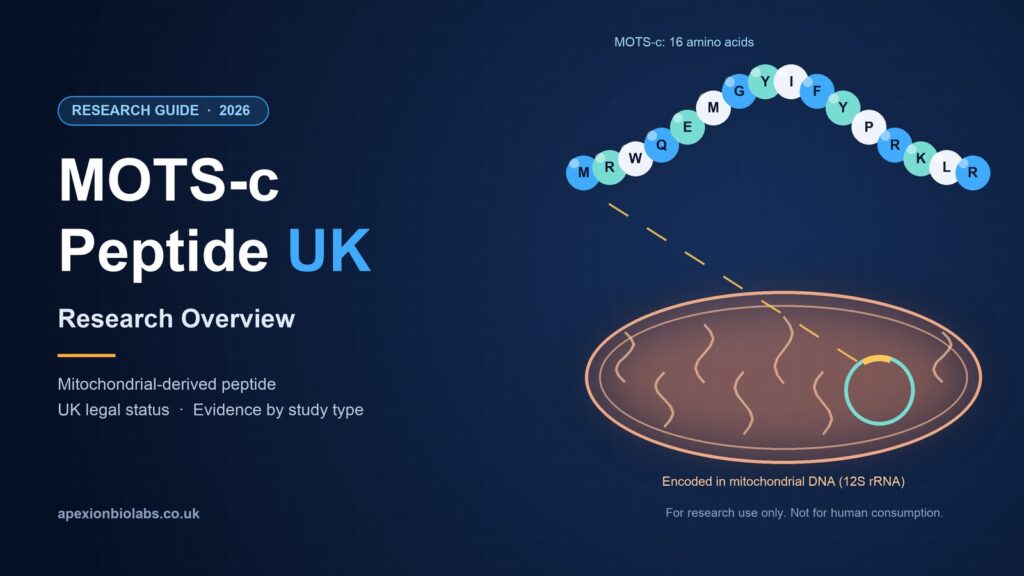
MOTS-c stands for “mitochondrial ORF of the 12S rRNA type-c”, where ORF is a stretch of DNA that codes for a protein. In plain terms, it’s a 16-amino-acid peptide whose code hides inside a mitochondrial gene that mainly makes ribosomal RNA. You’ll also see it written as “MOTC” or “MOTS c” in searches; they all mean the same molecule.
| Spec | Detail |
|---|---|
| Full name | Mitochondrial ORF of the 12S rRNA type-c |
| Length | 16 amino acids |
| Sequence | MRWQEMGYIFYPRKLR (PubChem CID 146675088) |
| Gene | MT-RNR1 (mitochondrial 12S rRNA) |
| First described | Lee et al., Cell Metabolism, 2015 |
| Class | Mitochondrial-derived peptide |
| Molecular weight | About 2,174.6 g/mol |
Lee and colleagues found the short coding stretch, made the peptide, and showed it turns up in mouse tissues and human blood. The cells and mice in that paper are where nearly all later MOTS-c work began.
Mitochondrial-Derived Peptides: MOTS-c, Humanin and SHLPs
MOTS-c belongs to a small family called mitochondrial-derived peptides. Humanin was the first, found in 2001, and the six small humanin-like peptides (SHLP1 to SHLP6) followed. All of them are coded in the same stretch of mitochondrial DNA. They act as signals the mitochondria send out to the rest of the cell and body, according to a 2020 review by Merry and colleagues, and MOTS-c is the most studied of them for metabolism.
Is MOTS-c Legal in the UK?
Yes, MOTS-c is legal to buy and possess in the UK as a research material. UK law has three separate routes that could catch a substance like this, and it doesn’t fall foul of any of them as long as it’s sold for lab work with no medicinal claims. A fourth set of rules, anti-doping, applies only to athletes.
Here’s each route, with the law behind it:
| Route | UK status | Law | Source | Checked |
|---|---|---|---|---|
| Drug control | Not listed | Misuse of Drugs Act 1971 | legislation.gov.uk, Schedule 2 | 15 Nov 2026 |
| Psychoactive substances | Not covered | Psychoactive Substances Act 2016 | legislation.gov.uk | 15 Nov 2026 |
| As a medicine | Not licensed by the MHRA; can’t be sold with medicinal claims | Human Medicines Regulations 2012 | legislation.gov.uk; MHRA GN8 | 15 Nov 2026 |
| Research material | Sold as research use only, Research Use Only | General product and medicines law | No single law | 15 Nov 2026 |
| Sport | Prohibited at all times | WADA Prohibited List / UKAD | wada-ama.org | 15 Nov 2026 |
The Psychoactive Substances Act only covers things that act on the brain to change mental state. MOTS-c is a metabolic peptide, and the Alzheimer’s Drug Discovery Foundation’s 2025 report on it notes that it doesn’t cross the blood-brain barrier, so the Act doesn’t apply. Most research peptides go through the same three checks, so the answer to whether peptides are legal in the UK usually matches the answer for MOTS-c.
Is MOTS-c a Controlled Substance in the UK?
No. MOTS-c doesn’t appear in any class or schedule of the Misuse of Drugs Act 1971, so possessing it isn’t a drug offence. That’s where a lot of confusion starts, though. “Not controlled” only means the police drug laws don’t cover it. It doesn’t mean anyone has checked it for safety or approved it for any use. Those questions belong to medicines law, which is the next layer down.
Is MOTS-c a Licensed Medicine? Can It Be Prescribed?
No. There’s no MHRA marketing authorisation for MOTS-c or any product containing it, and you can confirm that yourself on the MHRA products database. Under the Human Medicines Regulations 2012, anything sold with a claim that it treats, prevents or changes a body function counts as a medicine, and an unlicensed one can’t be sold that way. The MHRA’s GN8 guidance on borderline products explains how it decides which side of that line a product falls on. With no licence, there’s no approved product a UK doctor could prescribe.
Can You Buy MOTS-c in the UK?
Yes, as research-use-only (RUO) material for laboratories. An RUO label means the seller supplies it for in-vitro and lab study, makes no health claims, and doesn’t sell it for anyone to take. Suppliers selling this way stay outside medicines law because they aren’t presenting a medicine. That label is also a promise about what the seller won’t say, so any site pairing “research use only” with dosing advice or results is breaking the very terms that keep it legal.
The MHRA and UK Peptide Clinics in 2026
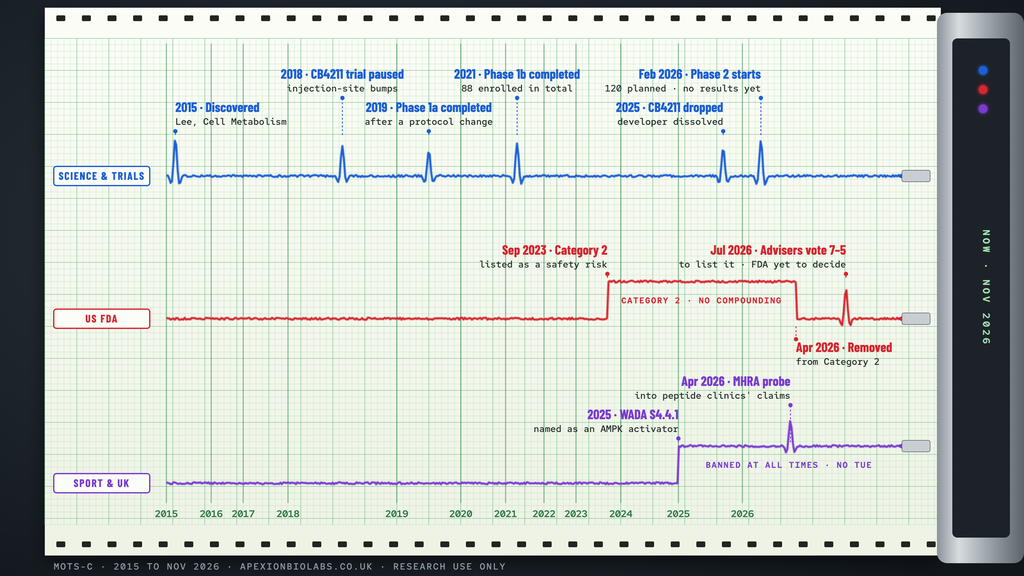
On 4 April 2026, The Guardian reported that the MHRA would investigate UK clinics offering unregulated peptide therapies over potentially unlawful health claims. The paper said the MHRA confirmed one clinic’s website was making medicinal claims, and that the claims were removed after the Guardian contacted it. The report is about clinics making health claims to the public. It doesn’t change the status of research supply.
Is MOTS-c Approved Anywhere?
No regulator has approved MOTS-c as a medicine. In the US, it isn’t FDA-approved and isn’t on the 503A list of substances pharmacies may compound. On 23 July 2026, the FDA’s Pharmacy Compounding Advisory Committee voted 7 to 5 to recommend adding it, against FDA staff advice, but the agency hasn’t made a final decision (FDA meeting page).
Is MOTS-c Banned in Sport?
Yes. The 2026 WADA Prohibited List names MOTS-c under S4.4.1, “activators of the AMP-activated protein kinase (AMPK)”, part of the hormone and metabolic modulators class. Everything in that class is prohibited at all times, in and out of competition. WADA first named MOTS-c there as an example in the 2025 list.
You might see “S4.1” or “S0” in AI summaries. Those come from sources that number the list differently or predate the 2025 update; USADA gives the same S4.4.1 reference as the list itself. In the UK, UK Anti-Doping applies the WADA list.
How Does MOTS-c Work?
Researchers have mapped a few routes, and each comes from a specific kind of study. Keep that in mind as you read, because a result in a dish isn’t the same as a result in a person.
AMPK and the folate cycle (cell and mouse studies). In the 2015 Lee paper, studies report that MOTS-c slowed the folate cycle inside cells. That caused a build-up of a molecule called AICAR, which switched on AMPK, an enzyme that acts as the cell’s fuel gauge. When AMPK is on, cells take up more glucose and burn more fat for energy. In mice on a high-fat diet, MOTS-c treatment was linked to better insulin response in muscle.
Moving into the nucleus (cell studies). A 2018 study by Kim and colleagues found that when cells were put under metabolic stress, such as glucose shortage, MOTS-c travelled from the mitochondria into the nucleus. There, it was linked with changes in genes that help cells cope with stress. This was surprising: it showed mitochondria can send a coded message straight to the cell’s main genome.
Natural levels in people (observational). The human body makes its own MOTS-c. The 2021 Reynolds study found that blood and muscle levels rose in healthy young men after exercise. A 2020 study of ageing men found muscle levels were higher in older men than younger ones, which the authors linked to changes in muscle fibre type. These studies measured natural MOTS-c; nobody was given any.
So when you read “MOTS-c activates AMPK”, the accurate version is: studies in cells and mice report that it does.
What Has MOTS-c Been Studied For?
This is where the research has gone so far, and at what level:
| Research area | In vitro | Animal | Human | Citation |
|---|---|---|---|---|
| Insulin sensitivity/glucose | Yes | Yes (high-fat-diet mice) | Observational | Lee 2015 |
| Physical capacity in ageing | No | Yes (aged mice) | Observational | Reynolds 2021 |
| Bone and muscle metabolism | Yes | Yes | No | Yi 2023 review |
| Inflammation/cell stress | Yes | Yes | No | Li 2025 |
| Levels in disease groups | No | No | Observational | Ozkaya 2025 |
Insulin and glucose is the original thread. In Lee’s mice, MOTS-c was linked to better glucose handling on a high-fat diet, mostly through skeletal muscle.
Ageing and physical capacity came next. In the Reynolds work, aged mice given MOTS-c late in life did better on treadmill and grip tests than untreated aged mice. The Alzheimer’s Drug Discovery Foundation states it plainly in its 2025 MOTS-c report: “MOTS-c rejuvenates aging phenotypes in muscle in mice.”
Bone studies are mostly cell and rodent work on bone-forming cells, pulled together in a 2023 review by Yi and colleagues in Frontiers in Physiology.
Inflammation and cell stress papers cover several tissues. One 2025 mouse study in Redox Biology looked at lung injury after blood flow was cut off and restored, and linked MOTS-c to protective stress-response genes.
Disease groups is the human side. A 2025 study in Archives of Endocrinology and Metabolism compared blood MOTS-c in people with and without obesity and looked at links with inflammation and insulin resistance markers. Studies like this show associations, not cause and effect.
Where the Claims Go Too Far
You’ll often see MOTS-c sold online as an “exercise mimetic”, a “fat burner” or an anti-ageing peptide. Those labels come from headlines about mouse papers, not from findings in people. A mouse running further on a treadmill tells researchers where to look next. It doesn’t tell anyone what MOTS-c would do in a human body, because nobody has finished a trial that tests that. The careful reading is narrower: MOTS-c is a promising research target with strong animal data and an open human question.
Has MOTS-c Been Tested in Humans?
Not as a treatment, no. All the human data on natural MOTS-c is observational. Researchers have measured how much people make, how levels change with age, exercise and disease, and how those levels line up with metabolic markers. In the ADDF’s count, that’s 14 biomarker studies so far. None of them gave MOTS-c to anyone, so none of them can show what it does when added.
Observational work is still useful. It tells researchers that natural MOTS-c tracks with metabolic health in people, which is part of why the animal results get attention. But “levels are lower in this group” and “adding it helps this group” are two very different findings, and only the first exists in humans so far.
CB4211: The MOTS-c Analogue That Was Discontinued
The one human programme involved CB4211, a modified version of MOTS-c made by CohBar. It ran a Phase 1a/1b trial (NCT03998514) in healthy volunteers and people with fatty liver disease, enrolling 88 people and finishing in April 2021. Topline results said it met its safety goal, though injection-site reactions were common. The ADDF’s report, updated September 2025, says development was discontinued after CohBar dissolved.
A newer Phase 2 trial, NCT07505745, sponsored by Hudson Biotech, is listed on ClinicalTrials.gov as recruiting since 2 February 2026, with 120 adults with prediabetes planned. No results are posted. Until it or another trial reports, no completed trial shows a benefit of MOTS-c in people.
MOTS-c vs SS-31 vs NAD+
These three often turn up together in a MOTS-c vs SS-31 vs NAD+ comparison because they’re all studied in mitochondrial research, but they’re different kinds of molecules:
| Compound | What it is | Where it comes from |
|---|---|---|
| MOTS-c | Peptide coded by mitochondrial DNA | Made naturally; synthetic for research |
| SS-31 | Synthetic peptide that targets mitochondria | Lab-designed; not made by the body |
| NAD+ | Coenzyme | Made naturally from vitamin B3 forms |
The short version: MOTS-c is a signal the mitochondria send out, SS-31 is a lab-built peptide aimed at the mitochondrial membrane, and NAD+ is a helper molecule cells use in hundreds of reactions. Apexion supplies all three as mitochondria research peptides in pre-filled research pens.
How to Verify Research-Grade MOTS-c
For a 16-amino-acid peptide, three checks do most of the work:
- HPLC: Shows purity, meaning how much of the sample is the target peptide versus fragments and leftovers from synthesis.
- Mass spectrometry: Confirms identity by matching the measured mass to MOTS-c’s expected weight of about 2,174.6 g/mol.
- A batch-matched COA: A peptide certificate of analysis should carry the same batch number as the product itself, along with the HPLC and mass results.
The Apexion MOTS-c research peptide is made fresh to order in a pre-filled research pen, typically ≥98% HPLC-verified, and its batch COA follows with the order. Each pen’s batch number or QR code ties it to its record through quality and batch verification. Matching that number to the certificate is also the first step to verify a research peptide batch from any supplier.
How Should MOTS-c Be Stored?
Like most research peptides, MOTS-c keeps best cold, dry and out of light, with −20 °C the usual long-term temperature. Each batch comes with its own storage guidance, so check that first. Peptides in solution break down faster than dry powder, so research peptide storage and handling depends on the form in the lab. The format changes things too, because peptide pen vs vial formats differ in how the contents are measured and handled.
Frequently Asked Questions
Mitochondrial ORF of the 12S rRNA type-c, where ORF means a protein-coding stretch of DNA. The name describes where its code is: inside the mitochondrial 12S rRNA gene.
No. It isn’t listed in the Misuse of Drugs Act 1971, and the Psychoactive Substances Act 2016 doesn’t apply because it isn’t a psychoactive compound. It’s still unlicensed as a medicine.
Yes, as research-use-only material for laboratory study. It isn’t available as a licensed medicine, so there’s no approved product for clinical use.
No company has finished the trials a regulator needs to see. Approval takes controlled human studies showing safety and benefit, and the only completed trial, of the analogue CB4211, was an early safety study before the programme stopped.
In cells and mice, studies report it activates AMPK through the folate cycle, moves to the nucleus under stress, and is linked to better insulin response and physical capacity in mice. Human studies so far only measure natural levels.
No. MOTS-c is a 16-amino-acid peptide coded by mitochondrial DNA. NAD+ is a coenzyme cells use in energy reactions. Both appear in mitochondria research, but they’re unrelated molecules.
Yes. Human cells make it from mitochondrial DNA, and it’s found in blood and muscle. The 2021 Reynolds study found levels rose after exercise, and other work links them to age.
Yes, at all times. It’s named under S4.4.1, the AMPK activator group in the metabolic modulators class of the 2026 Prohibited List, and UK Anti-Doping applies that list.
The Bottom Line
MOTS-c is legal in the UK as a research material: it isn’t a controlled drug, it isn’t a licensed medicine, and it can’t be sold with health claims. Athletes face a separate rule, since WADA bans it at all times. On the science, it’s one of the most interesting peptides in mitochondria research, with strong cell and mouse data and human studies that, so far, only measure what the body makes. Apexion supplies MOTS-c for laboratory research use only.
Sources
Research
- Lee C, et al. (2015). Cell Metabolism
- Kim KH, et al. (2018). Cell Metabolism
- D’Souza RF, et al. (2020). Aging
- Merry TL, et al. (2020). Am J Physiol Endocrinol Metab
- Reynolds JC, et al. (2021). Nature Communications
- Yi X, et al. (2023). Frontiers in Physiology
- Li X, et al. (2025). Redox Biology
- Ozkaya DY, et al. (2025). Arch Endocrinol Metab
- Alzheimer’s Drug Discovery Foundation (2025). MOTS-c Cognitive Vitality report
Trials
UK law and regulators
- Misuse of Drugs Act 1971, Schedule 2
- Psychoactive Substances Act 2016
- Human Medicines Regulations 2012
- MHRA Guidance Note 8
- MHRA products database
- The Guardian, 4 April 2026
- FDA Pharmacy Compounding Advisory Committee, 23–24 July 2026
Sport