
Peptide Stacks Explained: A UK Research Guide (2026)
Quick answer
What is a peptide stack?
A peptide stack is a combination of two or more peptides studied together, either as separate vials in one protocol or as a single pre-mixed blend. Researchers pair peptides that act on different pathways to study complementary mechanisms. Very few combinations have been tested as combinations, and none is licensed for human use in the UK.
- Common research stacks: BPC-157 + TB-500, and CJC-1295 + ipamorelin
- A blend needs a COA that confirms every component
- Legal as research materials, but most of the components are banned in sport
Updated October 2026
“Stacking” has gone mainstream. Vogue covered it in November 2025, Women’s Health picked it up in April 2026, and Reddit threads swap stack cheat sheets by the hundred. Almost all of that coverage is written for personal use, so anyone wanting the lab-bench version has had to piece it together.
This guide puts it in one place: what peptide stacks are, the common research combinations, the named blends (Wolverine, KLOW and GLOW), pre-mixed blends vs separate vials, UK legal status, and how to check a blend’s paperwork.
Apexion’s blends are supplied strictly for laboratory research. They are not for human or veterinary use. This page is general information, not medical or legal advice.
What Is a Peptide Stack?
A peptide stack is two or more peptides used together in one research protocol. Some labs keep each compound in its own vial and combine them at the bench. Others work from a pre-mixed blend, where fixed amounts of each peptide come together in a single vial or pen. Both count as peptide stacking.
So what are peptide stacks in practice? They come in two formats:
- Separate vials: each peptide is supplied on its own, and the researcher decides how to combine them.
- Pre-mixed blend: the combination is fixed at the point of manufacture, with one label and one batch number.
The word itself is gym slang. Scientific papers say “combination” or “co-administration”, which is why a literature search for “Wolverine stack” comes back nearly empty while “BPC-157 and thymosin beta-4” turns up real studies.
The logic behind combining is simple enough. Each peptide binds its own receptor or nudges its own pathway, so two compounds can reach the same system from different directions. The textbook case pairs a GHRH analogue (CJC-1295) with a ghrelin-receptor agonist (ipamorelin), two separate routes into pituitary growth-hormone signalling.
Peptides themselves are familiar ground for medicine. “A peptide is a legitimate molecule made from things we know about and already use,” Jeremy Korman, MD, told Cedars-Sinai in July 2026.
Why Are Peptides Studied Together?
Researchers study peptides together to compare complementary mechanisms inside one model. The working idea is that two compounds with different targets might reveal something neither shows alone. For most popular stacks, that idea comes from each peptide’s individual mechanism, and the combination itself has rarely been put to a direct test.
Three reasons come up again and again:
- Different receptor targets. Two peptides hitting two receptors give a cleaner comparison than two peptides competing for one.
- Different pathways in the same tissue model. A tendon or skin model lets a lab watch cell migration, collagen and blood-vessel signals side by side.
- One blend, one batch. A fixed mix keeps the ratio identical from run to run and cuts down on bench handling.
Most synergy claims are built on paper, from what each compound does alone. The first direct test of the best-known pair only appeared in July 2026, when a team in Istanbul published a rat Achilles-tendon study with four groups: control, BPC-157, TB-500 and the two combined.
Both peptides improved tendon structure on their own, and TB-500 also raised the load the repaired tendon could take before failing. The combined group showed no extra gain over either peptide alone. The authors suggest the two may converge “on shared downstream pathways” and concluded that “both peptides warrant further investigation.”
That result gives a useful way to size up any stack. We call it the Pathway, Proof, Paperwork check:
| Question | What to look for |
|---|---|
| Pathway | Do the components act on different receptors or pathways? |
| Proof | Has anyone studied the combination itself, or only each part? |
| Paperwork | Does the COA identify and measure every component? |
What Is the Most Common Peptide Stack?
The two most common peptide stacks in the UK are BPC-157 + TB-500, known as the “Wolverine” stack, and CJC-1295 + ipamorelin. They’re the most searched and most sold combinations, and each pairs compounds with clearly different targets. GHK-Cu blends such as GLOW and KLOW come next.
BPC-157 + TB-500 brings together two peptides studied in tissue repair models, each from a different starting point. CJC-1295 + ipamorelin pairs two compounds that act on separate receptors in the same pituitary signalling system.
The copper-peptide blends are catching up quickly. “Peptide stacks KLOW” now has its own related search on Google, a sign of where interest in popular peptide stacks is heading.
Common Research Peptide Stacks at a Glance
The table below covers the combinations UK researchers look for most, what each component is studied for, and how much evidence exists for the combination itself. It doubles as a quick peptide stacking chart. In every row, the bulk of the published work looks at the peptides one at a time.
| Stack | Components | What each component is studied for | Evidence for the combination |
|---|---|---|---|
| Wolverine | BPC-157 + TB-500 | Gut, tendon and blood-vessel models; actin and cell migration | One 2026 rat tendon study; otherwise each peptide alone |
| KLOW | GHK-Cu + BPC-157 + TB-500 + KPV | As above, plus copper-peptide collagen research and KPV anti-inflammatory pathway models | Studies of each peptide on its own only |
| GLOW | GHK-Cu + BPC-157 + TB-500 | Collagen, tissue and cell-migration models | Studies of each peptide on its own only |
| CJC-1295 + Ipamorelin | GHRH analogue + ghrelin-receptor agonist | Pituitary growth-hormone signalling via two receptors | Studies of each peptide on its own, plus a class-level mechanistic rationale |
BPC-157 + TB-500 (the “Wolverine” Stack)
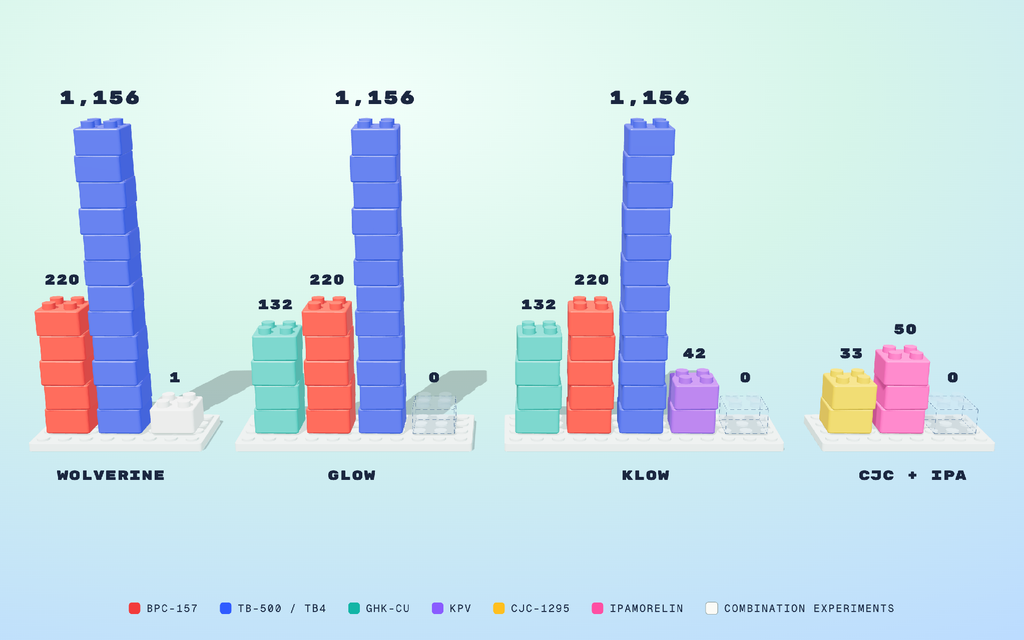
BPC-157 is a 15-amino-acid peptide based on a fragment of a gastric protein, studied mostly in rat models of gut, tendon and blood-vessel biology. TB-500 is a synthetic peptide based on thymosin β4, a protein best known for binding actin, the scaffolding inside cells. The pair is a classic two-pathway combination, and the 2026 tendon study above is the first to test them side by side. Our BPC-157 vs TB-500 guide compares them in detail, and the Wolverine blend specification and COA lists the 10mg + 10mg contents.
CJC-1295 + Ipamorelin
CJC-1295 mimics GHRH, the hypothalamic signal that tells the pituitary to release growth hormone. Ipamorelin binds the ghrelin receptor, a separate switch on the same cells. The precedent comes from the drug class: a 1990 study led by Cyril Bowers found that a GHRP and GHRH acted synergistically through independent mechanisms. Here’s why CJC-1295 and Ipamorelin are studied together, and the CJC-1295 + Ipamorelin specification (no DAC, 5mg + 5mg).
KLOW and GLOW
Both blends add GHK-Cu, a copper-binding tripeptide. A 2018 gene-data review by Loren Pickart reported that GHK changes the expression of 31.2% of human genes by 50% or more. KLOW then adds KPV, a three-amino-acid fragment of alpha-MSH. See the KLOW vs GLOW key differences and our GHK-Cu research overview.
Wolverine vs KLOW vs GLOW: What’s in Each Stack?
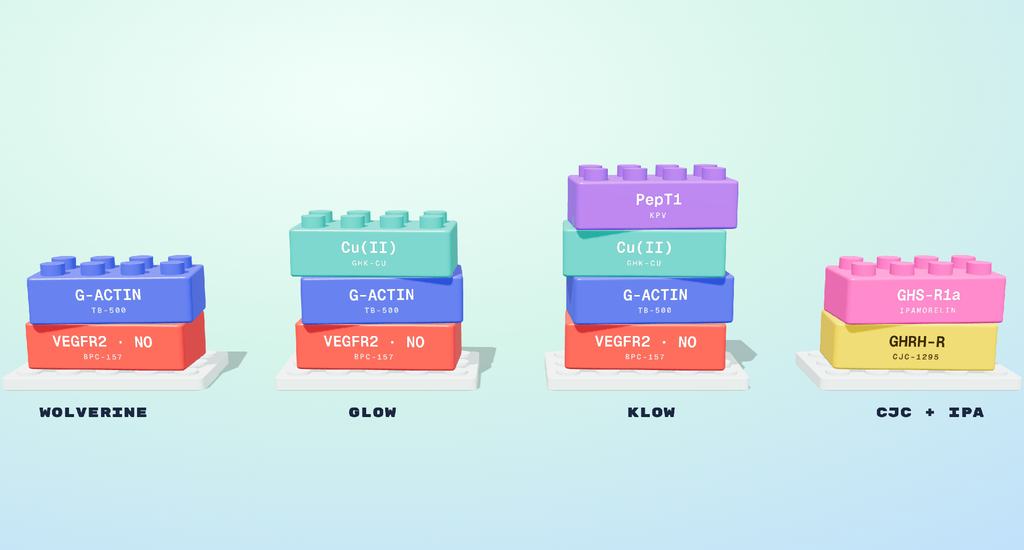
All three blends contain BPC-157 and TB-500 at 10mg each. GLOW adds 50mg of GHK-Cu, and KLOW adds the same GHK-Cu plus 10mg of KPV. Wolverine is the two-peptide base, GLOW is the three-peptide version, and KLOW is the four-peptide version with the largest total mass.
| Wolverine | GLOW | KLOW | |
|---|---|---|---|
| BPC-157 | 10mg | 10mg | 10mg |
| TB-500 | 10mg | 10mg | 10mg |
| GHK-Cu | None | 50mg | 50mg |
| KPV | None | None | 10mg |
| Total | 20mg | 70mg | 80mg |
GHK-Cu makes up most of the mass in GLOW and KLOW, so the copper peptide is the main thing separating them from Wolverine. The peptide stack names themselves are branding. Wolverine borrows from the Marvel character, while GLOW and KLOW are trade names you won’t find in a single paper.
Apexion supplies all three as pre-filled research pens, prepared to order in the UK. Full details are on the Wolverine blend specification and COA, GLOW 70mg specification and COA and KLOW 80mg specification and COA pages.
Pre-Mixed Blend vs Separate Vials: What’s the Difference?
A pre-mixed blend puts fixed amounts of each peptide into one vial or pen, so the ratio is set before it reaches the lab. Separate vials let a researcher change the ratio between experiments, but every extra vial adds handling steps, documents to file and chances for error at the bench.
| Factor | Pre-mixed blend | Separate vials |
|---|---|---|
| Ratio flexibility | Fixed by the manufacturer | Set by the researcher |
| Handling steps | One item to prepare and log | One per peptide |
| Consistency between runs | Same ratio every batch | Depends on bench technique |
| Documentation | One COA covering every component | One COA per vial |
| Storage | One set of conditions | Each peptide on its own label guidance |
Each format suits a different design. A study that tests different ratios needs separate vials, while one that repeats a fixed combination many times gains from a blend, because the ratio can’t drift.
Apexion’s blends come as pre-filled research pens, which keep the fixed ratio in a sealed, measured format for laboratory handling. Our guide to peptide pens vs vials covers how the two compare.
Which Peptides Should Not Be Stacked Together?
There’s no validated list of peptides that shouldn’t be stacked, because almost no combinations have been formally studied. From a research-quality view, though, some pairings are much harder to justify than others. The weak spots are redundant targets, clashing chemistry and blends too crowded to verify.
- Two compounds on the same receptor. Pairing ipamorelin with another ghrelin-receptor agonist, or two GHRH analogues, gives no mechanistic reason to combine them. Any result becomes hard to pin on either one.
- Peptides with different stability or solvent needs. A blend has to suit every component at once. Copper-bound GHK-Cu, for example, brings metal-binding chemistry that the other peptides in a mix don’t share.
- Large blends with many components. Each extra peptide is another identity to confirm and another peak to measure on the COA.
All three points come back to the Pathway and Paperwork questions in the check above. If either one fails, the combination is a weak research tool.
How Many Peptides Can You Stack at Once?
There’s no set limit on how many peptides can be stacked. Each added component makes results harder to attribute and the product harder to verify, so good research design usually favours the fewest variables that answer the question.
The arithmetic gets steep fast. Testing two peptides properly took the 2026 tendon study four groups. A full test of a four-peptide blend, covering every on-off combination, would need 16.
Is Peptide Stacking Legal in the UK?
Peptide stacking follows the same UK rules as single peptides. Research blends are legal to buy and sell as laboratory materials, but they can’t be sold or advertised for human use. Most of the individual components are also banned in sport under the WADA Prohibited List, which UKAD enforces in the UK.
Regulatory Status
The MHRA regulates medicines under the Human Medicines Regulations 2012. A licensed medicine holds a marketing authorisation, and research peptides hold none. The MHRA’s Guidance Note 8, amended in March 2026, decides whether something counts as a medicine by its presentation and function, including implicit claims on websites and social media. Our guide on are peptides legal in the UK goes further.
Sport
BPC-157 is named under S0 (non-approved substances) on the WADA list. TB-500, CJC-1295 and ipamorelin fall under S2 (peptide hormones, growth factors and related substances). All are banned at all times, in and out of competition. More detail is in our BPC-157 UK guide.
How to Verify a Peptide Blend
A blend’s certificate of analysis (COA) should identify and measure every component separately. A single overall purity figure can’t tell you whether one peptide in the mix is short or missing. Look for a separate HPLC result and LC-MS mass for each peptide, matched to the lot on the label.
Run through this checklist with the COA in hand:
- The lot number on the vial or pen matches the COA.
- Each peptide is listed with its own HPLC peak and purity.
- There’s an LC-MS mass for each component.
- The amount of each component is stated (for example, 10mg + 10mg).
- The testing lab, method and test date are named.
Apexion prepares each blend to order, so the batch is tested after it’s made and the certificate follows that batch. Scan the QR code on the product or enter the batch number to pull it up. Our guides explain how to read a peptide COA, how to verify a research peptide batch and how to evaluate a research peptide supplier. The Apexion batch verification page shows the process step by step.
Frequently Asked Questions
Peptide stacks are combinations of two or more peptides studied together in one research protocol. They come either as separate vials combined at the bench or as a pre-mixed blend in one vial or pen. Researchers usually pair compounds with different targets, such as BPC-157 with TB-500, to compare complementary mechanisms.
The Wolverine stack is the nickname for BPC-157 combined with TB-500, usually 10mg of each. BPC-157 is studied in gut, tendon and blood-vessel models, and TB-500 in actin and cell-migration research. A 2026 rat tendon study was the first to test the pair directly. The name comes from the Marvel character.
GLOW contains three peptides: BPC-157, TB-500 and GHK-Cu, for 70mg in total. KLOW contains the same three plus 10mg of KPV, a tripeptide fragment of alpha-MSH, for 80mg in total. KPV is the only difference, and it adds anti-inflammatory pathway research to the copper-peptide and cell-migration work GLOW covers.
No. Peptides are short chains of amino acids joined by peptide bonds. Anabolic steroids are lipid molecules built on a four-ring carbon skeleton derived from cholesterol. The two classes differ in structure and in the receptors they act on, though both appear on the WADA Prohibited List.
A blend is as pure as each of its components, and a good COA shows that component by component. Every peptide should have its own HPLC peak and purity figure. Apexion blends are typically ≥98% HPLC-verified, with a certificate for each batch that you can check by QR code or batch number.
Lyophilised peptides keep best cold, dark and dry, and pre-filled research pens need a cool, stable environment that follows the batch guidance. Long-term storage is typically at −20 °C. Keep blends away from heat, direct light and unnecessary handling, which supports consistency and lowers contamination risk.
The Bottom Line
Peptide stacks combine compounds with different mechanisms, and that logic is sound. The evidence, though, still comes mostly from studies of each peptide alone, with the first direct test of a popular pair arriving in 2026. The same UK rules apply to blends as to single peptides, and every component should appear separately on the COA.
Apexion’s blends are supplied strictly for laboratory research and are not for human or veterinary use. To compare specifications, browse Apexion research stacks.
Sources
- Biçer O, Adanir O, et al. Effects of BPC-157 and TB-500 on Achilles tendon healing in rats. Jt Dis Relat Surg, July 2026. PubMed
- Bowers CY, et al. GH-releasing peptide stimulates GH release and acts synergistically with GHRH. J Clin Endocrinol Metab, 1990. Oxford Academic
- Pickart L, Margolina A. Regenerative and protective actions of the GHK-Cu peptide in the light of the new gene data. Int J Mol Sci, 2018. PMC
- Cedars-Sinai. Peptide Therapy: What the Science Shows About BPC-157, TB-500 and Wolverine Stacks. July 2026. Cedars-Sinai
- MHRA. Guidance Note 8: A guide to what is a medicinal product (amended March 2026). GOV.UK
- WADA Prohibited List 2026 and UK Anti-Doping. UKAD