
BPC-157 + TB-500 + KPV Blend: What It Is, Research & How It Compares to Wolverine and KLOW (2026)
Reviewed by Oscar Reyes, PhD, Synthesis Lead at Apexion BioLabs · Scientific review of the chemistry and analytical content
Quick answer
What is the BPC-157 + TB-500 + KPV blend?
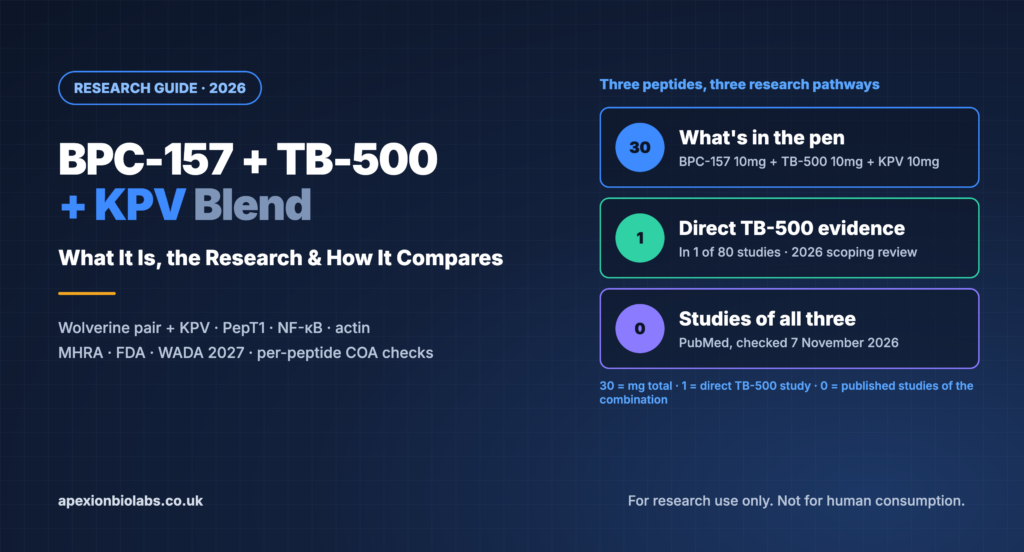
It is a research blend of three peptides: BPC-157, TB-500 and KPV. The first two make up the pairing nicknamed “Wolverine”, and KPV is a tripeptide studied in inflammatory-signalling models, which places this preparation between that pair and the four-peptide KLOW blend. Each peptide carries its own animal and cell literature. The three have not been studied together.
- BPC-157 10mg + TB-500 10mg + KPV 10mg, 30mg total, in one pre-filled research pen
- The evidence for each peptide is preclinical; a PubMed search on 7 November 2026 returned no studies of the three given together
- UK: no MHRA marketing authorisation; sold as laboratory material only
Four blends, three nicknames and the same short list of peptides. Anyone comparing a bpc 157 tb 500 kpv blend against Wolverine, GLOW or KLOW is comparing which research pathways each preparation covers, because the peptides inside them repeat. BPC-157 is a 15-amino-acid peptide studied in rodent tissue-repair models, TB-500 is a seven-residue fragment taken from an actin-binding protein, and KPV is a three-amino-acid piece of a hormone studied in inflammatory-signalling and gut-barrier work. Adding KPV to the pair adds one more pathway to the batch, and nothing published says it adds more than that.
This guide covers what each peptide is, what the animal and cell literature reports, how the four blends line up, why a laboratory might choose one preparation over three vials, where UK law and the anti-doping lists put them, and how a blend certificate should be checked. Apexion supplies this material strictly for laboratory research, under the Research Use Only notice.
What Is the BPC-157 + TB-500 + KPV Blend?
It is one preparation carrying three separate research peptides. BPC-157 is a 15-amino-acid synthetic peptide. TB-500 is a short fragment based on thymosin beta-4. KPV is a three-amino-acid peptide taken from the tail end of alpha-melanocyte-stimulating hormone. Each has its own published literature, and putting all three in one preparation lets a laboratory work across three pathways from a single batch.
It circulates under several names: a BPC/TB/KPV blend, a recovery blend, or an extended version of the two-peptide Wolverine pairing. Those are trade nicknames, and none describes a tested property.
Apexion lists a 30mg version: 10mg apiece in a single pre-filled research pen, made up to order here in the UK. The BPC-157 + TB-500 + KPV blend specification and COA records the measured content for each of the three peptides against the 10:10:10 label claim, which is the only way to tell a blend matches what it says.
One word in that product name deserves unpacking. “Recovery” entered the vocabulary from decades of rodent studies on tissue-repair models, where these peptides were first characterised. It describes the research field the peptides came out of, and it was never a finding in people.
Blend Composition at a Glance
| BPC-157 | TB-500 | KPV | |
|---|---|---|---|
| What it is | 15-amino-acid synthetic peptide (GEPPPGKPADDAGLV) | Ac-LKKTETQ, from the actin-binding region of thymosin beta-4 | Lys-Pro-Val, the C-terminal tripeptide of alpha-MSH |
| Origin | A fragment of a protein found in gastric juice | Thymosin beta-4, a 43-amino-acid protein | Alpha-melanocyte-stimulating hormone |
| Formula | C62H98N16O22 | C38H68N10O14 | C16H30N4O4 |
| Molecular weight | ~1,419.5 g/mol | ~889.0 g/mol | ~342.4 g/mol |
| CAS | 137525-51-0 | Not assigned to the fragment | 67727-97-3 |
| Main research area | Blood-vessel formation, nitric-oxide signalling, gut and tendon models | Actin binding, cell migration | Inflammatory signalling, PepT1 uptake, gut-barrier models |
| Amount in Apexion’s pen | 10mg | 10mg | 10mg |
Formulas and masses above come from PubChem (CIDs 9941957, 62707662 and 125672, checked 7 November 2026). The three masses are far enough apart to be told apart on any mass spectrum, which is what makes a blend certificate checkable at all.
What Does Each Peptide Do in Research?
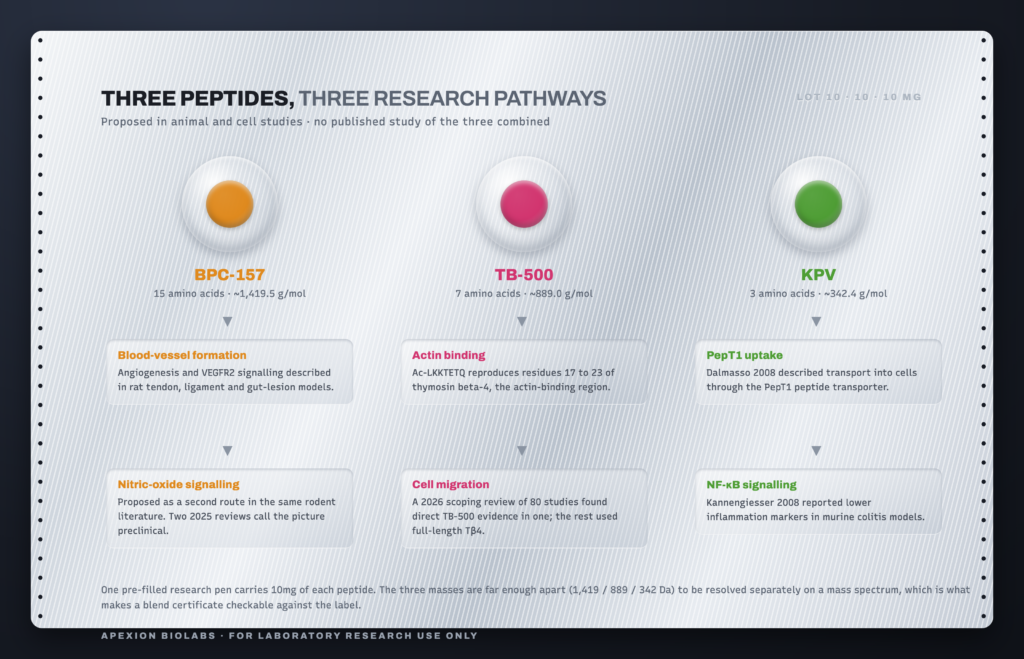
In animal and cell studies, each peptide has been linked to a different pathway. BPC-157 appears in work on blood-vessel formation and nitric-oxide signalling. TB-500 appears in work on actin and cell movement. KPV appears in work on inflammatory signalling. Three separate pathways is the reason researchers put them side by side.
BPC-157
BPC-157 is a pentadecapeptide, a 15-amino-acid chain, derived from a protein identified in gastric juice. Rat studies make up most of its literature, covering tendon, ligament, muscle and gut-lesion models, with angiogenesis and VEGFR2 signalling among the proposed mechanisms. Two 2025 reviews describe the picture as preclinical. Józwiak and colleagues published a literature and patent review in Pharmaceuticals on 30 January 2025 (18(2):185), and McGuire and colleagues reviewed the musculoskeletal literature in Current Reviews in Musculoskeletal Medicine in August 2025 (PMC12446177), searching the record through March 2025. BPC-157 UK research turns on that 15-residue sequence, and a batch record is what ties a given pen to it.
TB-500
TB-500 reproduces seven residues, Ac-LKKTETQ, from positions 17 to 23 of thymosin beta-4. That distinction carries more weight than most write-ups give it, because the great majority of published work used the full 43-residue protein instead of the fragment. A 2026 scoping review by McGuire, Hughes, Maak and Cushman in Applied Sciences (DOI 10.3390/app16126202) screened 1,772 records, included 80 studies, and found direct evidence on TB-500 itself in a single one. Anyone reading an actin or cell-migration paper should check which molecule was actually used. Most TB-500 peptide UK material is the seven-residue fragment, so a paper describing the 43-residue protein is describing something else.
KPV
KPV is Lys-Pro-Val, the final three residues of alpha-MSH, and the smallest peptide of the three by a wide margin. Kannengiesser and colleagues reported lower inflammation markers in murine colitis models in Inflammatory Bowel Diseases in March 2008 (PMID 18092346). Dalmasso and colleagues described uptake through the PepT1 transporter in Gastroenterology in January 2008 (PMID 18061177), and cell studies since have centred on NF-κB signalling and epithelial-barrier models. KPV peptide UK supply is almost always the synthetic tripeptide, and the lot record is where its measured mass against 342.4 g/mol appears. BPC-157 vs TB-500 separates the two larger peptides on parent protein, length, and the assays each appears in.
KPV vs BPC-157 vs TB-500: What’s the Difference?
They differ in size, in where they came from and in which models they appear in. BPC-157 at 15 residues and TB-500 at seven are studied mainly in animal models of tissue repair. KPV at three residues descends from a different hormone family altogether, alpha-MSH, and belongs to inflammation and gut-barrier work.
- Size: 15 residues, 7 residues and 3 residues, which works out to roughly 1,419, 889 and 342 g/mol.
- Origin: A gastric-juice protein, an actin-binding protein, and a melanocortin hormone.
- Main research model: Rat tendon, ligament and gut studies; cell-migration and actin assays; murine colitis and epithelial-barrier studies.
- How it enters cells: KPV is the only one of the three with a described transporter route, PepT1, from the Dalmasso work above. BPC-157 and TB-500 are studied through receptor and cytoskeletal signalling instead.
What Does KPV Add to the Wolverine Blend?
Wolverine is BPC-157 and TB-500 together. Adding KPV adds one more research pathway, inflammatory signalling, and that single addition is the whole difference between the two preparations. It does not follow that the three-peptide version does more, because no study has compared them.
The nickname itself is worth a line. “Wolverine” came from the comic character and the regenerative ability attached to him, applied to these peptides by people selling them online. It carries no scientific meaning and appears in no paper. The BPC-157 + TB-500 (Wolverine) blend carries the same two peptides at 10mg each, 20mg against this one’s 30mg.
Sellers add KPV because it broadens the pitch at low cost: it is the cheapest of the three by mass and extends the preparation into a second research area. A laboratory may well want the opposite. Keeping KPV in its own vial is what allows its contribution to be measured on its own, and a blended preparation forecloses that comparison by design.
Wolverine vs BPC-157 + TB-500 + KPV vs GLOW vs KLOW
All four preparations are built from the same four peptides. What separates them is which research pathways each one covers, and the total mass in the pen follows from that rather than indicating anything about strength.
| Blend | BPC-157 | TB-500 | KPV | GHK-Cu | Apexion total |
|---|---|---|---|---|---|
| Wolverine | Yes | Yes | No | No | 20mg |
| BPC-157 + TB-500 + KPV | Yes | Yes | Yes | No | 30mg |
| GLOW | Yes | Yes | No | Yes | 70mg |
| KLOW | Yes | Yes | Yes | Yes | 80mg |
The three-peptide blend and GLOW each add one peptide to Wolverine in different directions: this one towards inflammatory signalling, GLOW towards copper-peptide and matrix work. KLOW is the only preparation carrying all four. A Wolverine vs KLOW comparison therefore spans two extra peptides, where this blend differs from the pair by one. KLOW vs GLOW turns on a single peptide, KPV, since both carry GHK-Cu. The KLOW peptide blend runs to 80mg across four peptides, and the GLOW peptide blend to 70mg across three, so a larger total reflects more peptides rather than more of any one. Current lots are on the KLOW blend and GLOW blend pages.
What Does the Research Show?
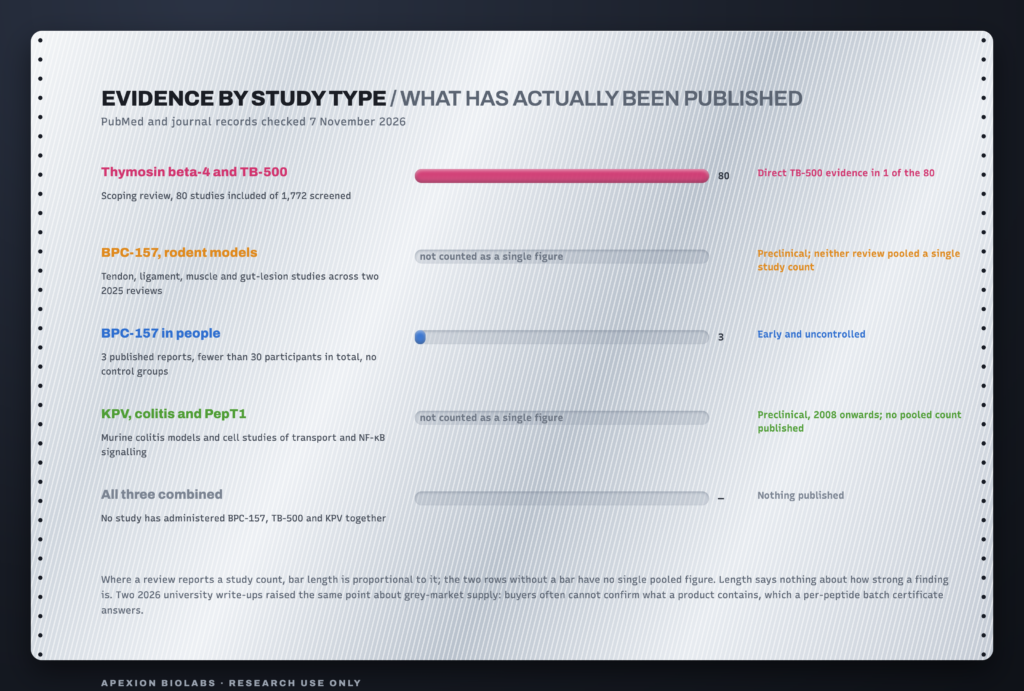
Each peptide has animal and cell research behind it, and BPC-157 alone adds a handful of small early reports in people. The combination has no published literature at all. A PubMed search on 7 November 2026 for BPC-157 together with KPV returned a single record, a 2026 review of pharmacy-compounding policy in the International Journal of Pharmaceutical Compounding, and no study in which the three were given together. Any statement about what the blend does in people runs ahead of what has been published.
| Peptide or area | Study type | What was reported | Status |
|---|---|---|---|
| BPC-157: tendon and ligament | Animal (rat) | Tissue-repair markers | Preclinical |
| BPC-157: gut | Animal (rat) | Protective effects in lesion models | Preclinical |
| BPC-157: in people | Three published reports, fewer than 30 participants in total, no control groups | Very limited | Early |
| Thymosin beta-4: cell migration | Cell and animal | Actin regulation and cell movement | Preclinical, mostly full-length Tβ4 |
| The TB-500 fragment itself | Direct evidence in 1 of 80 included studies | Minimal | Preclinical |
| KPV: colitis | Animal (mouse) | Lower inflammation markers | Preclinical |
| KPV: PepT1 and NF-κB | Cell | Uptake and signalling activity | Preclinical |
| All three combined | None found (PubMed, 7 November 2026) | Nothing published | No data |
Two independent academic assessments landed on the same two limits this year. Patricia Brubaker, PhD, Professor Emerita of Physiology and Medicine at the University of Toronto, wrote for McGill University’s Office for Science and Society on 13 March 2026 that “only 3 publications have reported on the administration of BPC 157 to humans,” and that with grey-market supply “there is no guarantee that the purchased product even contains BPC 157.” Stuart Phillips, Professor of Kinesiology at McMaster University, made the product-quality point in a university Q&A on research-only peptides on 21 April 2026, describing unverified supply as “leaving end users with no reliable way to verify what it is they’re getting, let alone its purity, potency, and sterility.”
Those two limits are not the same kind of problem. The thin literature is fixed, and no supplier changes it. Identity and purity are entirely answerable by a batch certificate that tests each peptide separately, which the verification section below sets out.
Why Do Labs Use a Blend Instead of Single Peptides?
A blend gives one batch, one certificate and a fixed ratio across every pen drawn from it. For work comparing conditions rather than compounds, that removes three sets of lot numbers and three chances of a mismatch between vials.
The trade-off is built into the same design. Three peptides in fixed proportion cannot be told apart by their contribution, so any observation belongs to the preparation as a whole. Work that needs to isolate one peptide uses single preparations, which is why BPC-157, TB-500 and KPV are listed on their own alongside the blends. Peptide stacks explained sets out how a fixed-ratio preparation is documented, which is a single certificate covering every component rather than one per vial.
Is a BPC-157 + TB-500 Blend Available in the UK?
Yes, as laboratory material. The Misuse of Drugs Act 1971 does not schedule any of the three, and the MHRA has granted no marketing authorisation for them, which leaves research supply open while the Human Medicines Regulations 2012 close off any sale, supply or advertising aimed at people.
So the restriction attaches to the claim made about a substance, not to the substance itself. That principle is what governs whether peptides are legal in the UK across the board, and the terms Apexion supplies under are in its Research Use Only notice.
What Is the FDA’s Position?
The FDA lists all three peptides on its bulk drug substances page, current as of 22 April 2026, under substances nominated for compounding but subsequently withdrawn. For BPC-157, the agency states that it “has identified no, or only limited, safety-related information for the proposed routes of administration.” None of the three appears in the Category 2 table.
Every regulatory and anti-doping statement above was read off a primary source on 7 November 2026.
Are BPC-157, TB-500 and KPV Banned in Sport?
The 2027 WADA Prohibited List, approved on 10 September 2026 and in force from 1 January 2027, names BPC-157 under S0, the class covering substances with no approval for human therapeutic use from any government health agency, and names TB-500 along with thymosin beta-4 under S2.
KPV is not named individually. What changed for 2027 is that, as the US Anti-Doping Agency’s advisory on the new list puts it, “‘peptides’ in general are now named as prohibited substances in the S0 class,” and USADA adds that “even if a peptide is not specifically named on the List, utmost caution should be taken.” Anyone competing under anti-doping rules should read the current WADA Prohibited List and ask UK Anti-Doping for a written position.
How to Verify a Research Blend
A blend certificate has to test each peptide on its own. HPLC should resolve three separate peaks with a purity figure against each. Mass spectrometry should confirm three masses, near 1,419, 889 and 342 Da. One combined purity percentage tells you nothing about which peptide is short or missing, and a blend certificate that reports only a total figure cannot be checked against the label.
- Lot number: It should match the number printed on the pen, not just the product name.
- Purity and mass per peptide: Three peaks, three masses, each reported separately.
- The stated ratio: Measured content against the 10:10:10 mg label claim.
- Named laboratory and test date: Named, dated, and checkable with the laboratory itself.
- Storage conditions: On the document, and agreeing with what the product label says.
Those checks are exactly what the two academics quoted earlier say buyers currently cannot do, and a per-peptide certificate is what closes that question. Knowing how to read a peptide certificate of analysis is what separates a document from proof, and a lot code that cannot be tied to the pen it arrived with fails the first test when you verify a research peptide batch. A certificate is only ever worth as much as the party issuing it, so who ran the test is the first question to settle when you evaluate a research peptide supplier: whether the laboratory is named, and whether its record can be traced back to it.
Because each Apexion pen is made up against an order in the UK, testing happens on that batch, and its certificate reaches the customer with the pen, tied to it by batch number and QR code. A peptide pen vs vial decision changes what the certificate can cover, since a pen’s figures describe the filled unit rather than a powder weighed out later. Reconstituted peptide storage and handling for research runs to tighter limits than the sealed pen, because a peptide in solution degrades on a different timescale.
Frequently Asked Questions
Wolverine is an online nickname for a two-peptide preparation of BPC-157 and TB-500. It comes from the comic character associated with regeneration and appears in no scientific papers. Adding KPV to that pair gives the three-peptide blend described in this guide.
No. KLOW carries four peptides: KPV, BPC-157, TB-500 and GHK-Cu, the copper tripeptide. The three-peptide blend covers the same peptides minus GHK-Cu, so KLOW extends it into copper-peptide and matrix research.
KPV is the one-letter code for its three amino acids: lysine, proline and valine. The sequence Lys-Pro-Val forms the C-terminal end of alpha-melanocyte-stimulating hormone, and the peptide weighs about 342.4 g/mol.
No published study has administered the three peptides together. A PubMed search on 7 November 2026 for BPC-157 with KPV returned one record, a review of compounding policy. BPC-157 alone has three published human reports covering fewer than 30 participants.
No. Thymosin beta-4 is a 43-amino-acid actin-binding protein. TB-500 reproduces seven of its residues, Ac-LKKTETQ, positions 17 to 23. A 2026 scoping review of 80 studies found direct evidence on the fragment in only one of them.
The name comes from the research field the three peptides were characterised in: rodent models of tissue repair and inflammatory signalling. It points to where the literature came from, and no published study supports it as a description of what the preparation does.
The Bottom Line
This is the Wolverine pairing with KPV added, giving three peptides across three research pathways in one 30mg pen. Each peptide carries animal and cell literature, BPC-157 adds three small human reports, and the three together have never been studied. Two universities flagged the same supply-identity concern this year, and a certificate testing each peptide separately is the answer to it. Nothing here carries a UK licence; the material exists for the bench and for nothing else.
BPC-157 + TB-500 + KPV 30mg batch COA
Apexion Biolabs supplies this blend for laboratory research and no other purpose. It is neither a medicine nor a supplement nor a food, and it is intended for no therapeutic, diagnostic, human or veterinary application whatsoever. Terms are set out in the Research Use Only notice.
Sources
- Józwiak M, Bauer M, Kamysz W, Kleczkowska P. Multifunctionality and Possible Medical Application of the BPC 157 Peptide: Literature and Patent Review. Pharmaceuticals, 30 January 2025;18(2):185. doi:10.3390/ph18020185
- McGuire B, et al. Narrative review of the BPC-157 musculoskeletal literature. Curr Rev Musculoskelet Med, August 2025;18(12):611-619. PMC12446177
- McGuire B, Hughes J, Maak T, Cushman D. Scoping review of the thymosin beta-4 and TB-500 literature, 1,772 records screened, 80 studies included. Applied Sciences, 2026. doi:10.3390/app16126202
- Kannengiesser K, et al. Melanocortin-derived tripeptide KPV has anti-inflammatory potential in murine models of inflammatory bowel disease. Inflamm Bowel Dis, March 2008;14(3):324-331. PMID 18092346
- Dalmasso G, et al. PepT1-mediated tripeptide KPV uptake reduces intestinal inflammation. Gastroenterology, January 2008;134(1):166-178. PMID 18061177
- Brubaker P. Body Protection Compound: No Proof Required! McGill Office for Science and Society, 13 March 2026.
- Beattie M. What do we know about “research only” peptides? Q&A with expert Stuart Phillips. McMaster University, 21 April 2026.
- US Food and Drug Administration. Certain bulk drug substances for use in compounding that may present significant safety risks, current as of 22 April 2026.
- US Anti-Doping Agency. Athlete Advisory: What’s New on the 2027 Prohibited List?
- World Anti-Doping Agency. Prohibited List, 2027 edition, in force 1 January 2027.
- PubChem. BPC-157 CID 9941957, TB-500 CID 62707662, KPV CID 125672.