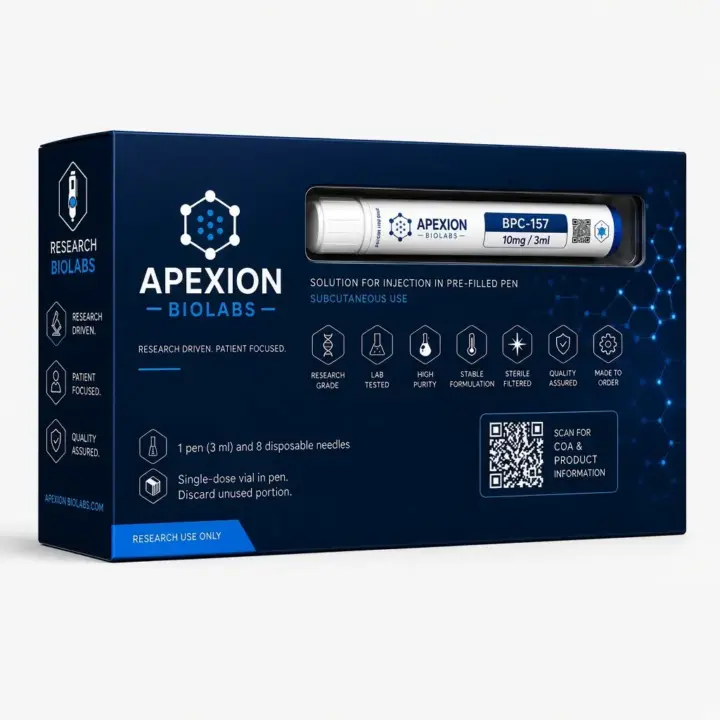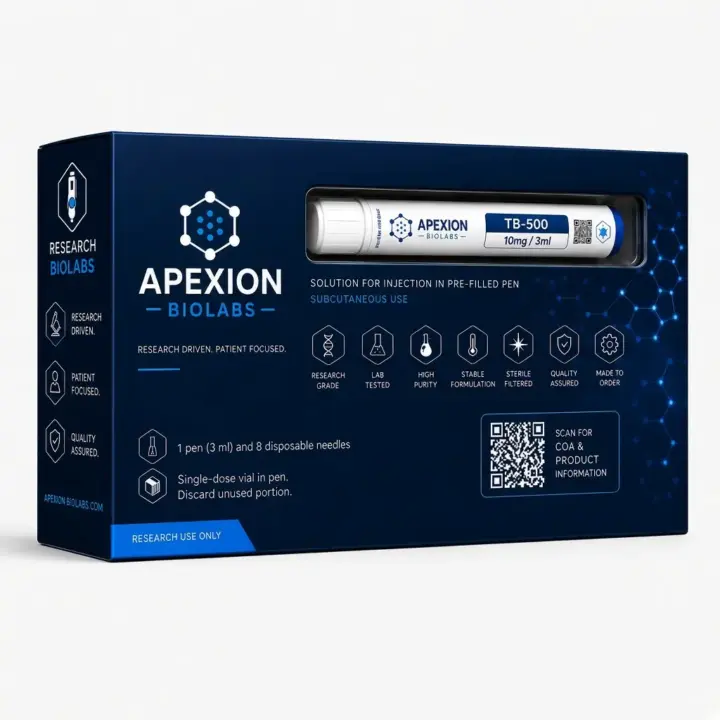
 GHK-CU 100MG


3-PEPTIDE RESEARCH BLEND
BPC-157 + TB-500 + KPV (Recovery Blend) 30mg
Research Blends, Tissue and Cell-Migration Research
£129.99Free UK tracked delivery
- Made fresh to order
- Batch documentation pending
- UK tracked delivery
- Made fresh to order: dispatched within 1 to 2 working days
- Results published when verified
Research Use Only
BPC-157 + TB-500 + KPV 30mg is a three-peptide research blend with 10 mg of each compound in one pre-filled research pen. It is prepared to order in the UK as a single batch and shipped cold chain by tracked delivery.
The blend adds KPV, a tripeptide from the end of alpha-MSH, to the BPC-157 + TB-500 pairing. That puts it one step short of KLOW, which also carries GHK-Cu. The animal and cell work behind each one was done on that compound alone, and the BPC-157 + TB-500 + KPV blend has no published study as a combination.
Blend composition
| BPC-157 | 10 mg · Synthetic 15-amino-acid peptide |
|---|---|
| TB-500 | 10 mg · Synthetic thymosin beta-4 fragment (Ac-LKKTETQ) |
| KPV | 10 mg · Tripeptide Lys-Pro-Val (alpha-MSH 11–13) |
| Total | 30 mg in one pre-filled research pen |
How each component is studied
- BPC-157: a 15-residue sequence studied in rat fibroblast cultures and isolated blood-vessel preparations, where work has measured receptor expression and the Src-Caveolin-1-eNOS signalling pathway.
- TB-500: a seven-residue acetylated fragment matching residues 17–23 of thymosin beta-4, the stretch that binds actin. Cross-linking and mass-spectrometry work has mapped where the parent protein contacts actin.
- KPV: three amino acids from the end of alpha-MSH, compared with the full hormone in keratinocyte cell lines using NF-κB and MAPK signalling readouts.
5 key research areas
- Fibroblast receptor expression. Fibroblast cultures were used to track BPC-157 and receptor expression at gene and protein level.
- Nitric oxide signalling. Vessel preparations and endothelial cells were used to map BPC-157 and the Src-Caveolin-1-eNOS pathway.
- Actin binding. Thymosin beta-4 binds G-actin, and its LKKTETQ region is the motif carried by the TB-500 fragment.
- Contact-site mapping. Chemical cross-linking and HPLC-ESI-MS located where thymosin beta-4 touches actin, and mutation work showed residues across the sequence shape binding kinetics.
- Melanocortin signalling. Keratinocyte cell lines were used to compare KPV with alpha-MSH and ACTH on NF-κB and MAPK readouts.
Selected published research
Peer-reviewed studies on each of the three components, with PubMed IDs:
- Chang CH, et al. (2014). Pentadecapeptide BPC 157 enhances the growth hormone receptor expression in tendon fibroblasts. Molecules. PMID 25415472
- Hsieh MJ, et al. (2020). Modulatory effects of BPC 157 on vasomotor tone and the activation of Src-Caveolin-1-endothelial nitric oxide synthase pathway. Scientific Reports. PMID 33051481
- Knop J, et al. (2013). High-resolution HPLC-ESI-MS characterization of the contact sites of the actin-thymosin β(4) complex by chemical and enzymatic cross-linking. Biochemistry. PMID 23924371
- Au JK, et al. (2007). Contributions from all over: widely distributed residues in thymosin beta-4 affect the kinetics and stability of actin binding. Annals of the New York Academy of Sciences. PMID 17468230
- Elliott RJ, et al. (2004). alpha-Melanocyte-stimulating hormone, MSH 11-13 KPV and adrenocorticotropic hormone signalling in human keratinocyte cells. Journal of Investigative Dermatology. PMID 15102092
These references cover laboratory and animal research on the separate compounds. None examined this three-peptide blend, and none is evidence of safety or effect in humans.
Why a single-batch blend
- All three peptides are measured into one pen from one batch
- Fixed 1:1:1 proportions, 10 mg of each
- One batch number covers the whole blend
- No need to source, log and track three separate materials
What arrives
30mg pen
One pre-filled Apexion research pen
Three components
BPC-157, TB-500 fragment and KPV, 10 mg each
Protected packaging
Sealed and tamper-evident
Batch traceability
Batch number on every pen; certificate on the COA tab
Preparation and UK dispatch
- Made fresh to order after checkout
- Prepared and quality checked before dispatch
- Tracked Royal Mail delivery across the UK
- UK-based product and documentation support
Simple, secure checkout
Pay by Bank is the preferred option
Card payments are temporarily unavailable.
Each pen carries a batch number. The COA tab shows the batch certificate on file for this blend.
Research use only. This blend is supplied for in-vitro laboratory research by qualified researchers. It is not a medicine, is not licensed by the MHRA, and is not intended for human or veterinary use, diagnosis or treatment.
| Content | 30 mg total, one pre-filled research pen |
|---|---|
| Purity | Independent testing in progress; results published on verification |
| Active ingredient | BPC-157 10 mg · TB-500 10 mg · KPV 10 mg |
| CAS | 137525-51-0 (BPC-157) / not assigned (TB-500 fragment) / 67727-97-3 (KPV) |
| Molecular formula | C62H98N16O22 / C38H68N10O14 / C16H30N4O4 |
| Molecular weight | ~1419.5 / ~889.0 / ~342.4 g/mol |
| Form | Pre-filled research pen (three-peptide blend) |
| Origin | UK-stocked, tracked Royal Mail dispatch |
| Intended use | Laboratory research only. |
The batch Certificate of Analysis for this product is shown below. Read how we verify every batch on our Quality & Batch Verification page.
| Documentation status | Independent testing in progress |
|---|---|
| Test method | HPLC (purity and identity) |
| Analysis | Independent third-party laboratory, plus in-house QC on every pen |
| Verification | Batch number on every pen; COA linked by QR once published |
| Batch certificate |
Batch Certificate of Analysis (R3V-COA-2026-041; lot 2381089-85-29). Tap the certificate to enlarge it. 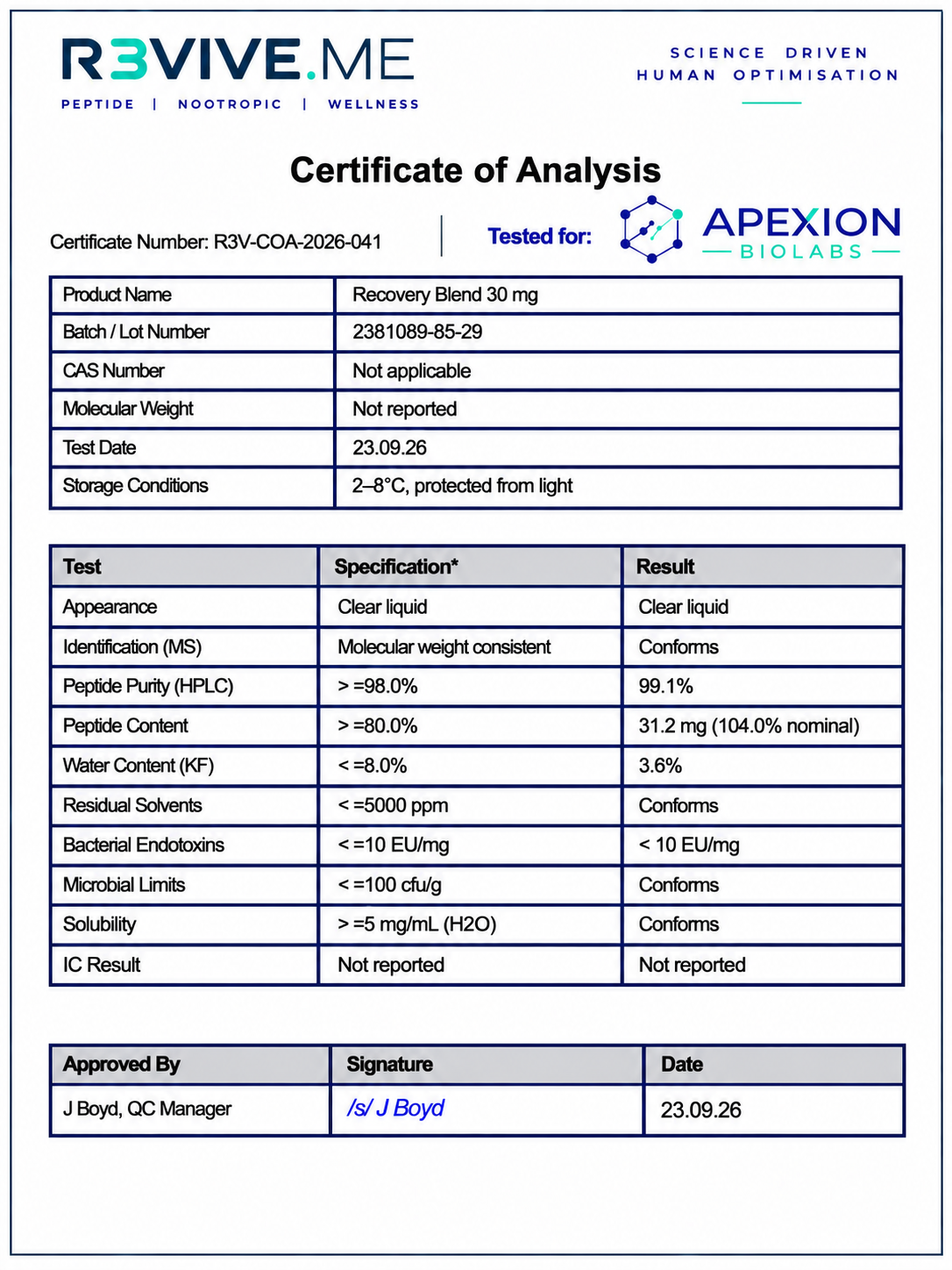
|
Storage conditions
- Shipped cold chain to keep the pen cool in transit
- Long-term: −20 °C in a temperature-controlled environment
- Short-term: keep cool and stable (2–8 °C) and away from direct light
- Keep the pen sealed when not in use
- Avoid repeated temperature changes (freeze–thaw cycles)
Handling guidance
- Check that the packaging and tamper seal are intact on arrival
- Handle as little as possible, using standard laboratory practice
- Record the batch number for traceability
- Follow any batch-specific guidance supplied with your order
What does the BPC-157 + TB-500 + KPV pen contain?
Three research peptides: BPC-157, the TB-500 fragment of thymosin beta-4, and KPV, with 10 mg of each in one pre-filled research pen. The three were never studied together as a mix. It is for laboratory research only.
How does this blend compare with the Wolverine blend and KLOW?
The Wolverine blend contains BPC-157 and TB-500 only. This blend adds KPV to that pair. KLOW has all three plus GHK-Cu. Every one of them is mixed as a single batch and supplied for research use only.
What ratio is used in the 30mg pen?
The ratio is 1:1:1. Each pen contains BPC-157 10 mg, TB-500 10 mg and KPV 10 mg, giving 30 mg in total under one batch reference.
Is the BPC-157 + TB-500 + KPV blend independently tested?
Every BPC-157 + TB-500 + KPV pen is made fresh after your order is placed, then prepared and quality checked before dispatch. The COA tab shows the batch certificate on file for this blend, and each pen carries a batch number so its documentation can be traced.
Can this blend be used in humans or animals?
No. This blend is not a medicine and is not licensed by the MHRA. It is supplied strictly for in-vitro laboratory research, and is not for human or veterinary use, diagnosis or treatment.
How should this blend be stored?
This blend is shipped cold chain. On arrival, keep the pen sealed and store it at −20 °C for long-term storage, away from heat and direct light. Handle it as little as possible and follow any batch-specific guidance supplied with your order.
Upsell
Frequently bought together
Bundle price
£184.98
£199.98
Save £15.00
Cross-sell