
What Is KLOW Peptide? Research and UK Legal Status (2026)
Reviewed by Oscar Reyes, PhD, Synthesis Lead at Apexion BioLabs · Scientific review of the chemistry and analytical content
Quick answer
What is KLOW peptide?
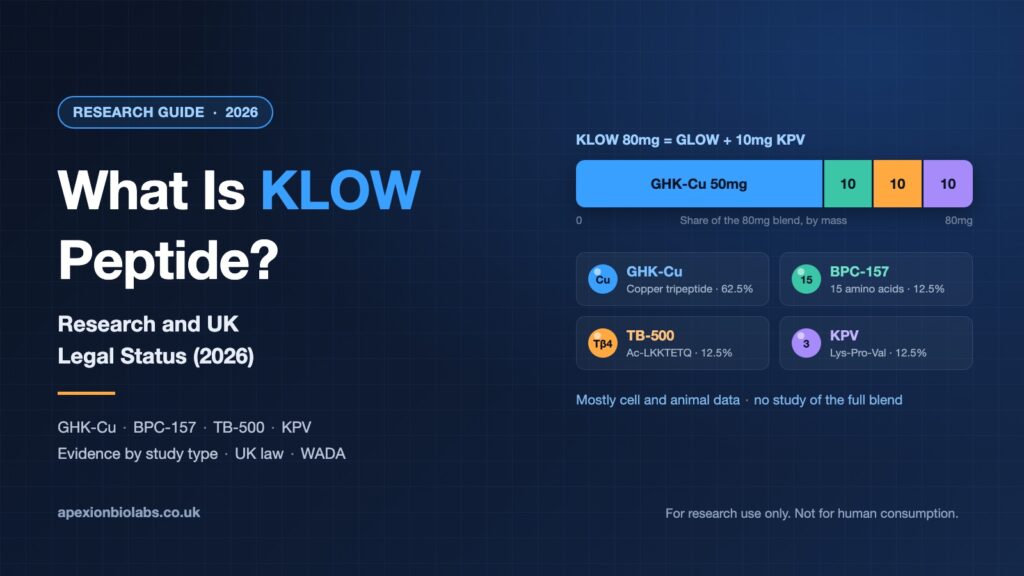
KLOW is an 80mg research blend of four compounds: GHK-Cu (50mg), BPC-157 (10mg), TB-500 (10mg) and KPV (10mg). It’s the three-compound GLOW blend with KPV added. Each component has its own cell and animal research, but nobody has published a study of all four in combination. Under UK law it’s sold for research use only.
- GLOW + 10mg KPV = 80mg
- Evidence is per component, mostly cell and animal
- UK: uncontrolled, unlicensed, sold for research use only
Apexion supplies KLOW 80mg as a pre-filled research pen, with batch details on the product page.
A lab manager unpacks a research pen labelled KLOW 80mg and goes looking for its paper trail. PubMed offers seven records. Every one is a radiology, cardiology or physiology paper, listed only because a researcher’s surname happens to be Klow.
So what is KLOW peptide, if the biggest medical database has never heard of it? It’s a supplier’s name for four compounds sharing one pen: GHK-Cu, BPC-157, TB-500 and KPV. Their research goes back to 1981, when scientists first sequenced thymosin beta-4, the protein TB-500 is cut from. Yet in the decades since, not one published study has put all four in the same experiment.
We’ve followed each compound’s trail on its own, with every finding tagged cell, animal or human. Then we checked where the blend stood under UK law in October 2026.
Research use only: Apexion sells KLOW for in-vitro and animal laboratory work only. Human and veterinary use fall outside its terms of sale. Read our Research Use Only notice.
What Is KLOW Peptide?
KLOW peptide is a fixed-ratio blend of four research compounds supplied together in one vial or pen. GHK-Cu, the copper-carrying member, makes up 50mg of the 80mg total. BPC-157, TB-500 and KPV contribute 10mg each, so the copper peptide accounts for five-eighths of the mass.
| Component | Amount | Share of 80mg | Class |
|---|---|---|---|
| GHK-Cu | 50mg | 62.5% | Copper tripeptide |
| BPC-157 | 10mg | 12.5% | 15-amino-acid peptide |
| TB-500 | 10mg | 12.5% | Thymosin beta-4 fragment |
| KPV | 10mg | 12.5% | Tripeptide (from alpha-MSH) |
The 50/10/10/10 recipe is the one most UK listings print, though nothing in law or chemistry fixes it. Suppliers choose their own amounts and pack sizes, so a vial carrying the same name can hold a different total or a different balance. The label’s per-component figures, checked against the certificate, are the only reliable guide to a given batch.
Why Is It Called KLOW?
The name grew out of GLOW, an older trade blend whose first letter came from GHK-Cu. Once sellers bolted KPV on as a fourth compound, the G became a K. KLOW, then, is shorthand for “GLOW plus KPV”.
It’s a marketing nickname with no chemical meaning. No journal, database or regulator uses it, and that’s exactly why those seven PubMed hits belong to a researcher called Klow.
What’s in the KLOW Blend?
Four compounds with four separate research histories. Two are tripeptides, one is a 15-residue chain and one is a short motif lifted from a 43-residue protein.
GHK-Cu (50mg)
GHK-Cu pairs the tripeptide glycine-histidine-lysine with one copper(II) ion. Biochemist Loren Pickart isolated GHK from human plasma in 1973, and decades later his team singled out its copper binding as “the most distinctive feature of GHK” (Pickart et al., 2015).
Most GHK-Cu work is cell research. Cultured fibroblasts have been used to track collagen and glycosaminoglycan output, and a 2018 gene-data review catalogued wide changes in gene expression in cell datasets. Human data come from small cosmetic studies of topical formulas. Our GHK-Cu research overview goes deeper.
BPC-157 (10mg)
Made by chemical synthesis, BPC-157 is a 15-residue sequence copied from a section of a larger gastric-juice protein. Its name, and a large share of its papers, come from Predrag Sikirić’s team in Zagreb, starting in the early 1990s.
Almost all of that work is animal research in rats, covering tendon, blood-vessel and gastric tissue models. A 2026 review co-written by Sikirić gathers it together. Human data remain very limited. For the full picture, read the BPC-157 UK guide.
TB-500 (10mg)
TB-500 is a seven-amino-acid fragment, Ac-LKKTETQ, taken from thymosin beta-4. It reproduces residues 17 to 23 of the 43-residue protein, the stretch that binds actin, so it carries the protein’s best-known motif without the rest.
The research is cell and animal work on actin handling and cell migration. In endothelial migration assays, Philp and colleagues (2003) found the motif and full thymosin beta-4 “display near-identical activity”. Much of the wider literature tested the full protein, which the TB-500 Peptide UK guide untangles in detail.
KPV (10mg)
KPV (lysine-proline-valine) mirrors the final three residues of alpha-MSH, a hormone processed from the larger precursor POMC. Weighing about 342 g/mol, KPV is the lightest of KLOW’s four molecules.
Studies are cell and animal work on inflammatory signalling. In a 2007 study, Guillaume Dalmasso and colleagues at Emory showed that the PepT1 transporter carries KPV into epithelial cells and T cells, where NF-κB signalling was measured. Follow-up work used chemically induced inflammation models in mice. The KPV peptide UK guide covers it all.
What Does KLOW Do in Research?
KLOW isn’t studied as a blend. Researchers study its components one at a time, and each one is examined through a different pathway: copper signalling, tissue-model biology, actin handling and inflammatory signalling. That spread across pathways is the reason labs put the four in one container.
| Component | Pathway studied | Model | Example study type |
|---|---|---|---|
| GHK-Cu | Copper binding, collagen and gene expression | Cell; small topical human studies | Fibroblast culture; gene-expression datasets |
| BPC-157 | Growth-factor (VEGFR2) and nitric-oxide pathways | Animal (rat) | Tendon and blood-vessel tissue models |
| TB-500 | Actin binding, cell migration | Cell and animal | Endothelial cell migration; aortic-ring sprouting |
| KPV | NF-κB inflammatory signalling, PepT1 transport | Cell and animal (mouse) | Epithelial cell lines; induced-inflammation mouse models |
Read across the table and a pattern appears. Each compound has been studied in its own type of model, with its own readouts, by largely separate research groups. The blend is a hypothesis that four pathways might be observed together in one model. Whether that’s true is an open research question, and the next section looks at how much evidence exists for it.
What Does the Research on KLOW Actually Show?
There are no published studies of the four-compound blend. A PubMed search we ran on 22 October 2026, combining all four compound names and their common synonyms, returned zero records. Every finding covered above belongs to a single component, with nearly all of it drawn from cell cultures and animals.
Figure 1: PubMed records per KLOW component, the BPC-157 and TB-500 pair, and the four-compound blend, searched 22 October 2026
Only half of KLOW has ever been tested as a mixture. Biçer and colleagues (Joint Diseases and Related Surgery, July 2026) compared rats given BPC-157, TB-500, both, or neither (study record). On their tendon measures, the combination added nothing measurable beyond either compound alone.
That result shows why a combination can’t borrow its evidence from its parts. Mixing compounds creates a new test condition. They may act independently, add up, cancel out or interact chemically in the container. Only a study of the mixture itself can tell those apart, which is the “proof” question our peptide stacks guide works through for every common blend.
So the evidence for KLOW today is four separate dossiers sharing a label.
KLOW vs GLOW vs Wolverine
The three blends nest inside one another. Wolverine is the two-compound base of BPC-157 plus TB-500, GLOW brings in GHK-Cu, and KLOW then tops GLOW up with KPV.
| Blend | GHK-Cu | BPC-157 | TB-500 | KPV | Total |
|---|---|---|---|---|---|
| Wolverine | None | 10mg | 10mg | None | 20mg |
| GLOW | 50mg | 10mg | 10mg | None | 70mg |
| KLOW | 50mg | 10mg | 10mg | 10mg | 80mg |
KLOW = GLOW + KPV. Wolverine = BPC-157 + TB-500. Only Wolverine’s pairing has a published combination study, the 2026 rat paper above.
We compare the first two side by side in KLOW vs GLOW: the key difference. The individual blends are listed as the GLOW 70mg research pen and the Wolverine 20mg blend.
Is KLOW Peptide Legal in the UK?
Yes, KLOW is lawful to sell and hold for laboratory research across the UK. None of its four components is a controlled drug in the UK and none holds a medicine licence, which means it can be sold to labs but can’t be sold or presented for human use.
Four pieces of law and guidance apply (checked October 2026):
| Instrument | Scope | KLOW’s position |
|---|---|---|
| Human Medicines Regulations 2012 | Defines a medicinal product; bars supply of unlicensed medicines | Unlicensed, so it can’t be promoted as a medicine |
| Misuse of Drugs Act 1971 | Class A, B and C controlled drugs | None of the four is listed |
| Psychoactive Substances Act 2016 | Mind-altering substances | No such effect recorded for any component |
| MHRA Guidance Note 8 | Medicines by presentation | Health claims, testimonials or use instructions would make a listing a medicine |
Guidance Note 8 carries the most weight day to day. The MHRA judges a product partly by how it’s presented, so the words on a listing, a social post or even an image can turn a research material into an unlicensed medicine. A blend sold with promises about what it does to people fails that test, whatever the small print says.
The wider picture is in our guide are peptides legal in the UK.
Can You Buy KLOW in the UK?
Laboratories can, from UK suppliers that sell under research-use-only terms. Pharmacies don’t stock it, and there’s no prescription route through the NHS or privately, because none of the four components has a licence to prescribe against. Apexion’s conditions of sale are set out in the Research Use Only notice.
Does the 2026 US FDA Peptide Review Change Anything in the UK?
Nothing changes in the UK. The FDA’s Pharmacy Compounding Advisory Committee met on 23 July 2026 and backed BPC-157, KPV and TB-500 by eight votes to six for the list of substances US compounding pharmacies may use, as PharmExec covered. It’s a recommendation that still needs formal FDA rulemaking, and it applies only to American pharmacies. Parliament and the MHRA set UK status.
Is KLOW Banned in Sport?
Two of KLOW’s components are named on the WADA Prohibited List: BPC-157 in class S0, for non-approved substances, and TB-500 in class S2, the peptide hormone and growth factor class. A blend containing them falls under those entries.
KPV and GHK-Cu aren’t named on the 2026 list or on WADA’s 2027 list, released in September 2026. From 1 January 2027, S0 gives “peptides” as an example and applies to any compound lacking approval as a human medicine, listed by name or not. UK Anti-Doping applies the list in Britain.
KLOW Formats: Powder Vial vs Pre-Filled Pen
KLOW is supplied in two forms. A vial holds the four compounds as one freeze-dried powder cake. A pre-filled pen holds a supplier-prepared solution with a stated concentration, kept cold as the batch sheet directs.
| Powder vial | Pre-filled research pen | |
|---|---|---|
| State | Freeze-dried (lyophilised) solid | Solution prepared by the supplier |
| What the label states | Total mg, ideally per-component mg | Total mg and the solution’s concentration |
| Records | Lab prepares and records its own solution | Preparation recorded by the supplier against the batch |
| Storage | Cold and dry, sealed from light | Cold, per the batch sheet |
The main difference for a lab is who prepares the solution and whose records cover it. With a pen, that step is documented upstream against the lot.
Apexion supplies KLOW as an 80mg pre-filled research pen, with each one filled to order in Britain. Our peptide pen vs vial guide compares the formats in depth, and peptide pens UK explains how research pens are made and documented.
How to Verify a KLOW Batch
A blend’s certificate of analysis should identify and measure all four components separately. One overall purity figure for the mixture can’t show whether a single component is short, degraded or missing, and since GHK-Cu accounts for 62.5% of the weight, it can easily mask a shortfall in a 10mg partner.
Check five points against the batch in hand:
| Check | What a good blend COA shows |
|---|---|
| Lot match | The same lot code on the pen or vial and the certificate |
| Separate HPLC per component | Four purity figures, one per compound, plus the column and detector used |
| LC-MS mass for each of the four | An observed mass matching each compound’s known value |
| mg per component vs the label | Measured content for each compound beside the labelled 50/10/10/10 |
| Independent lab and date | A named third-party lab and a test date for that lot |
Figure 2: Four separate results a KLOW certificate should carry, one lane per component with labelled mg, share of the blend and expected mass
The mass check is quick because the four molecules are so far apart in size. Any reading that doesn’t match one of the four expected values needs an explanation from the supplier before the batch is used.
Two guides take this further: how to read a peptide certificate of analysis and how to verify a research peptide batch. Apexion lot codes can be checked on the batch verification page.
Frequently Asked Questions
KLOW peptide is made of four research compounds: GHK-Cu (50mg), BPC-157 (10mg), TB-500 (10mg) and KPV (10mg). Together they weigh 80mg. In plain terms: one copper-carrying tripeptide, one 15-residue chain from gastric-juice research, the actin-gripping motif of thymosin beta-4 and a C-terminal snippet of alpha-MSH.
No. GLOW is the three-compound version, totalling 70mg of GHK-Cu, BPC-157 and TB-500. KLOW keeps every one of those amounts and adds 10mg of KPV, reaching 80mg. The K in the name flags the newcomer, and KPV is the only difference between the two.
The 80 is the total mass of all four compounds in the container, measured in milligrams. That’s 50mg of the copper peptide plus 10mg apiece of the other three. The total alone doesn’t reveal the balance, so the label and certificate should list each component’s amount.
No. No study of any kind, human or animal, has tested the four-compound blend, and a PubMed search on 22 October 2026 found zero records. Human data exist for GHK-Cu only in small topical cosmetic studies. The nearest combination data come from a single 2026 rat paper pairing BPC-157 with TB-500.
Yes, for laboratory research. None of the four is scheduled as a controlled drug by the 1971 Misuse of Drugs Act, and none carries an MHRA licence. Suppliers can sell it to labs under research-use-only terms, but selling or presenting it for human use would breach the Human Medicines Regulations 2012.
KLOW comes either as a freeze-dried cake in a glass vial or as a supplier-prepared solution inside a pre-filled pen. Apexion’s KLOW is an 80mg research pen that’s filled for each order in Britain. Whichever format, the batch certificate should give a separate result for every component.
The Bottom Line
KLOW is a trade name for four compounds in one container: 50mg of GHK-Cu alongside 10mg apiece of BPC-157, TB-500 and KPV. The research behind it is real but separate, mostly cell and animal work on each component, and nobody has published a study of the blend. UK law allows it as an unlicensed, uncontrolled research material, while two of its components appear on WADA’s list. Judge any batch by a certificate that measures all four.
Lab buyers will find the blend’s details on its KLOW 80mg specification and COA listing.
References and Editorial Review
This guide relies on primary sources:
- Pickart L, Vasquez-Soltero JM, Margolina A. BioMed Research International, 2015. GHK peptide and copper binding (PMC4508379).
- Pickart L, Margolina A. International Journal of Molecular Sciences, 2018. GHK and gene-expression data (PMC6073405).
- Matek D, Sikirić P, et al. Pharmaceuticals (Basel), 2026. Review of BPC-157 research (PMC12944561).
- Philp D, et al. FASEB Journal, 2003. Thymosin beta-4 actin-binding motif and endothelial cell migration (PMID 14500546).
- Dalmasso G, et al. Gastroenterology, 2007. PepT1-mediated KPV transport in epithelial cells and T cells (PMC2431115).
- Biçer O, et al. Joint Dis Relat Surg, 2026;37(3):822-837. BPC-157 and TB-500 in a rat Achilles tendon model (DOI 10.52312/jdrs.2026.2951).
- PharmExec. FDA panel votes on four peptides, 24 July 2026.
- Human Medicines Regulations 2012, Misuse of Drugs Act 1971 and Psychoactive Substances Act 2016.
- MHRA Guidance Note 8: A guide to what is a medicinal product.
- WADA Prohibited List 2026 and 2027 and UK Anti-Doping.
PubMed searches run 22 October 2026 by the Apexion editorial team. Regulatory information checked October 2026.
Disclaimer: Apexion publishes this page to inform laboratory research. KLOW is sold strictly as an in-vitro and animal research reagent; it isn’t approved as a medicine, food or supplement and must stay out of human and veterinary use. This page gives no medical or legal advice, and its regulatory information is subject to update. See our Research Use Only notice.