
KLOW vs GLOW Peptide Blend: Key Differences Compared
Quick answer
What is the difference between KLOW and GLOW?
GLOW is a 70mg three-peptide blend of GHK-Cu (50mg), BPC-157 (10mg) and TB-500 (10mg). KLOW is an 80mg four-peptide blend containing the same three compounds in the same amounts, plus 10mg of KPV. KPV is the only compositional difference, and it’s a tripeptide studied mainly in inflammatory-signalling research.
Key takeaways
- Both blends share one core: GHK-Cu, BPC-157 and TB-500.
- KLOW adds 10mg of KPV to that core.
- GLOW 70 and KLOW 80 are named after their total milligrams.
- Pick the blend that matches what your study measures, and check every component on the batch certificate.
Below, we break down what’s in each blend, what KPV adds, what “70” and “80” mean, and how both compare with the Wolverine stack and with GHK-Cu on its own.
All compound blends are supplied for laboratory research use only and are Research Use Only.
What Is the GLOW Peptide Blend?
GLOW is a three-peptide research blend of GHK-Cu, BPC-157 and TB-500, most often supplied as 70mg: 50mg of GHK-Cu with 10mg each of BPC-157 and TB-500. Laboratories study it in models of skin structure, collagen and connective tissue, where all three compounds have their own published research.
What Is GLOW Peptide Made Of?
| Compound | Amount | What it’s studied for |
|---|---|---|
| GHK-Cu (glycyl-L-histidyl-L-lysine copper complex) | 50mg | A copper-binding tripeptide studied in collagen production and tissue remodelling |
| BPC-157 (body protection compound-157) | 10mg | A 15-amino-acid peptide studied in tendon, tissue and blood-vessel-formation models |
| TB-500 (a fragment of thymosin beta-4) | 10mg | A short synthetic peptide studied in cell-migration research |
GHK-Cu makes up about 71% of the blend by weight. That’s why GLOW is often described as a “GHK-Cu-led” formula, with the other two compounds in supporting amounts.
Why These Three Compounds Are Studied Together
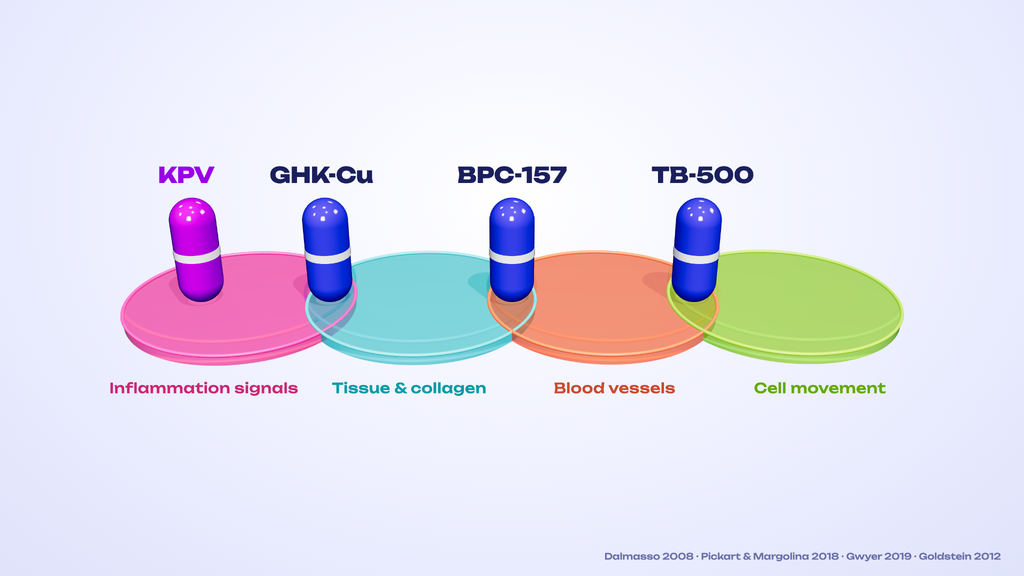
Each compound reaches a different part of the same repair process. In published models, GHK-Cu is linked to collagen and matrix remodelling, BPC-157 to blood-vessel formation, and TB-500 to the way cells move into damaged tissue. Researchers combine them to look at those overlapping pathways in one model, with a single preparation. Full compound details and the batch certificate are on the GLOW 70mg research pen specification & COA page. For how blends like this compare with other common combinations, see peptide stacks explained.
What Is the KLOW Peptide Blend?
KLOW is an 80mg four-peptide research blend. It contains GLOW’s GHK-Cu (50mg), BPC-157 (10mg) and TB-500 (10mg), plus 10mg of KPV. It’s studied in the same tissue models as GLOW, with extra attention on inflammation-signalling pathways, the area where most KPV research has been done.
What Is KLOW 80?
“80” is the total number of milligrams in each pen or vial: 50 + 10 + 10 + 10. The name spells out the formula. The K stands for KPV and “LOW” comes from GLOW, so KLOW is shorthand for “GLOW with KPV”. Some suppliers print the total on the label (KLOW 80) and others leave it off, which is why the same blend can appear under both names.
KLOW Composition at a Glance
- GHK-Cu, 50mg: the copper tripeptide from GLOW, now 62.5% of the blend
- BPC-157, 10mg: unchanged from GLOW
- TB-500, 10mg: unchanged from GLOW
- KPV, 10mg: lysine-proline-valine, the last three amino acids of the hormone α-MSH
The compound list, batch number and certificate are on the KLOW 80mg research pen specification & COA page.
What Is the Difference Between KLOW and GLOW Peptide?
The difference is KPV. KLOW contains everything in GLOW at the same amounts, plus 10mg of KPV. Three things follow from that. The total rises from 70mg to 80mg, GHK-Cu’s share of the blend falls from about 71% to 62.5%, and inflammation-signalling measurements become part of what the blend is used to study. Our KPV peptide guide covers what KPV is and how it’s studied.
KLOW vs GLOW Head-to-Head Comparison
| GLOW | KLOW | |
|---|---|---|
| Total content | 70mg | 80mg |
| Number of compounds | 3 | 4 |
| GHK-Cu | 50mg | 50mg |
| BPC-157 | 10mg | 10mg |
| TB-500 | 10mg | 10mg |
| KPV | none | 10mg |
| GHK-Cu share of blend | ~71% | ~62.5% |
| Main research areas | Skin structure, collagen, tissue-repair models | The same, plus inflammation-signalling models |
| Apexion format | 70mg pre-filled research pen | 80mg pre-filled research pen |
| Apexion price | £175 | £195 |
GLOW and KLOW carry identical amounts of GHK-Cu, BPC-157 and TB-500, so any comparison between them comes down to KPV. KLOW costs £20 more for its extra 10mg. GLOW keeps a higher concentration of GHK-Cu, while KLOW spreads the same GHK-Cu across a larger total.
The share change has a knock-on effect in study design. Each milligram of GLOW carries about 0.71mg of GHK-Cu, and each milligram of KLOW carries 0.625mg. If two study arms are matched by total blend weight, the KLOW arm receives less GHK-Cu, BPC-157 and TB-500 than the GLOW arm. Matching by pen, or by GHK-Cu content, keeps the shared core identical and leaves KPV as the only variable.
What Does KPV Add to KLOW?
KPV (lysine-proline-valine) is the last three amino acids of alpha-melanocyte-stimulating hormone, or α-MSH. It’s studied mainly for its role in inflammation signalling, especially the NF-κB pathway, and in models of the gut lining and skin cells. In KLOW, it adds an inflammation-focused compound to a core built around tissue structure.
What Is KPV Peptide?
α-MSH is a 13-amino-acid hormone best known for its role in skin pigmentation. Scientists found that its tail end, the three amino acids K-P-V, kept much of the hormone’s anti-inflammatory activity on its own. A 2008 review in Endocrine Reviews by Brzoska and colleagues described KPV as keeping α-MSH’s anti-inflammatory effect while lacking its pigmentary action. That combination is the reason KPV became a research compound in its own right.
The UK has its own piece of the story. Researchers at the University of Sheffield studied KPV signalling in human keratinocytes (skin cells) in 2004, describing the tail-end tripeptides of α-MSH as “the smallest minimal sequences reported to prevent inflammation”.
KPV and NF-κB Inflammatory Signalling Research
NF-κB is a protein complex that works like a master switch inside cells, turning on genes that drive inflammation. In a 2008 Gastroenterology study, Dalmasso and colleagues reported that nanomolar concentrations of KPV inhibited NF-κB and MAP kinase signalling in human intestinal cells and immune cells. In mouse models of colitis, KPV reduced pro-inflammatory cytokine expression. A German team using two other mouse colitis models reported similar anti-inflammatory effects in the same year.
GLOW already has a foothold on this pathway. Pickart and Margolina (2018) list NF-κB among the molecules GHK is reported to suppress. KPV gives KLOW a second, more targeted compound on a pathway the core already touches.
KPV in Epithelial and Barrier Research
The same Dalmasso study showed how KPV gets into cells. It’s carried by PepT1, a transporter for small peptides that is normally found in the small intestine and appears in the colon during inflammation. That discovery shaped later work: a 2017 study in Molecular Therapy loaded KPV into hyaluronic-acid nanoparticles aimed at colon-lining cells and immune cells in mouse models.
Adding KPV lets one blend cover inflammation-signalling measurements alongside GLOW’s tissue focus. The single compound is also available as KPV 10mg.
The Shared Core: GHK-Cu, BPC-157 and TB-500
Both blends are built on the same three compounds in the same amounts. Everything in this section applies equally to KLOW and GLOW, and these three compounds account for 70mg of each pen. Each one has its own research history, stretching back to the 1970s for GHK.
GHK-Cu
GHK is a tripeptide found naturally in human plasma, saliva and urine, and its levels fall with age. It binds copper tightly, and the copper complex is the form studied in most research. A 2015 review by Pickart, Vasquez-Soltero and Margolina described GHK stimulating collagen, decorin and glycosaminoglycans in laboratory models. The same review reported that GHK can up- and down-regulate at least 4,000 human genes. There’s more background in our GHK-Cu research overview, and the single compound is listed as GHK-Cu 50mg.
BPC-157
BPC-157 is a 15-amino-acid peptide based on a sequence from a protein found in gastric juice. It’s studied in tendon, ligament, muscle and blood-vessel-formation models. A 2019 review from Loughborough University’s National Centre for Sport and Exercise Medicine found consistently positive results across the soft-tissue studies it examined, while noting that most were carried out in small rodent models. That rodent-led evidence base is the one researchers work from today. For how it compares with TB-500, see BPC-157 vs TB-500, or view BPC-157 10mg.
TB-500
TB-500 is a synthetic peptide based on thymosin beta-4 (Tβ4), a 43-amino-acid protein present in almost every human cell. Goldstein and colleagues (2012) describe Tβ4 binding to actin, the protein that forms a cell’s internal scaffolding, and promoting cell migration. The active part is small: a 2003 study found that the seven-amino-acid actin-binding sequence LKKTETQ promoted repair in aged mice at levels comparable to the full protein. That short sequence is the basis of most TB-500 research material. The single compound is available as TB-500 10mg.
KLOW 80 vs GLOW 70: What Do the Numbers Mean?
The numbers are total milligrams. GLOW 70 is GHK-Cu 50mg + BPC-157 10mg + TB-500 10mg. KLOW 80 adds KPV 10mg. The three shared compounds come in identical amounts in both blends, so the extra 10mg in KLOW is entirely KPV.
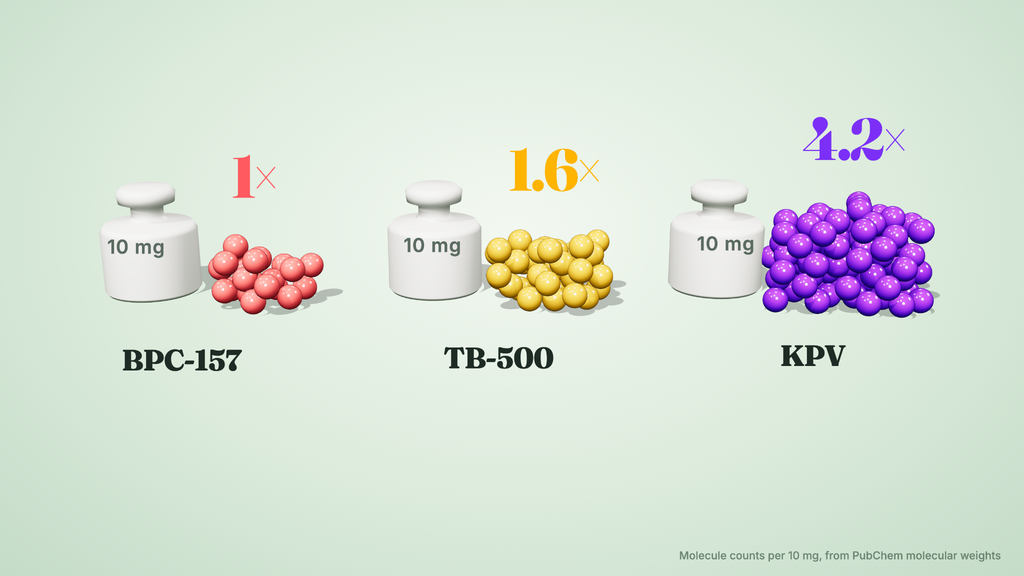
Milligrams measure weight, though, and peptides differ a lot in size. KPV weighs about 342 daltons per molecule, while BPC-157 weighs about 1,420 (PubChem). The same 10mg of KPV therefore holds roughly four times as many molecules as 10mg of BPC-157. On the label, KPV is 12.5% of KLOW. Counted in molecules, it’s closer to a sixth.
Some suppliers sell other totals, such as KLOW 70 or a 30mg GLOW, so read the amount of each component and ignore the headline number.
Is KLOW Peptide Worth It Compared With GLOW?
It depends on the research design. If a study measures inflammation signalling, KLOW includes KPV without needing a separate compound. If a study focuses only on tissue and collagen pathways, GLOW covers the same core for £20 less. The better choice is the one that matches the measurements you plan to take.
Cost Comparison
| Option | What you get | Apexion price |
|---|---|---|
| GLOW 70mg | GHK-Cu 50mg + BPC-157 10mg + TB-500 10mg | £175 |
| KLOW 80mg | The GLOW core + KPV 10mg | £195 |
| GLOW’s three compounds bought separately | GHK-Cu 50mg (£65) + BPC-157 10mg (£65) + TB-500 10mg (£90) | £220 |
| KLOW’s four compounds bought separately | The above + KPV 10mg (£90) | £310 |
KPV costs £90 as a single pen and £20 as the step from GLOW to KLOW. So a design that needs all four compounds together is cheaper as KLOW, and a design that needs KPV on its own time course is better served by the single KPV 10mg pen.
When a Single-Compound Design Makes More Sense
A blend answers a combined question. When four compounds go in together, it’s hard to say which one produced a change in a measurement. Single compounds keep each variable separate, which is the standard route for dose-response work or for testing one mechanism. Predrag Sikirić, whose University of Zagreb lab produced much of the early BPC-157 research, put the open-ended nature of this work well in a June 2026 interview with Chemistry World: “In science, you are never all done. There is always an area that still has to be investigated.”
Which Blend Fits Your Research?
Neither blend is “better” in general. Each suits a different study design, and the right pick follows from what you plan to measure. The table below matches four common designs to the blend, or single compound, that covers them without extra variables.
| If your study… | Choose |
|---|---|
| Measures only skin structure, collagen or tissue-remodelling pathways | GLOW |
| Also measures inflammation-signalling markers such as NF-κB or cytokines | KLOW |
| Needs to isolate the effect of one variable | Single compounds |
| Leaves GHK-Cu out of the design | Wolverine (BPC-157 + TB-500) |
The easiest way to choose is to work backwards from your endpoints. A GLOW study usually measures structural outcomes such as collagen deposition, hydroxyproline content, tube formation in blood-vessel assays or cell movement in scratch-wound assays. A KLOW study adds signalling readouts on top: NF-κB reporter activity, or cytokines such as TNF-α and IL-6 measured by ELISA. If none of your planned readouts involve inflammation, KPV adds a compound without adding data.
KLOW vs GLOW vs Wolverine Stack
The Wolverine stack is the two-compound base: BPC-157 + TB-500. GLOW adds GHK-Cu, and KLOW adds GHK-Cu plus KPV. Each blend adds one compound to the one before, so the three form a ladder. At Apexion, the steps cost £120, £175 and £195, so moving from Wolverine to GLOW adds 50mg of GHK-Cu for £55, and moving from GLOW to KLOW adds 10mg of KPV for £20.
| Blend | BPC-157 | TB-500 | GHK-Cu | KPV | Compounds |
|---|---|---|---|---|---|
| Wolverine | ✓ | ✓ | none | none | 2 |
| GLOW | ✓ | ✓ | ✓ | none | 3 |
| KLOW | ✓ | ✓ | ✓ | ✓ | 4 |
The ladder also clears up a common mix-up. KLOW carries exactly the same BPC-157 and TB-500 as Wolverine, 10mg of each, and then adds 60mg of other compounds on top. For the two-compound option, see the BPC-157 + TB-500 20mg (Wolverine) blend, and for the pair compared head to head, BPC-157 vs TB-500.
KLOW and GLOW vs GHK-Cu Alone
GHK-Cu on its own isolates the copper-peptide variable. GLOW and KLOW study it alongside BPC-157 and TB-500, and in KLOW’s case KPV too. The choice comes down to what else goes in with it, and a single pen is the cleanest way to get a GHK-Cu-only baseline.
The single pen carries the same 50mg of GHK-Cu found in both blends. That makes a three-arm design possible: GHK-Cu alone, GLOW and KLOW. Comparing the arms shows what the copper peptide does by itself, what BPC-157 and TB-500 add to it, and what KPV adds on top.
A GHK-Cu-only design is the cleaner route for single-variable studies and for gene-expression work, where Pickart’s 4,000-gene findings give a clear starting point. At £65, GHK-Cu 50mg is also the lowest-cost way into copper-peptide research. Our GHK-Cu research overview covers the compound in more depth.
Not Every “GLOW” Is the Same Formula
The name “GLOW” is used for more than one product. Some US clinics use it for a different mixed formula of GHK-Cu, glutathione and vitamin C, which shares only one ingredient with the research blend. Supplier versions of the peptide blend also vary, from 70mg down to 30mg totals with 10mg of each compound.
Even popular online summaries quote ranges of 5 to 10mg for BPC-157 and TB-500 and 20 to 50mg for GHK-Cu. So check the component list and the milligrams of each compound on the label and certificate, and treat the product name as a starting point. (Glutathione is sold as a separate compound at Apexion.)
Pre-Filled Pen vs Vial: KLOW and GLOW Formats
KLOW and GLOW come either as freeze-dried powder in vials or as pre-filled research pens. The main differences are the preparation steps, the chance of contamination during handling, and how batches are labelled. A vial arrives as powder and a pen arrives ready.
| Vial | Pre-filled research pen | |
|---|---|---|
| Arrives as | Freeze-dried (lyophilised) powder | Ready-prepared in the pen |
| Lab preparation | Mixing (preparing) before measurement | Prepared fresh to order before dispatch |
| Handling steps | More transfers between containers | Fewer transfers in the lab |
| Batch labelling | On the vial | On the pen, tied to a batch certificate |
Apexion supplies both blends as pre-filled pens, prepared to order in the UK. Each pen carries a batch number that links back to its certificate, so the record for a study arm stays tied to the exact material used. For a fuller comparison, read pre-filled pens vs vials.
How Are KLOW and GLOW Tested?
Each component of a blend should be identified and measured separately. The usual methods are HPLC (high-performance liquid chromatography) for purity and LC-MS (liquid chromatography-mass spectrometry) for identity. Testing each compound on its own confirms that all three or four are present, correct and in the amounts stated on the label.
A blend certificate should show:
- every component by name
- the milligrams and purity of each component
- the batch number, matching the one on the pen or vial
- the name of the testing laboratory
- the test date
A certificate that gives a single purity figure for the whole blend is a warning sign. It can’t tell you whether one compound is under-filled or missing.
Mass spectrometry answers a second question for TB-500. The name is used for both the short seven-amino-acid fragment and full-length thymosin beta-4, which weigh about 889 and 4,963 daltons respectively. A measured mass shows which one is in the batch. Our guides explain how to read a peptide COA and how to verify a research peptide batch, and Apexion batch verification lets you check a batch number against its certificate.
Storage and Handling of Peptide Blends
Blends need the same care as single peptides, with one extra reason: every compound in the mix has to stay stable at the same time. Standard lab practice:
- Store cold, with long-term storage typically at −20 °C.
- Keep away from light and heat.
- Avoid repeated freezing and thawing.
- Log the date each pen or vial is opened, next to its batch number.
- Keep blends and single compounds in clearly separated, labelled storage, since GLOW, KLOW and GHK-Cu pens share several of the same compound names.
Our guide to peptide storage and handling covers temperatures and logging in more detail.
Are KLOW and GLOW Legal?
In the UK, KLOW and GLOW are sold as research materials only. None of their components are licensed medicines. BPC-157 and TB-500 are on the WADA list of substances banned in sport, so labs that work with athletes or sports bodies need to keep that in view.
UK law decides whether a product is a medicine by how it’s presented and used. Under the Human Medicines Regulations 2012, anything sold with claims about treating or preventing disease in people counts as a medicinal product and needs a licence. Research blends are sold with compound identity, purity and batch data only, which keeps them in the research-materials category.
The WADA 2026 Prohibited List names BPC-157 under section S0 (non-approved substances) and “Thymosin-ß4 and its derivatives e.g. TB-500” under section S2. Both bans apply at all times, in and out of competition.
Frequently Asked Questions
KLOW contains a fourth peptide, KPV, and GLOW doesn’t. Both blends share GHK-Cu (50mg), BPC-157 (10mg) and TB-500 (10mg) in identical amounts. KLOW adds 10mg of KPV, bringing the total from 70mg to 80mg and adding inflammation-signalling research to the blend’s scope.
Yes. KLOW uses the same three-compound core as GLOW in the same amounts: 50mg of GHK-Cu, 10mg of BPC-157 and 10mg of TB-500. The only addition is 10mg of KPV, which is why the name swaps GLOW’s G for a K. The extra 10mg lifts the total from 70mg to 80mg and lowers GHK-Cu’s share of the blend from about 71% to 62.5%.
KLOW 80 means the blend contains 80mg in total. That total is made up of 50mg of GHK-Cu, 10mg of BPC-157, 10mg of TB-500 and 10mg of KPV. Some suppliers sell other totals under the same name, so check the milligrams of each compound on the label.
No. The Wolverine stack contains only BPC-157 and TB-500, usually 10mg of each for 20mg in total. KLOW includes those same two compounds and adds GHK-Cu (50mg) and KPV (10mg), making it a four-peptide, 80mg blend. At Apexion, Wolverine is a 20mg pen at £120 and KLOW is an 80mg pen at £195.
Yes. Because the two blends share an identical core, a study can run them side by side and treat KPV as the single variable. Any difference in inflammation-signalling measurements between the two groups can then be linked to the added KPV. Matching the arms by pen, and not by total milligrams, keeps the GHK-Cu, BPC-157 and TB-500 content the same in both.
Apexion Biolabs supplies both as pre-filled research pens, prepared to order in the UK, with batch documentation and tracked UK delivery. GLOW 70mg is £175 and KLOW 80mg is £195. Both are sold for laboratory research use only and are Research Use Only.
KLOW vs GLOW: The Bottom Line
KLOW and GLOW share the same three-peptide core, and the one difference is 10mg of KPV. Choose GLOW for tissue and collagen designs, KLOW when inflammation signalling is part of what you measure, and single compounds when one variable needs to stand alone. Then check the amount of every component on the batch certificate.
See all Apexion research blends. All Apexion research peptide pens are for laboratory research use only and are Research Use Only.