
Tesamorelin UK: What It Is, Legal Status and Research (2026)
Reviewed by Oscar Reyes, PhD, Synthesis Lead at Apexion BioLabs · Scientific review of the chemistry and analytical content
Quick answer
What is Tesamorelin?
Tesamorelin is a synthetic, stabilised form of growth hormone-releasing hormone (GHRH). In the US, tesamorelin is an approved medicine (Egrifta) for one narrow use. UK regulators have never granted it a marketing authorisation, which leaves it outside the medicines system here. Buying it is legal only as a laboratory research material.
- A 44-amino-acid GHRH analogue that acts on the pituitary
- Not a controlled drug, but not licensed or available on the NHS in the UK
- Banned in sport under WADA S2
Search “tesamorelin UK” and page one is a wall of research shops. Click through to the US results and you’ll land on clinic pages talking about prescriptions, pharmacy collection and insurance cover. Both sets of pages describe the same 44-amino-acid molecule. Tesamorelin is a licensed drug in the United States and a research material in the UK, and most of the muddled claims online come from blending those two stories together.
Below, we pull them apart. You’ll get what tesamorelin is, how it acts on the pituitary, what UK law and anti-doping rules say about it, how it compares with ipamorelin and CJC-1295, and what to check on a batch certificate.
Apexion Biolabs supplies tesamorelin as a laboratory research material, covered by our Research Use Only policy. The page contains no medical advice.
What Is Tesamorelin?
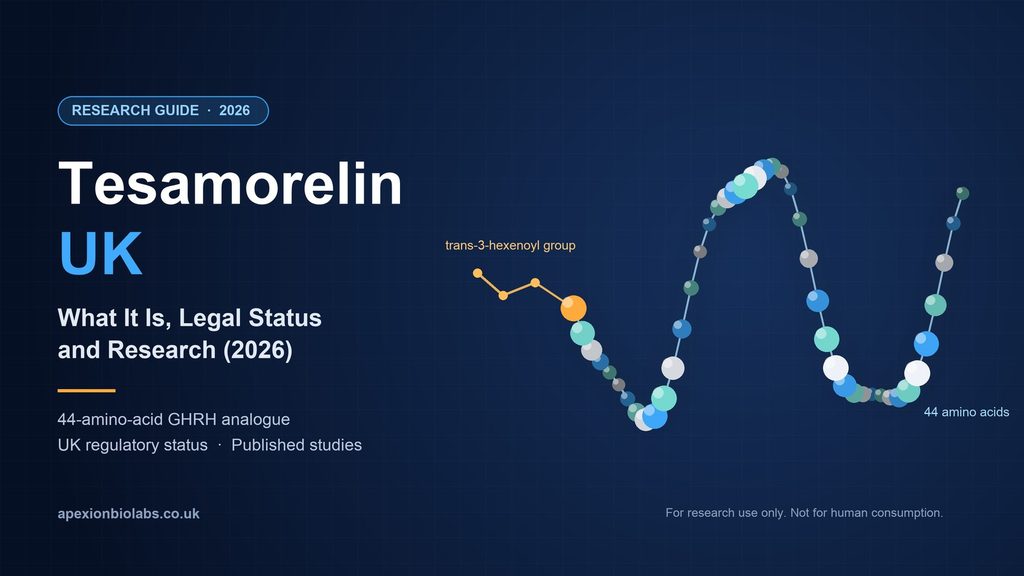
Tesamorelin is a synthetic analogue of human growth hormone-releasing hormone, GHRH(1-44). It keeps all 44 amino acids of the natural hormone and adds a trans-3-hexenoyl group to the first one. That small cap helps the molecule survive the enzyme that strips natural GHRH apart within minutes, while the receptor-binding sequence stays untouched.
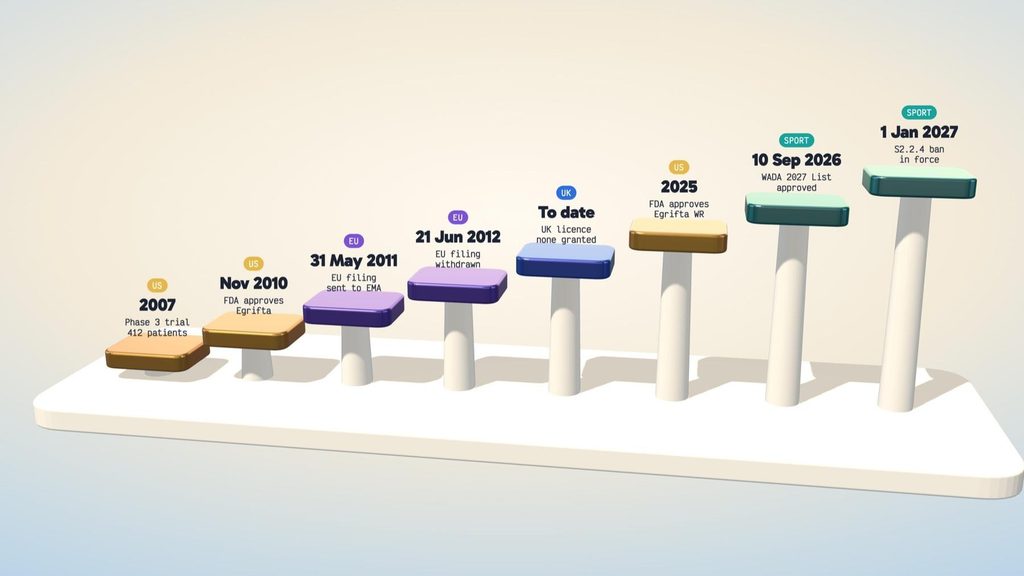
Theratechnologies, a Canadian drug developer, created it. The FDA approved it as Egrifta in November 2010, a date recorded in Adrian et al. (2018).
Structural Stabilization
Natural GHRH has a weak spot at its front end. An enzyme called dipeptidyl peptidase-4 (DPP-4) clips off the first two amino acids, tyrosine and alanine, and the shortened fragment loses most of its activity. Tesamorelin’s trans-3-hexenoyl group is fixed to that first tyrosine, which blocks the cut.
Everything after the cap matches the human hormone residue for residue. So researchers get a full-length GHRH sequence with a longer working window, and no change to the part that docks with the receptor.
| Detail | Tesamorelin |
|---|---|
| Name | Tesamorelin (US brand name: Egrifta) |
| Class | Stabilised GHRH(1-44) analogue |
| Length | 44 amino acids |
| Formula | C221H366N72O67S (PubChem) |
| Molecular weight | About 5,135.9 g/mol |
| CAS number | 218949-48-5 |
| Reference form | Lyophilised powder as the standard reference; our material comes as a pre-filled 20mg research pen |
| Storage | Chilled, kept dry and shielded from light, per the batch sheet |
| UK status | Research material with no marketing authorisation |
What Is Tesamorelin Used For?
In the US, tesamorelin has one approved use: reducing excess abdominal fat in adults with HIV who have lipodystrophy, a condition that changes where fat is stored. It’s prescription-only and sold as Egrifta SV and, since 2025, Egrifta WR. The FDA label states it isn’t indicated for weight-loss management. In the UK, its only use is laboratory research. Lot details for our material are on the Tesamorelin 20mg specification and COA page.
How Does Tesamorelin Work?
Tesamorelin binds GHRH receptors on somatotrophs, the growth hormone-producing cells of the anterior pituitary. The receptor raises cAMP inside the cell, the cell releases stored growth hormone (GH) in pulses, and GH then prompts the liver to make IGF-1. Studies track IGF-1 because it’s steadier and easier to measure than GH pulses.
Here’s the chain, one step at a time:
- Binding: tesamorelin docks with the GHRH receptor, a G-protein-coupled receptor on somatotroph cells.
- Signal: cAMP rises and switches on protein kinase A.
- Release: stored GH leaves the cell in bursts, keeping to the pituitary’s own rhythm.
- Readout: circulating GH reaches the liver, which produces IGF-1.
The clearest picture of that pattern comes from Massachusetts General Hospital. Stanley and colleagues gave healthy men tesamorelin for two weeks and concluded that it “augments basal and pulsatile GH secretion” (JCEM, 2011). A companion study by Makimura et al. followed 13 men on the same schedule and found that it “increased endogenous GH release and IGF-1” (Growth Hormone & IGF Research, 2011).
The pulse detail is the reason GH-axis researchers treat releasing factors as their own category. Tesamorelin acts upstream, so the pituitary still sets the timing and the somatostatin and IGF-1 feedback loops stay in place. Recombinant growth hormone skips the pituitary entirely.
Tesamorelin in the US vs the UK: Approved Drug or Research Material?
The same molecule has very different statuses depending on the border. The US approved tesamorelin as a prescription medicine, Egrifta, in 2010. In the EU, the marketing authorisation application was withdrawn in 2012 before any decision. The UK has never licensed it, so tesamorelin can only be supplied here as a research material.
United States. Theratechnologies markets tesamorelin under the Egrifta name for its single approved indication. The original 1mg-vial product has since given way to newer formulations, the latest being Egrifta WR, approved in 2025 (FDA label, 2025).
European Union. The Spanish company Ferrer Internacional applied to the European Medicines Agency. Ferrer withdrew the application in June 2012 after the CHMP, the EMA’s medicines committee, said the data submitted did not yet let it conclude a positive benefit-risk balance (EMA).
United Kingdom. The MHRA grants UK marketing authorisations, and no company has ever held one for tesamorelin.
| US | EU | UK | |
|---|---|---|---|
| Status | FDA-approved medicine (Egrifta), 2010 | Application withdrawn (EMA) | No marketing authorisation |
| Use | One narrow approved indication | None | Laboratory research only |
| How it’s supplied | Prescription only | Not supplied as a medicine | Research material, not for human use |
Is Tesamorelin Legal in the UK?
Yes, for laboratory work. The Misuse of Drugs Act 1971 doesn’t list tesamorelin in any class, which means possession isn’t a criminal offence. With no UK marketing authorisation, though, nobody may sell, supply or advertise it for human use. UK suppliers can only offer it for laboratory research.
Two laws set those limits:
- [Misuse of Drugs Act 1971]: sorts controlled drugs into Classes A, B and C. Tesamorelin appears in none of them, which answers “is it illegal to have tesamorelin?” with a clear no.
- [Human Medicines Regulations 2012]: regulation 46 bars anyone from selling or supplying a medicinal product without a marketing authorisation, and the MHRA enforces it.
The same two-law test applies to most research compounds, and the UK rules for research peptides turn on it compound by compound.
Do You Need a Prescription for Tesamorelin?
UK prescribers have no route to it. A prescription needs a licensed medicine behind it, and tesamorelin has no UK licence. Egrifta is a US product, and no UK version has ever been authorised.
Is Tesamorelin Available on the NHS?
No. NHS prescribers work from licensed medicines, and tesamorelin has never had a UK licence for any condition.
Can You Buy Tesamorelin Over the Counter?
No pharmacy stocks it, because it has no medicinal status here. UK research suppliers list it with research-use-only labels, for laboratory work. The MHRA and Border Force also seize unlicensed medicines at the border. Over two weeks in March 2026 they intercepted more than 2 million doses, valued at about £4.6m (The Pharmaceutical Journal).
Is Tesamorelin Banned in Sport?
Yes, and by name. WADA’s Prohibited List places tesamorelin under S2.2.4, growth hormone releasing factors, as an example of a GHRH analogue. Class S2 substances are prohibited year-round, during competition periods and outside them, with UK Anti-Doping (UKAD) handling enforcement in the UK.
The named examples are only part of the rule. S2 also covers “other substances with similar chemical structure or similar biological effect(s)”, so a GHRH analogue missing from the printed list is still prohibited. Sport bodies treat tesamorelin as a doping substance whatever its legal status for laboratories.
WADA’s Executive Committee signed off the 2027 Prohibited List on 10 September 2026, and it applies from 1 January 2027. Its headline changes cover other classes, such as cannabinoids, glucocorticoids and beta-blockers.
Tesamorelin vs Ipamorelin vs CJC-1295: What’s the Difference?
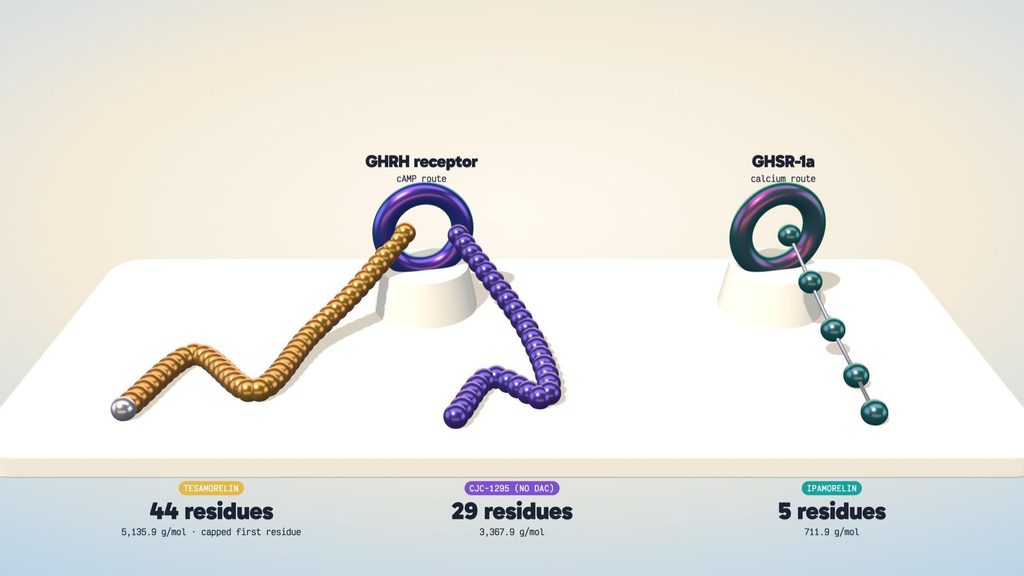
All three act on the growth hormone axis, but through different receptors. Tesamorelin and CJC-1295 are GHRH analogues, so they target the GHRH receptor. Ipamorelin is a ghrelin-receptor (GHSR-1a) agonist, which reaches the same pituitary cells through a second, separate receptor.
| Tesamorelin | CJC-1295 | Ipamorelin | |
|---|---|---|---|
| Class | GHRH(1-44) analogue | Modified GHRH(1-29) analogue | Ghrelin-receptor agonist (a pentapeptide) |
| Length | 44 amino acids | 29 amino acids | 5 amino acids |
| Receptor | GHRH receptor | GHRH receptor | GHSR-1a |
| Regulatory status | US-approved (Egrifta) | Not approved anywhere | Not approved anywhere |
| UK status | Research material | Research material | Research material |
CJC-1295 starts from GHRH(1-29), the shortest stretch of the hormone that still binds fully, and swaps four amino acids to toughen it. Tesamorelin keeps the whole 44-residue chain and protects only the front end. Ipamorelin belongs to a different family altogether, the growth hormone secretagogues, built to mimic ghrelin.
Can tesamorelin and ipamorelin be studied together? The receptor logic explains why labs pair the two classes. The GHRH receptor works through cAMP, while GHSR-1a signals mainly through calcium, so a combined design shows how two independent inputs to the same somatotroph interact. The CJC-1295 pairing follows the same reasoning, set out in CJC-1295 vs Ipamorelin and peptide stacks explained. Lot data is on the CJC-1295 + Ipamorelin specification page.
The three compounds share one more thing: WADA lists all of them in the same S2.2.4 clause.
What Is Tesamorelin Studied For?
Tesamorelin’s research record comes in three evidence levels. The strongest is the approved US indication, backed by phase 3 trials. Next are other clinical studies of the GH axis in defined groups. Laboratory work then uses tesamorelin as a stable GHRH-receptor tool in cell and tissue models.
| Research area | Evidence level | What was studied |
|---|---|---|
| Abdominal fat accumulation in adults with HIV-associated lipodystrophy | Approved US indication | Phase 3 trial of 412 patients measuring visceral adipose tissue by CT scan over 26 weeks (Falutz et al., NEJM 2007) |
| GH pulsatility and IGF-1 output | Other clinical research | Short-term studies in healthy men at Massachusetts General Hospital (covered above) |
| GHRH receptor signalling | Preclinical and laboratory | Pituitary cell and receptor assays using tesamorelin as a protease-resistant GHRH reference |
The labels count because claims online often borrow the weight of the first row for uses studied far less. The phase 3 evidence covers one defined patient group and one measured endpoint. Anything beyond that belongs in the lower rows.
How to Verify Research-Grade Tesamorelin
A tesamorelin certificate of analysis (COA) should prove three things. The lot number must match the pen label, the HPLC result must show purity, and the LC-MS (liquid chromatography-mass spectrometry) result must match the expected mass of about 5,135.9. For a peptide this size, look for a deconvoluted mass, because the raw spectrum shows several charge states.
| Check | What to confirm |
|---|---|
| Product identity | The label reads “Tesamorelin” and matches the order |
| Lot number | Identical on the pen and the COA |
| HPLC purity | Result and method both stated |
| LC-MS identity | Deconvoluted mass close to 5,135.9 |
| CAS number | 218949-48-5 where listed |
That mass point trips up a lot of first-time COA readers. A 44-residue peptide carries several protons at once, so the raw trace shows peaks near 1,028 (5+) and 857 (6+). Software then converts those peaks back into one mass of about 5,136. The guide to reading a peptide COA walks through those charge states. Lot-matching steps are set out in how to verify a research peptide batch, and our own process is described under Apexion batch verification.
How Should Tesamorelin Be Stored?
Does tesamorelin peptide need refrigeration? Lyophilised powder keeps best chilled, dry and in the dark, and freezer storage at around −20 °C is usual for the long term. Solutions and pre-filled pens should be refrigerated according to the batch guidance supplied with them.
- Leave the pack closed until the lab needs it, since moisture speeds up breakdown.
- Limit freeze-thaw cycles, which can damage a long peptide chain.
- Shield it from light and keep it in its original packaging.
Formulation changes the rules, which is why the batch sheet always wins. The US medicine Egrifta WR, for example, is labelled for room-temperature storage at 20 to 25 °C before and after mixing (FDA label, 2025). Research material is a different preparation, so it follows its own instructions. Research material is a different preparation, so storage after reconstitution sets out the temperatures and receipt checks that apply to it.
Frequently Asked Questions
Yes, for laboratory research. No class of the Misuse of Drugs Act 1971 includes tesamorelin, so possession is lawful. Without a UK marketing authorisation, the Human Medicines Regulations 2012 stop anyone selling or supplying it as a medicine for human use. UK suppliers offer it for laboratory study alone.
No prescription route exists in the UK. Prescriptions cover licensed medicines, and tesamorelin has never been licensed by the MHRA. The prescription-only product, Egrifta, is a US medicine approved by the FDA. In the UK, tesamorelin is available only as a research material, and it isn’t offered on the NHS.
Egrifta is the US brand name for tesamorelin, made by Theratechnologies and approved by the FDA in 2010. Both contain the same active molecule. Egrifta is a finished, licensed medicine in the US. Research-grade tesamorelin is a laboratory material that ships with a batch-specific certificate and holds no medicinal status.
No. Tesamorelin is a peptide, a chain of 44 amino acids modelled on growth hormone-releasing hormone. Steroids are fat-soluble compounds derived from cholesterol, with fused carbon rings at their core. Tesamorelin targets pituitary GHRH receptors, and anabolic steroids target androgen receptors. Chemically, the two families have nothing in common.
Tesamorelin is a 44-amino-acid GHRH analogue that binds the GHRH receptor. Ipamorelin, a five-residue peptide, targets the ghrelin receptor, GHSR-1a. Both act on GH-producing pituitary cells through separate receptors. Tesamorelin is US-approved as Egrifta, ipamorelin is approved nowhere, and both are WADA-prohibited.
Lyophilised tesamorelin powder should stay chilled, dry and shaded from light, with freezer storage around −20 °C usual for the long term. Solutions and pre-filled pens should be refrigerated according to the batch guidance. Storage depends on formulation: the US medicine Egrifta WR, for example, carries a room-temperature label.
Conclusion
Tesamorelin is a US-approved molecule with a very different status in the UK. Here it’s an unlicensed, uncontrolled laboratory material, unavailable on prescription or the NHS and banned in sport under WADA S2. For laboratory work, a batch earns trust through its COA: a matching lot number, a stated HPLC purity and a deconvoluted mass near 5,135.9. Every compound we cover gets the same documentation-first treatment, from this guide to our GHK-Cu research overview.
View Tesamorelin 20mg specification and COA
Disclaimer: This guide is educational content. Apexion Biolabs sells tesamorelin to qualified researchers as a laboratory material only. In the UK it holds no MHRA authorisation and has no medicinal status, and it must never be used in humans or animals. The page offers no medical advice and no guidance on dosing or administration.
Sources
- FDA: Egrifta SV prescribing information (2024) and Egrifta WR label (2025)
- EMA: Ferrer Internacional withdraws its application for Egrifta (2012)
- Adrian et al., J Frailty Aging, 2018 (PMC6766405)
- Falutz et al., NEJM, 2007 (PubMed 18057338)
- Stanley et al., JCEM, 2011 (PubMed 20943777) and Makimura et al., GH & IGF Research, 2011 (PubMed 21531600)
- MHRA on gov.uk and Human Medicines Regulations 2012, regulation 46
- legislation.gov.uk: Misuse of Drugs Act 1971
- WADA 2026 Prohibited List and WADA 2027 Prohibited List