
Tesamorelin vs CJC-1295 + Ipamorelin: Key Differences (2026)
Reviewed by Oscar Reyes, PhD, Synthesis Lead at Apexion BioLabs · Scientific review of the chemistry and analytical content · Updated October 2026
Quick answer
What’s the difference between Tesamorelin and CJC-1295 + Ipamorelin?
- Tesamorelin: a single 44-amino-acid GHRH analogue, with an approved-drug record in the US for one specific indication.
- CJC-1295 (no DAC) + Ipamorelin: a pair. A 29-amino-acid GHRH analogue plus a 5-amino-acid ghrelin-receptor agonist, so it acts through two receptors.
- Status: neither is licensed in the UK, and all three are on WADA’s S2 list.
- One receptor vs two receptors
- 44 vs 29 + 5 amino acids
- UK: research use only
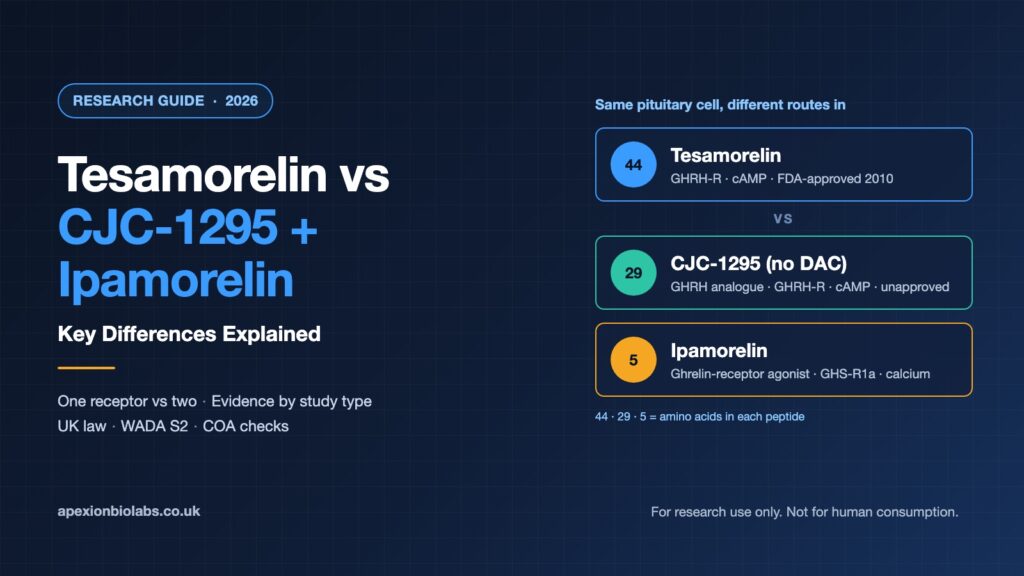
Tesamorelin is one lab-made peptide that copies growth hormone-releasing hormone (GHRH), the signal the hypothalamus sends to the pituitary. CJC-1295 + Ipamorelin is a pair: a shorter GHRH copy matched with a tiny peptide that works through the ghrelin receptor. Set side by side in a Tesamorelin vs CJC-1295 + Ipamorelin comparison, the first works through one receptor and the second through two. Tesamorelin also carries a US drug record, while the pair is studied as research material.
All three reach the same pituitary cells, and that shared target is why they get compared so often. This guide sets out how each one is built, how each signals, what kind of study backs every finding, and where all three stand under UK law and in sport. Apexion supplies these compounds for laboratory research only, under our research use notice.
Tesamorelin vs CJC-1295 vs Ipamorelin at a Glance
Tesamorelin and CJC-1295 are both GHRH analogues that bind the GHRH receptor and signal through cAMP. Ipamorelin binds a second receptor, GHS-R1a, and signals through calcium. Tesamorelin is the only one with a drug approval (US, 2010). All three appear in WADA class S2.
| Feature | Tesamorelin | CJC-1295 (no DAC) | Ipamorelin | CJC-1295 + Ipamorelin pair |
|---|---|---|---|---|
| Class | GHRH analogue | GHRH analogue | Ghrelin-receptor agonist (GHS) | GHRH analogue + GHS |
| Amino acids | 44 (+ hexenoyl cap) | 29 (4 swaps) | 5 | 29 + 5 |
| Receptor | GHRH-R | GHRH-R | GHS-R1a | Both |
| Messenger inside the cell | cAMP | cAMP | Calcium | cAMP + calcium |
| Half-life | Minutes (US label) | Minutes (secondary sources) | About 2 hours (Gobburu 1999) | Two different clocks |
| Approval history | US-approved, one indication (2010) | Never approved | Never approved | Never approved |
| Main study types | Human randomised trials | Human PK (DAC form only) | Animal, human PK, one Phase II | No published study |
| WADA | S2 | S2 | S2 | S2 |
| Apexion format | Tesamorelin 20mg pen | In the 10mg blend pen | In the 10mg blend pen | CJC-1295 (no DAC) + Ipamorelin pen (5mg + 5mg) |
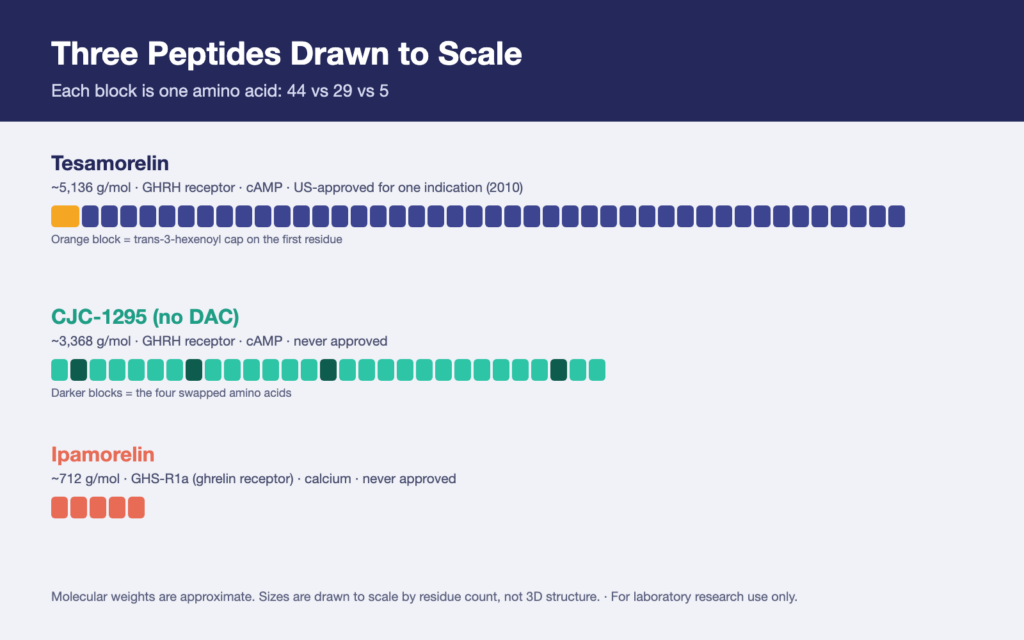
Two rows explain most of the confusion online. The receptor row shows that Tesamorelin and CJC-1295 are two keys for the same lock, while Ipamorelin uses a different lock on the same cell. The approval row shows why Tesamorelin has controlled human trial data and the others mostly don’t.
What Is Tesamorelin?
Tesamorelin is a synthetic GHRH analogue. Its chain is the full 44-residue sequence of human GHRH, capped at the tyrosine end with a trans-3-hexenoyl group. The cap shields the front of the chain from DPP-4, the enzyme that clips natural GHRH within minutes. The receptor-binding sequence stays the same.
Theratechnologies developed it, and the US FDA approved it in November 2010 under the brand name Egrifta for one indication: lowering excess abdominal fat in adults living with HIV-associated lipodystrophy. Newer US formulations followed, the latest being Egrifta WR in 2025. The approval is a regulatory record tied to that single indication. In Europe the marketing application was withdrawn in 2012, and the UK has never licensed it.
At about 5,136 g/mol, Tesamorelin is also the heaviest of the three by far, and Tesamorelin UK sets out its chemistry, legal status and storage in more depth.
What Are CJC-1295 and Ipamorelin?
CJC-1295 and Ipamorelin are two unrelated synthetic peptides that are often supplied together. CJC-1295 (no DAC) is a reworked GHRH fragment, residues 1 to 29. Ipamorelin is a five-unit peptide that binds the ghrelin receptor. Neither has ever been approved as a medicine.
CJC-1295 (no DAC): Mod GRF(1-29)
Take the first 29 residues of GHRH, change four of them to slow enzyme attack, and you have CJC-1295 without DAC. Chemists at ConjuChem designed the series, and the no-DAC form is also sold as modified GRF (1-29), or Mod GRF. It binds the same GHRH receptor as Tesamorelin, but it carries no hexenoyl cap and is 15 amino acids shorter. No peer-reviewed human half-life exists for this form. Estimates of a few minutes come from secondary sources and from how fast the parent chain breaks down. Each of the four substitutions is broken down in What Is CJC-1295 + Ipamorelin.
Ipamorelin: a Selective Ghrelin-Receptor Agonist
Ipamorelin is a pentapeptide, Aib-His-D-2-Nal-D-Phe-Lys-NH2, built at Novo Nordisk in the 1990s. Three of those five building blocks are unusual or mirror-image forms that enzymes struggle to cut. Raun and colleagues (1998) called it “the first selective growth hormone secretagogue” after rat and swine studies in which it raised growth hormone without the ACTH and cortisol rise seen with older peptides. A 1999 study by Gobburu’s group in 40 healthy men put its terminal half-life at about 2 hours.
How Do They Work Differently?
Tesamorelin and CJC-1295 both bind the GHRH receptor on pituitary somatotroph cells and raise cAMP inside the cell. Ipamorelin binds GHS-R1a, the ghrelin receptor, on the same cells and raises calcium. Somatostatin, released by the hypothalamus, acts as the brake on both routes.
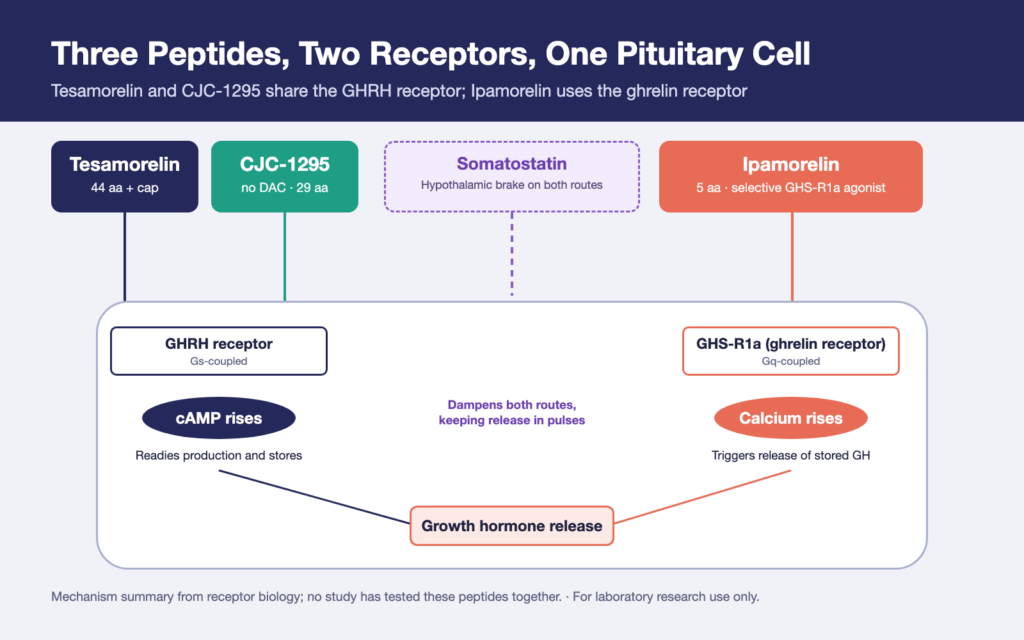
Imagine a single growth-hormone-making cell in the pituitary, a somatotroph, carrying two receptors. The GHRH receptor is the slow, steady input. Once activated, it raises cAMP, which pushes the cell to make more growth hormone and to release it. Tesamorelin and CJC-1295 both press this button, just with different-sized fingers.
GHS-R1a is the fast trigger. Ghrelin, the body’s own ligand, raises calcium inside the cell, and calcium drives the release of hormone that’s already stored. Ipamorelin copies ghrelin at this receptor, which makes Tesamorelin vs Ipamorelin a question about two separate receptors on one cell. That’s why the pair is often summed up in one line: one input primes the cell, the other pulls the trigger.
Somatostatin works upstream as the off switch. It dampens both routes, which keeps growth hormone release in pulses. You’ll often read that Ipamorelin “suppresses somatostatin.” We found no study showing that for Ipamorelin directly, so this guide leaves the claim out.
Is CJC-1295 the Same as Tesamorelin?
No. CJC-1295 and Tesamorelin are both GHRH analogues that bind the same receptor, but they are different molecules. Tesamorelin has 44 amino acids and a hexenoyl cap. CJC-1295 has 29 amino acids with four swaps. Their half-lives, evidence bases and approval records differ.
The differences in short:
- Length: 44 amino acids for Tesamorelin, 29 for CJC-1295.
- Modifications: Tesamorelin adds one chemical cap at the front; CJC-1295 swaps four amino acids along the chain.
- Half-life: both run in minutes, except CJC-1295 with DAC, which lasts days.
- Human evidence: Tesamorelin has randomised trials; CJC-1295 has pharmacokinetic studies, all of the DAC form.
- Approval: Tesamorelin is US-approved; CJC-1295 has never been approved.
The CJC-1295 Name Problem: DAC vs No DAC
“CJC-1295” covers two compounds. The DAC version carries a drug affinity complex that binds albumin in the blood, and Teichman and colleagues (2006) reported its half-life at 5.8 to 8.1 days. The no-DAC version lasts minutes. Apexion’s pen contains the no-DAC form, and the source-material blend report on the CJC-1295 (no DAC) + Ipamorelin page notes that CJC-1295 DAC was not detected.
What Does the Research Show? Evidence by Study Type
Tesamorelin has human randomised trials in one approved indication. CJC-1295’s human data comes from pharmacokinetic studies of the DAC form only. Ipamorelin has animal studies, human pharmacokinetics and one Phase II trial that missed its primary endpoint. No published study has tested CJC-1295 and Ipamorelin together.
| Compound | Study type | Population or model | What was measured | Regulatory note |
|---|---|---|---|---|
| Tesamorelin | Human randomised trial (Falutz 2007, NEJM) | 412 adults with HIV, 26 weeks | Visceral adipose tissue on CT, IGF-I, blood lipids | Basis for the 2010 US approval |
| CJC-1295 (DAC) | Human pharmacokinetic (Teichman 2006) | Healthy adults aged 21 to 61 | Half-life, GH and IGF-I levels | Never approved; DAC form only |
| CJC-1295 (DAC) | Human study (Ionescu 2006) | Healthy men aged 20 to 40 | Overnight GH pulse pattern | Never approved; DAC form only |
| Ipamorelin | Animal (Raun 1998) | Rat cells, rats, swine | GH, ACTH and cortisol release | Never approved |
| Ipamorelin | Human pharmacokinetic (Gobburu 1999) | 40 healthy men | Half-life, GH peak timing | Never approved |
| Ipamorelin | Human Phase II (Beck 2014) | Hospital patients after surgery | Time-based clinical endpoint | Primary endpoint not met (p = 0.15) |
| CJC-1295 + Ipamorelin | None published | None | None | No combination study |
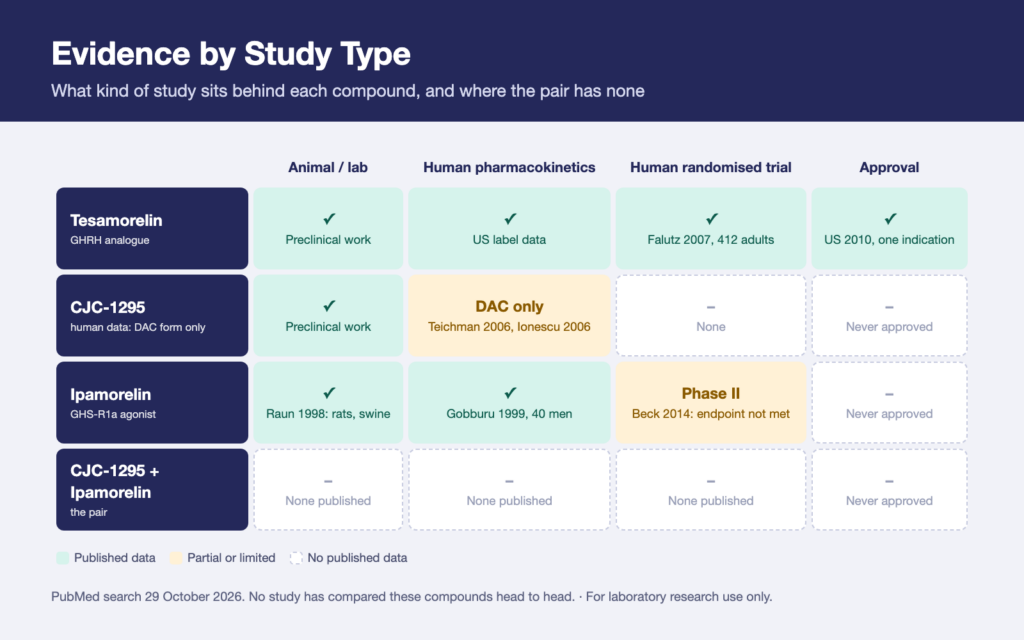
A June 2026 review in Frontiers in Endocrinology by Dominikowski and colleagues at Poznan University of Medical Sciences sorted these peptides into evidence tiers, “from regulatory-grade randomized trial data to a complete absence of human studies.” Tesamorelin belongs on the top rung of that ladder, and the CJC-1295 + Ipamorelin pair on one of the lowest. A PubMed search on 29 October 2026 turned up no primary study of the combination, only review articles and doping-detection papers.
What the Evidence Can’t Tell You
The evidence can’t rank these compounds. No study has compared Tesamorelin with CJC-1295 or Ipamorelin head to head, so no published study ranks one above another. Tesamorelin’s trials cover one patient group, the CJC-1295 human data used a different molecule, and the pair has no trial at all.
Why Are GHRH Analogues and Ghrelin Agonists Studied Together?
The case for combining the two classes is receptor biology: both signals land on the same pituitary cell through different receptors and messengers. Natural physiology already works this way, with GHRH and ghrelin acting together while somatostatin holds the brake. A research pair recreates both inputs in one model.
That reasoning is theoretical so far. The published record holds no study of CJC-1295 plus Ipamorelin, and Tesamorelin, which fits the GHRH side of the same logic, has never been paired with Ipamorelin in a paper either. Pre-mixed research blends follow their own documentation rules, set out in peptide stacks explained.
Other GHRH-Axis Compounds: Sermorelin and More
Sermorelin, CJC-1295 with DAC, GHRP-2 and GHRP-6 work on the same axis. Sermorelin and the CJC-1295 forms act on the GHRH side, and the GHRPs join Ipamorelin on the ghrelin side. Each is a separate molecule with its own record.
- Sermorelin: GHRH(1-29) with no modifications. Set Tesamorelin vs Sermorelin side by side and you get the full 44-residue chain with a cap against the bare 29-residue fragment. It was approved in the US under the brand Geref, and EMD Serono stopped marketing it in 2008, as a 2013 Federal Register notice records.
- CJC-1295 with DAC: the albumin-binding version, with a half-life measured in days.
- GHRP-2 and GHRP-6: older ghrelin-receptor peptides. Raun’s 1998 work found they raised ACTH and cortisol, which Ipamorelin did not.
Are Tesamorelin, CJC-1295 and Ipamorelin Legal in the UK?
Yes, as laboratory research material. None of the three holds a UK marketing authorisation, so none can be sold or presented as a medicine here. None is listed under the Misuse of Drugs Act 1971. Tesamorelin’s US approval has no effect on its UK status.
| UK law or guidance | How it applies |
|---|---|
| Human Medicines Regulations 2012 | None of the three holds a UK marketing authorisation; presenting them as treating or preventing disease makes them medicines |
| Misuse of Drugs Act 1971 | None of the three is listed |
| Tesamorelin’s US approval | Gives it no UK status; no UK-licensed version exists, so there is no prescription route |
| MHRA borderline guidance (GN8) | Sets the presentation and function tests for products near the medicines line |
Checked in October 2026 against regulation 2 of the Human Medicines Regulations 2012, Schedule 2 of the Misuse of Drugs Act 1971 and MHRA’s guidance on borderline products.
The presentation rule does most of the work. MHRA’s test looks at how a product is presented: anything marketed as preventing or treating disease in people counts as a medicine, whatever it contains. A US licence doesn’t carry across the Atlantic, so Tesamorelin has no prescription route in the UK. Applied to other compounds, the same tests answer the wider question: are peptides legal in the UK?
Are They Banned in Sport?
Yes, all three. Class S2.2.4 of WADA’s 2026 Prohibited List covers growth hormone releasing factors. It lists GHRH analogues such as CJC-1295 and Tesamorelin by name, along with growth hormone secretagogues and GHRPs, Ipamorelin’s group. A team at King’s College London’s Drug Control Centre has built a urine test that detects sermorelin, Tesamorelin and both CJC-1295 forms at 1 ng/ml or less.
Research Formats and Documentation
Apexion supplies the two options as pre-filled research pens made fresh for each order: a Tesamorelin 20mg pen and a CJC-1295 (no DAC) + Ipamorelin blend pen with 5mg of each peptide. A single compound and a two-peptide blend need different paperwork.
What each certificate of analysis (COA) should show:
- Tesamorelin: one HPLC peak with its purity, and a measured mass near 5,136 g/mol.
- CJC-1295 + Ipamorelin: two distinct HPLC peaks with a purity figure for each, and two measured masses, near 3,368 g/mol for CJC-1295 (no DAC) and 712 g/mol for Ipamorelin.
- Both: a lot number that matches the pen label.
Pens are prepared to order, and the batch certificate arrives with the order, linked to the pen through its batch number or QR code. The batch certificate is easier to check once you know how to read a peptide certificate of analysis, and the format itself is weighed up in peptide pen vs vial.
Frequently Asked Questions
Tesamorelin copies GHRH: 44 amino acids, working at the GHRH receptor through cAMP. Ipamorelin is a five-unit peptide that binds the ghrelin receptor, GHS-R1a, and raises calcium. Both reach the same pituitary cells. Tesamorelin is US-approved for one indication, while Ipamorelin is a research compound.
No. Both are GHRH analogues and bind the same receptor, but they are different molecules. Tesamorelin keeps all 44 amino acids and adds a hexenoyl cap. CJC-1295 has 29 amino acids with four swaps. Tesamorelin has US approval, and CJC-1295 has none.
Yes, for one indication. The FDA approved Tesamorelin as Egrifta in November 2010 for excess abdominal fat in adults with HIV-associated lipodystrophy, its single approved use. Newer formulations followed, most recently Egrifta WR in 2025. The UK has never licensed it.
No. Neither form of CJC-1295, with or without DAC, has been approved by the FDA or any other medicines regulator. Its human data comes from pharmacokinetic studies of the DAC form, published in 2006. Ipamorelin has never been approved either.
They reach the same pituitary cell through two receptors. CJC-1295 acts at the GHRH receptor and Ipamorelin at the ghrelin receptor, copying the two natural signals that control growth hormone release. The pairing has never been tested in a published study.
Yes, as research material. None holds a UK marketing authorisation, and none is listed under the Misuse of Drugs Act 1971. They can’t be sold as medicines. All three are prohibited in sport under WADA class S2.
Conclusion
Tesamorelin is one GHRH analogue with a US drug record and controlled trials. CJC-1295 + Ipamorelin is a two-receptor pair with pharmacokinetic data and no combination study. For lab work, match the compound to the receptor question being asked, and check that the COA proves every peptide in the pen.
Sources
- FDA. Egrifta SV prescribing information (2024) and Egrifta WR label (2025).
- Falutz J, et al. New England Journal of Medicine. 2007;357(23):2359-70 (PMID 18057338).
- Raun K, et al. European Journal of Endocrinology. 1998;139(5):552-61 (PMID 9849822).
- Gobburu JV, et al. Pharmaceutical Research. 1999;16(9):1412-6 (PMID 10496658).
- Teichman SL, et al. Journal of Clinical Endocrinology & Metabolism. 2006;91(3):799-805 (PMID 16352683).
- Ionescu M, Frohman LA. Journal of Clinical Endocrinology & Metabolism. 2006;91(12):4792-7 (PMID 17018654).
- Beck DE, et al. International Journal of Colorectal Disease. 2014;29(12):1527-34 (PMID 25331030).
- Dominikowski A, et al. Frontiers in Endocrinology. 2026;17:1822475 (PMID 42395176).
- Memdouh S, et al. Drug Testing and Analysis. 2021;13(11-12):1871-1887 (PMID 34665524).
- Federal Register. Determination for Geref (sermorelin acetate), 2013.
- WADA. 2026 Prohibited List, S2.2.4.
- legislation.gov.uk: Human Medicines Regulations 2012; Misuse of Drugs Act 1971. MHRA borderline products guidance.
Disclaimer: Tesamorelin, CJC-1295 and Ipamorelin from Apexion are sold for laboratory research use only, never for use in people or animals. They aren’t medicines, supplements or food, and nothing in this guide is medical or legal advice. Full terms are in our research use notice.