
How Long Do Peptide Pens Last? Sealed, Opened & In Transit
Reviewed by Oscar Reyes, PhD, Synthesis Lead at Apexion BioLabs · Scientific review of the chemistry and analytical content
Quick answer
How Long Do Peptide Pens Last?
Sealed, a research pen keeps to the date on its batch documentation at 2 to 8 °C, away from light. Opened, the window gets shorter, set by that batch’s own stated conditions rather than a universal day count.
- Sealed at 2 to 8 °C: to the date given in the batch documentation
- Opened: shorter than sealed, and set by that batch
- Freezing only where the batch documentation states −20 °C
Research use only. This page describes how research peptides behave in storage and how laboratories record that. Apexion BioLabs products are supplied strictly for laboratory research use and are not intended for human or veterinary consumption. The research notice carries the full terms of supply.
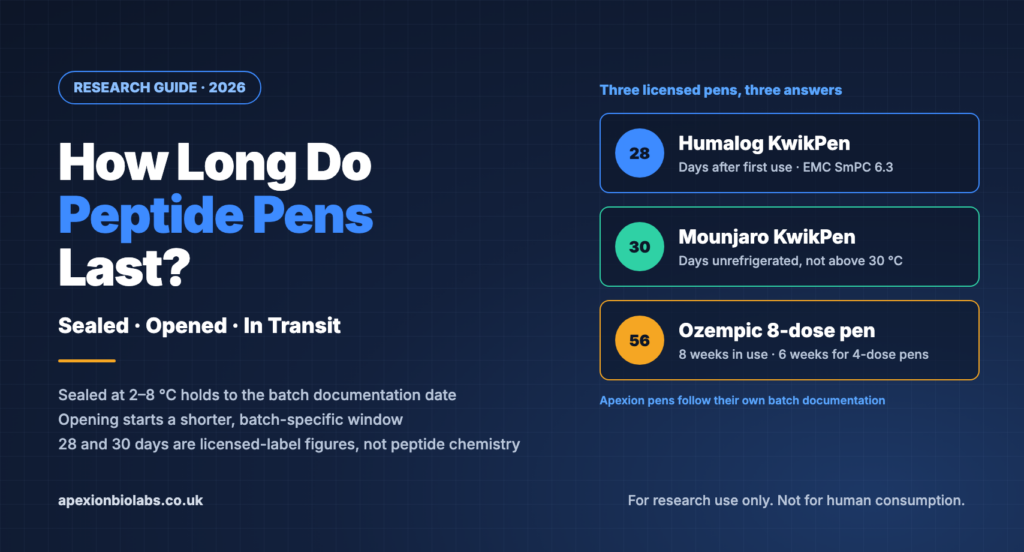
Ask three manufacturers how long a pen keeps and you get three different numbers. Insulin lispro says 28 days after first use. Mounjaro says 30. Ozempic says six to eight weeks. Same fridge, same class of molecule, three answers on the box.
Those three numbers tell you most of what you need to know when you ask how long do peptide pens last: the answer is never a single figure. The number is a property of one product and its own stability testing, not a law of peptide chemistry. A research pen has three windows worth tracking, and they behave differently: sealed, opened, and in transit.
How Long Does a Peptide Pen Last? The Short Answer
A sealed research pen keeps to the date in its batch documentation at 2 to 8 °C. Opening it starts a shorter, batch-specific window, because the solution now has a puncture point and warm handling time. Transit is a short excursion the batch documentation accounts for. Freezing is correct only where that documentation says so.
Treating those states as one number is where most storage mistakes begin. A pen sealed in a fridge for three weeks differs from one opened on arrival and handled twice a week since.
| Pen state | Conditions | How long it lasts |
|---|---|---|
| Sealed, refrigerated | 2 to 8 °C, away from direct light | To the date in the batch documentation |
| Sealed, long-term | -20 °C, temperature-controlled | Per batch documentation |
| Sealed, room-temperature excursion | Short, recorded, out of direct light | Per batch documentation; log time and temperature |
| Opened, first use logged | 2 to 8 °C between handling sessions | Per batch documentation; shorter than sealed |
| In transit (cold chain) | Insulated, not resting on coolant | Per batch documentation; inspect on arrival |
Notice how many rows say “per batch documentation”. That is deliberate. The certificate issued with your batch states the conditions it was tested under, and your storage log records whether the pen stayed inside them. Together they answer the question for the pen in front of you. A number from a forum post answers it for a different pen. No day count here is invented, because a figure copied from someone else’s product does not describe the pen in your fridge. The National Institute for Biological Standards and Control takes the same line with its own reference materials: where it has no post-reconstitution data, it tells customers to “perform their own assessment of stability after reconstitution in their chosen diluent at their desired storage temperature”.
Sealed vs Opened: Why the Window Changes
People ask how long do pre-filled peptide pens last as one question. It is two. A sealed pen is a closed system, and opening it gives three slow chemical processes more room to work.
Hydrolysis: Water attacks the peptide bond, which is why a solution ages in a way dry powder does not.
Oxidation: Methionine, cysteine and tryptophan residues pick up oxygen, helped by light and trace metals.
Aggregation: Molecules clump together, the process behind visible haze or stringy particles.
Putri Nugrahadi, Wouter Hinrichs, Henderik Frijlink, Christian Schöneich and Christina Avanti cover all three in their 2023 Pharmaceutics review, an in-vitro formulation study rather than a study of pens in use. Their conclusion: “the most practical approaches to peptide stabilization are pH optimization and selecting the appropriate type of buffer”, a job done long before the pen reaches a lab.
Opening adds two things the chemistry alone does not. The septum now has a puncture point, so contamination becomes a real variable, and every handling session brings the solution up towards room temperature and back down. Neither is dramatic alone. Both are cumulative, which is why opened windows run shorter. How much warm air reaches the solution at each puncture depends on how pre-filled research pens are built, cartridge and septum included.
Where Do the 28- and 30-Day Figures Come From?
They come from the labels of licensed medicines, and they are product-specific test results. Under the European Medicines Agency’s in-use stability testing guideline, the maker of a multi-dose product runs its own study to “define a in-use shelf life”, then prints that number. Different product, different study, different number.
Here is what the UK summaries of product characteristics actually say:
| Licensed pen | In-use window on the label |
|---|---|
| Humalog 100 units/ml KwikPen (insulin lispro) | 28 days after first use |
| Mounjaro KwikPen 10mg (tirzepatide) | Up to 30 days unrefrigerated, not above 30 °C |
| Ozempic 0.25 mg (semaglutide) | 6 weeks for 4-dose pens, 8 weeks for the 1 mg 8-dose pen |
Three licensed pens, three answers, spanning 28 to 56 days. If 28 days were a property of peptides in solution, Ozempic could not carry double that on an approved label. What differs is the formulation: buffer, pH, preservative system and the stability data behind each.
The spread makes sense once you see what the number measures. An in-use study keeps the product under the conditions a user would create, repeated puncturing included, then tests it at intervals for potency, breakdown products and microbial growth. The printed window is the last point at which it still passed. A stronger preservative system pushes that point further out, which is how one semaglutide pen reaches eight weeks while an insulin pen stops at four.
The “28-day rule” is a habit borrowed from pharmacy, and where the 28-day rule comes from answers the same question for reconstituted vials. For research material it is a starting assumption, nothing more. Apexion BioLabs supplies no licensed medicines, so none of these labels applies to an Apexion pen.
Do Peptide Pens Need to Be Refrigerated?
Yes. Keep a research pen at 2 to 8 °C away from direct light for short-term storage, and at -20 °C in a temperature-controlled environment for long-term storage where the batch documentation states it. That wording is on every Apexion pen product page.
Two details change the result more than people expect.
Use an interior shelf. The door is the warmest part of a fridge and swings through room air every time someone opens it. Regulators treat position as a real risk: the Ozempic summary of product characteristics instructs users to “keep away from the cooling element”, because the coldest spot brings the opposite problem of accidental freezing.
Measure the fridge rather than trusting the dial. In a September 2024 thread on GLP-1 Forum, a member put a wireless temperature monitor inside the small fridge holding their pen and found it sat at roughly 37 to 41 °F, about 3 to 5 °C. Cheap check, and it turns an assumption into a record.
Freeze a pen only where its batch documentation states -20 °C storage, never as an improvised way to stretch a window. Each band in fridge vs freezer vs room temperature storage protects against something specific, and improvised freezing protects against nothing.
How Long Can a Peptide Pen Stay Out of the Fridge?
A short, recorded excursion is not the same as degradation. Stability work usually heats material far beyond anything a delivery van produces. NIBSC describes running accelerated thermal degradation studies in which products rest “at elevated temperatures (up to +45 or +56 °C) for periods of time (months to years) which far exceed typical shipment transit times”. That is in-vitro testing on freeze-dried reference materials, so read it as shipping context, never as permission to leave a pen on a bench.
Cold-chain shipping keeps that excursion short and known. On arrival, three steps turn an unknown into a documented fact.
1. Record it: Note the arrival date, how long the pen was outside 2 to 8 °C, and the temperature if you have one.
2. Inspect it: Check the solution against the degradation signs below before it goes into the fridge.
3. Follow the batch documentation: Its stated conditions decide whether the material still suits the research work, a judgement set out step by step for a temperature excursion.
Storage Conditions by Apexion Pen Product
Every Apexion pen carries the same published storage note, which is worth knowing in itself: long-term -20 °C, short-term 2 to 8 °C away from direct light, on every product in the catalogue. What changes is whether the batch certificate of analysis is already published or still following the order.
Read the last column carefully. A pen marked “follows the order” has not skipped testing. Its batch is not prepared yet, so the certificate governing its storage window is issued with the pen rather than published in advance. That certificate is the document you file, and it is why the table gives conditions rather than day counts.
| Pen | Format | Batch documentation |
|---|---|---|
| GLP3-RTA 40mg | Pre-filled research pen | COA published |
| GLP3-RTA 20mg | Pre-filled research pen | Follows the order |
| Tesamorelin 20mg | Pre-filled research pen | COA published |
| KLOW 80mg | Pre-filled research pen | COA published |
| CJC-1295 (no DAC) + Ipamorelin 20mg | Pre-filled research pen | COA published |
| MOTS-c 40mg | Pre-filled research pen | Follows the order |
| GLOW 70mg | Pre-filled research pen | COA published |
| BPC-157 10mg | Pre-filled research pen | Follows the order |
| TB-500 10mg | Pre-filled research pen | Follows the order |
| GHK-Cu 50mg | Pre-filled research pen | Follows the order |
| NAD+ 500mg | Pre-filled research pen | Follows the order |
| Glutathione 500mg | Pre-filled research pen | Follows the order |
| PT-141 10mg | Pre-filled research pen | Follows the order |
| MT2 (Melanotan II) 10mg | Pre-filled research pen | Follows the order |
Each batch is checked analytically and tracked, with purity typically at or above 98% by HPLC. The certificate confirms identity, purity and batch-specific information, and you can pull it up by scanning the QR code on the pen or using the batch number. Every peptide pen in the catalogue is prepared to order in the UK, which is why the certificate travels with the batch.
Signs a Pen’s Solution May Have Degraded
Visual inspection catches the obvious failures and costs nothing. Before any handling session, bring the cartridge into good light and look for three things.
Cloudiness or haze. A solution that started clear and turned milky suggests aggregation. It is the most common visible change and the easiest to miss in poor light.
Colour change. Yellowing, or any tint the material did not have on arrival, points towards oxidation.
Particles or strands. Visible specks, floating fibres or stringy material mean solids have come out of solution.
Any of these means the same thing: do not use the material in research work, and record what you saw against the batch number. A clear solution is not proof of potency, since degradation starts long before anything becomes visible, which is why batch documentation and a storage log outrank a visual check. The same three signs show up in reconstituted peptide storage and handling, listed beside the detail specific to vials.
Logging Pen Storage in a Research Setting
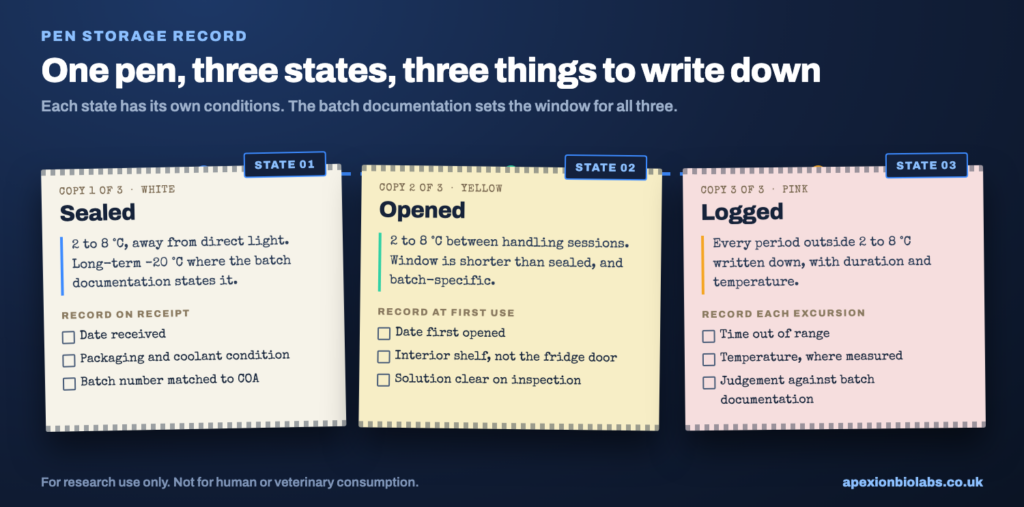
A storage log turns “it has been in the fridge a while” into data you can stand behind. Four fields do most of the work.
1. Date received: Plus the condition of the packaging and any coolant on arrival.
2. Date first opened: This is the one people forget, and it is the field that defines the opened window.
3. Excursions: Every period outside 2 to 8 °C, with duration and temperature where known.
4. COA match: Confirm the batch number on the pen matches the certificate you were issued.
Keep it with the material rather than in a separate file, and a six-month-old question about a result becomes answerable in seconds. Storage is the first variable any reviewer asks about. A fuller receipt checklist, storage log and COA match was written for reconstituted material, and every field on it copies across to pens.
Peptide Pen Shelf Life FAQs
The opened window is shorter than the sealed one and is set by the batch documentation for that specific pen. Keep it at 2 to 8 °C between handling sessions, log the first-use date, and judge the material against its own stated conditions rather than a borrowed figure.
There is no single 30-day cliff. That figure is an in-use window from a licensed medicine label, set by that product’s own stability study. Licensed pens carry windows ranging from 28 days to 8 weeks, which shows the number belongs to the product rather than to peptides generally.
Only where the batch documentation states -20 °C storage. Apexion pens list long-term storage at -20 °C in a temperature-controlled environment and short-term storage at 2 to 8 °C. Freezing a pen that is not documented for it risks damage to both the solution and the cartridge.
A short excursion is not automatic degradation, and stability testing routinely heats material far beyond ambient conditions. Record how long the pen was out and at what temperature, inspect the solution for haze, colour change or particles, then follow the batch documentation.
As a solution, BPC-157 follows the same principle as every other pen: the batch documentation sets the window, with short-term storage at 2 to 8 °C away from light. BPC-157 has its own stability data, separate from the pen it arrives in.
Because Eli Lilly’s own in-use stability study produced that result, and the UK summary of product characteristics prints it: up to 30 days unrefrigerated at not above 30 °C, after which the pen is discarded. Mounjaro is a licensed medicine and is not sold by Apexion BioLabs.
A lyophilised vial generally outlasts a pen, because dry powder resists hydrolysis in a way a solution cannot. A pen trades that longer shelf life for a known concentration and less handling. That trade-off runs through every peptide pen vs vial decision.
Sources, Research Use and Editorial Review
The 28-day figure comes from the UK summary of product characteristics for Humalog 100 units/ml KwikPen. The 30-day figure comes from the summary for Mounjaro KwikPen 10mg. The six and eight week windows come from the summary for Ozempic 0.25 mg.
The rule that every multi-dose product defines its own in-use shelf life through its own study is set by the European Medicines Agency guideline on in-use stability testing. The guidance on assessing stability for your own conditions comes from NIBSC standardisation FAQs. The degradation chemistry is drawn from the 2023 review in Pharmaceutics. All were checked on 19 November 2026.
Licensed medicine labels appear here only to explain where widely quoted day counts originate. Those products are not sold by Apexion BioLabs. The stability work cited is in-vitro formulation and reference-material research, which is why the guidance above points to batch documentation rather than a fixed number.
Apexion BioLabs products are supplied strictly for laboratory research use only. They are not medicines, supplements or food products, and they are not intended for human consumption, therapeutic use, veterinary use or diagnostic applications. This page was written for a research audience and reviewed by Oscar Reyes, PhD, on 19 November 2026.