
Thymosin Alpha-1 vs Thymosin Beta-4 (TB-500): Key Differences Explained
Reviewed by Oscar Reyes, PhD, Synthesis Lead at Apexion BioLabs · Scientific review of the chemistry and analytical content
Quick answer
Is thymosin alpha-1 the same as thymosin beta-4?
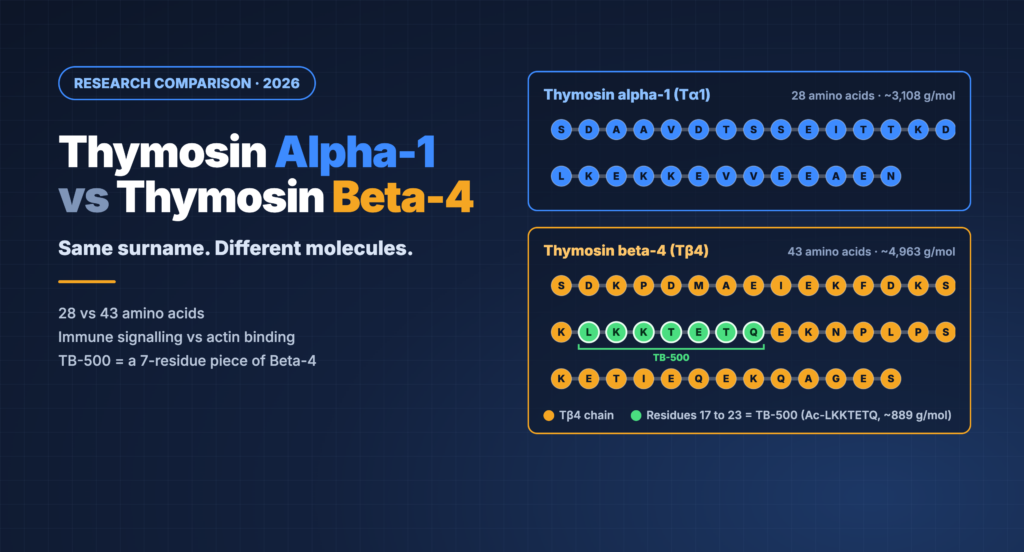
Thymosin alpha-1 and thymosin beta-4 are two different molecules that share a surname.
- Thymosin alpha-1 (Tα1): 28 amino acids. Studied for how it signals to immune cells. Its synthetic form, thymalfasin, is an approved medicine in several countries outside the UK and US.
- Thymosin beta-4 (Tβ4): 43 amino acids. Binds a cell protein called actin; studied in cell-movement and tissue-repair models.
- TB-500: A lab-made, seven-amino-acid piece of Tβ4. It has nothing to do with Tα1.
- UK: none of the three is a licensed medicine, and all are sold for research use only
- WADA Prohibited List: thymosin beta-4 and TB-500 are prohibited (S2); thymosin alpha-1 is not named
Thymosin alpha-1 and TB-500 are supplied by Apexion for laboratory research only, under its research use notice. Nothing on this page describes human or veterinary use.
Picture two colleagues who share a surname, work on different floors, and keep getting each other’s post. That is thymosin alpha-1 and thymosin beta-4. The shared name is why “is TB-500 the same as thymosin alpha-1?” became such a common question, and the answer is no.
Thymosin alpha-1 is a 28-amino-acid chain that immune cells respond to. Thymosin beta-4 is a 43-amino-acid chain that works inside cells on their scaffolding, and TB-500 is a small synthetic piece of it. This thymosin alpha 1 vs thymosin beta 4 comparison covers the chemistry, the research behind each, where UK and sports rules put them, and how to tell them apart on a certificate of analysis.
Thymosin alpha-1 and TB-500 are supplied by Apexion for laboratory research only, under its research use notice. Nothing on this page describes human or veterinary use.
Thymosin Alpha-1 vs Thymosin Beta-4: Key Differences at a Glance
Size separates them fastest: about 3,108 g/mol for thymosin alpha-1, about 4,963 g/mol for thymosin beta-4, and about 889 g/mol for seven-amino-acid TB-500. Any mass spectrometer tells them apart on the first run.
| Thymosin alpha-1 (Tα1) | Thymosin beta-4 (Tβ4) | TB-500 | |
|---|---|---|---|
| Length | 28 amino acids | 43 amino acids | 7 amino acids (Ac-LKKTETQ), synthetic |
| Origin | Cut from prothymosin alpha in the thymus and other tissues | Made in most cell types; first found in thymus extract | Lab-made copy of Tβ4 residues 17 to 23 |
| Binds or targets | Toll-like receptors (TLR2, TLR9) on immune cells | G-actin, the building block of the cell skeleton | Tβ4’s actin-binding stretch |
| Main research areas | Immune signalling, infection models, vaccine response | Cell migration, blood vessels, corneal and cardiac repair models | Cell and animal repair models; one early-phase human trial |
| Medicine name | Thymalfasin (Zadaxin) | None; RGN-259 eye drops reached Phase 3 | None |
| UK status | Not licensed; research use only | Not licensed; research use only | Not licensed; research use only |
| WADA list | Not named | Prohibited, S2 | Prohibited, S2 (named example) |
| Apexion product | Thymosin alpha-1 20mg research pen | Not supplied | TB-500 research pen |
Every cell was checked on 17 November 2026 against PubChem, UniProt, the WADA list and the Apexion product pages, with the molecular weights taken from PubChem entries such as thymosin alpha-1, CID 16130571.
Why Do Thymosin Alpha-1 and Beta-4 Share a Name?
The name comes from a New York lab in the 1960s. Allan Goldstein and Abraham White were chasing a factor in calf thymus that encouraged lymphocyte growth, and in their 1966 paper in PNAS they called it “thymosin”. In Goldstein’s own history of the thymosins, the team spent the next decade purifying a crude extract named thymosin fraction 5, which turned out to contain “a family of at least 40 mostly small acidic polypeptides”.
Those peptides were sorted by electric charge on a gel. Peptides with an isoelectric point below 5 were called alpha, those between 5 and 7 beta, and anything above 7 gamma, as a 2021 review in the International Journal of Molecular Sciences explains. Alpha-1 was the first alpha-group peptide sequenced, in 1977, and beta-4 the fourth beta-group spot, sequenced in 1981.
Thymulin (a nine-amino-acid zinc-dependent peptide) and thymalin (a Russian bovine thymus extract) are other names from that era, and different again.
What Is Thymosin Alpha-1?
Thymosin alpha-1 is a 28-amino-acid peptide with an acetyl cap on its first amino acid. Cells do not make it from scratch. They make a 111-amino-acid protein called prothymosin alpha, and thymosin alpha-1 is residues 2 to 29 of it, according to UniProt entry P06454.
The synthetic copy is called thymalfasin, chemically identical to the natural peptide and sold as a medicine under the brand name Zadaxin. Dominari and colleagues, writing in the World Journal of Virology in 2020, put the approval count at “more than 35 countries”, chiefly for hepatitis B and C. The UK and US are not among them.
Research-grade material is the same molecule with different paperwork: no medicine licence, no clinical label, and a certificate of analysis instead of a patient leaflet. Those differences decide where thymosin alpha-1 stands under UK law.
How Is Thymosin Alpha-1 Studied?
Most laboratory work follows one thread: how the peptide talks to immune cells through Toll-like receptors. In a 2004 cell study in Blood, Luigina Romani’s team in Perugia showed that dendritic cells (the cells that present antigens to T cells) matured and released interleukin-12 after exposure to thymosin alpha-1, with the signal running through TLR9.
What Is Thymosin Beta-4?
Thymosin beta-4 is a 43-amino-acid peptide and one of the most common small proteins inside cells. A 2021 review in Frontiers in Endocrinology reports that Tβ4 makes up 70 to 80 percent of the beta-thymosin content in human tissues, turning up in the thymus, spleen, brain, heart, platelets and white blood cells.
Its job became clear in 1991, when Daniel Safer’s group showed in the Journal of Biological Chemistry that a small peptide they had been studying, one that stopped actin forming filaments, was thymosin beta-4. Tβ4 binds single actin units (G-actin) and keeps a pool of them ready. The stretch that does the binding is a seven-amino-acid motif, LKKTETQ, at positions 17 to 23 of the chain, and that motif is the reason TB-500 exists.
How Is Thymosin Beta-4 Studied?
Animal models cover blood-vessel formation, corneal injury in mice and rats, and cardiac tissue in mice. Human research has mostly gone through RGN-259, a thymosin beta-4 eye drop developed by RegeneRx and ReGenTree. Its latest Phase 3 study, NCT05555589, was marked complete in July 2026 with 70 participants, with no results posted when we checked on 17 November 2026.
Is TB-500 the Same as Thymosin Beta-4?
No. TB-500 is a short synthetic peptide built from a piece of thymosin beta-4. Its sequence is Ac-LKKTETQ: the seven amino acids at positions 17 to 23 of Tβ4, with an acetyl group added to the front. Full thymosin beta-4 is 43 amino acids.
The name started as a product label, and suppliers use it loosely. A US FDA briefing document for its July 2026 compounding committee meeting described TB-500 as a common name rather than an official one, with more than one active molecule sold under it.
The “acetate vs TB-500” question is about salt form. Peptides usually come as a salt (acetate or trifluoroacetate) because that is how they leave the purification column, so a 10 mg vial of acetate contains a little less than 10 mg of peptide. A good certificate of analysis states both the salt form and the net peptide content.
Apexion’s TB-500 is the Ac-LKKTETQ fragment, with the formula C38H68N10O14 and a molecular weight of about 889 g/mol on the product page. The research record for TB-500 peptide in the UK keeps the fragment and the full protein apart throughout. Neither is “better”: one is a 43-amino-acid protein with decades of data, the other a seven-amino-acid fragment with far less published work of its own.
Is TB-500 the Same as Thymosin Alpha-1?
No, and this is the mix-up that causes the most trouble. TB-500 comes from thymosin beta-4 and binds actin. Thymosin alpha-1 comes from prothymosin alpha and acts on immune-cell receptors. The two share no sequence at all and are about 2,200 g/mol apart on a mass spectrometer.
How Do They Work? Mechanisms Compared
Thymosin alpha-1 works from the outside of cells. Thymosin beta-4 works on the inside.
Thymosin alpha-1: a signal to immune cells (cell and animal studies). The peptide binds Toll-like receptors, the sensors immune cells use to recognise microbes. In Romani’s 2004 cell study, removing the MyD88 adaptor protein that TLRs rely on wiped out the response, which tied the effect to a receptor.
Thymosin beta-4: a structural helper (cell studies). Tβ4 binds G-actin one-to-one and stops it polymerising into filaments, which changes how fast a cell can rearrange its skeleton and move. Philp’s 2003 work showed that the actin-binding motif alone reproduced the migration effect of the whole protein in cultured endothelial cells, while fragments missing part of the motif did nothing.
Thymosin beta-4: a survival signal in heart cells (mice). In a 2004 paper in Nature, Bock-Marquette and colleagues found that Tβ4 formed a complex with integrin-linked kinase and switched on the survival kinase Akt in mouse cardiac cells, a second mechanism beyond actin.
TB-500 (cell and animal studies). A 2024 study from the Korea Institute of Science and Technology, in the Journal of Chromatography B, tracked how TB-500 breaks down in rats and found a shorter product, Ac-LKKTE, that was active in a fibroblast migration assay.
What Has Each Been Studied For?
The table below separates what has been seen in dishes, in animals and in people. The human column only lists work on the licensed medicine or on a registered trial.
| Peptide | Research area | Cell | Animal | Human |
|---|---|---|---|---|
| Tα1 | Hepatitis B | 10 trials, 1,349 adults, pooled in the 2026 Cochrane review; very low to low certainty | ||
| Tα1 | Vaccine response | Mice and poultry, reviewed in Ann N Y Acad Sci, 2012 | Older adults given influenza vaccine, summarised in 2007 | |
| Tα1 | Sepsis and COVID-19 | TESTS Phase 3, BMJ 2025: 1,089 adults, 28-day mortality 23.4% vs 24.1% on placebo, no clear difference. A 2023 meta-analysis of 9 COVID-19 studies did not support routine use | ||
| Tβ4 | Corneal wounds | Yes | Mice and rats, Sosne 2002 | RGN-259 eye-drop trials; Phase 3 NCT05555589 complete, no results posted |
| Tβ4 | Cardiac repair | Yes | Mice, Bock-Marquette 2004 | Early-phase trials registered, none completed to approval |
| TB-500 | Tissue-repair models | Yes (actin motif) | Rats, KIST 2024 | Phase 1/2 safety trial NCT07487363, 80 planned, recruiting since February 2026 |
The thymosin alpha-1 human data is real but mixed. The Cochrane team, searching up to June 2026, found the hepatitis B trials “may reduce death from any cause” but rated that evidence as very low certainty, and the TESTS sepsis trial, the largest ever run on the peptide, found no clear benefit on its main outcome.
TB-500’s own human record is one trial. Hudson Biotech’s Phase 1/2 study, updated on 12 November 2026, is a safety study in adults with stable cardiovascular disease and had not reported when we checked.
Does Thymosin Beta-4 Cause Cancer? What Research Says
Cell and tissue studies have measured Tβ4 at higher levels in some aggressive tumours, and some animal work points the other way: actin control and cell movement are part of how cancers spread. The authors of the 2021 IJMS review call its role in tumour formation “controversial” and note that in their own hands the peptide slowed pancreatic cancer in mice. No human study answers the question, and this article offers no safety verdict.
Where the Claims Go Too Far
Three leaps appear again and again in supplier copy. Thymalfasin trial results belong to a licensed medicine given in hospital, and do not transfer to a research-grade vial. A result in mice is a result in mice. And any “immune booster” or “healing peptide” language turns a research description into a medical claim that neither peptide is licensed to carry in the UK.
Regulatory and Legal Status: UK, US and Sport
In Britain, neither thymosin alpha-1 nor thymosin beta-4 (or TB-500) is a licensed medicine, and neither appears in the Misuse of Drugs Act. Both are legal to supply and buy as research reagents, provided no medical claim is made and no human use is suggested.
| Thymosin alpha-1 | Thymosin beta-4 / TB-500 | Checked | |
|---|---|---|---|
| UK MHRA licence | None in the MHRA products database | None | 17 Nov 2026 |
| Misuse of Drugs Act 1971 | Not in any schedule | Not listed | 17 Nov 2026 |
| Approved elsewhere | Thymalfasin (Zadaxin), more than 35 countries | No | 17 Nov 2026 |
| US FDA | Not approved. Reviewed by the compounding advisory committee on 4 December 2024 for uses from hepatitis B to ME/CFS; now in the FDA’s “nominated but withdrawn” table, current to 22 April 2026 | Not approved. The fragment is in the same withdrawn table; a July 2026 committee vote backed reconsidering it | 17 Nov 2026 |
| WADA Prohibited List 2026 | Not named | Prohibited, S2: “Thymosin-β4 and its derivatives e.g. TB-500” | 17 Nov 2026 |
The WADA entry is the one behind “is thymosin beta-4 still banned?”. Yes. The 2026 Prohibited List names thymosin-β4 and its derivatives under section S2, and gives TB-500 as the example. The list is revised every January, and UK Anti-Doping enforces it in Britain.
Thymosin alpha-1 is not named on the list, though anyone covered by anti-doping rules should still put the question to UKAD in writing. None of the US detail changes anything in Britain, where whether peptides are legal in the UK is decided by the MHRA and the medical claim, not the molecule.
Have Thymosin Alpha-1 and Beta-4 Been Studied Together?
Yes, but only measured side by side, and only decades ago. In a 1987 cell study, Baxevanis and colleagues found that thymosin alpha-1 increased, while thymosin beta-4 reduced, the proliferation of human lymphocytes in a mixed culture. A 1986 paper and a 1992 survey of 681 healthy adults measured both in serum, where Tβ4 circulated at roughly 20 times the level of Tα1. There is no published study of the two given together as a combination, in animals or in people.
How to Verify Research-Grade Thymosin Alpha-1 and TB-500
Two checks settle most doubts. The first is identity by mass: HPLC gives a purity percentage, and mass spectrometry confirms the peak is the right molecule, around 3,108 g/mol for thymosin alpha-1, 889 g/mol for the TB-500 fragment, or 4,963 g/mol if the vial is actually full-length thymosin beta-4.
The second check is sequence. For TB-500, the certificate should state Ac-LKKTETQ or spell out that it is the 17-23 fragment, because “TB-500” on its own could mean either molecule. Salt form, net peptide content and the identity method are the fields that count when reading a peptide certificate of analysis, and matching the lot number on the label to the document is how you verify a research peptide batch.
The Apexion thymosin alpha-1 research pen lists its sequence, CAS number and formula on the product page, and the Apexion TB-500 research peptide states the fragment formula and notes that full-length Tβ4 carries a different CAS number. A reader on the Phoenix Rising forums, in a thread that ran from 2018 to 2020, described sending a UK-bought peptide to an independent lab because the supplier’s paperwork was not enough.
Frequently Asked Questions
Thymosin alpha-1 is a 28-amino-acid piece of the protein prothymosin alpha, studied for how it signals to immune cells through Toll-like receptors. Thymosin beta-4 is a 43-amino-acid peptide found in most cells, which binds actin to control cell shape and movement.
Only by history. Both were isolated from thymosin fraction 5, a calf-thymus extract studied in the 1970s, and named by how they moved on a gel. They come from different genes, have different sequences and bind different targets.
No. TB-500 is a synthetic seven-amino-acid fragment of thymosin beta-4. It shares no sequence with thymosin alpha-1 and weighs about 889 g/mol against roughly 3,108 g/mol.
Not quite. Thymosin beta-4 is the full 43-amino-acid protein. TB-500 copies residues 17 to 23 of it, the actin-binding stretch, with an acetyl group added. Some suppliers use “TB-500” for both, so the sequence on the certificate of analysis is the only reliable way to know which is in the vial.
Yes. The 2026 WADA Prohibited List names thymosin-β4 and its derivatives in section S2, with TB-500 as the example. UK Anti-Doping applies the list in Britain. Thymosin alpha-1 is not named on it.
Yes. Its synthetic form, thymalfasin (Zadaxin), has medicine approvals in over 35 countries, mostly for hepatitis B and C, per Dominari’s 2020 review. It is not licensed in the UK, and the US FDA has not approved it.
Thymosin alpha-1. Its laboratory work centres on Toll-like receptor signalling in dendritic cells and T-cell maturation, and its human trials cover hepatitis B, vaccine response, sepsis and COVID-19.
TB-500 is studied in cell and animal tissue-repair models, where its actin-binding motif is thought to reproduce part of thymosin beta-4’s effect on cell migration. One Phase 1/2 human safety trial, run by Hudson Biotech, began recruiting in 2026.
The Bottom Line
Thymosin alpha-1 and thymosin beta-4 are two unrelated molecules with one shared surname. Alpha-1 is the 28-amino-acid immune-signalling peptide with a medicine licence in some countries and the stronger human trial record. Beta-4 is the 43-amino-acid actin binder, and TB-500 is a seven-amino-acid copy of its working end. In the UK all three are research reagents, and in sport only the beta pair is prohibited.
Sources
- Goldstein AL, et al. PNAS, 1966. PubMed 5230175
- Goldstein AL. Ann N Y Acad Sci, 2007. PubMed 17600284
- Goldstein AL, et al. PNAS, 1977. PubMed 265536
- Low TL, et al. PNAS, 1981. PMC319967
- Safer D, et al. J Biol Chem, 1991. PubMed 1999398
- Dominari A, et al. World J Virol, 2020. PMC7747025
- Xing Y, et al. Front Endocrinol, 2021. PMC8724243
- Kis E, et al. Int J Mol Sci, 2021. PMC8228050
- Baxevanis CN, et al. Immunopharmacology, 1987. PubMed 2954929
- Naing C, et al. Cochrane Database Syst Rev, 2026. CD014610
- Liu Y, et al. BMJ, 2025. PubMed 39814420
- WADA. Prohibited List 2026
- US FDA. Bulk drug substances that may present significant safety risks, 22 April 2026
- PubChem. Thymosin beta-4, CID 45382195
- PubChem. TB-500 (Ac-LKKTETQ), CID 62707662
- UniProt P62328 and P06454
Thymosin alpha-1 and TB-500 are supplied by Apexion Biolabs strictly for laboratory research. They are not medicines, supplements or foods, and are not for human or veterinary use. Regulatory details reflect our 17 November 2026 review and may change. Full terms: research use notice.