
What Is Cagrilintide? How the Amylin Analogue Works, CagriSema and UK Legal Status
Reviewed by Oscar Reyes, PhD, Synthesis Lead at Apexion BioLabs · Scientific review of the chemistry and analytical content
Quick answer
- What it is: A long-acting, lab-made version of the hormone amylin, developed by Novo Nordisk.
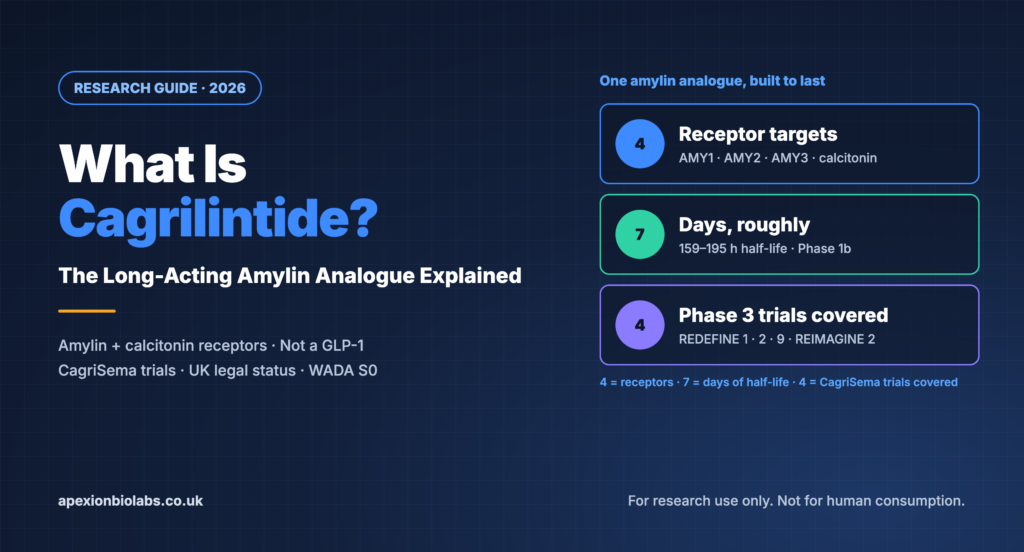
- How it acts: It switches on the three amylin receptors (AMY1, AMY2 and AMY3) and the calcitonin receptor. That’s a different pathway from GLP-1.
- CagriSema: Cagrilintide paired with semaglutide in one weekly product, tested in a large Phase 3 programme.
- UK status: Not controlled under the Misuse of Drugs Act and not licensed by the MHRA. It’s supplied in the UK only as research-use-only material.
- Evidence: Cell and animal studies, Phase 1 and 2 human trials, and Phase 3 trials as part of CagriSema.
Every time the pancreas releases insulin, a second hormone leaves with it. That hormone is amylin, and for decades it got far less attention than its famous partner. Cagrilintide is Novo Nordisk’s attempt to change that: a long-lasting copy of amylin, built to survive in the body for days instead of minutes.
So, what is cagrilintide? It’s an investigational amylin analogue that acts on amylin and calcitonin receptors in the brainstem, and it’s best known as the “Cagri” half of CagriSema. It isn’t a GLP-1 drug, it isn’t approved anywhere yet, and in the UK it’s sold only as lab research material. Below you’ll find what the molecule is, how studies say it works, where it stands legally, and what the trials actually tested.
Apexion supplies cagrilintide for laboratory research use only, as set out in its research use notice. It isn’t for human or veterinary use.
What Is Cagrilintide?
Cagrilintide is a synthetic peptide modelled on human amylin. Novo Nordisk’s chemists changed parts of the amino acid chain to stop it clumping, then attached a fatty-acid side chain. That side chain lets the molecule bind to albumin, a common blood protein, which slows its clearance a great deal. The team described the whole design process in the Journal of Medicinal Chemistry in 2021, pointing to amylin’s “high propensity toward the formation of amyloid fibrils” as the main hurdle they had to engineer around.
| Spec | Detail |
|---|---|
| Class | Long-acting acylated amylin analogue |
| Developer | Novo Nordisk |
| Receptors | AMY1, AMY2, AMY3 and the calcitonin receptor (CTR) |
| Half-life extension | Fatty-acid side chain (acylation) that binds albumin |
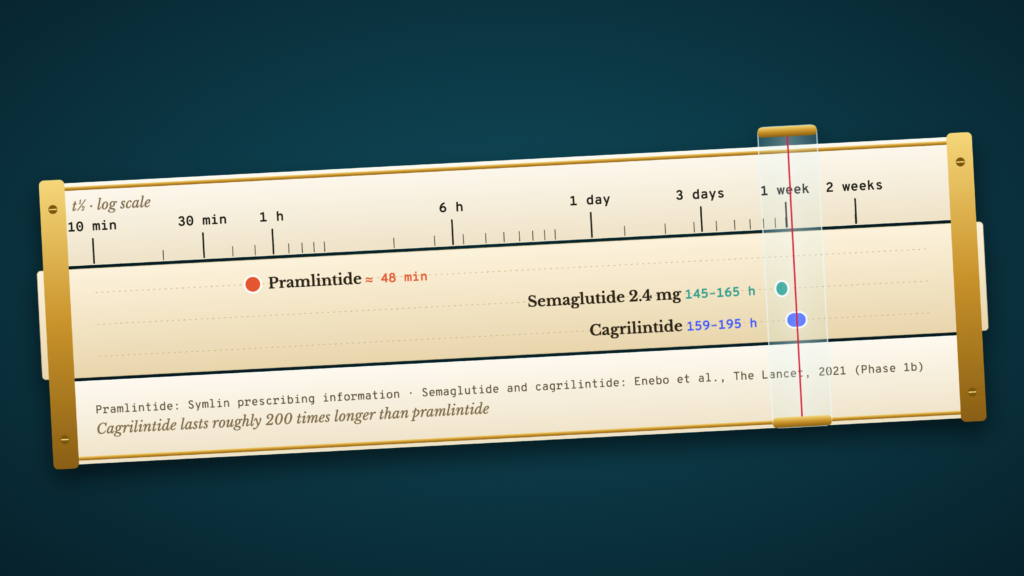
| Half-life | About 159 to 195 hours in a Phase 1b trial |
| Development code | NNC0174-0833 (also published as AM833) |
| CAS number | 1415456-99-3 |
| Molecular weight | About 4,409 g/mol |
| Status | Investigational, not approved anywhere |
That half-life is the whole point of the design. A molecule that lasts about a week is a very different research tool from one that’s gone within the hour. The Phase 1b trial behind that figure also found cagrilintide didn’t change semaglutide’s exposure when the two were given together, an early sign the pair could share one product.
What Is Amylin?
Amylin is a 37-amino-acid hormone made by the same pancreatic beta cells that make insulin, and the two are released together after meals. Native amylin has a stubborn chemistry problem: it tends to fold into sticky fibrils, and enzymes break it down within minutes. Pramlintide, an earlier amylin copy, fixed the clumping but was still short-acting. Cagrilintide was designed to fix both.
How Does Cagrilintide Work?
Cagrilintide is a “dual” agonist within one receptor family. Amylin receptors form when the calcitonin receptor pairs with a helper protein called RAMP, so the same core receptor shows up in both groups. Each finding below comes from a specific type of study, and that label tells you how far it can be stretched.
Receptor activity (cell studies). In lab assays, cagrilintide switched on all three amylin receptor subtypes and the calcitonin receptor on its own. A 2021 pharmacology paper by Fletcher and colleagues compared it, under its code name AM833, with six other agonists in this receptor family and found it acted broadly across them.
The brainstem (animal studies). The newest work maps where it acts. A 2026 study in Nature Metabolism built an atlas of more than 530,000 cells from rat, mouse and macaque brainstems. In rats, cagrilintide changed gene activity in area postrema neurons, but long-term effects on food intake ran through a separate group of cells in the nucleus of the solitary tract. When researchers knocked down a signal in those cells, cagrilintide’s effect disappeared while semaglutide’s didn’t.
Fullness, stomach emptying and glucagon (reviews of animal and human work). Natural amylin slows how fast the stomach empties, lowers glucagon release after meals and helps end a meal, according to a July 2026 review in Diabetes, Obesity and Metabolism. Cagrilintide is studied because it copies those signals for much longer.
Is Cagrilintide a GLP-1?
No. GLP-1 drugs such as semaglutide act on the GLP-1 receptor, while cagrilintide acts on amylin and calcitonin receptors, so the two reach the brain’s appetite circuits through different doors. Dr Timothy Garvey of the University of Alabama at Birmingham, lead author of the REDEFINE 1 paper, put it this way in a July 2026 interview: “They activate some overlapping populations of neurons, but separate neurons.” That difference is exactly why Novo Nordisk paired the two.
Is Cagrilintide Legal in the UK?
Yes, as a research material. Cagrilintide isn’t a controlled drug, and it isn’t a licensed medicine either. UK law treats those as separate questions, and the second one is where the limits come from: it can’t be sold for anyone to take, or with any health claim.
| Route | UK status | Law or body | Checked |
|---|---|---|---|
| Drug control | Not listed | Misuse of Drugs Act 1971, Schedule 2 | 15 Nov 2026 |
| As a medicine | No MHRA authorisation; supplying it for human use is unlawful | Human Medicines Regulations 2012 | 15 Nov 2026 |
| Research material | Research use only, Research Use Only | No single law | 15 Nov 2026 |
| NICE | CagriSema topic selected 10 June 2026, awaiting development (GID-TA12443) | NICE | 15 Nov 2026 |
| Sport | Not named; falls under S0 (non-approved substances), banned at all times | WADA Prohibited List / UKAD | 15 Nov 2026 |
The sport row trips people up. Cagrilintide doesn’t appear by name on the 2026 WADA list, but the S0 section bans any substance with no current approval for human therapeutic use. Until a regulator approves it, athletes tested under UK Anti-Doping rules should treat it as prohibited in and out of competition.
You can confirm the medicine row yourself: the MHRA products database lists no product containing cagrilintide.
Is Cagrilintide Approved Anywhere?
No. Neither cagrilintide alone nor CagriSema has a licence from any regulator. Novo Nordisk filed a New Drug Application for CagriSema with the US FDA in December 2025, for long-term weight management in adults, and the company has said it expects a US decision in the fourth quarter of 2026. As of 15 November 2026, no approval has been announced, and the FDA hasn’t published a decision date. No UK application has been announced.
What Does Research Use Only Mean for Cagrilintide?
Research use only (RUO) means the material is sold for in-vitro and lab study, with no health claims and nothing that points to use in people. That’s what keeps a supplier outside medicines law. The same reasoning covers most compounds in this area, which is why the question of whether peptides are legal in the UK has a similar answer for most of them. Apexion’s own terms are in its research use notice.
What Is CagriSema?
CagriSema is a fixed combination of cagrilintide 2.4 mg and semaglutide 2.4 mg, given once a week as one product. It’s the form most cagrilintide research now takes. Its Phase 3 programme comes in two families: REDEFINE trials in overweight and obesity, and REIMAGINE trials in type 2 diabetes.
| Trial | Phase | Who was studied | Compared with | Status |
|---|---|---|---|---|
| REDEFINE 1 | 3a | 3,417 adults with obesity or overweight, no diabetes | Cagrilintide alone, semaglutide alone, placebo | Published in NEJM, June 2025 |
| REDEFINE 2 | 3a | Adults with overweight or obesity and type 2 diabetes | Placebo | Completed; published in NEJM, June 2025 |
| REDEFINE 9 | 3 | About 300 adults with obesity, testing two lower strengths | Placebo | Completed April 2026 |
| REIMAGINE 2 | 3 | 2,734 adults with type 2 diabetes on metformin | Semaglutide, cagrilintide, placebo | Completed November 2025 |
REDEFINE 1 is the one to read first, because it’s the only trial here with cagrilintide-alone and semaglutide-alone arms side by side. Participants were assigned in a 21:3:3:7 ratio across CagriSema, semaglutide, cagrilintide and placebo, and followed for 68 weeks. That design lets researchers see what each half adds, rather than only comparing the pair with nothing.
REDEFINE 9 answers a different question. Instead of the full 2.4 mg pairing, it tested two lower strengths of the combination against placebo. The Health Research Authority’s REDEFINE 9 summary shows the trial also went through UK research review.
What is CagriSema used for? Right now, nothing outside trials. It’s being studied for long-term weight management and for type 2 diabetes.
When will it be available in the UK? There’s no date. It would first need an MHRA licence, and NICE would then appraise it before any NHS use. NICE has selected the topic but hasn’t started the appraisal.
What Has Cagrilintide Been Studied For?
Here’s the research so far, sorted by the kind of study behind it:
| Area | Cell studies | Animal | Human |
|---|---|---|---|
| Amylin and calcitonin receptor pharmacology | Yes | No | No |
| Food intake and body-weight signalling | No | Rodents | Phase 2 |
| Glucose control | No | No | Phase 2, with semaglutide |
| Combined with semaglutide | No | No | Phase 3 |
Receptor pharmacology is where it started. The J Med Chem paper and the Fletcher study mapped how strongly it binds each receptor and how long it lasts.
Food intake signalling comes next. Rodent work, including a 2025 tool-compound study by Gabery and colleagues, set out how amylin analogues act on feeding circuits. The first human evidence for cagrilintide alone came from a Phase 2 dose-finding trial in The Lancet in 2021, which enrolled 706 adults across 57 sites in ten countries, including the UK, and compared five strengths with placebo and liraglutide over 26 weeks.
Glucose control was tested in a 2023 Phase 2 trial by Frias and colleagues in adults with type 2 diabetes, with cagrilintide given alongside semaglutide. That work led on to the REIMAGINE trials.
The semaglutide combination is where almost all current human work is happening, through the trials in the CagriSema section.
Where the Claims Go Too Far
A Phase 3 trial tests one licensed-grade product, made under strict manufacturing rules, in carefully monitored volunteers. Its results describe that product in those people. They don’t transfer to research-grade material, and they say nothing about it. The same goes for animal work: a rat result points researchers to the next question, not to a human outcome.
What Adverse Events Were Reported in Cagrilintide Trials?
The trials report adverse events, and the pattern is consistent: most were gastrointestinal. These are findings from controlled trials, not a safety verdict.
- Phase 2, cagrilintide alone: Gastrointestinal events affected 41% to 63% of participants across the cagrilintide groups, against 32% with placebo, mostly nausea, constipation and diarrhoea. Reactions where the product was given were also common (Lau et al., The Lancet, 2021).
- REDEFINE 1, CagriSema: Gastrointestinal events affected 79.6% of the CagriSema group and 39.9% of the placebo group. The authors describe them as mainly short-lived and mild to moderate (Garvey et al., NEJM, 2025).
- REDEFINE 2, CagriSema in type 2 diabetes: The paper reports the same gastrointestinal pattern (Davies et al., NEJM, 2025).
In the Phase 2 trial, 4% of participants stopped treatment because of adverse events, with similar rates across groups.
Cagrilintide vs Semaglutide vs Tirzepatide vs Retatrutide
These four come up together all the time, but each one targets a different set of receptors:
| Compound | Receptors targeted | UK status |
|---|---|---|
| Cagrilintide | Amylin (AMY1-3) and calcitonin | Not licensed; research use only |
| Semaglutide | GLP-1 | MHRA-licensed (Ozempic, Wegovy) |
| Tirzepatide | GIP and GLP-1 | MHRA-licensed (Mounjaro) |
| Retatrutide | GIP, GLP-1 and glucagon | Not licensed; in Phase 3 trials |
So is cagrilintide better than semaglutide or tirzepatide? The question doesn’t have a straight answer, because they aren’t competing for the same receptor. Semaglutide and tirzepatide both lean on GLP-1, with tirzepatide adding GIP. Retatrutide goes further and adds glucagon too. Cagrilintide is the only one of the four that works through amylin receptors, which is why researchers study it as a partner for GLP-1 drugs rather than a replacement. Apexion lists cagrilintide and retatrutide among its metabolic research peptides.
How to Verify Research-Grade Cagrilintide
Independent testing shows why paperwork counts here. Finnrick, an independent peptide-testing database, lists 200 cagrilintide tests between April 2025 and November 2026 on its cagrilintide results page: 107 passed and 91 failed against its purity and labelled-amount criteria. A long lipidated peptide is harder to make cleanly than a short one, and the numbers reflect that.
Purity isn’t the only quality question researchers ask, either. In January 2026, members of the GLP-1 Forum began organising a group test of cagrilintide samples for fibril formation, planning a Thioflavin T assay, a dye that glows when amyloid fibrils are present. The group passed 100 members before the server hosting it shut down. It’s a fair lab question, given amylin’s history with fibrils, and it’s one a standard HPLC report doesn’t answer.
Cagrilintide weighs about 4,409 g/mol and carries a fatty-acid side chain, so three checks do the heavy lifting:
- HPLC: Shows purity, meaning how much of the sample is cagrilintide and how much is fragments or synthesis leftovers.
- LC-MS: Confirms identity by matching the measured mass to the expected one, which also catches a missing or wrong side chain.
- A batch-matched COA: The peptide certificate of analysis should carry the same batch number as the pen or vial in front of you.
The Apexion cagrilintide research pen is made fresh to order in the UK, with a batch number on every pen, and its batch COA follows with the order. Matching that number to the certificate is the first step whenever you verify a research peptide batch, from any supplier.
How Should Cagrilintide Be Stored?
Apexion’s batch guidance for cagrilintide is −20 °C for long-term storage and 2 to 8 °C for short spells, sealed, away from light, and without repeated freeze-thaw cycles. Peptides break down faster in solution than as dry powder, which is why research peptide storage and handling changes with the form on the bench. Format plays a part too, since a peptide pen vs vial set-up differs in how the contents are measured and kept sealed.
Frequently Asked Questions
It isn’t approved for any use. Researchers study it for appetite signalling, body-weight regulation and glucose control, mostly in combination with semaglutide as CagriSema.
No. It’s an amylin analogue. It acts on amylin and calcitonin receptors, not the GLP-1 receptor, though it’s often studied alongside GLP-1 drugs.
No. A US application for CagriSema was filed in December 2025, and Novo Nordisk expects a decision in late 2026. Cagrilintide on its own hasn’t been filed.
Yes, to buy and possess as research material. It isn’t a controlled drug, but it has no MHRA licence, so it can’t be sold for human use.
A once-weekly combination of cagrilintide and semaglutide made by Novo Nordisk. It’s in late-stage trials for weight management and type 2 diabetes.
No date has been set. It needs an MHRA licence first, then a NICE appraisal before the NHS could use it.
They can’t be ranked that simply. Each targets a different receptor family, which is why trials test them together as well as apart.
In cell studies, it activates amylin and calcitonin receptors. In rats, it acts on brainstem neurons linked to food intake, and human trials have measured body weight, glucose control and adverse events.
The Bottom Line
Cagrilintide is a long-acting copy of amylin, the hormone that travels with insulin, and it reaches appetite circuits through amylin and calcitonin receptors rather than GLP-1. Its biggest test is CagriSema, now waiting on an FDA decision and on NICE’s queue in the UK. Until a regulator approves it, cagrilintide stays an investigational compound in the UK, legal to supply only for laboratory research. Apexion supplies it on that basis, with a batch-matched COA for every pen.
Sources
Research
- Kruse T, et al. (2021). Journal of Medicinal Chemistry
- Fletcher MM, et al. (2021). Journal of Pharmacology and Experimental Therapeutics
- Enebo LB, et al. (2021). The Lancet, Phase 1b
- Lau DCW, et al. (2021). The Lancet, Phase 2
- Frias JP, et al. (2023). The Lancet, Phase 2 in type 2 diabetes
- Garvey WT, et al. (2025). NEJM, REDEFINE 1
- Davies MJ, et al. (2025). NEJM, REDEFINE 2
- Gabery S, et al. (2025). Life Sciences
- Ludwig MQ, et al. (2026). Nature Metabolism
- Amylin analogs review (2026). Diabetes, Obesity and Metabolism
Trials
Regulation
- Misuse of Drugs Act 1971, Schedule 2
- Human Medicines Regulations 2012
- MHRA products database
- NICE, GID-TA12443
Sport