
Kisspeptin-10 UK: What It Is, Research & Legal Status (2026)
Reviewed by Oscar Reyes, PhD, Synthesis Lead at Apexion BioLabs · Scientific review of the chemistry and analytical content
Quick answer
What is Kisspeptin-10?
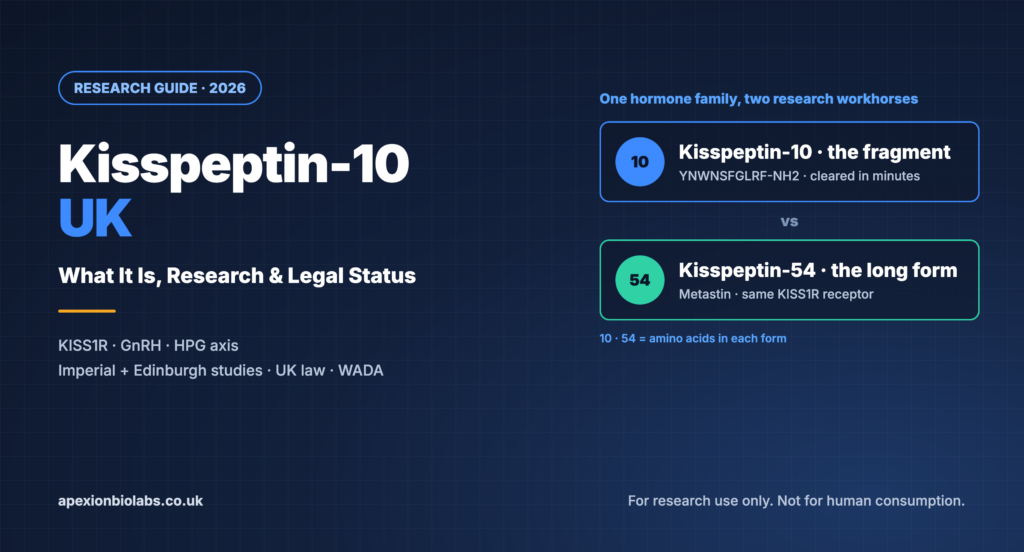
Kisspeptin-10 is the shortest active fragment of Kisspeptin, a hormone encoded by the KISS1 gene. It activates the KISS1R (GPR54) receptor on GnRH neurons, the starting point of the reproductive hormone axis. It has been studied in cell, animal, and supervised human research, and much of the human Kisspeptin UK work came from Imperial and Edinburgh. For Kisspeptin-10 UK status: no medicine licence, and supply is for laboratory research only.
- A 10-amino-acid peptide (YNWNSFGLRF-NH2)
- Studied mainly in reproductive endocrinology, at Imperial College London, Edinburgh and elsewhere
- UK: research use only, no MHRA licence; listed on the WADA Prohibited List (S2, males)
Kisspeptin-10 is a ten-amino-acid peptide, the smallest working piece of Kisspeptin, the brain signal at the very top of the chain controlling puberty and reproduction. Its name comes from chocolate. The gene was found in 1996 by researchers in Hershey, Pennsylvania, and was named after the town’s best-known product, Hershey’s Kisses (Society for Endocrinology).
For Kisspeptin UK readers, there’s a second surprise: some of the most detailed human work on this hormone was done in Britain, at Imperial College London and the University of Edinburgh. That’s why Kisspeptin-10 UK research is a good place to understand what the peptide does and doesn’t do.
This guide explains what Kisspeptin is, how it signals, how the fragments differ, what each study type reports, how it compares with hCG, its UK legal and sport status, and how labs check a batch.
Apexion supplies Kisspeptin-10 strictly for laboratory research. It is not for human or veterinary use. This article is general information, not medical advice. Our Research Use Notice has the full terms.
What Is Kisspeptin?
Kisspeptins are a family of peptides made from the KISS1 gene, and each Kisspeptin peptide in it is a cut of the same chain. Cells cut a 145-amino-acid precursor into Kisspeptin-54, -14, -13 and -10, which share the same tail end. All of them bind one receptor, KISS1R (also called GPR54), and act at the top of the hormone axis that controls puberty and reproduction.
The story took three turns before anyone linked it to hormones:
- 1996, Hershey: Lee and colleagues identified KISS1 as a gene that suppressed metastasis in melanoma cell lines (Lee et al., 1996, JNCI). That early role is why the long form was first named metastin.
- 2001, the receptor: Ohtaki and colleagues showed the KISS1 peptides are the natural ligand of an orphan receptor, GPR54 (Ohtaki et al., 2001, Nature).
- 2003, puberty: two groups independently found that people with loss-of-function GPR54 mutations never started puberty (de Roux et al., 2003, PNAS; Seminara et al., 2003, NEJM).
That last finding moved Kisspeptin from cancer cell biology to the top of the reproductive axis, where most research has focused since.
What Is Kisspeptin-10?
Kisspeptin-10 is a decapeptide: the final ten amino acids of the precursor, positions 112 to 121. Edinburgh researchers describe it as “the minimal kisspeptin sequence with full intrinsic bioactivity” (George et al., 2011), and it’s the form most research catalogues list, including our Kisspeptin 10mg research material.
Kisspeptin-10 at a Glance
The core identity data, checked against PubChem (CID 25240297):
| Field | Detail |
|---|---|
| Names | Kisspeptin-10 (also written Kisspeptin 10), KP-10, metastin (45-54), KISS1 (112-121) |
| Sequence | Tyr-Asn-Trp-Asn-Ser-Phe-Gly-Leu-Arg-Phe-NH2 (YNWNSFGLRF-NH2) |
| Length | 10 amino acids (a decapeptide), with a C-terminal amide (RF-amide family) |
| Formula | C63H83N17O14 (PubChem) |
| Molecular weight | 1,302.4 g/mol (PubChem) |
| CAS | 374675-21-5 |
| Receptor | KISS1R (GPR54), a G-protein coupled receptor |
| Research form | Lyophilised powder; Apexion supplies a pre-filled research pen |
| UK status | Research use only; not MHRA-licensed |
The C-terminal amide is more than a detail. That Arg-Phe-NH2 ending makes Kisspeptin an RF-amide peptide, and the receptor recognises this tail.
How Does Kisspeptin Work?
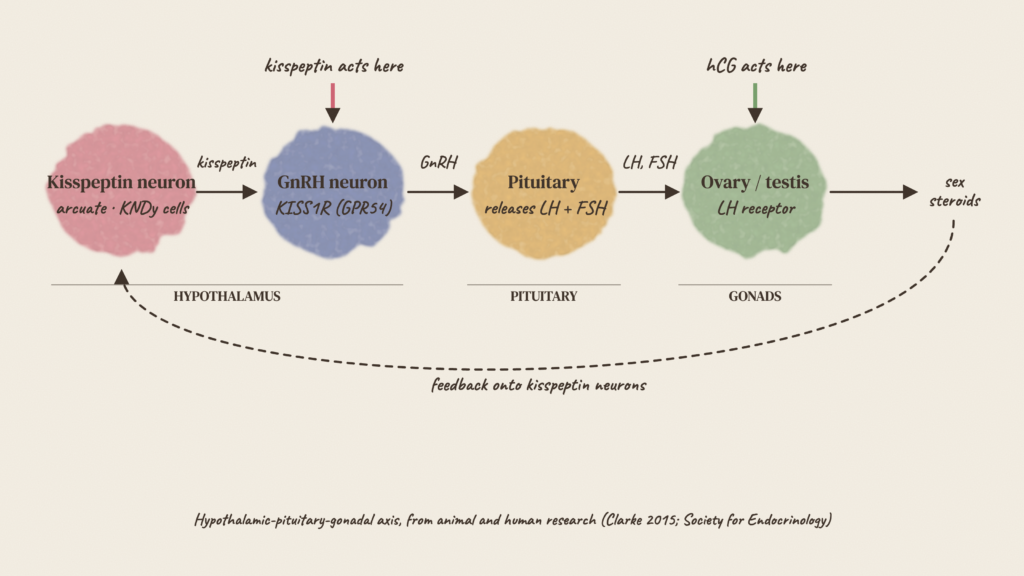
Kisspeptin neurons in the hypothalamus release Kisspeptin onto GnRH neurons. When it binds KISS1R, the GnRH neurons release GnRH. That tells the pituitary to release LH and FSH, which act on the ovaries or testes. That’s why researchers call Kisspeptin the upstream switch of the HPG (hypothalamic-pituitary-gonadal) axis.
Most of the detail comes from animal models:
- Two neuron groups. In rodents, Kisspeptin neurons cluster in the arcuate nucleus and in the AVPV/preoptic area. The arcuate group is linked to the regular hormone pulses, and the AVPV group to the pre-ovulatory LH surge (Clarke et al., 2015).
- KNDy cells. Arcuate neurons release Kisspeptin alongside neurokinin B and dynorphin, so they’re nicknamed “KNDy” (pronounced “candy”). The three are thought to act together to produce GnRH pulses (Society for Endocrinology).
- Timing changes the response. Pulsatility is central to the axis. In the Edinburgh volunteer study, a higher single dose produced a smaller LH response than a moderate one, while a steady infusion increased LH pulse frequency (George et al., 2011).
- Feedback. Sex steroids feed back onto Kisspeptin neurons, which is how the axis keeps itself in balance.
GnRH itself is a releasing hormone from the same brain region, and the same releasing-hormone logic runs through Tesamorelin research, where a GHRH analogue acts on the growth hormone axis instead.
Is Kisspeptin Testosterone?
No. Kisspeptin is a peptide signal in the brain, while testosterone is a steroid made in the testes, three steps further down the axis. Human studies measured LH as the main endpoint, with testosterone recorded in some designs as a downstream research marker.
Kisspeptin-10 vs Kisspeptin-54: What’s the Difference?
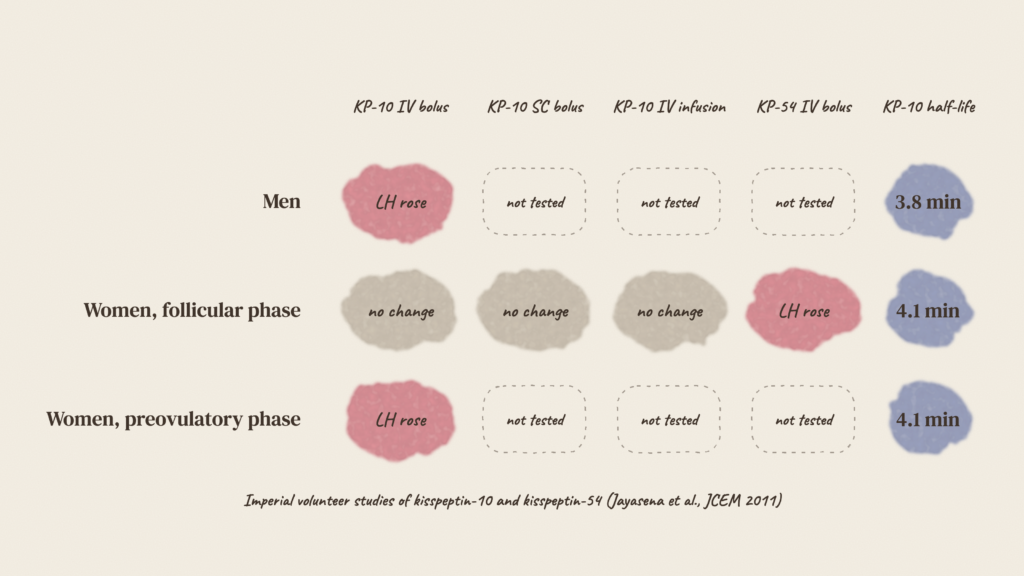
Both come from the same precursor and bind the same receptor. Kisspeptin-54 is the long form and stays in human plasma for about half an hour. Kisspeptin-10 is the short fragment and is cleared in minutes. Imperial researchers compared the two directly in volunteers (Jayasena et al., 2011).
| Kisspeptin-54 | Kisspeptin-14 / -13 | Kisspeptin-10 | |
|---|---|---|---|
| Length | 54 aa | 14 / 13 aa | 10 aa |
| Also called | Metastin | None in common use | KP-10 |
| Receptor | KISS1R | KISS1R | KISS1R |
| Plasma half-life in humans | 27.6 min (Dhillo 2005) | Not reported in volunteers | About 4 min (Jayasena 2011) |
| Typical research use | Human endocrine studies | Lab assays | Lab assays, human studies, reagent catalogues |
Half-life shapes study design. Imperial calculated the Kisspeptin-10 half-life as roughly 7-fold shorter than Kisspeptin-54’s, so a short fragment suits receptor assays and tightly timed experiments, while the long form was the one taken forward into Imperial’s longer human protocols.
What Is Kisspeptin Used For in Research?
Kisspeptin is a research tool in reproductive endocrinology. It’s used to study puberty genetics, the GnRH/LH pulse generator, the LH surge, and how metabolism and stress feed into reproduction. It’s also studied outside reproduction, largely in cell and animal models (reviewed in Tng, 2015).
Research areas by model:
- KISS1R pharmacology: cell assays
- GnRH pulse generation: animal models (rodent, sheep, primate)
- Puberty and hypogonadotropic hypogonadism: human genetics
- LH and FSH responses: supervised human volunteer studies
- Brain processing of emotional and sexual cues: human brain imaging at Imperial (Comninos et al., 2017, JCI)
- Metastasis-suppressor biology: cancer cell lines (the original discovery)
- Collagen in heart tissue: human cardiac fibroblasts and mice (Radwańska et al., 2023, Sci Rep)
What Does the Research on Kisspeptin-10 Show?
In supervised human studies, Kisspeptin-10 given by researchers triggered LH release in men. In women, it did so only at certain phases of the menstrual cycle, which researchers call sexual dimorphism. Most other findings come from animal and cell models. It isn’t an approved medicine for any condition.
UK Human Studies
Three UK studies form the core of the human data:
- Imperial, 2005 (Kisspeptin-54): a double-blind, placebo-controlled crossover study in six healthy men, with a 90-minute intravenous infusion in hospital. Plasma LH and FSH rose against saline, and testosterone was measured alongside them (Dhillo et al., 2005).
- Edinburgh, 2011 (Kisspeptin-10): healthy men received intravenous boluses and infusions. The authors concluded that “Kisspeptin-10 boluses potently evoke LH secretion in men” (George et al., 2011).
- Imperial, 2011 (Kisspeptin-10, five studies): 11 men and 35 women, with intravenous and subcutaneous routes. Kisspeptin-10 stimulated gonadotropin release in men and in preovulatory-phase women, but the authors found it “fails to stimulate gonadotropin release in women during the follicular phase” (Jayasena et al., 2011).
Imperial later took Kisspeptin-54 into investigational protocols: as an egg-maturation trigger in IVF research in women at high risk of ovarian hyperstimulation syndrome (Abbara et al., 2015), and in brain-imaging studies of volunteers with hypoactive sexual desire disorder (Mills et al., 2023, JAMA Netw Open). Both remain investigational research.
Research by study type
| Research area | Study type | What was reported | Status |
|---|---|---|---|
| KISS1R activation | Cell | KP-10 is the minimal sequence with full activity at the receptor | Established |
| GnRH/LH pulse generation | Animal | Kisspeptin neurons drive GnRH pulses | Established in animals |
| LH release in men | Human volunteers (Edinburgh, Imperial) | LH rose after KP-10 (George 2011; Jayasena 2011) | Research only |
| LH release in women | Human volunteers (Imperial) | Response depended on cycle phase | Research only |
| Puberty disorders | Human genetics | Loss of GPR54 function: puberty doesn’t start (2003) | Established |
| Emotional and sexual brain processing | Human imaging (Imperial) | Altered brain activity in response to cues (Comninos 2017) | Early research |
| Collagen in heart tissue | Cells + mice | Higher collagen content (Radwańska 2023) | Preclinical |
| Metastasis suppression | Cell lines | The original KISS1 discovery (Lee 1996) | Preclinical |
These volunteer studies were small, exposures lasted minutes to hours, and everything happened in clinical research units under ethics approval. No Kisspeptin product has ever been granted a UK licence, and the US and EU have none either.
Kisspeptin vs hCG: Where Each Acts
They act at opposite ends of the hormone axis. Kisspeptin acts at the top, in the hypothalamus, prompting the body’s own GnRH and then LH release. hCG acts at the bottom, mimicking LH and binding directly to the LH receptor on the gonads. hCG is a licensed UK prescription medicine for specific uses; Kisspeptin isn’t licensed.
| Kisspeptin | hCG | |
|---|---|---|
| Type | Peptide (10-54 aa) | Glycoprotein hormone |
| Where it acts | Hypothalamus (KISS1R on GnRH neurons) | Gonads (LH receptor) |
| Effect studied | Release of the body’s own GnRH, then LH/FSH | Direct activation of the LH receptor |
| UK status | Research only, not licensed | Licensed prescription medicine |
The comparison came up in UK IVF research for a reason. Because Kisspeptin releases the body’s own LH, which is cleared quickly, Imperial studied Kisspeptin-54 as an alternative trigger for egg maturation in women at high risk of ovarian hyperstimulation (Abbara et al., 2015).
Is Kisspeptin as good as TRT? That comparison doesn’t line up. Testosterone therapy replaces a steroid at the end of the axis, while Kisspeptin is an unlicensed research peptide that acts at the start of it.
Is Kisspeptin Legal in the UK?
Buying Kisspeptin-10 for laboratory research is lawful in the UK. The Misuse of Drugs Act 1971 doesn’t list it as a controlled drug, and the MHRA hasn’t licensed it as a medicine. That means it can’t lawfully be marketed or sold for use in people, and no prescription route exists.
What decides it is how the product is presented and supplied. The Human Medicines Regulations 2012 treat anything offered for use in people as a medicinal product that needs a marketing authorisation. Kisspeptin-10 supplied for laboratory work falls outside that, which is the basis of our Research Use Only policy.
Are Peptides Legal in the UK?
Broadly, yes for research, no for human use without a licence. That single test is why peptides are legal in the UK as research materials, with a few controlled exceptions and separate sport rules.
Can You Get Kisspeptin on Prescription in the UK?
No. A prescription needs a licensed medicine, and there’s no licensed Kisspeptin product. Human use has only happened inside ethics-approved research studies, such as the Imperial and Edinburgh volunteer work.
UK legal position checked 4 November 2026 against MHRA and legislation.gov.uk.
Is Kisspeptin Banned in Sport?
For male athletes, it is. Kisspeptin and its agonist analogues appear in section S2.2.1 of the WADA Prohibited List, the testosterone-stimulating peptides prohibited in males, next to CG, LH and GnRH analogues. WADA’s explanatory note for the 2024 list gives the reason: they act to stimulate GnRH secretion.
Section S2 applies whether or not an athlete is competing. WADA published its 2027 Prohibited List in September 2026, applying from 1 January 2027, and UKAD is responsible for it across UK sport.
How to Verify Research-Grade Kisspeptin-10
Check for a COA tied to the batch itself. LC-MS should show a mass of about 1,302 Da, and HPLC should show purity with the method stated. Because Kisspeptin-10 is only ten residues long, a wrong, truncated, or deleted sequence changes the mass clearly and is easy to catch.
What to check on any Kisspeptin-10 COA:
- Lot number printed the same on the document and the container
- HPLC purity with column, gradient, and wavelength given
- LC-MS mass close to 1,302 Da for the amidated peptide
- Named lab and test date for that batch
- Salt form: acetate or TFA, since the counter-ion changes how much peptide each milligram contains
- Storage conditions stated by the supplier
Knowing how to read a peptide COA makes each field quicker to check, and the steps to verify a research peptide batch are the same for any short peptide. Freeze-dried Kisspeptin-10 is best kept chilled, dry, and protected from light, following standard peptide storage and handling in the lab. Apexion supplies it pre-filled, and the peptide pen vs vial comparison covers how the two formats differ for laboratory handling.
Frequently Asked Questions
The KISS1 gene was discovered in 1996 by researchers at Penn State’s medical school in Hershey, Pennsylvania, the home of the chocolate company. They named it after Hershey’s Kisses. The “peptin” part simply marks it as a peptide.
Both. Kisspeptin is a peptide hormone: a chain of amino acids that neurons release to signal other cells. Kisspeptin-10 is its shortest active form, while Kisspeptin-54 is the longer form used in most human plasma studies.
It switches on GnRH neurons in the hypothalamus. GnRH then prompts the pituitary to release LH and FSH, which signal the ovaries and testes to make sex steroids. Those steroids feed back on Kisspeptin neurons, closing the loop.
In UK studies of healthy men, researchers recorded a rise in LH after Kisspeptin, and testosterone was measured as a downstream marker in some designs (Dhillo 2005; George 2011). These were short, supervised research studies.
They share a receptor and the same final ten amino acids, but Kisspeptin-54 is over five times longer and lasts much longer in plasma. In Imperial’s volunteer work, the two also behaved differently in women at certain cycle phases.
No. The MHRA has never licensed a Kisspeptin product, and neither the FDA nor the EMA has approved one. All human use so far has been inside registered research studies.
To Sum Up
Ten amino acids are enough to switch on the reproductive axis from the top, and UK clinical research units did much of the work showing how. Kisspeptin-10 has no medicine licence anywhere, male athletes are barred from it, and UK supply is for research only.
Supplied by Apexion for laboratory research only, never for human or veterinary use; nothing here is medical advice. Specifications and batch documentation for Kisspeptin 10mg are published with the product, as each batch is verified.
Sources
- Society for Endocrinology, You and Your Hormones: Kisspeptin (last reviewed May 2021)
- Lee JH et al., JNCI, 1996. doi:10.1093/jnci/88.23.1731
- Ohtaki T et al., Nature, 2001. PMID 11385580
- de Roux N et al., PNAS, 2003. doi:10.1073/pnas.1834399100
- Seminara SB et al., NEJM, 2003. doi:10.1056/NEJMoa035322
- Dhillo WS et al., JCEM, 2005. doi:10.1210/jc.2005-1468
- Jayasena CN et al., JCEM, 2011. PMC3232613
- George JT et al., JCEM, 2011. doi:10.1210/jc.2011-0089
- Abbara A et al., JCEM, 2015. doi:10.1210/jc.2015-2332
- Comninos AN et al., J Clin Invest, 2017. doi:10.1172/JCI89519
- Mills EG et al., JAMA Netw Open, 2023. doi:10.1001/jamanetworkopen.2022.54313
- Radwańska P et al., Sci Rep, 2023. doi:10.1038/s41598-023-47224-3
- Clarke H et al., Endocrinol Metab, 2015. PMC4508256
- Tng EL, Singapore Med J, 2015. PMC4678402
- PubChem, Kisspeptin-10, CID 25240297
- Human Medicines Regulations 2012; WADA Prohibited List; UKAD