
SS-31 (Elamipretide) vs MOTS-c: Key Differences in Mitochondrial Research (2026)
Reviewed by Oscar Reyes, PhD, Synthesis Lead at Apexion BioLabs · Scientific review of the chemistry and analytical content
Quick answer
What’s the difference between SS-31 and MOTS-c?
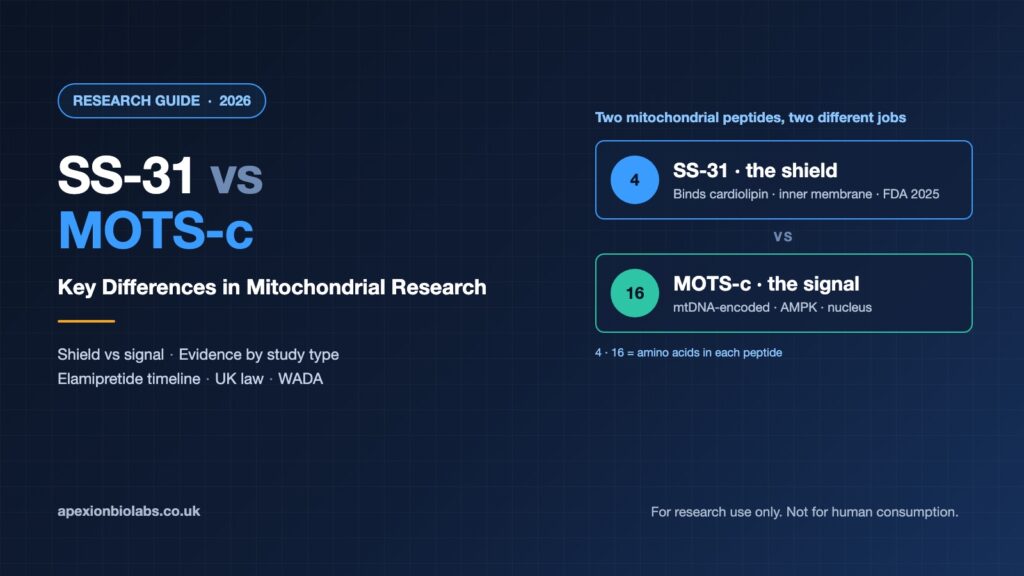
- SS-31 (Elamipretide): a 4-amino-acid synthetic peptide that binds cardiolipin on the inner mitochondrial membrane. This is the ‘shield’.
- MOTS-c: a 16-amino-acid peptide encoded in mitochondrial DNA, studied in AMPK and metabolic signalling. This is the ‘signal’.
- Regulatory record: Elamipretide holds a US accelerated approval for one rare condition, Barth syndrome; MOTS-c has no approval anywhere.
- 4 vs 16 amino acids
- Membrane vs signalling
- UK: research use only
SS-31 is a four-amino-acid peptide designed in a lab to settle on the inner membrane of mitochondria, where it binds a lipid called cardiolipin. MOTS-c is a 16-amino-acid peptide that cells make from their own mitochondrial DNA, and it travels out to act as a messenger about the cell’s metabolic state. In the SS-31 vs MOTS-c comparison, one is a structural shield that stays put and the other is a signal that moves.
They’re compared because both are mitochondrial research peptides, so the two names keep landing next to each other in lab catalogues and reading lists. This guide covers how each is built, where each acts, which kind of study supports each finding, Elamipretide’s regulatory timeline and UK status. Apexion supplies both for laboratory research only; the terms are in our research use notice.
SS-31 vs MOTS-c at a Glance
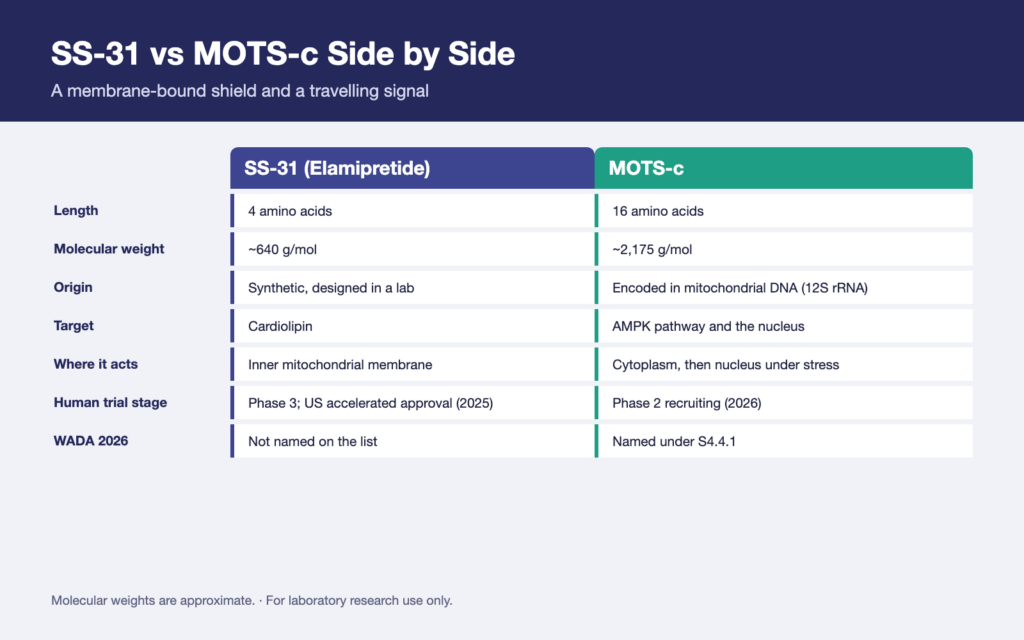
SS-31 is a lab-built four-residue peptide that anchors to cardiolipin in the inner mitochondrial membrane. MOTS-c is a 16-residue messenger read from mitochondrial DNA, which acts through AMPK and can reach the nucleus. SS-31 has human trials and one US approval; MOTS-c research is mostly cell and mouse work.
| Feature | SS-31 | MOTS-c |
|---|---|---|
| Also called | Elamipretide, MTP-131, Bendavia (US brand: Forzinity) | Mitochondrial ORF of the 12S rRNA-c |
| Length | 4 amino acids (D-Arg-Dmt-Lys-Phe-NH2) | 16 amino acids |
| Molecular weight | ~640 g/mol | ~2,175 g/mol |
| Origin | Synthetic, designed in a lab | Encoded in mitochondrial DNA (12S rRNA region) |
| Target | Cardiolipin | AMPK pathway and the nucleus |
| Where it acts | Inner mitochondrial membrane | Cytoplasm, then the nucleus under stress |
| Main study types | Cell, animal, human trials incl. Phase 3 | Cell and mouse; human natural-level studies; Phase 2 recruiting |
| Regulatory record | US accelerated approval, Barth syndrome (2025) | No approval anywhere |
| WADA (2026) | Not named on the list | Named under S4.4.1 (AMPK activators) |
| Apexion format | SS-31 30mg research pen | MOTS-c 40mg research pen |
What Is SS-31 (Elamipretide)?
SS-31 is a four-residue synthetic peptide, D-Arg-Dmt-Lys-Phe-NH2, where Dmt stands for 2′,6′-dimethyltyrosine. Two of its residues are aromatic and two carry a positive charge, and that alternating pattern carries it through cell membranes to the inner mitochondrial membrane. Once there, it docks onto cardiolipin, a four-tailed lipid that anchors the respiratory complexes.
At about 640 g/mol, it’s a small molecule for a peptide, roughly a third the weight of MOTS-c. Hazel Szeto and Peter Schiller found the series while building opioid-receptor peptides, when some of their designs unexpectedly gathered in mitochondria.
A 2020 study from the University of Washington mapped what SS-31 actually touches. Using chemical cross-linking and mass spectrometry on isolated mitochondria, Chavez and colleagues found that every protein bound by SS-31 was a known cardiolipin binder. The interacting proteins fell into two groups: those that drive ATP production through oxidative phosphorylation, and those in 2-oxoglutarate metabolism. Our SS-31 UK guide covers its chemistry and trial history in depth.
Is SS-31 the Same as Elamipretide?
Yes, every one of these names points to the same tetrapeptide. “SS” stands for Szeto-Schiller, the lab that first made it. Stealth BioTherapeutics took it into development as MTP-131, also called Bendavia, before it received the generic name Elamipretide. In the US, the licensed product is sold as Forzinity.
What Is MOTS-c?
MOTS-c is a 16-residue peptide whose code is tucked inside the 12S rRNA gene, a stretch of mitochondrial DNA once thought to make only ribosomal RNA. Changhan Lee and Pinchas Cohen’s group at USC described it first, in a 2015 Cell Metabolism paper. It weighs about 2,175 g/mol. The team opened that paper by noting that the role of mitochondria “as a signaling unit is increasingly being appreciated,” and MOTS-c became one of the clearest examples.
In that first paper, MOTS-c slowed the folate cycle in cultured cells, letting a molecule called AICAR build up. AICAR then switched on AMPK, the cell’s fuel sensor, in cells and in mouse muscle. Three years later, Kim and colleagues found that when cultured cells were short of glucose, MOTS-c relocated to the nucleus and adjusted nuclear gene activity. They read this as a sign that the two genomes were built to talk to each other. That nuclear step is where the MOTS-c mechanism stops looking like a simple metabolic signal.
How Do They Work Differently? Shield vs Signal
SS-31 works where it lands: at the inner mitochondrial membrane, bound to cardiolipin beside the electron transport chain. MOTS-c works by travelling: it activates AMPK in the cytoplasm and, under stress, enters the nucleus to change gene activity. One supports structure in place; the other carries information.
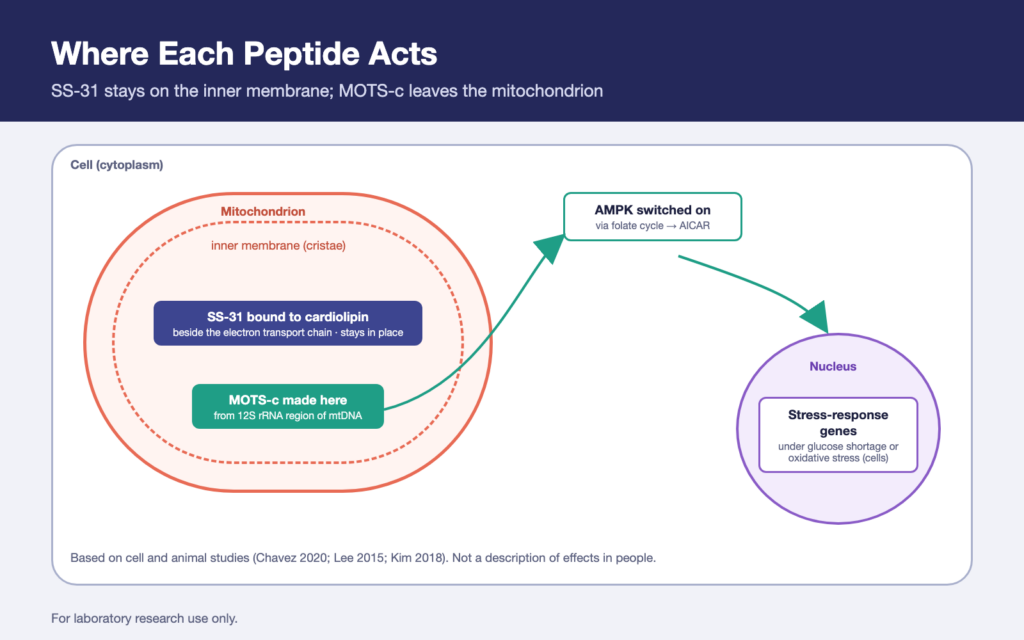
SS-31, the shield (cell and animal models). The inner membrane is folded into ridges called cristae, and cardiolipin helps hold those folds and the respiratory machinery together. Lab work on SS-31 looks at how its grip on cardiolipin relates to that structure, to electron flow and to reactive oxygen species. Everything happens inside the mitochondrion, close to where it settles.
MOTS-c, the signal (cell and mouse models). MOTS-c is made inside the mitochondrion and then acts elsewhere. Through the folate-AICAR route it switches on AMPK. When cells face glucose shortage or oxidative stress, it relocates to the nucleus and attaches to stress-response genes, including ones governed by the NRF2 transcription factor.
The two even differ in where the instructions come from. SS-31 is a chemist’s design. MOTS-c is read from the cell’s own mitochondrial genome, so cells already carry it, and human studies can measure natural levels in blood and muscle.
What Does the Research Show? Evidence by Study Type
SS-31 has cell, animal and human trial data, including Phase 3 work and one US accelerated approval. MOTS-c research is mostly cell and mouse studies, plus human studies measuring natural blood and muscle levels, an early safety trial of the analogue CB4211 and a Phase 2 trial of native MOTS-c that opened in 2026.
| Compound | Study type | Model or population | What was measured | Status |
|---|---|---|---|---|
| SS-31 | Cell and animal | Isolated mitochondria, mice | Cardiolipin binding, protein interactions, ROS | Large preclinical literature |
| SS-31 | Human Phase 2/3 (TAZPOWER) | Barth syndrome | Functional measures; knee extensor strength | Basis of the 2025 US accelerated approval |
| SS-31 | Human Phase 3 (MMPOWER-3) | Primary mitochondrial myopathy | Walking distance and fatigue scores | Primary endpoints not met |
| SS-31 | Human Phase 2 (EMBRACE STEMI) | Heart attack patients | Infarct size | Primary endpoint not met |
| MOTS-c | Cell and mouse (Lee 2015; Kim 2018) | Cultured cells, mouse muscle | AICAR, AMPK activation, nuclear gene regulation | Preclinical |
| MOTS-c | Human observational (Reynolds 2021) | Young men | Natural MOTS-c levels during exercise | No peptide given |
| CB4211 (MOTS-c analogue) | Human Phase 1a/1b (NCT03998514) | Adults | Safety and tolerability | Completed 2021; separate molecule |
| MOTS-c | Human Phase 2 (NCT07505745) | 120 adults planned | Insulin-sensitivity measures | Recruiting since February 2026 |
Which Has More Human Evidence?
SS-31, by a wide margin. Elamipretide has been through multiple human trials, including Phase 3, and has a US regulatory decision. Human data for MOTS-c itself is limited to measuring natural levels, an analogue’s safety study and a Phase 2 trial with no findings published yet.
Elamipretide’s Regulatory Timeline
The FDA’s decision came on 19 September 2025: accelerated approval for Forzinity, the hydrochloride salt of Elamipretide, in Barth syndrome for patients of 30 kg body weight and above. The decision leaned on an intermediate endpoint, knee extensor muscle strength, so continued approval hinges on a confirmatory study.
The path ran from the Szeto-Schiller lab to Stealth BioTherapeutics, through trials as MTP-131 and Bendavia, to the generic name Elamipretide. The TAZPOWER trial in Barth syndrome supplied the data behind the filing. The confirmatory study, 4TAZPower, enrolled its first participant in July 2026. In the UK, the MHRA has granted no marketing authorisation for Elamipretide.
Have SS-31 and MOTS-c Been Studied Together?
No. Searching PubMed on 29 October 2026 turned up no study, in cells, animals or people, that tested SS-31 and MOTS-c together. The one paper naming both is a 2025 narrative review that discusses each peptide separately.
That means the “SS-31 before MOTS-c” ordering idea seen online has no published data behind it. The logic of shield first, then signal, is an appealing story built from two separate literatures. A combination study would need its own design, with groups for each peptide alone and together.
Are SS-31 and MOTS-c Legal in the UK?
Yes, as laboratory research material. The MHRA has licensed neither peptide, which rules out selling or describing either as a medicine here. The Misuse of Drugs Act 1971 doesn’t schedule either one, and the US decision on Elamipretide carries no weight in UK law.
| UK law or guidance | How it applies to SS-31 and MOTS-c |
|---|---|
| Human Medicines Regulations 2012 | No UK marketing authorisation for either; presenting them as treating or preventing disease makes them medicines |
| Misuse of Drugs Act 1971 | Neither is listed |
| MHRA | No licence for Elamipretide; the US approval gives it no UK status |
| MHRA borderline guidance (GN8) | Sets the presentation and function tests for products near the medicines line |
Verified October 2026 using MHRA’s borderline products guidance, the Human Medicines Regulations 2012 (regulation 2) and the Misuse of Drugs Act 1971 (Schedule 2). How the same rules play out for other research compounds is set out in are peptides legal in the UK.
Are They Banned in Sport?
WADA’s 2026 Prohibited List gives MOTS-c by name in class S4.4.1, the AMPK activators, in the same line as AICAR. SS-31 has no entry on the 2026 list. Class S0 applies to substances that no government health regulator has approved for human therapeutic use, and the FDA’s September 2025 decision on Elamipretide is a matter of public record.
How to Verify SS-31 and MOTS-c Research Pens
A certificate of analysis (COA) for either pen needs three things: an HPLC purity figure, a measured mass that identifies the peptide and a lot number that matches the label. For SS-31, the measured mass should be close to 640 g/mol. For MOTS-c, expect a figure close to 2,175 g/mol.
Both come from Apexion as pre-filled research pens, each prepared after the order is placed: an SS-31 30mg pen and a MOTS-c 40mg pen. Each pen’s batch number or QR code ties it to the certificate that follows with the order. Every line of that document is explained in our guide to reading a peptide certificate of analysis.
How Do They Compare With NAD+?
NAD+ is a coenzyme, a non-peptide molecule that carries electrons through metabolism, which places it in a different chemical class from both peptides. Our three-way comparison, MOTS-c vs SS-31 vs NAD+, sets all three side by side.
Frequently Asked Questions
SS-31 is a lab-designed tetrapeptide that clings to cardiolipin in the inner mitochondrial membrane and stays there. MOTS-c is a 16-residue messenger made from mitochondrial DNA, which signals through AMPK and can relocate to the nucleus. One acts as a structural shield; the other carries information.
Yes. The Szeto-Schiller lab named it SS-31, Stealth BioTherapeutics used MTP-131 and Bendavia during development, and Elamipretide is its international generic name. Forzinity is the US brand. Each name refers to the same tetrapeptide, D-Arg-Dmt-Lys-Phe-NH2.
Yes, for one use. Forzinity (Elamipretide HCl) received FDA accelerated approval on 19 September 2025, limited to Barth syndrome in patients of 30 kg and above. Its continued approval rests on a confirmatory trial, which opened in July 2026.
SS-31 has far more. Elamipretide has completed several human trials, including Phase 3, and holds a US accelerated approval. Human data for MOTS-c covers natural blood and muscle levels, an analogue safety study and a Phase 2 trial still recruiting.
No study of SS-31 and MOTS-c together appears in PubMed as of October 2026, whether in cells, animals or people. Ordering ideas shared online, such as “SS-31 first, then MOTS-c”, have no published data behind them.
Yes, as research material. With no MHRA licence and no listing under the Misuse of Drugs Act 1971, both are lawful lab materials that can’t be marketed as medicines. For sport, WADA names MOTS-c under S4.4.1.
To Sum Up
SS-31 is a synthetic shield that binds cardiolipin and has a deep trial record. MOTS-c is a mitochondrial-encoded signal studied mainly in cells and mice. For lab work, pick the peptide that matches the question, membrane structure or metabolic signalling, and confirm each batch on its COA.
Sources
- Szeto HH. Clinical Pharmacology & Therapeutics. 2014 (PMC4267688).
- Chavez JD, et al. PNAS. 2020;117(26):15363-15373 (PMC7334473).
- Tung C, et al. International Journal of Molecular Sciences. 2025 (PMC11816484).
- Lee C, et al. Cell Metabolism. 2015 (PMC4350682).
- Kim KH, et al. Cell Metabolism. 2018;28(3):516-524 (PMC6185997).
- Reynolds JC, et al. Nature Communications. 2021 (PMC7817689).
- ClinicalTrials.gov: TAZPOWER (NCT03098797), MMPOWER-3 (NCT03323749), CB4211 (NCT03998514), MOTS-c Phase 2 (NCT07505745).
- US FDA. Forzinity (Elamipretide) prescribing information, 2025.
- WADA. 2026 Prohibited List, S4.4.1.
- legislation.gov.uk: Human Medicines Regulations 2012; Misuse of Drugs Act 1971. MHRA borderline products guidance.
Disclaimer: SS-31 and MOTS-c from Apexion are sold for laboratory research use only, never for use in people or animals. They aren’t medicines, supplements or food, and nothing in this guide is medical or legal advice. Full terms are in our research use notice.