
MOTS-c Peptide UK: Research Overview and Legal Status (2026)
Reviewed by Oscar Reyes, PhD, Synthesis Lead at Apexion BioLabs · Scientific review of the chemistry and analytical content
Quick answer
What is MOTS-c peptide?
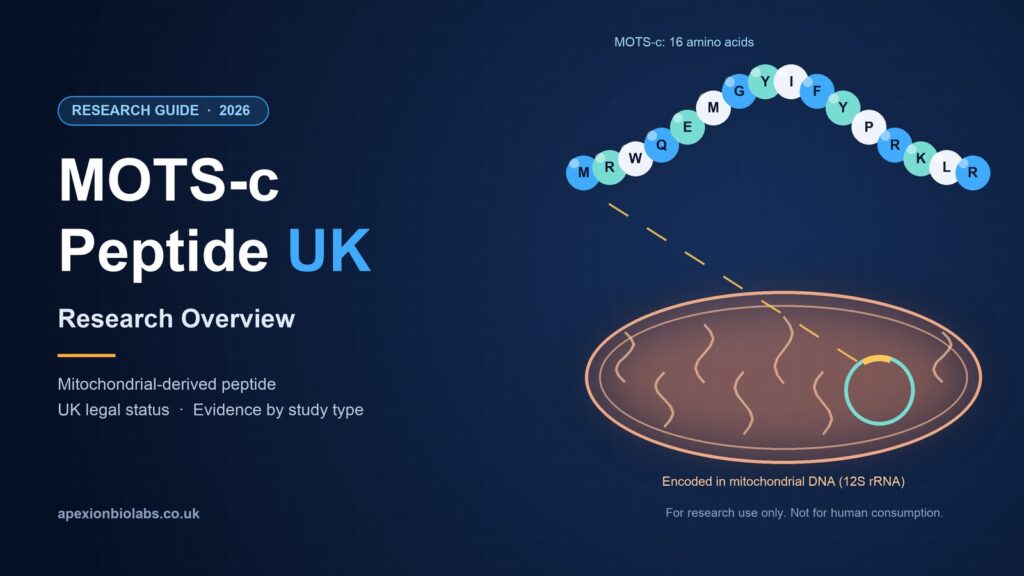
MOTS-c is a peptide of 16 amino acids, coded in mitochondrial DNA, inside the 12S rRNA region. Scientists study it mostly in cells and mice, looking at metabolism and exercise. It holds no approval from any regulator, and UK suppliers offer it purely as a research material.
- 16 amino acids, first described in 2015
- Most evidence comes from mouse and cell work; human data are mostly measured levels
- UK: not controlled, not licensed, research use only; WADA S4
Search “MOTS-c peptide UK” and nearly every result is a shop listing. A price, a vial size, a purity figure. Very few of them stop to explain what the molecule actually is, how strong the evidence behind it really is, or where UK law draws its lines.
This guide fills in those blanks. It starts with the peptide’s origin in mitochondrial DNA and the way it signals inside lab cells, then moves through the research areas, the human studies (including a Phase 2 trial that began recruiting in 2026), UK law, anti-doping rules and what a trustworthy certificate looks like. Every finding carries a label telling you where it came from, whether a cell dish, a mouse or a human volunteer.
Apexion’s MOTS-c goes to laboratories for research and nothing more. People and animals are outside its intended use, nothing here is medical advice, and our Research Use Only notice sets out the terms.
What Is MOTS-c Peptide?
MOTS-c stands for “mitochondrial open reading frame of the 12S rRNA-c”. In plain terms, it’s a short peptide whose code is tucked into a stretch of mitochondrial DNA that scientists had long assumed only made ribosomal RNA. It was first reported in 2015, in a Cell Metabolism paper from a USC team led by Changhan Lee and Pinchas Cohen.
That discovery surprised people. Every mitochondrion holds a tiny genome of its own, about 16,500 base pairs, and for decades it was thought to hold just 37 genes. MOTS-c showed that short stretches inside those genes could also code for working peptides, small enough to have been missed.
The USC team found it by scanning the 12S rRNA gene for short open reading frames, the stretches of code that could in theory be read into a protein. One candidate stood out. They then raised antibodies against it and detected the peptide in mouse tissues and in circulating blood, which told them it wasn’t just a quirk of the code.
Here’s the molecule at a glance:
| Field | Detail |
|---|---|
| Name | MOTS-c (mitochondrial open reading frame of the 12S rRNA-c) |
| Sequence | MRWQEMGYIFYPRKLR |
| Length | 16 amino acids |
| Formula | C101H152N28O22S2 |
| Molecular weight | ~2,174.6 g/mol (PubChem CID 146675088) |
| CAS number | 1627580-64-6 |
| Origin | Mitochondrial DNA (MT-RNR1, the 12S rRNA gene) |
| Form at Apexion | Pre-filled 40mg research pen, prepared to order in the UK |
| UK status | Research material only; no MHRA licence, not a controlled drug |
Batch identity data and the certificate for our pens are listed under MOTS-c 40mg specification and COA.
Mitochondrial-Derived Peptides: MOTS-c, Humanin and SHLPs
MOTS-c belongs to a small family called mitochondrial-derived peptides, or MDPs. Merry and colleagues, reviewing the field in 2020, count eight identified so far:
- Humanin: the first one found, in 2001. It’s coded in the 16S rRNA gene and is 24 amino acids long.
- SHLP1 to SHLP6: six “small humanin-like peptides”, also coded in the 16S rRNA region.
- MOTS-c: the only known MDP coded in the 12S rRNA gene.
The same review notes there may be “tens to hundreds of potential peptide-encoding short ORFs” in mitochondrial DNA still waiting to be characterised. So the list of mitochondrial peptides is short today, and it may grow.
How Does MOTS-c Work?
In cell and mouse studies, MOTS-c acts as a metabolic signal. It slows a pathway called the folate-methionine cycle, allowing a molecule named AICAR to build up. AICAR then turns on AMPK, which works like a fuel gauge inside the cell. Under stress, MOTS-c also moves into the cell nucleus and changes which genes are active.
Here’s the chain, step by step, with the model behind each link:
- The folate-methionine cycle slows (cells, Lee 2015). This cycle supplies building blocks for DNA and for methyl groups. MOTS-c dampens it.
- AICAR accumulates (cells, Lee 2015). AICAR is an intermediate in purine production, and a slower folate cycle leaves more of it sitting unused.
- AMPK switches on (cells and mouse skeletal muscle, Lee 2015). AMPK responds to low energy by nudging cells towards taking up glucose and burning fuel.
- MOTS-c enters the nucleus (cells, Kim et al., Cell Metabolism 2018). When cultured cells were starved of glucose or put under oxidative stress, MOTS-c moved out of the cytoplasm and into the nucleus and bound to stress-response genes.
There’s a neat twist in step two. AICAR is itself a well-known lab tool for switching on AMPK, and WADA lists it in the same anti-doping section as MOTS-c. So the peptide appears to reach AMPK by raising the cell’s own supply of a compound researchers already use for the same job.
That fourth step is the striking one. It means a peptide coded by mitochondrial DNA can talk back to the nuclear genome, a two-way conversation biologists hadn’t expected.
Where “exercise mimetic” comes from. You’ll often see MOTS-c called an “exercise mimetic”. The label comes from mouse work: AMPK is the same sensor that exercise activates, and mice given MOTS-c performed better on treadmill and grip tests. No human study has shown anything of the sort, so the phrase describes what happened in mice. Nothing comparable has been recorded in people.
What Is MOTS-c Studied For?
MOTS-c serves researchers as a probe for how cells signal about their energy state, and how mitochondria pass that information along. Most of the work uses cultured cells and mice, plus a few human studies that track how much MOTS-c people already carry in muscle and circulation.
The main research areas, each with its model:
- Glucose handling (mouse, skeletal muscle): Lee’s 2015 work tracked how muscle took up and used glucose, and skeletal muscle turned out to be the main tissue responding to MOTS-c in mice. Muscle is where most glucose ends up after a meal, so it’s the natural place for a metabolic signal to show its effect.
- Exercise capacity (mouse; human levels observational): Reynolds and colleagues (Nature Communications, 2021) reported better running and grip performance in mice at young, middle and old ages. In the same paper, a small group of sedentary young men did a cycling session, and their MOTS-c levels rose during exercise. That’s an observation of natural levels, and nobody in it received the peptide.
- Ageing (aged mice; human levels by age, observational): mice that first received MOTS-c late in life still showed changes in physical-capacity measures. In people, D’Souza and colleagues (Aging, 2020) compared men of different ages and found that blood and muscle levels move in opposite directions as people get older.
- Inflammatory signalling (cell and mouse): cell cultures and mouse models have looked at how MOTS-c relates to inflammatory signalling molecules called cytokines. Because AMPK also influences these pathways, the work ties back to the same energy-sensing chain described above.
- Other preclinical models: cell and rodent studies across several tissue types, summarised in the Zheng 2023 review.
MOTS-c in Metabolic Research: What Mouse Studies Show
Many searches about MOTS-c ask about body weight. The research behind those searches is a set of mouse experiments, so that’s where the answer starts and ends.
In Lee’s 2015 paper, mice were fed a high-fat diet, a standard way of putting metabolism under stress in the lab. Researchers then compared treated mice with untreated ones eating the same food, tracking metabolic markers such as body mass and insulin response over several weeks. These are animal results under tightly controlled lab conditions. The same paper also looked at older mice with age-related changes in insulin response, which explains MOTS-c’s place in ageing research alongside metabolic work.
No human study has measured body-weight changes from MOTS-c itself. The trials of CB4211, a modified analogue, are a separate molecule and a separate question, covered below. Research-grade MOTS-c carries no weight-related claim of any kind.
What Does the Research on MOTS-c Actually Show?
There’s a lot of cell and mouse data, and almost no human data from giving the peptide itself. Human studies so far mostly measure the MOTS-c people already make. The table keeps each finding pinned to its model.
| Area | Model | What researchers reported | Evidence level |
|---|---|---|---|
| Folate pathway to AMPK | Cells; mouse muscle | AICAR build-up and AMPK activation (Lee 2015) | Preclinical |
| Nuclear signalling | Cells | Enters the nucleus when cells are stressed (Kim 2018) | Preclinical |
| High-fat feeding model | Mice | Metabolic markers tracked on high-fat feed (Lee 2015) | Preclinical |
| Physical capacity | Mice of three ages | Better treadmill and grip measures (Reynolds 2021) | Preclinical |
| Exercise and natural levels | Young men | Levels rose in muscle and blood during exercise (Reynolds 2021) | Human observational |
| Age and natural levels | Men aged 18 to 81 | Blood levels lower with age, muscle levels higher (D’Souza 2020) | Human observational |
| CB4211 | Two adult groups | Phase 1a/1b safety study, completed 2021 | Human trial of an analogue |
| Native MOTS-c | Adults | Phase 2 study recruiting since 2026, no results yet | Human trial, in progress |
Observational vs interventional. Measuring a molecule and giving a molecule are two very different experiments. When Reynolds and D’Souza measured MOTS-c, they learned how the body’s own supply behaves. They didn’t learn what happens when someone receives extra peptide from outside. Only an interventional trial answers that, and for native MOTS-c, the first one is still running.
Why mouse results don’t carry over to people. Three reasons crop up repeatedly:
- Uniform animals. Lab mice are usually inbred, so every animal shares the same genes. People vary enormously.
- Controlled conditions. Diet, light, temperature and activity are fixed in a mouse study. Real metabolism runs under none of those controls.
- Different readouts. A treadmill time or a grip score is a mouse measure. It doesn’t map neatly onto anything a human trial would count as an outcome.
One more piece of context helps. Look at the conflict-of-interest notes on Reynolds 2021 and D’Souza 2020 and you’ll see that senior authors on both had consulting ties to CohBar, the company that developed the analogue. That’s common in early-stage science, where the discoverers are often the ones commercialising the work. Labs outside the original USC network have since run their own cell and animal studies, as the reference list of the Zheng 2023 review shows, and that wider base makes the picture sturdier.
The reviewers who’ve followed this field closely are optimistic and careful at once. As Zheng, Wei and Wang wrote in Frontiers in Endocrinology in 2023, “Understanding the detailed molecular details of MOTS-c is an ongoing endeavor.”
Has MOTS-c Been Tested in Humans?
Not as a full trial programme for MOTS-c itself. A modified version called CB4211 went through early safety testing, and a Phase 2 trial of the unmodified peptide opened in 2026. Neither has led to an approval, and no regulator in any country has authorised MOTS-c.
CB4211. CohBar, a company co-founded by Pinchas Cohen, developed CB4211 as an analogue of MOTS-c. The Phase 1a/1b trial for CB4211 (NCT03998514) enrolled healthy volunteers and a second adult group, and was completed in 2021. CohBar reported that it met its primary safety endpoint, with the other readouts treated as exploratory. No later-stage CB4211 trial was registered.
Why build an analogue at all? Natural peptides tend to break down quickly once they’re outside the cell, so drug developers often tweak the sequence to make a molecule last longer and behave more predictably. The trade-off is that the analogue’s data can’t simply be borrowed for the original peptide.
Native MOTS-c. Hudson Biotech is running a placebo-controlled Phase 2 study, NCT07505745, which opened to adult volunteers in February 2026. Its main focus is insulin sensitivity, measured against a placebo group, which makes it the first study able to say what added MOTS-c does in people. When we checked the registry in October 2026, it was still recruiting and had posted no results.
Is MOTS-c Legal in the UK?
It is, as a laboratory research material. MOTS-c is absent from the controlled drug schedules, and no MHRA licence has ever been issued for it. That means it can’t be sold, supplied or promoted for human consumption anywhere in Britain.
Three laws shape its position (checked October 2026):
| Law | What it says | How it applies to MOTS-c |
|---|---|---|
| Human Medicines Regulations 2012 | Regulation 2 sets out what counts as a medicinal product. Regulation 46 bars selling, supplying or offering an unlicensed medicinal product. | MOTS-c has no marketing authorisation, so it can’t be offered as a medicine. |
| Misuse of Drugs Act 1971 | Places controlled drugs into classes A, B and C. | MOTS-c isn’t listed. |
| Psychoactive Substances Act 2016 | Covers substances capable of producing a psychoactive effect, defined as one that affects mental functioning or emotional state through the central nervous system. | No psychoactive effect has been reported for MOTS-c. |
The detail that catches sellers out comes from MHRA Guidance Note 8, the MHRA’s own guidance on classifying products. Presentation alone can turn a product into a medicine. The MHRA looks at every claim made for it, explicit or implied, including those on websites, in testimonials and on social media. Even a product name can count as an implied claim. A peptide sold with a dosing chart or a promised effect in people can therefore be treated as an unlicensed medicine, regardless of any research-use label. At that point, regulation 46 applies, and offering it for sale becomes an offence.
Status varies between peptides. For the other common ones, are peptides legal in the UK lays out each case.
Can You Buy MOTS-c in the UK?
It’s available from UK research suppliers, sold under research-use-only terms. You won’t find it in pharmacies, because no licence exists for it. Buying from abroad brings its own problem, because customs officers check parcels for medicines: unlicensed medicines arriving at the UK border can be seized. Apexion’s sale terms appear in the Research Use Only notice.
Do You Need a Prescription for MOTS-c?
There’s no UK prescription route for MOTS-c, NHS or private. A prescription needs a licensed product, or at least a recognised unlicensed-medicine pathway, and MOTS-c has neither. UK clinics that offer it to clients as a service are operating outside that system, and the MHRA opened enquiries into peptide claims from clinics in April 2026. Research suppliers sell it to laboratories, and the people they deal with are researchers.
Is MOTS-c Banned in Sport?
WADA, the global anti-doping agency, names MOTS-c in section S4.4.1 of its Prohibited List, under metabolic modulators as an activator of AMPK. Everything in this section stays banned year-round, whether or not a competition is under way. MOTS-c first appeared there by name on the 2025 list, as the ISSF reported when the list was published, and AICAR is named in the same section.
The 2027 Prohibited List, approved in September 2026, keeps the same entry and comes into force on 1 January 2027. UK Anti-Doping (UKAD) applies the list across British sport. The US agency USADA also publishes a plain-English explainer on MOTS-c.
MOTS-c vs SS-31 and Other Mitochondrial Peptides
MOTS-c, SS-31 and humanin all appear in mitochondrial studies, yet they start in different places and do different jobs in lab models. Two are made by the cell’s own mitochondrial DNA. The third was designed by chemists. The quickest way to tell them apart is to ask where each one does its work: MOTS-c signals to the nucleus, SS-31 holds on to a membrane lipid, and humanin acts mostly from outside the cell.
| MOTS-c | SS-31 | Humanin | |
|---|---|---|---|
| Origin | Mitochondrial DNA, 12S rRNA | Synthetic (Szeto-Schiller series) | Mitochondrial DNA, 16S rRNA |
| Length | 16 amino acids | 4 amino acids | 24 amino acids |
| Where it acts (lab models) | Cytoplasm and nucleus; AMPK signalling | Inner mitochondrial membrane; binds cardiolipin | Released from cells; binds cell-surface receptors |
| Human data | Natural levels measured; analogue Phase 1; Phase 2 recruiting | Several human trials, as elamipretide | Natural levels measured |
| Approval | None | US accelerated approval for one rare condition (2025) | None |
The MOTS-c vs SS-31 vs NAD+ comparison on our blog goes deeper into each molecule. SS-31 also has its own UK research overview and the SS-31 specification page.
How to Verify Research-Grade MOTS-c
The certificate of analysis (COA) for the batch is the first thing to read. It should carry a lot code matching the label, an HPLC purity result alongside its method, and an LC-MS mass close to 2,174.6. It should also name the independent lab, give the test date and state the salt form.
The mass result is easier to read once you know what the raw spectrum looks like. Electrospray LC-MS gives a peptide several positive charges at once, so MOTS-c appears as a series of peaks. Divide the mass (plus the added protons) by the charge and you get the positions: about 725.9 for the 3+ ion and 544.7 for the 4+ ion. A COA that reports a deconvoluted mass of around 2,174.6 has done that maths for you.
For the HPLC result, look for the method behind the number. Reverse-phase HPLC on a C18 column, with UV detection around 214 to 220 nm, is the usual set-up for a peptide this size. A purity figure with no method attached is much harder to judge.
| Check | What to look for |
|---|---|
| Lot number | Same code on certificate and label |
| HPLC purity | Purity %, with column type and detector stated |
| LC-MS identity | Mass near 2,174.6, or charge states near 725.9 (3+) and 544.7 (4+) |
| Lab and date | Testing lab named; report dated |
| Salt form | TFA or acetate, since the counter-ion adds weight to the powder |
Red flags are easy to spot once you know them: dosing charts, body-weight or other outcome claims, and certificates with no lot number at all.
For a longer walkthrough, try how to read a peptide certificate of analysis and how to verify a research peptide batch. Lot codes can be looked up on our batch verification page. Since Apexion supplies MOTS-c as a pre-filled research pen, our peptide pen vs vial comparison explains how the two formats differ.
How Should MOTS-c Be Stored?
Dry powder keeps best cold, dry and dark, at −20 °C for long periods. Solutions and pre-filled pens go in the fridge, as the batch sheet directs. MOTS-c has a particular weak spot: its sequence includes methionine and tryptophan, two residues that oxidise readily when exposed to air and light. Oxidised methionine adds 16 to the mass, so it shows up on LC-MS as a small extra peak just above the main one. Fewer opening and closing cycles mean less oxidation, and a cleaner spectrum when the batch is retested. The full routine is covered by the storage and handling guide.
Frequently Asked Questions
Yes, though strictly as a research material. UK suppliers sell MOTS-c to laboratories under research-use-only terms, and no pharmacy stocks it because it holds no MHRA licence. Because no drug schedule lists it, holding it for lab work is lawful. Marketing it as something people take would turn it into an unlicensed medicine under the Human Medicines Regulations 2012. A reputable supplier will provide a batch COA and clear research-use terms.
In cell and mouse studies, MOTS-c slows the folate-methionine cycle. That raises AICAR and activates AMPK, the enzyme that tracks a cell’s energy supply. When cultured cells are stressed, MOTS-c also travels into their nucleus, where it influences stress-response genes. It gives researchers a way to probe how mitochondria send signals outward, especially when energy runs low. Those findings come from cell cultures and mice.
Yes. Cells make MOTS-c from a short stretch of code within mitochondrial DNA’s 12S rRNA gene, and it’s found in human blood and muscle. Research-grade MOTS-c is chemically synthesised to match that natural 16-amino-acid sequence, then purified and tested batch by batch. The natural and synthetic versions share the same amino-acid sequence, which is what an LC-MS identity check confirms.
Only partly. So far, human work has only measured the MOTS-c people make themselves, during exercise and across age groups. An analogue, CB4211, completed an early safety trial in 2021. A Phase 2 trial of unmodified MOTS-c (NCT07505745) opened in February 2026 and hasn’t reported results. Until it does, there’s no controlled human data on the native peptide.
No. CB4211 is a modified analogue that CohBar developed from MOTS-c, with changes intended to make it more suitable for development as a drug. It’s a different molecule, so its trial data don’t describe MOTS-c, and the two shouldn’t be treated as interchangeable in a protocol or a literature search. Its only registered trial, a Phase 1a/1b safety study, finished in 2021.
The name comes from mouse studies. MOTS-c switches on AMPK, the same energy sensor exercise activates, and mice given it performed better on treadmill and grip tests. Human studies show exercise raises natural MOTS-c levels, which is a different finding. No trial has tested whether giving the peptide mimics exercise in people, so the label is best read as shorthand for a mouse result.
The Bottom Line
In short, MOTS-c is a mitochondrial-DNA peptide whose research record is built mostly on cells and mice. Human research so far measures natural levels, with an analogue’s safety study behind it and a Phase 2 trial of the unmodified peptide still enrolling. In the UK, it’s an unlicensed, uncontrolled research material, and WADA prohibits it in sport. Apexion provides it to laboratories alone, for research and nothing else.
View MOTS-c 40mg specification and COA, or browse the mitochondria research range.
Disclaimer: This guide is educational and written for researchers. Apexion’s MOTS-c is a laboratory research material and doesn’t count as a medicine, supplement or food. It must not be given to humans or animals, and none of this guide counts as medical or legal advice. Regulatory details were checked in October 2026 and can change. See our Research Use Only notice.
Sources
Research
- Lee C, et al. Cell Metabolism, 2015. PMC4350682
- Kim KH, et al. Cell Metabolism, 2018. PMC6185997
- Reynolds JC, et al. Nature Communications, 2021. PMC7817689
- D’Souza RF, et al. Aging, 2020. PMC7138593
- Merry TL, et al. American Journal of Physiology: Endocrinology and Metabolism, 2020. PMC7750512
- Zheng Y, Wei Z, Wang T. Frontiers in Endocrinology, 2023. PMC9905433
- PubChem. MOTS-c, CID 146675088
Trials
- CB4211 Phase 1a/1b: NCT03998514
- MOTS-c Phase 2: NCT07505745
UK law
- Human Medicines Regulations 2012
- Misuse of Drugs Act 1971
- Psychoactive Substances Act 2016
- MHRA. Guidance Note 8: A guide to what is a medicinal product