
MOTS-c vs SS-31 vs NAD+: A Research Comparison (2026)

Quick answer
How do MOTS-c, SS-31 and NAD+ differ?
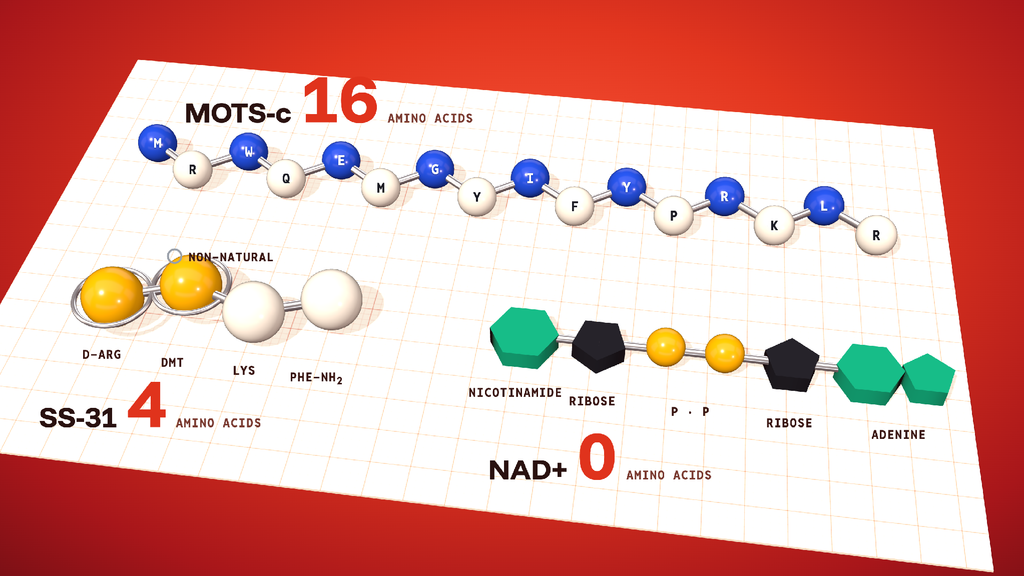
MOTS-c, a 16-amino-acid peptide coded by mitochondrial DNA, is studied as a metabolic messenger. SS-31, also called elamipretide, is a lab-made peptide built from four amino acids, and it latches onto cardiolipin, a lipid found only in the mitochondrial inner membrane. NAD+ is something else entirely: a coenzyme with no amino acids, carrying electrons through the cell’s energy chemistry.
- Three targets: a signalling pathway, a membrane lipid and redox chemistry
- Evidence ranges from mouse studies (MOTS-c) to a US-approved medicine (SS-31)
- Swap one for another and the experiment changes, so they aren’t interchangeable
Type MOTS-c into a search bar and SS-31 and NAD+ follow close behind. UK shops sell the three as a “bioenergetic trio”, and podcast hosts talk listeners through how to stack them. It makes a tidy bundle. Look at the chemistry, though, and you find three different kinds of molecule doing three different jobs in three different places.
This guide gives each one its own profile, then lines them up by target, location and strength of evidence. It finishes with their UK and sport status and the tests that confirm a batch matches its label.
Apexion provides MOTS-c, SS-31 and NAD+ only for lab research. None is intended for humans or animals, and this guide offers general information only, with no medical advice.
MOTS-c vs SS-31 vs NAD+ at a Glance
All three act on mitochondria, each at its own level. MOTS-c sends signals, SS-31 protects the membrane folds, and NAD+ supplies the spark of electron chemistry that powers the whole system. “Signal, shield, spark” is an easy way to keep them apart, and the table fills in the detail.
| MOTS-c | SS-31 (elamipretide) | NAD+ | |
|---|---|---|---|
| What it is | Mitochondrial-derived peptide | Synthetic tetrapeptide | Coenzyme (a dinucleotide) |
| Is it a peptide? | Yes (16 amino acids) | Yes (4 amino acids) | No |
| Origin | Encoded in mitochondrial DNA (the 12S rRNA region) | Synthetic (a Szeto-Schiller peptide) | Made in every cell from vitamin B3 precursors |
| Main target | AMPK and metabolic signalling; moves to the nucleus under stress | Cardiolipin in the inner mitochondrial membrane | Redox reactions; substrate for sirtuins and PARPs |
| Role in one phrase | A signal (“upstream”) | Structural protection (“downstream”) | A cofactor in the fuel chemistry |
| Human evidence | Very limited; first Phase 2a trial opened in 2026 | Clinical trials; FDA accelerated approval for Barth syndrome (2025) | Mostly for the precursors (NR, NMN) |
| Molecular weight | ~2,174.6 g/mol | ~639.8 g/mol (free base) | ~663.4 g/mol |
Those three weights come back later in this guide. On a COA, they’re the fastest way to tell the compounds apart.
What Is MOTS-c?
MOTS-c is a mitochondrial-derived peptide (MDP) of 16 amino acids, coded by a short stretch of the 12S rRNA gene in mitochondrial DNA. USC researchers Changhan Lee and Pinchas Cohen reported it in Cell Metabolism in 2015. Its name spells out where it comes from: the mitochondrial open reading frame of the 12S rRNA-c.
It belongs to a small family. A 2020 review by Merry and colleagues counts eight known MDPs: humanin, MOTS-c and SHLP1 through SHLP6, the small humanin-like peptides. MOTS-c is the only one of the eight coded in the 12S gene. The other seven come from the neighbouring 16S gene.
Finding it changed what scientists thought mitochondrial DNA could do. “We didn’t know that our mitochondrial DNA encoded messages to control the nucleus,” Lee told the USC Leonard Davis School of Gerontology in 2018.
Four lines of research have grown from that discovery:
- AMPK and the folate-methionine cycle: cell experiments show MOTS-c braking the folate cycle and the purine synthesis linked to it. AMPK, the enzyme that reads a cell’s fuel levels, switches on as a result.
- Glucose handling: skeletal muscle was the main target tissue in the 2015 mouse work, and most glucose studies since have followed it there.
- Exercise: Reynolds and colleagues (2021, *Nature Communications*) reported MOTS-c rising 11.9-fold in skeletal muscle samples after a cycling session. The same paper reports higher physical capacity in mice aged 2, 12 and 22 months.
- Nuclear translocation: when fuel runs short, MOTS-c enters the nucleus and helps steer nuclear genes, as Zheng and colleagues’ 2023 review describes.
What Is MOTS-c Used For in Research?
Laboratories use MOTS-c to study how mitochondria send messages across the cell. Common projects look at AMPK activation in cultured muscle cells, glucose handling in mice made insulin resistant by diet or by age, exercise adaptation in young and old mice, and gene regulation once the peptide reaches the nucleus.
The MOTS-c 40mg specification and COA page holds the batch data for the 40mg pen.
What Is SS-31 (Elamipretide)?
SS-31 (D-Arg-Dmt-Lys-Phe-NH2) is a synthetic peptide only four residues long. It crosses into cells, collects along the inner membrane of each mitochondrion and binds cardiolipin, a lipid that keeps the respiratory protein complexes in place. Its drug name is elamipretide, and older papers use Bendavia or MTP-131.
The “SS” honours Hazel Szeto and Peter Schiller, the pharmacologist and chemist behind a family of small aromatic-cationic peptides. Stealth BioTherapeutics took SS-31 into the clinic as elamipretide, and in June 2026 the company took the name Mighty Therapeutics.
Cardiolipin makes an unusually precise target. Szeto’s 2014 review in the *British Journal of Pharmacology* explains that this lipid appears only on the inner membrane, shapes the folds called cristae and decides whether cytochrome c carries electrons or turns into a peroxidase. When SS-31 binds cardiolipin, cytochrome c stays on electron duty, and lab models show fewer reactive oxygen species as a result.
Three studies show how far the research has spread:
- Aged muscle: in Campbell 2018, eight weeks of SS-31 in 26-month-old mice restored redox balance and raised exercise tolerance with no rise in mitochondrial content. The paper’s title describes it as reversing age-related redox stress in those mice.
- Protein partners: Chavez 2020 (*PNAS*) used cross-linking mass spectrometry to map what SS-31 touches. Every partner was a known cardiolipin binder, involved either in ATP production or in 2-oxoglutarate metabolism.
- Kidney, heart and eye models: a 2022 review by Zhu and colleagues gathers the kidney work in rodent and cell models, which runs alongside a long record in heart and retina models.
The University of Washington group behind Campbell and Chavez is still at it. In August 2026, a joint Mighty Therapeutics and UW team won a $1 million XPRIZE Healthspan Milestone 2 award for its elamipretide research, and UW’s David Marcinek said in the announcement: “Mitochondria are a key link between molecular drivers of aging and age-related pathology.”
Why Is Barth Syndrome Important to SS-31?
In this rare inherited mitochondrial disorder, variants in the TAFAZZIN gene leave cardiolipin badly built, which makes it a direct match for a cardiolipin-binding peptide. The US FDA responded on 19 September 2025 with accelerated approval for elamipretide, sold as Forzinity, in Barth syndrome. It has no UK approval, and trial results in other conditions have been mixed.
Check the SS-31 30mg specification and COA for lot data on the 50mg pen.
What Is NAD+?
Nicotinamide adenine dinucleotide, or NAD+, is a coenzyme present in all living cells. It ferries electrons through energy metabolism by flipping between NAD+ and NADH. Sirtuins and PARPs also use it up as they signal and repair DNA.
City of Hope biochemist Charles Brenner reaches for an electrical picture, calling NAD coenzymes “the wiring, if you will” that high-energy electrons travel along (*Pasadena Magazine*).
Its link to ageing comes from animal work showing NAD+ levels falling with age in several model organisms. Human measurements are catching up. A 2025 *Nature Metabolism* review by Vinten and colleagues notes that data on NAD+ in human tissues is still sparse, which keeps the field busy with new studies.
The finished coenzyme and its precursors are easy to confuse:
- Precursors: niacin, nicotinamide riboside (NR) and nicotinamide mononucleotide (NMN) are vitamin B3 forms that cells turn into NAD+ through enzyme pathways. The bulk of human trials test NR or NMN.
- NAD+ itself: the end product, added directly to enzyme and cell assays.
The 500mg pen’s purity results are on the NAD+ 1000mg specification and COA page.
Is NAD+ a Peptide?
No. It’s a dinucleotide, built from two nucleotides (a nicotinamide unit and an adenine unit) bridged by a pair of phosphates. Peptides, by definition, are strings of amino acids, and NAD+ contains none. It ends up next to mitochondrial peptides since energy-metabolism labs study all of them and the same suppliers stock them.
Chemically, it has far more in common with ATP than with any peptide on the shelf. The graphic below shows how differently the three are put together.
What Is the Difference Between NAD and Peptides?
- Building blocks: peptides are amino acids linked through peptide bonds. NAD+ is two sugars, two bases and two phosphates.
- How each is made: cells build peptides on ribosomes from a genetic code, while NAD+ comes from enzyme pathways fed by vitamin B3.
- How each is verified: a peptide’s COA confirms the mass of its sequence. An NAD+ COA confirms the dinucleotide’s mass and usually its UV absorbance at 260 nm.
What Is the Difference Between SS-31 and MOTS-c?
SS-31 is a lab-designed peptide that protects the structure of the mitochondrial membrane, while MOTS-c is a naturally coded peptide that relays signals from mitochondria out to the wider cell. Origin, size, target and depth of evidence all differ, so findings for one don’t transfer to the other.
Point by point, SS-31 vs MOTS-c looks like this:
- Origin: MOTS-c is coded in mitochondrial DNA. SS-31 came out of a medicinal chemistry programme and doesn’t occur in nature.
- Size and structure: at 16 standard amino acids, MOTS-c is four times the length. SS-31 stops at four, and two of them (D-arginine and dimethyltyrosine) are non-natural forms that resist enzymes.
- Target: MOTS-c works upstream as a signal, through AMPK and the nucleus. SS-31 works downstream as structural protection, gripping cardiolipin next to the respiratory complexes.
- Evidence: SS-31 has a US approval and several clinical trials. MOTS-c has a decade of cell and mouse work and one Phase 2a trial underway.
Those differences decide study design. A team asking how cristae keep their shape under oxidative stress reaches for SS-31. A team asking how mitochondria warn the nucleus about a fuel shortage reaches for MOTS-c.
MOTS-c vs NAD+: How Do They Differ?
MOTS-c acts as a peptide messenger, and NAD+ takes part in the energy chemistry directly. Their research overlaps because AMPK and the NAD+-dependent sirtuins influence each other in lab studies. Still, one is a peptide and the other a nucleotide-based cofactor, and their jobs differ.
Picture a building’s heating system. MOTS-c adjusts the thermostat, changing which enzymes switch on. NAD+ is closer to the water in the pipes, picking up electrons as NADH, handing them on and coming back round to collect more.
A common search asks whether NAD+ has to go with MOTS-c. The research answer is short. They’re independent molecules, nothing published shows that one needs the other to act, and no combination study of the pair has appeared in the literature.
Where Does Each One Act in the Mitochondrion?
The three work at separate addresses. SS-31 holds onto cardiolipin in the inner membrane, close to the respiratory complexes. NAD+ moves electrons around in the matrix and cytosol. MOTS-c starts in the mitochondria and travels to the nucleus when the cell comes under metabolic stress.
| Location | Compound | What happens there |
|---|---|---|
| Inner membrane | SS-31 | Binds cardiolipin next to the electron transport chain |
| Matrix and cytosol | NAD+ | NAD+/NADH redox reactions, and sirtuin and PARP activity |
| Mitochondria → nucleus | MOTS-c | Signalling to the nucleus under metabolic stress |
Because those addresses don’t overlap, researchers can study each layer of mitochondrial function on its own terms.
What Does the Research Show for Each?
How far each has been tested varies widely. SS-31 leads on human data, with a US approval for one rare disease. Most MOTS-c findings are preclinical, from cells and mice, and its first Phase 2a trial has been recruiting since February 2026. Human NAD+ research mainly tests NR and NMN, the precursors, with much less work on NAD+ itself.
| Cell and animal studies | Human studies | Regulatory status | |
|---|---|---|---|
| MOTS-c | Many (mouse metabolism, exercise) | Very limited; the analogue CB4211 completed early-stage trials, and a Phase 2a study (NCT07505745) began in 2026 | Not approved anywhere |
| SS-31 | Many (heart, kidney, muscle and eye models; aged mice) | Several clinical trials, with mixed results outside Barth syndrome | US accelerated approval for Barth syndrome only |
| NAD+ | Many | Trials of the precursors (NR, NMN); limited for NAD+ itself | Precursors sold as food supplements |
For MOTS-c, two reviews give the fullest picture. Zheng and colleagues (2023) follow the peptide from discovery through nuclear signalling. Miller and colleagues’ 2022 review in the *Journal of Clinical Investigation* places all eight MDPs in ageing research and sketches where drug development could take them.
The graphic below puts the difference in numbers, comparing how much published research and how many registered trials stand behind each compound.

Are MOTS-c, SS-31 and NAD+ Studied Together?
The three get mentioned together a lot, since each covers a separate piece of how mitochondria work, yet published combination studies are close to nonexistent. The “stack” guides online build on the logic of each mechanism. Peer-reviewed papers so far test them one at a time.
Testing the idea properly is harder, because a combination study needs separate arms to show what each compound adds. Nobody has published that design yet, so the question stays open. Our guide, peptide stacks explained, covers how combinations are handled more broadly.
Are MOTS-c, SS-31 and NAD+ Legal in the UK?
Yes, for laboratory research. In the UK, MOTS-c and SS-31 may legally be bought as research materials, but as unlicensed medicines they can’t be marketed for human use or bought over the counter as treatments. Precursors of NAD+ reach shops as food supplements, and research-grade NAD+ is sold for lab use as a reagent.
- MOTS-c: no regulator anywhere has approved it, and UK suppliers list it as a laboratory reagent.
- SS-31: the MHRA hasn’t licensed elamipretide, so its US approval doesn’t carry over to the UK.
The wider picture is in are peptides legal in the UK, alongside our Research Use Only policy.
Are MOTS-c and SS-31 Banned in Sport?
MOTS-c is prohibited at all times, in competition or out of it. The WADA 2027 Prohibited List, published on 21 September 2026 and in force from 1 January 2027, keeps it under S4.4.1 (metabolic modulators) as an AMPK activator, the same entry it had in 2026. SS-31 isn’t named on either list.
SS-31’s position needs a closer look. WADA’s S0 class catches substances with “no current approval by any governmental regulatory health authority for human therapeutic use”. Elamipretide gained a US approval in 2025, so its status for an athlete is a question for the national agency. UKAD enforces the List in the UK and handles those queries. USADA’s MOTS-c explainer sets out why the peptide was listed.
How to Verify Research-Grade MOTS-c, SS-31 and NAD+
Begin with the batch’s own certificate of analysis (COA). The three molecules have very different masses, so the LC-MS result works as a quick identity check. A “MOTS-c” batch reading near 640, or an “SS-31” batch reading near 2,175, has been mislabelled, and the paperwork shows it straight away.
| MOTS-c | SS-31 | NAD+ | |
|---|---|---|---|
| Sequence or structure | 16 amino acids (shown in the first graphic) | D-Arg-Dmt-Lys-Phe-NH2 | Nicotinamide and adenine nucleotides joined by a diphosphate |
| Formula | C101H152N28O22S2 | C32H49N9O5 | C21H27N7O14P2 |
| Molecular weight | ~2,174.6 g/mol | ~639.8 g/mol (free base) | ~663.4 g/mol |
| CAS number | 1627580-64-6 | 736992-21-5 | 53-84-9 |
| Form | Pre-filled research pen | Pre-filled research pen | Pre-filled research pen |
Run each batch through this checklist:
- Match the COA’s lot number to the label.
- Look for an HPLC purity figure with the method named.
- Compare the LC-MS mass with the expected value. Salt forms such as SS-31 acetate or hydrochloride can push the paper formula weight above 640.
- Check that the lab is named and the test is dated.
- Find storage guidance specific to that batch.
All three come from Apexion as pre-filled research pens, made to order in Britain and typically ≥98% HPLC-verified. Every batch has a COA covering identity, purity and batch details. A quick scan of the pen’s QR code brings it up, and the batch number works too. Apexion batch verification explains that process. How to read a peptide COA walks through each line, and the guide to verify a research peptide batch covers the follow-up checks.
Frequently Asked Questions
MDPs are small peptides read from short open reading frames inside the mitochondrial genome. Researchers know of eight: humanin, MOTS-c and the six SHLPs (small humanin-like peptides 1 to 6). They relay messages from mitochondria across the cell. Because SS-31 is synthetic, it falls outside the group even though it targets mitochondria.
Yes. Elamipretide is the official drug name for SS-31, the Szeto-Schiller lab code for D-Arg-Dmt-Lys-Phe-NH2. Bendavia and MTP-131 are older names for the same molecule. Forzinity is the US medicine containing elamipretide HCl, while research-grade SS-31 is sold as a reagent and is a different product.
Yes. It’s coded by the 12S rRNA gene in mitochondrial DNA, and lab studies have found it in cells, tissue and plasma, with lower circulating levels in older samples. The research-grade version is synthesised to the same 16-residue sequence, so a COA should report a mass close to 2,175.
No. NR and NMN are smaller vitamin B3 compounds that cells build into NAD+, which is the end-stage coenzyme. Human trials mostly give NR or NMN; research-grade NAD+ goes straight into enzyme and cell assays. Each of the three has its own mass, so a COA separates them instantly.
No. The MHRA hasn’t authorised elamipretide, and neither has the European Medicines Agency. The only approval anywhere came from the FDA in September 2025: an accelerated approval for Barth syndrome that still requires a confirmatory trial. UK laboratories can obtain SS-31 only as a research material.
Follow the storage guidance for each batch and keep all three somewhere cool and stable, out of heat and bright light. Long-term storage is usually at −20 °C, and handling them as little as possible keeps results consistent and cuts the chance of contamination. Our peptide storage and handling guide goes into more depth.
Summing Up
These three compounds share an organelle and very little else. One is a messenger coded in mitochondrial DNA, one is a designed peptide that guards the inner membrane and one is the coenzyme that keeps electrons moving. The evidence behind them stretches from a first Phase 2a trial to a US-approved medicine, so each one answers its own research question.
Apexion supplies all three for laboratory research only. Batches and formats are listed in Apexion’s mitochondria research range.
Sources
- Lee C, Zeng J, Drew BG, et al. The mitochondrial-derived peptide MOTS-c promotes metabolic homeostasis and reduces obesity and insulin resistance. Cell Metabolism, 2015.
- Reynolds JC, Lai RW, Woodhead JST, et al. MOTS-c is an exercise-induced mitochondrial-encoded regulator of age-dependent physical decline and muscle homeostasis. Nature Communications, 2021.
- Zheng Y, Wei Z, Wang T. MOTS-c: a promising mitochondrial-derived peptide for therapeutic exploitation. Frontiers in Endocrinology, 2023 (PMC9905433).
- Szeto HH. First-in-class cardiolipin-protective compound as a therapeutic agent to restore mitochondrial bioenergetics. British Journal of Pharmacology, 2014.
- Campbell MD, Duan J, Samuelson AT, et al. Improving mitochondrial function with SS-31 reverses age-related redox stress and improves exercise tolerance in aged mice. Free Radical Biology and Medicine, 2018 (PMC6588449).
- Chavez JD, Tang X, Campbell MD, et al. Mitochondrial protein interaction landscape of SS-31. PNAS, 2020.
- Zhu Y, Luo M, Bai X, et al. SS-31, a mitochondria-targeting peptide, ameliorates kidney disease. Oxidative Medicine and Cellular Longevity, 2022 (PMC9192202).
- Merry TL, Chan A, Woodhead JST, et al. Mitochondrial-derived peptides in energy metabolism. American Journal of Physiology: Endocrinology and Metabolism, 2020 (PMC7750512).
- Miller B, Kim SJ, Kumagai H, Yen K, Cohen P. Mitochondria-derived peptides in aging and healthspan. Journal of Clinical Investigation, 2022.
- Vinten KT, Trętowicz MM, et al. NAD+ precursor supplementation in human ageing: clinical evidence and challenges. Nature Metabolism, 2025.
- US FDA. Approval package, NDA 215244, Forzinity (elamipretide), 2025.
- World Anti-Doping Agency. Prohibited List 2026 and Prohibited List 2027.
- USADA. What is the MOTS-c peptide?
- ClinicalTrials.gov. NCT07505745, MOTS-c Phase 2a study, 2026.