
KPV Peptide UK: What It Is, Research and Legal Status (2026)

Quick answer
What is KPV peptide?
KPV is a tripeptide (lysine-proline-valine) taken from the end of alpha-melanocyte-stimulating hormone (α-MSH). It’s studied mainly for its effect on inflammatory signalling in gut and skin cell models. UK law allows its purchase as research material. No regulator has licensed it as a medicine, and no controlled clinical trial exists.
- Three amino acids: Lys-Pro-Val (α-MSH residues 11 to 13)
- The evidence comes mostly from mouse colitis and cell studies
- One of the four peptides in the KLOW blend
Three amino acids rarely make the news. KPV did in late July 2026, when a US Food and Drug Administration advisory panel backed it, by 8 votes to 6, for the American pharmacy compounding list. Search for KPV peptide in the UK, though, and you’ll mostly find shop listings and US consumer articles.
This guide follows the research trail: what KPV is, how it relates to α-MSH, what the evidence shows, why oral and vial forms both exist, its UK legal status, and what a batch certificate should show.
Apexion supplies KPV strictly for laboratory research. It is not for human or veterinary use. This is general information, not medical or legal advice.
What Is KPV Peptide?
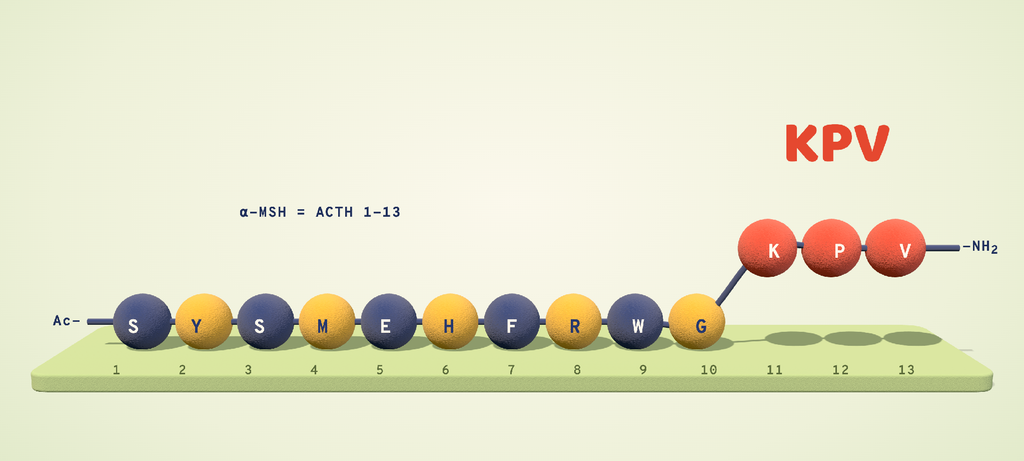
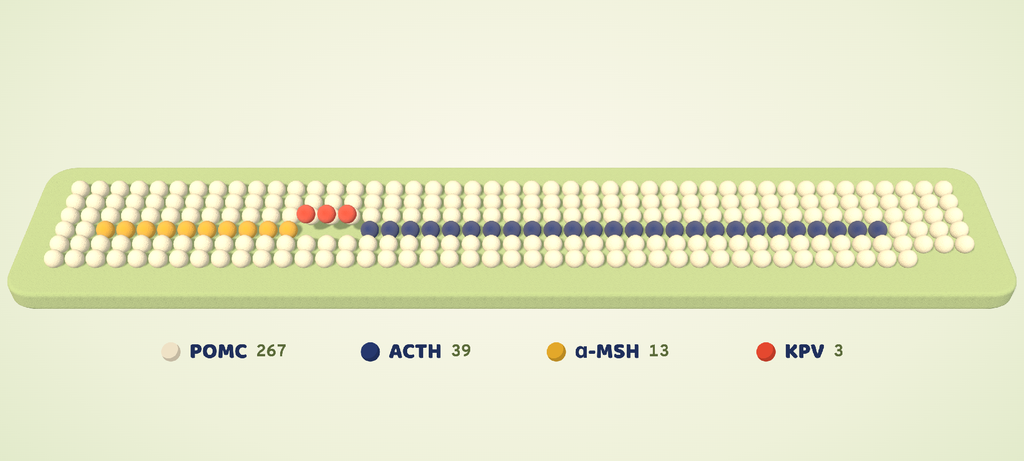
KPV is a three-amino-acid peptide, lysine-proline-valine, that matches positions 11 to 13 of α-MSH, a 13-amino-acid hormone. Researchers study it as a pared-down version of α-MSH’s anti-inflammatory activity, mostly in gut and skin cell models and in mice.
The parent hormone comes from a bigger precursor protein called POMC. Its first 13 residues line up with the start of another hormone, ACTH, which is why chemical databases such as PubChem also file KPV under the name ACTH-(11-13).
Interest in the fragment grew out of 1990s work by Anna Catania, James Lipton and colleagues, who reported that α-MSH could damp down inflammatory signalling. Thomas Luger’s University of Münster group summed it up in a 2007 review: “Most of the anti-inflammatory activities of α-MSH can be attributed to its C-terminal tripeptide KPV.”
| Property | Detail |
|---|---|
| Full name | Lysyl-prolyl-valine (KPV) |
| Sequence | Lys-Pro-Val |
| Class | Tripeptide, α-MSH fragment |
| Also listed as | α-MSH (11-13), ACTH (11-13) |
| Molecular formula | C16H30N4O4 |
| Molecular weight | ~342.4 g/mol |
| CAS number | 67727-97-3 |
| Research form | Lyophilised (freeze-dried) powder; Apexion supplies a pre-filled 10mg research pen |
| Storage | Cold, dry and dark |
Apexion’s product details are on the KPV 10mg specification and COA page.
How Does KPV Work?
The mechanism isn’t fully settled. Two lines of research stand out: KPV entering cells through the PepT1 transporter and quietening inflammatory signalling inside them, and the open question of whether it acts on melanocortin receptors such as MC1R the way full α-MSH does. Both rest on mouse and cell models.
PepT1 transport. PepT1 is a membrane transporter whose usual job is moving small two- and three-residue peptides out of the gut and into lining cells. In a 2007 Gastroenterology study, Guillaume Dalmasso, Didier Merlin and colleagues at Emory University showed that PepT1 also carries KPV into intestinal epithelial cells and T cells. Once inside those cultured cells, nanomolar amounts of KPV blocked NF-κB and MAP-kinase signalling, two of the main switches that turn on inflammatory genes.
The team also noted that PepT1 is “induced in colon during inflammatory bowel disease,” which made the inflamed mouse colon the obvious next test.
Melanocortin receptors. α-MSH acts through a family of melanocortin receptors, and MC1R is the best known of them. Whether KPV uses the same receptors is still debated. Luger’s review notes that “KPV seems not to bind to MC-1R,” and a 2008 mouse study by Kerstin Kannengiesser and colleagues found the peptide’s effects held up in mice with a non-working MC1R. The authors described them as “at least partially independent of MC1R signaling.”
KPV vs Alpha-MSH: What’s the Difference?
α-MSH is a 13-amino-acid hormone with roles in pigment, appetite and immune signalling. KPV is its final three residues, studied only for the anti-inflammatory part. The Münster group’s 2008 follow-up review described the fragment as keeping that activity with a “lack of pigmentary action.”
| α-MSH | KPV | |
|---|---|---|
| Length | 13 amino acids | 3 amino acids |
| Origin | Made from POMC in the pituitary and skin | C-terminal fragment of α-MSH |
| Receptors | Melanocortin receptors (MC1R to MC5R) | Debated; studied largely via PepT1 uptake |
| Pigment role | Yes | No pigment activity reported |
| Research focus | Pigment, appetite, inflammation | Inflammatory signalling in gut and skin models |
The short length is what drew researchers in. A three-residue peptide is cheap to make, simple to modify and small enough for PepT1 to carry.
What Does the Research on KPV Show?
Almost all KPV data is preclinical, mostly from mouse colitis models and cell studies, and no human trial has been run. The work keeps circling one question: how a tiny peptide behaves in inflamed gut tissue, and how to get more of it there.
| Research area | Model | Evidence level |
|---|---|---|
| Intestinal inflammation (colitis) | Mouse (DSS and TNBS models), intestinal cells | Preclinical: the most studied area |
| Oral and nanoparticle delivery to the colon | Mouse | Preclinical (delivery research) |
| Skin and keratinocytes | Cell culture | Preclinical |
| Wound models | Animal, cell | Limited |
| Humans | None | No controlled clinical trials |
The colitis work leans on two chemical models, DSS and TNBS, which each inflame the mouse colon in a predictable way. Dalmasso’s team gave KPV in the animals’ drinking water and tracked cytokine levels, and Kannengiesser’s group added a third model based on transferred immune cells.
Skin research is smaller and cell-based, mostly measuring inflammatory and oxidative-stress markers in keratinocytes, the main cells of the skin’s outer layer. In 2026, KPV also appeared in liver and fat-cell culture studies on lipid signalling.
Oral vs Lyophilised KPV: Why Are There Two Forms?
Research has looked at oral delivery because PepT1 carries KPV across the gut lining, while lyophilised powder is the standard research form for lab handling. A capsule or tablet listing is only as checkable as its paperwork, and without a batch COA there’s no way to confirm what’s inside.
Getting a peptide through the stomach intact is hard, so most oral KPV research is delivery research. Merlin’s group packed KPV into nanoparticles wrapped in a gel that releases them in the colon. In their 2010 mouse study, Hamed Laroui and colleagues reported a similar effect at a concentration “12,000-fold lower than that of KPV in free solution.” A January 2026 mouse study took the idea further with a KPV conjugate built to survive the gut and release its cargo where inflammation is present.
In papers, oral KPV means engineered carriers tested in mice. In shop listings, it usually means capsules or tablets, which need the same batch testing as any vial.
Apexion supplies KPV as a pre-filled 10mg research pen, which it prepares to order in the UK. The peptide pens vs vials comparison shows how that format differs from a traditional vial.
Is KPV Legal in the UK?
Yes. KPV can be bought in the UK as research material. No UK drug schedule controls it, and the MHRA has never licensed it as a medicine, so there’s no prescription route and no lawful sale for human use. Its status comes down to how it’s presented and supplied.
MHRA Guidance Note 8 sets two tests for a medicine. One asks whether a product is presented as treating or preventing disease. The other asks whether it’s used to modify physiological functions. Research material supplied for laboratory work, with no human-use claims, meets neither.
For the wider picture across compounds, read are peptides legal in the UK. Apexion sets out its supply terms in our Research Use Only policy.
Do You Need a Prescription for KPV?
No prescription route exists, because there’s no licensed KPV medicine in the UK to prescribe. A clinic offering KPV isn’t supplying an MHRA-licensed product. The MHRA’s guidance adds that “where unauthorised products are marketed for a medical purpose MHRA will take appropriate action.” The same reasoning answers the over-the-counter question: pharmacy counters stock licensed medicines, and KPV holds no licence.
Is KPV Banned in Sport?
WADA doesn’t list KPV by name on its 2026 Prohibited List, and the 2027 list, published in September 2026, doesn’t name it either. KPV still falls under S0, the always-prohibited class for substances with no approval for human therapeutic use. Once the 2027 wording takes effect on 1 January, S0 spells this out by including “peptides” in its examples.
What Are the Risks and Unknowns of KPV?
There’s no controlled human safety data on KPV, so nobody knows what side effects it has in people. Every observation so far comes from mice and cultured cells. Questions such as “who shouldn’t take KPV” have no evidence-based answer, because no clinical trial has ever addressed them.
Three unknowns stand out:
- Identity and purity: untested products may contain less KPV than labelled, a different form of it, or impurities
- Long-term exposure: published studies run for days or weeks in mice
- Combinations: blends add compounds that have never been studied together in people
Searches pairing KPV with cancer trace back to a 2016 mouse study from Merlin’s lab on colitis-linked tumours. That’s early animal work with no clinical evidence behind it.
KPV in Research Blends: KLOW
KLOW combines 50mg of GHK-Cu with BPC-157, TB-500 and KPV at 10mg apiece, 80mg in all. KPV is what separates it from GLOW, the three-peptide blend it builds on. Apexion supplies it as one pre-filled 80mg research pen.
Within the blend, KPV contributes the PepT1 and NF-κB line of research. Our KLOW vs GLOW comparison sets the two blends side by side, and the KLOW 80mg specification and COA page lists the components. The largest ingredient has its own GHK-Cu UK guide, and peptide stacks explained covers blend design in general.
How to Verify Research-Grade KPV
Check the batch-specific COA first. KPV’s small mass, about 342 g/mol, makes the LC-MS result a quick identity check. One detail deserves a look: free-acid KPV and the C-amidated version found at the end of α-MSH differ by about 1 g/mol, so the COA should name the form it tested.
- ☐ Lot numbers on the COA and the pen label agree
- ☐ HPLC purity is reported alongside its method
- ☐ The LC-MS mass is about 342 for free-acid KPV, or about 341 for the amidated form, with the form named
- ☐ The report gives the testing lab’s name and the test date
- ☐ Storage guidance comes with the batch
Two guides go line by line: how to read a peptide COA and verify a research peptide batch. Apexion batch verification explains how each pen’s QR code leads to its documentation.
Frequently Asked Questions
KPV turns up in laboratory research on inflammatory signalling, mostly in mouse colitis models and intestinal or skin cell cultures, where researchers track NF-κB activity and cytokine output. Other work uses it to develop gut-targeted nanoparticle delivery. It has no approved medical use and no controlled human trials.
Yes, as research material. KPV appears nowhere in the Misuse of Drugs Act 1971 schedules and carries no MHRA licence, so it can’t be prescribed or supplied for human use. In sport, WADA’s S0 class covers it as a peptide with no therapeutic approval.
No. KPV is the closing stretch of α-MSH, positions 11 to 13. α-MSH has 13 residues and acts on melanocortin receptors with roles in pigment, appetite and immune signalling. KPV is studied only for the anti-inflammatory part, has no reported pigment activity, and enters cells largely through the PepT1 transporter.
No. They’re unrelated peptides. KPV has three amino acids and comes from α-MSH. BPC-157 has 15 amino acids, modelled on part of a stomach protein. Both appear in the KLOW blend, alongside GHK-Cu and TB-500. Our BPC-157 UK guide covers it in full.
KPV is studied in oral form because PepT1, a transporter in the gut lining, carries it into intestinal cells, and PepT1 levels rise in the inflamed mouse colon. That makes the gut a natural target. Researchers now test nanoparticle and conjugate carriers in mice to protect the peptide on its way through.
Lyophilised KPV stays most stable sealed up somewhere cold, dry and dark, as the batch label directs, since moisture is the biggest threat to freeze-dried powder. Apexion’s pre-filled pens stay cool and out of heat and direct light, and long-term storage is at −20 °C.
The Bottom Line
KPV is the three-residue tail of α-MSH, studied mainly in mouse models of gut inflammation and in cell cultures. No human trials exist. UK law treats it as a research material, it isn’t a medicine, and it’s the extra ingredient that turns GLOW into KLOW.
View the KPV 10mg specification and COA.
Apexion supplies KPV strictly for laboratory research. It is not for human or veterinary use. This is general information, not medical or legal advice.
Sources
- Dalmasso G et al. Gastroenterology, 2008; 134(1): 166-178 (online October 2007). PMID 18061177.
- Kannengiesser K et al. Inflammatory Bowel Diseases, 2008; 14(3): 324-331. PMID 18092346.
- Laroui H et al. Gastroenterology, 2010; 138(3): 843-853. PMID 19909746.
- Luger TA, Brzoska T. Annals of the Rheumatic Diseases, 2007; 66 Suppl 3: iii52-55. PMID 17934097.
- Brzoska T et al. Endocrine Reviews, 2008; 29(5): 581-602. PMID 18612139.
- Viennois E et al. Cellular and Molecular Gastroenterology and Hepatology, 2016; 2(3): 340-357. PMID 27458604.
- Cheng J et al. Science Advances, 2026; 12(3): eaea2989. PMID 41533788.
- MHRA. Guidance Note 8: A guide to what is a medicinal product.
- WADA. 2027 Prohibited List (September 2026).
- PubChem CID 125672.