
What Is CJC-1295 + Ipamorelin? Research and UK Status (2026)
Reviewed by Oscar Reyes, PhD, Synthesis Lead at Apexion BioLabs · Scientific review of the chemistry and analytical content
Quick answer
What is CJC-1295 + Ipamorelin?
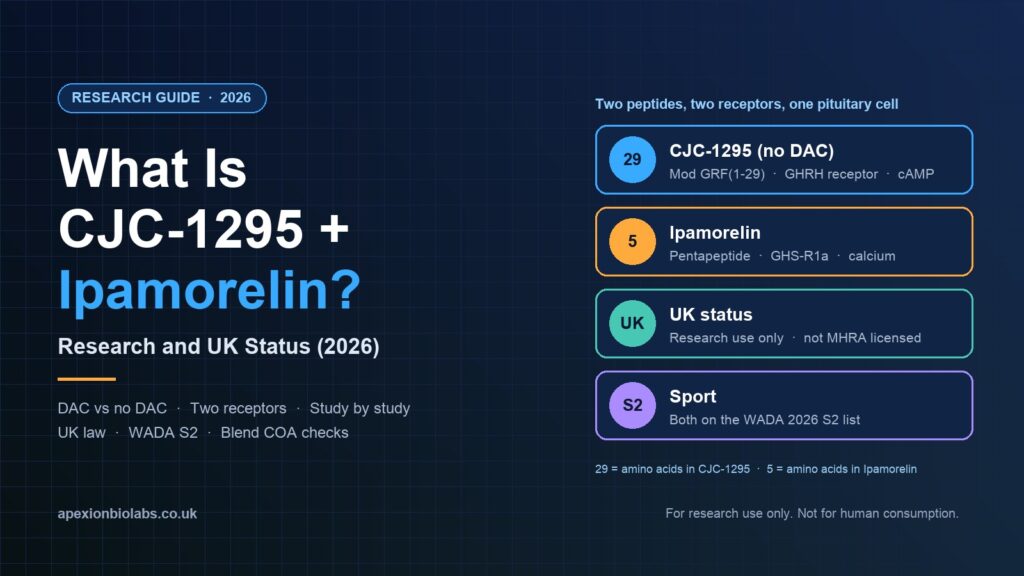
CJC-1295 + Ipamorelin is a research blend of two peptides that act on the growth-hormone axis through different receptors. CJC-1295 (no DAC) is a modified GHRH(1-29) analogue, and Ipamorelin is a selective ghrelin-receptor (GHS-R1a) agonist. Most evidence covers each peptide on its own. Neither is licensed in the UK, and both appear on WADA’s S2 list.
- Two receptors, one pathway (GHRH-R + GHS-R1a)
- “No DAC” = short-acting; DAC = albumin-bound, long-acting
- UK: research use only, not MHRA licensed
Two labs, seven years apart, built the two halves of a popular growth-hormone research blend. Novo Nordisk unveiled Ipamorelin in 1998, and Montreal’s ConjuChem followed with CJC-1295 in 2005. Put them together and you have CJC-1295 + Ipamorelin.
The short version: CJC-1295 (no DAC) is a lab-built copy of GHRH, the cue that tells pituitary cells to make growth hormone. Ipamorelin copies ghrelin and switches on a second receptor that triggers release. Two signals reach one cell, which is why researchers study them in pairs.
Online, the story gets muddled. Many treat CJC-1295 with DAC and without DAC as one molecule, though each is a distinct compound with its own data. This guide separates the evidence for each, study by study, then covers the blend’s UK legal status and WADA’s 2026 list.
All Apexion materials are supplied for laboratory research only. Read our research-use notice before ordering.
What Is CJC-1295?
CJC-1295 is a lab-made version of growth hormone-releasing hormone (GHRH), the hypothalamus’s cue for pituitary cells to put out growth hormone. It’s built on GHRH(1-29), the first 29 amino acids of the natural 44-residue hormone. That short stretch carries the part that binds the receptor.
GHRH itself was only isolated in 1982, and researchers soon found the first 29 residues did nearly all the work. That made GHRH(1-29) the natural starting point for anyone trying to build a sturdier version.
Natural GHRH(1-29) has one weakness in the lab: an enzyme called dipeptidyl peptidase-IV (DPP-IV) chops off its first two amino acids within minutes. So chemists at ConjuChem swapped four residues to make the chain tougher and more stable:
- Position 2: D-alanine replaces L-alanine, which blocks the DPP-IV cut
- Position 8: glutamine replaces asparagine
- Position 15: alanine replaces glycine
- Position 27: leucine replaces methionine
Jetté and colleagues (2005) describe the result in Endocrinology as “a tetrasubstituted form of hGRF(1-29)”. In their rat studies, the conjugated version stayed in plasma beyond 72 hours.
| Feature | CJC-1295 |
|---|---|
| Name | CJC-1295; the no-DAC form is also called modified GRF(1-29) |
| Sequence length | 29 amino acids (DAC form adds a modified lysine at position 30) |
| Class | GHRH analogue (peptide) |
| Receptor | GHRH receptor (GHRH-R) on anterior pituitary cells |
| Forms | With DAC (albumin-binding) and without DAC |
| Molecular weight (no DAC) | About 3,368 g/mol |
What Does “No DAC” Mean? Mod GRF(1-29) Explained
Here’s the naming quirk that trips up most pages. In the original research, “CJC-1295” meant the version with the drug affinity complex (DAC) attached. The Jetté paper defines it that way. “CJC-1295 no DAC” came later, as a trade label for the same four-swap chain minus that attachment.
Chemists already had names for that chain. It’s called modified GRF(1-29), usually shortened to Mod GRF(1-29), and older papers call it tetrasubstituted GRF(1-29). All three labels point to one 29-residue sequence.
So when a supplier lists “CJC-1295 (no DAC)”, read it as Mod GRF(1-29). The human data from the 2005 to 2006 ConjuChem programme belongs to the DAC version, and it doesn’t carry across to the shorter-lived form. Keeping that line clear is the single most useful habit when you read anything about this blend.
CJC-1295 With DAC vs Without DAC
DAC links the peptide to albumin, the most common protein in blood plasma. Albumin is large and long-lived, so the bound peptide rides along with it. In two human pharmacokinetic trials, Teichman and colleagues (2006) reported in the Journal of Clinical Endocrinology & Metabolism that “the estimated half-life of CJC-1295 was 5.8-8.1 d.” Without DAC, the half-life drops to minutes.
That second figure needs a caveat. We found no peer-reviewed human half-life for Mod GRF(1-29); the “minutes” estimate comes from secondary sources and from the known DPP-IV breakdown of the parent chain.
The DAC itself is a maleimidopropionamide group on an added lysine. Once in plasma, it bonds to a free thiol on albumin (cysteine 34), which the Jetté team confirmed by finding CJC-1295 on the albumin band in rat plasma.
| Form | What’s attached | Half-life | Human data | How it’s supplied |
|---|---|---|---|---|
| CJC-1295 with DAC | Maleimide group on lysine 30, binds albumin | About 5.8 to 8.1 days (Teichman 2006) | Yes: two pharmacokinetic trials in healthy adults, plus Ionescu 2006 | Single-peptide vials; less common |
| CJC-1295 no DAC (Mod GRF 1-29) | Nothing; four amino-acid swaps only | Minutes (secondary sources) | No published pharmacokinetic study found | Single vials and blends, including Apexion’s |
In a study design, the two forms behave like different tools. The DAC form keeps the GHRH receptor under steady stimulation for days, which is why Ionescu’s team saw trough growth hormone climb. The no-DAC form gives a brief signal that fades quickly, closer to the natural on-off rhythm of GHRH.
Apexion’s blend contains the no-DAC form, and the label and product page say so.
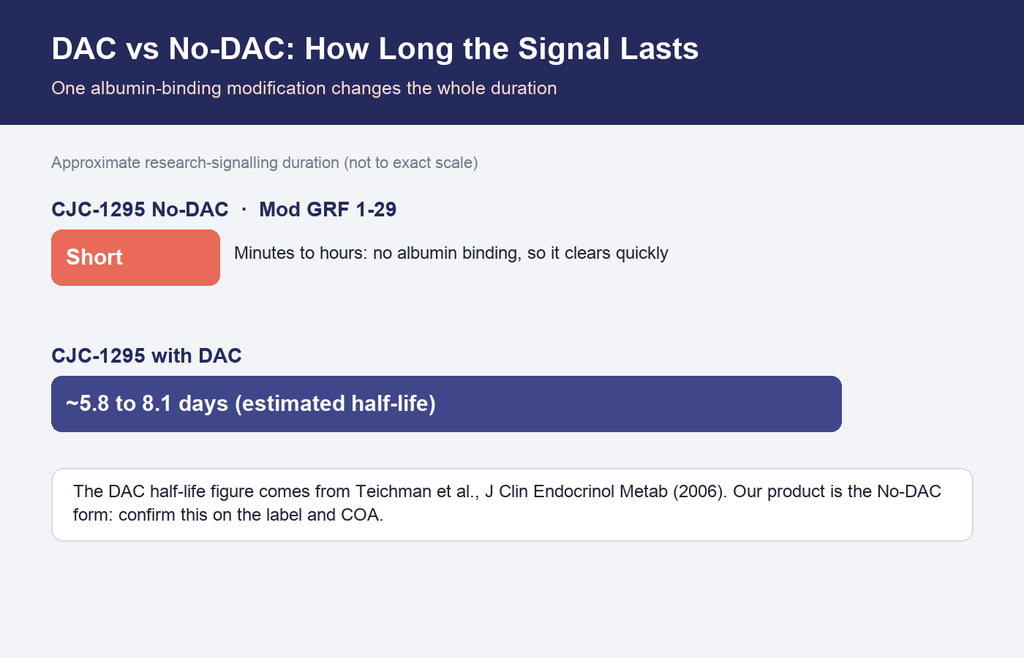
DAC vs no DAC: one albumin-binding group changes how long the signal lasts.
What Is Ipamorelin?
Ipamorelin is a five-amino-acid peptide (a pentapeptide) that binds the ghrelin receptor, known in papers as the growth hormone secretagogue receptor 1a (GHS-R1a). Ghrelin is best known as a hunger hormone, but its receptor is also found on pituitary cells, where switching it on prompts a burst of growth hormone.
The timing of its discovery is unusual. The receptor was cloned in 1996, but ghrelin, its natural partner, wasn’t identified until 1999. So Ipamorelin was designed to hit a receptor whose own hormone nobody had found yet.
Novo Nordisk scientists built Ipamorelin in the 1990s while trimming down an older compound called GHRP-1. Raun and colleagues (1998) give its sequence as Aib-His-D-2-Nal-D-Phe-Lys-NH2. Three of those five units are non-standard or mirror-image amino acids, which helps the molecule resist enzymes.
The same paper ran the classic tests. Ipamorelin released growth hormone from rat pituitary cells with a potency close to GHRP-6, and blocking studies showed it worked through the GHRP-type receptor, the same route GHRP-6 uses.
Ipamorelin also has human pharmacokinetic data. In 40 healthy male volunteers, Gobburu and colleagues (1999) measured “a short terminal half-life of 2 hours” and a single growth hormone peak at about 40 minutes (0.67 hours).
That profile, one quick pulse that fades, contrasts neatly with the week-long DAC form of CJC-1295.
| Feature | Ipamorelin |
|---|---|
| Class | Growth hormone secretagogue (GHRP family) |
| Receptor | Ghrelin receptor (GHS-R1a) |
| Length | 5 amino acids |
| Molecular weight | About 712 g/mol |
| Human half-life | About 2 hours (Gobburu 1999) |
Why Is Ipamorelin Called “Selective”?
The label comes straight from the title of Raun’s 1998 paper: “Ipamorelin, the first selective growth hormone secretagogue.” Older peptides in the same family, GHRP-2 and GHRP-6, also raised ACTH and cortisol, the stress-axis hormones.
In conscious pigs, the Novo Nordisk team saw something they hadn’t expected. In their words, “very surprisingly, Ipamorelin did not release ACTH or cortisol at levels significantly different from those observed following GHRH stimulation”, even at amounts more than 200-fold above the level needed for growth hormone release.
The same swine work also measured FSH, LH, prolactin and TSH, and none of the secretagogues tested moved them. That’s the closest the study comes to the common testosterone question. LH is the pituitary hormone that drives testosterone output, and it stayed flat, but testosterone itself wasn’t measured.
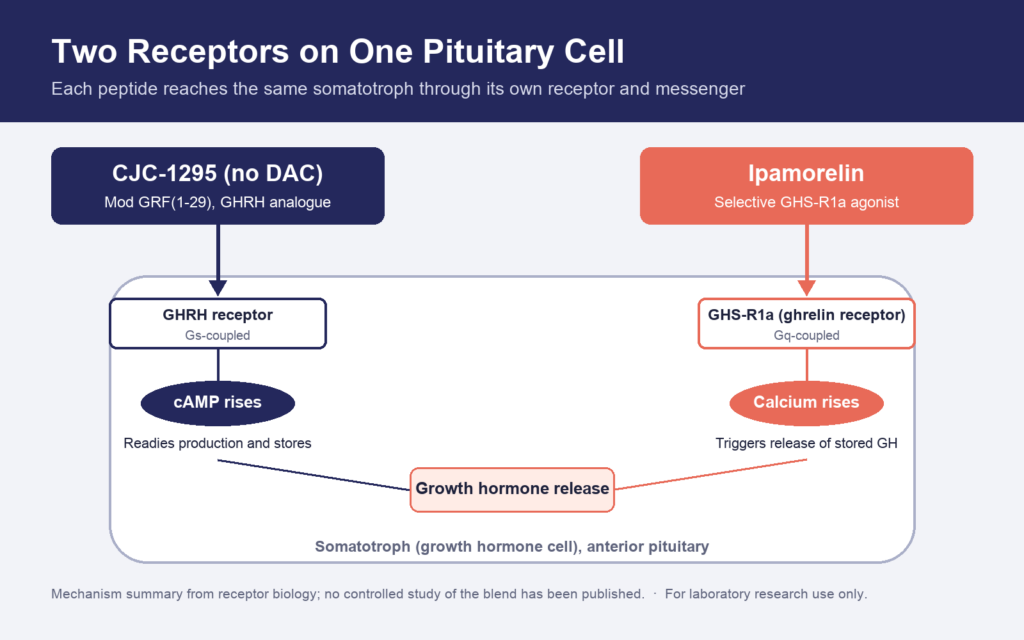
Two receptors on one pituitary cell: CJC-1295 works through cAMP, Ipamorelin through calcium.
How Do CJC-1295 and Ipamorelin Work Together?
Picture one somatotroph, the pituitary cell that makes growth hormone. It carries both receptors, and each one sends its own message inside the cell.
- GHRH-R (CJC-1295’s target): a Gs-coupled receptor that raises cyclic AMP (cAMP). cAMP boosts growth hormone production and readies stored hormone for release.
- GHS-R1a (Ipamorelin’s target): a Gq-coupled receptor that raises calcium inside the cell. Calcium is the trigger that pushes stored hormone out.
Two different messengers reach the same cell, so researchers study the pair to see how the two inputs interact. That’s the whole logic of the blend: two doors into one room.
Natural physiology already works this way. GHRH and ghrelin both act on the same cells, while a third signal, somatostatin, applies the brakes. Combining a GHRH-side input with a ghrelin-side input copies that two-signal setup in a lab model.
Studies with the DAC form add one more detail. Ionescu and Frohman (2006) found in healthy men that “CJC-1295 increased trough and mean GH secretion and IGF-I production with preserved GH pulsatility.” The pulse pattern held even under constant GHRH-R stimulation, which is why researchers see room for a separate pulse trigger on the ghrelin side.
What the blend does as a unit is still an open question, because nobody has published a controlled study of it. For how combined compounds are usually handled in study design, see our guide to peptide combinations in research.
CJC-1295 vs Ipamorelin: Key Differences
The two peptides reach the same cell from opposite sides of the signalling map. Here’s how they compare.
| Factor | CJC-1295 (no DAC) | Ipamorelin |
|---|---|---|
| Classification | GHRH analogue | Selective GH secretagogue (GHRP) |
| Receptor target | GHRH receptor | Ghrelin receptor (GHS-R1a) |
| Inside-cell messenger | cAMP | Calcium |
| Signal pattern studied | Short-acting (the DAC form is the long-acting version) | Rapid, single pulse |
| Structural class | Modified 29-amino-acid GHRH fragment | 5-amino-acid peptide |
| Pairing rationale | Provides the GHRH-side signal | Provides the ghrelin-receptor-side signal |
| Selectivity notes | Receptor-specific analogue | No ACTH or cortisol rise in swine (Raun 1998) |
| Regulatory status | Not an approved medicine in the UK | Not an approved medicine in the UK |
In short, CJC-1295 sets up the cell to make and release more hormone, while Ipamorelin pulls the trigger on release. Their timing differs too: hours for Ipamorelin in humans, and minutes or days for CJC-1295 depending on the form.
A related search compares Ipamorelin with tesamorelin. Tesamorelin is a GHRH analogue too, which puts it in the same class as CJC-1295. Our Tesamorelin research overview covers it in full.
What Does the Research Show?
A majority of the data covers each peptide alone. Much of it is animal or pharmacokinetic work, and the human studies are small. We found no published trial of the CJC-1295 + Ipamorelin blend.
| Study | Compound | Model | What was measured | Result |
|---|---|---|---|---|
| Raun 1998, Eur J Endocrinol | Ipamorelin | Animal (rat cells, rats, swine) | GH release; ACTH, cortisol, FSH, LH, prolactin, TSH | GH release similar to GHRP-6; no ACTH or cortisol rise above GHRH levels |
| Gobburu 1999, Pharm Res | Ipamorelin | Human pharmacokinetic (healthy men) | Half-life, GH response | Half-life about 2 hours; single GH peak at 0.67 hours |
| Jetté 2005, Endocrinology | CJC-1295 (DAC) | Animal (rat cells, rats) | GH output, plasma persistence | 4-fold GH increase vs GRF(1-29) over 2 hours; present beyond 72 hours |
| Teichman 2006, JCEM | CJC-1295 (DAC) | Human pharmacokinetic (healthy adults, 21 to 61) | GH, IGF-I, half-life | GH up 2- to 10-fold for 6+ days; IGF-I up 1.5- to 3-fold; half-life 5.8 to 8.1 days |
| Ionescu 2006, JCEM | CJC-1295 (DAC) | Human study (healthy men, 20 to 40) | GH pulse pattern overnight | Trough GH up 7.5-fold; mean GH up 46%; pulses preserved |
| Beck 2014, Int J Colorectal Dis | Ipamorelin | Human Phase II trial (post-operative ileus) | Time to first tolerated solid meal | 25.3 vs 32.6 hours for placebo; not significant (p = 0.15) |
The model column carries the most weight. Animal work shows a mechanism can happen in a living system. Pharmacokinetic work shows how long a compound lasts and what it does to hormone levels. Only a controlled trial tests whether a measurable outcome changes, and this set holds just one.
Two things jump out. Every CJC-1295 human study used the DAC form, so none of it describes the no-DAC peptide in the blend. And the only efficacy trial in the set, Beck’s for Ipamorelin, missed its main endpoint against placebo across 114 analysed participants.
What Adverse Events Were Reported in Human Trials?
Here’s what the published records show, and nothing more:
- Beck 2014 (Ipamorelin): treatment-emergent adverse events were recorded in 87.5% of the Ipamorelin group and 94.8% of the placebo group. The trial ran in a post-surgical population, which explains the high rates in both arms.
- Teichman 2006 (CJC-1295 DAC): the authors state that “no serious adverse reactions were reported” in their two short trials.
- ConjuChem, 2006 (CJC-1295 DAC): the company halted its Phase II programme for the DAC form in July 2006, and we found no peer-reviewed publication of that trial’s full results.
None of these studies tested the blend, and none establishes safety for human use.
Is CJC-1295 a Peptide or a Steroid?
Both are peptides. Each one is a string of amino acids linked end to end, the same units that make up proteins, only far fewer of them. CJC-1295 has 29 of them and Ipamorelin has five.
Steroids belong to a different chemical family: fat-soluble molecules with a four-ring core that cells make out of cholesterol. Anabolic steroids work by binding androgen receptors inside the cell. CJC-1295 and Ipamorelin act on receptors on the surface of pituitary cells, upstream of growth hormone.
Many anabolic steroids are controlled drugs in the UK, so people often assume these peptides are too. The next section covers why they aren’t.
Is Ipamorelin (and CJC-1295) Legal in the UK?
Yes, as research materials. Neither peptide is a controlled drug, neither holds an MHRA licence, and selling either one for human use is unlawful under the Human Medicines Regulations 2012. Here’s how each law applies, as checked in October 2026.
| Law | What it covers | How it applies |
|---|---|---|
| Human Medicines Regulations 2012 | Making, selling and supplying medicines | A medicine needs a marketing authorisation before it’s sold. Neither peptide has one, so supplying either for human use is unlawful |
| Misuse of Drugs Act 1971 | Controlled drugs (Classes A, B, C) | Neither CJC-1295 nor Ipamorelin is listed |
| Psychoactive Substances Act 2016 | Substances that affect mental functioning | Neither peptide is described in the literature as acting this way |
| MHRA Guidance Note 8 | How the MHRA decides what counts as a medicine | A product becomes a medicine by its function or by how it’s presented, so health claims can turn a research chemical into an unlicensed medicine |
For a UK lab, that adds up to three points:
- Buying and holding either peptide for research doesn’t need a Home Office licence, because neither is controlled.
- Labelling must stay in research terms, with no health, performance or human-use claims.
- Supply for human use is where the Human Medicines Regulations apply, whatever the product is called.
Guidance Note 8 is the one most sellers overlook. Under its “presentation” test, the words on a label or website can make something a medicine. That’s why responsible UK suppliers describe these peptides in research terms only.
For the wider picture across other compounds, see our guide on whether peptides are legal in the UK.
Do You Need a Prescription?
No. UK prescribers work from licensed medicines, plus a few tightly controlled special-order routes, and neither CJC-1295 nor Ipamorelin has a UK marketing authorisation to anchor one. The same holds for both forms of CJC-1295. In the UK, both peptides are available as research materials only.
Are CJC-1295 and Ipamorelin Banned in Sport?
Yes. The WADA 2026 Prohibited List places both under section S2, peptide hormones, growth factors, related substances and mimetics. The subsection on growth hormone releasing factors covers:
- GHRH and its analogues: CJC-1295 is named as an example, alongside sermorelin and tesamorelin
- Growth hormone secretagogues and their mimetics: the group that covers Ipamorelin
S2 substances are banned year-round, during events and between them. Testing and sanctions in Britain fall to UK Anti-Doping (UKAD).
WADA’s Executive Committee signed off the 2027 List on 10 September 2026. That edition replaces the current edition from 1 January 2027. Examples change from year to year, so the live edition is the one to check.
How Is the Blend Supplied and Verified?
A two-peptide product needs two-peptide paperwork. One purity figure for the whole blend can’t tell you whether both peptides are present, correct and in the right ratio. A blend COA should show a separate HPLC result and a separate mass spectrometry (LC-MS) identity check for each peptide.
What to look for:
| Check | What to confirm |
|---|---|
| Two HPLC peaks | Each peptide resolves at its own retention time, with its own purity figure |
| CJC-1295 (no DAC) mass | Observed mass close to 3,368 g/mol |
| Ipamorelin mass | Observed mass close to 712 g/mol |
| No-DAC confirmation | A DAC form would weigh noticeably more, so the mass also confirms which molecule you have |
| Batch match | The lot number on the COA matches the one on the product |
Each field on the report is decoded in our peptide COA reading guide, and our batch verification walkthrough shows how to tie a lot number back to its report.
Apexion supplies the blend as a pre-filled 10mg research pen: CJC-1295 (no DAC) 5mg and Ipamorelin 5mg, prepared to order in the UK from one batch under one batch reference. Every pen carries a batch number. The product page currently lists independent testing as in progress, and the COA will be linked by QR code once it’s published.
The pen keeps the material sealed for careful measurement at the bench. For how it compares with a standard vial, read our comparison of research pens and vials, and see the CJC-1295 + Ipamorelin 10mg research pen for the full specification.
Frequently Asked Questions
It’s a two-peptide research blend. CJC-1295 (no DAC) is a modified GHRH(1-29) analogue that targets the GHRH receptor, and Ipamorelin is a pentapeptide that targets the ghrelin receptor. Both receptors are found on the same pituitary cells, which is why researchers pair them. Apexion supplies it as one 10mg research pen holding 5mg of each.
The DAC version carries a chemical group that binds albumin, giving it a half-life of about 6 to 8 days in human studies. The no-DAC version, Mod GRF(1-29), has no such group and is broken down in minutes. All published human data for CJC-1295 used the DAC form, so check which one a study used before applying its figures.
It’s a peptide, a 29-amino-acid chain. Steroids are cholesterol-derived ring structures, and the anabolic ones bind androgen receptors. CJC-1295 targets GHRH receptors on pituitary cells, and Ipamorelin, a five-residue peptide, works on the ghrelin receptor.
Yes, as a research material. Ipamorelin appears nowhere in the Misuse of Drugs Act 1971 and has no MHRA licence. Supplying it for human use would fall foul of the Human Medicines Regulations 2012. The same applies to CJC-1295. Athletes face a separate ban under WADA’s S2 list, enforced in the UK by UKAD.
We found no published human trial of the blend. Each peptide has its own human data: CJC-1295 with DAC in pharmacokinetic studies, and Ipamorelin in a pharmacokinetic study and a Phase II trial that showed no significant benefit over placebo. Any claim about what the combination does goes beyond the published evidence.
In Raun’s 1998 swine study, Ipamorelin released growth hormone without raising ACTH or cortisol beyond GHRH levels, even at very high concentrations. Older peptides in its class, GHRP-2 and GHRP-6, raised both. FSH, LH, prolactin and TSH didn’t change either. These results come from animals, and they haven’t been repeated in a published human study.
Concluding
CJC-1295 + Ipamorelin pairs two peptides that reach one pituitary cell through two separate receptors. The science on each half is real but narrow: animal selectivity work for Ipamorelin, human pharmacokinetic data for the DAC form of CJC-1295, and one negative Phase II trial. The blend itself hasn’t been studied in a published trial.
For lab work, three checks count most: confirm the no-DAC form, demand separate results for each peptide, and match the batch to its COA.
CJC-1295 + Ipamorelin 10mg specification and COA
Disclaimer: Apexion Biolabs supplies CJC-1295 and Ipamorelin strictly for in vitro laboratory research. These materials are not medicines, supplements or food, and they are unsuitable for human or veterinary consumption. This guide summarises published research for education and offers no medical guidance.
Sources
Research
- Raun K, et al. Ipamorelin, the first selective growth hormone secretagogue. Eur J Endocrinol. 1998;139(5):552-61
- Gobburu JV, et al. Pharmacokinetic-pharmacodynamic modeling of Ipamorelin in human volunteers. Pharm Res. 1999;16(9):1412-6
- Jetté L, et al. Identification of CJC-1295 as a long-lasting GRF analog. Endocrinology. 2005;146(7):3052-8
- Teichman SL, et al. Prolonged stimulation of GH and IGF-I secretion by CJC-1295 in healthy adults. J Clin Endocrinol Metab. 2006;91(3):799-805
- Ionescu M, Frohman LA. Pulsatile secretion of GH persists during continuous stimulation by CJC-1295. J Clin Endocrinol Metab. 2006;91(12):4792-7
- Beck DE, et al. Proof-of-concept study of the ghrelin mimetic Ipamorelin. Int J Colorectal Dis. 2014;29(12):1527-34
Regulation
- Human Medicines Regulations 2012
- Misuse of Drugs Act 1971
- Psychoactive Substances Act 2016
- MHRA Guidance Note 8: A guide to what is a medicinal product
Sport