
How to Choose a Research Peptide Supplier in the UK (2026 Checklist)
Reviewed by Oscar Reyes, PhD, Synthesis Lead at Apexion BioLabs · Scientific review of the chemistry and analytical content
Quick answer
The checklist in five lines
- A UK-registered business you can find on Companies House
- A batch-specific COA whose lot number matches the label
- HPLC purity plus mass spec identity, from a lab you can verify
- Research-use-only labelling, with no use claims on any page
- Clear storage, tracked UK delivery and published terms
Say you found a research compound COA that looks perfect. The peptide name is right, the HPLC purity reads 99.1%, and a lab logo fills the top corner. Then you check the lot number, and it belongs to a different batch from the batch printed on your vial.
That one detail is why knowing how to choose a research peptide supplier comes down to evidence you can check yourself. This guide is for UK labs and independent researchers sourcing research compounds, where identity, purity and traceability decide whether a result can be trusted. It walks through 12 checks, from Companies House to COA report IDs, then gives you a scoring sheet to record what you find.
Everything discussed here is for laboratory research only. See our Research Notice.
How Do You Choose a Research Peptide Supplier in the UK?
Choose a supplier that can prove three things: who they are, what is in the batch, and that the product is presented for research only. Run the 12 checks below in order, because the first eight decide whether the rest need checking at all.
| # | Check | What to look for | Where to find it | Pass if |
|---|---|---|---|---|
| 1 | UK-registered business | Registered company name and number | Website footer, Companies House | Number matches an active company |
| 2 | Named contact | Real email, phone or address | Contact page | A person or team replies |
| 3 | UK stock and dispatch | Stock kept and posted in the UK | Shipping page, tracking | Tracked UK dispatch |
| 4 | Batch-specific COA | One report per batch | Product page, QR code or with the order | Each batch has its own report |
| 5 | Lot number matches | Same lot on COA and label | COA and product label | Exact match |
| 6 | HPLC purity | % main peak plus chromatogram | COA | Chromatogram shown |
| 7 | Mass spec identity | Observed mass vs expected | COA | Values agree |
| 8 | Verifiable lab | Lab named, report ID checkable | COA, lab website | Lab confirms the report |
| 9 | Research-use labelling | No use, dosing or results claims | Label, product pages | Clean across the whole site |
| 10 | Storage and packaging | Temperature, sealing, tamper evidence | Product page, parcel | Clear and consistent |
| 11 | Format QC | Fill, batch and date for each vial or pen | Label, COA | Recorded per unit |
| 12 | Terms and payment | Published terms, refunds, card payment | Terms page, checkout | All three present |
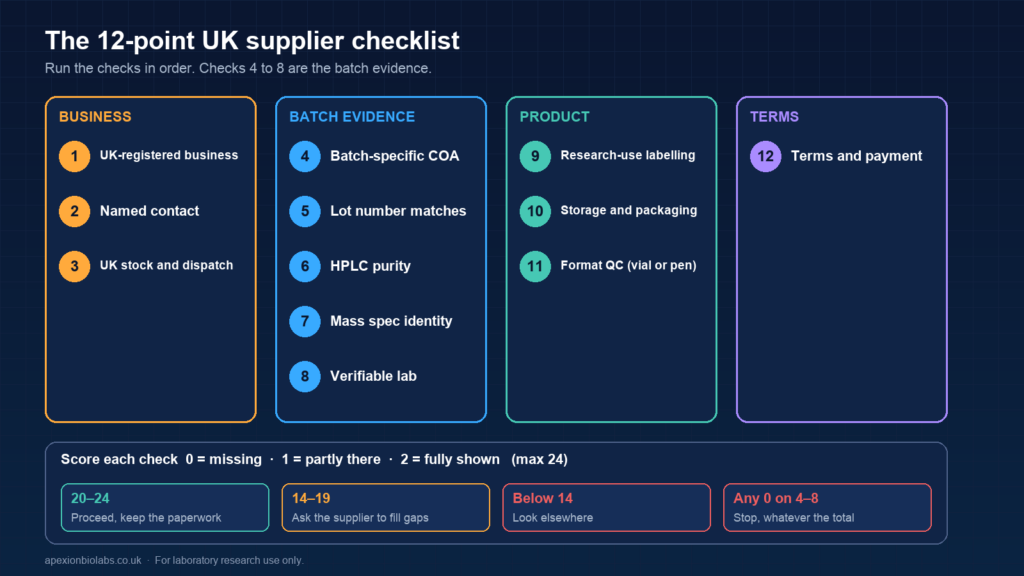
Twelve supplier checks grouped into business, batch evidence, product and terms, with a scoring guide
Step 1: Is the Supplier a Real, Traceable UK Business?
A lab can’t trace a batch back to a seller it can’t trace, so start with the business itself.
How Do You Check a Supplier on Companies House?
Search the supplier’s name or company number on the free Companies House register. Check that the status reads “Active”, that the registered name matches the trading name (or links to it clearly), and that the incorporation date fits the story the website tells. UK trading-disclosure rules require a limited company to show its registered name, number and office address on its website, so a footer with none of them is your first question to raise.
Can You Contact a Named Person?
Look for a working email, a phone or messaging line, and ideally a postal address. Send one short batch question before ordering. A clear reply within a day tells you more than any badge on the homepage.
Does It Stock and Dispatch From the UK?
Stock held in the UK ships in days with domestic tracking. Some “UK” sites import each order from abroad, which adds customs checks, longer transit and less control over temperature. A UK return address and a Royal Mail or courier tracking number are the quickest ways to tell the two apart.
Step 2: Does Every Batch Have Its Own Certificate of Analysis?
A Certificate of Analysis (COA) records what a lab found when it tested one batch, so “COA available” means little until you see whose batch it covers. Stocked products often show it on the product page; made-to-order products usually send it with the order, once that batch has been prepared and tested.
What Should a Batch-Specific COA Show?
Every credible COA carries the same core fields:
- Compound name and the form tested
- Batch or lot number
- Test date and, ideally, sample receipt date
- Method for each result (HPLC, mass spec)
- Result with units and the expected reference
- Lab name and contact details
- Report ID you can quote back to the lab
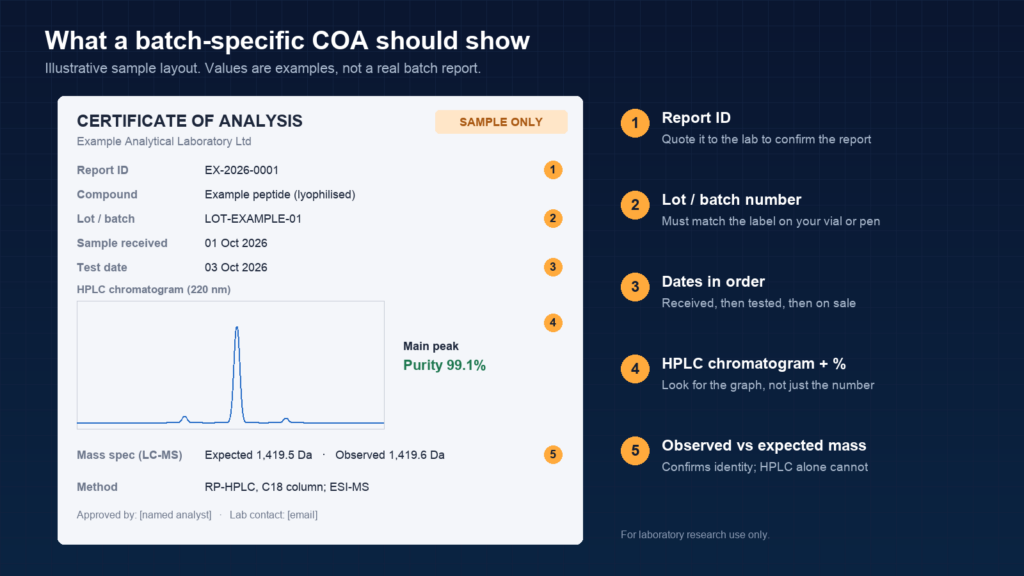
Example certificate of analysis showing the report ID, lot number, HPLC chromatogram, purity and mass result
Does the Lot Number Match the Label?
Hold the vial or pen next to the report and compare the lot numbers character by character. An exact match ties the paperwork to your unit. A near miss, such as one transposed digit, still counts as a mismatch until the supplier explains it in writing.
What If There’s No COA, or the Same COA for Every Batch?
No COA leaves you with a claim and no evidence. The same report reused across batches, or across different products, says only that one sample was tested at some point. Ask for the report that covers your lot.
Our guide on how to read a peptide COA explains each field, and you can verify a research peptide batch step by step once it arrives.
Step 3: Is Purity and Identity Tested by HPLC and Mass Spectrometry?
A good COA reports purity and identity, because each method answers a different question.
What Does HPLC Purity Tell You?
High-performance liquid chromatography (HPLC) separates a sample into its parts and reports the main peak as a percentage of everything detected. Look for the chromatogram itself, a graph with one tall peak and small neighbours, printed beside the number. Many suppliers quote ≥98% or ≥99% as their typical specification. That’s a supplier target, and no official standard sets it for research peptides.
What Does Mass Spec Confirm?
Mass spectrometry (often LC-MS) weighs the molecule. The report should list the observed molecular weight next to the expected value for that sequence. When the two agree within the lab’s stated tolerance, the batch is the peptide it claims to be.
Why Do You Need Both?
HPLC can show 99% purity for the wrong peptide, because it measures cleanliness and knows nothing about identity. Mass spec closes that loophole. HPLC purity also says nothing about water or salt content in the powder, since it only compares what was detected. Our COA reading guide shows where each value appears.
Step 4: Who Did the Testing, and Can You Verify the Report?
A report is only as strong as your ability to confirm it came from the lab named on it, and this is the check most buyers skip.
In-House vs Independent Lab: Does It Make a Difference?
In-house QC is useful for routine checks on every batch. An independent lab adds a second set of eyes with no stake in the sale. The strongest setup uses both, with the independent report named and dated on the COA.
How Do You Check a COA With the Lab That Issued It?
Three quick checks settle most doubts:
- Report ID: quote it to the lab by email, or use the lab’s online lookup if it offers one.
- Dates: the test date should fall after sample receipt and before the batch went on sale.
- Details: ask the lab to confirm the compound, lot number and headline result match its records.
A supplier with nothing to hide will tell you which lab to contact.
What Does Lab Accreditation Mean?
ISO/IEC 17025 is the international standard for the competence of testing laboratories. In the UK, UKAS is the sole national accreditation body under the Accreditation Regulations 2009. Accreditation covers specific methods, listed on the lab’s schedule of accreditation, so check that the schedule includes the test on your report.
Step 5: Is the Product Labelled and Sold for Research Use Only?
Research-use-only labelling tells you how the supplier sees its own product. Look for “for research use only” and “Research Use Only” on the label, and check that the label details match the COA.
Then read the rest of the site. Product pages, blogs and social posts should carry no medical claims, no use instructions, no dosing charts and no “results” testimonials. A supplier offering use advice is telling you how it presents the product, and that presentation carries legal weight.
MHRA Guidance Note 8 explains that a product can count as a medicine by presentation alone. It also states that where a product “is sold on or has links to a website which presents that product as a medicine, the website will be used by the MHRA as evidence”. Implied claims count, including testimonials and references to clinical research.
Step 6: How Are Peptides Stored, Packed and Shipped?
Good storage starts before dispatch. Lyophilised (freeze-dried) peptides last longest when kept cold, dry and away from light, and many product pages give −20 °C for keeping them over months. The supplier should state the conditions for each product.
In transit, look for:
- Temperature control: insulated packaging or cold packs where the product needs them
- Tamper evidence: sealed caps or security labels on each unit
- Tracked UK delivery: a tracking number on the day it ships
Receipt is the point where a good supplier record can still be undone, and storing peptides at the bench covers the checks from delivery onwards.
Step 7: Vials or Pre-Filled Research Pens: What Should You Check?
Format changes what the COA needs to cover. A vial COA usually describes the powder that went into it. A pre-filled pen adds a filling step, so the paperwork should account for that step as well.
| Format QC check | Vial | Pre-filled research pen |
|---|---|---|
| Fill verification | Mass per vial stated | Fill amount per pen stated |
| Batch number on each unit | On the vial label | On every pen |
| Date recorded | Manufacture or packing date | Fill or made-to-order date |
| Sterility or endotoxin testing | Only if actually performed and reported | Only if actually performed and reported |
| How the COA shows the format | Tested powder, linked to vial lot | Tested batch, linked to pen lot |
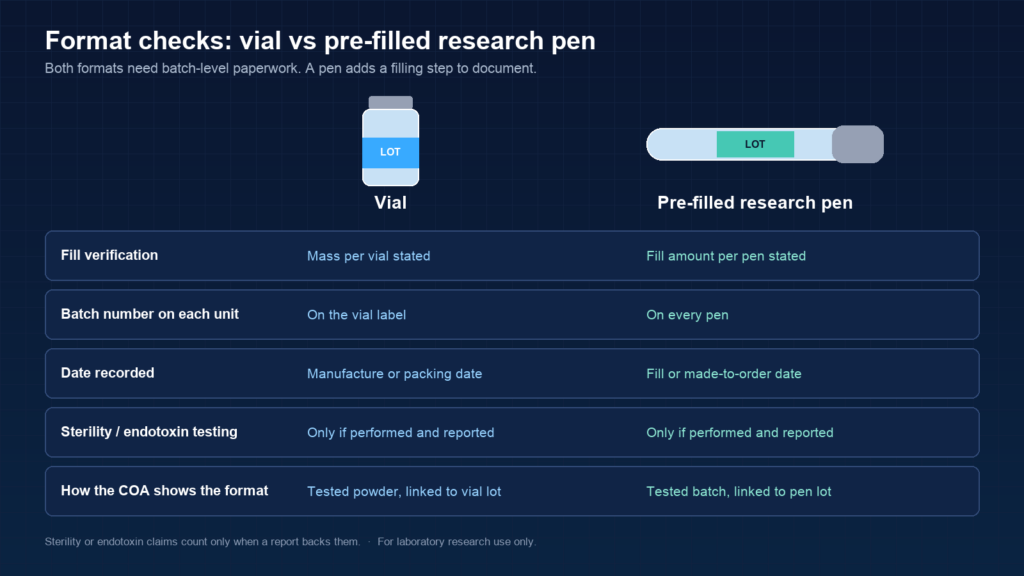
Format checks for vials and pre-filled research pens side by side
Treat sterility or endotoxin claims with care: they count only when a report backs them. Format affects what a report can even tell you, which is the ground covered by pen and vial formats.
Step 8: Are the Terms, Payment and Refund Policy Clear?
Published terms show a supplier expects to be held to something. Look for a terms page naming the governing law, a returns or damaged-goods policy, and a clear route for reporting a faulty or misdescribed item.
Payment is a quick signal. Card or bank payment through a recognised provider gives you a paper trail and some consumer protection. A crypto-only checkout removes both, which is why it appears on the red-flag list below.
Finally, judge how fast and how fully they answered your pre-order question.
What Are the Red Flags of an Unreliable Peptide Supplier?
One red flag is a question to ask. Two or more, and it’s time to look elsewhere.
| Red flag | Why it counts |
|---|---|
| No batch COA | No evidence links the product to any test |
| Same COA across batches or products | One old test standing in for many |
| COA from a lab you can’t trace | The report can’t be confirmed |
| Human-use or “results” wording | Presents the product as a medicine |
| Dosing charts | Use instructions on a research-only product |
| “Pharmaceutical grade” on RUO products | Implies a licensed medicine standard it hasn’t met |
| No UK address or company details | Nobody to hold accountable |
| Crypto-only payment | No paper trail or chargeback route |
| Prices far below market | Synthesis and testing have real costs |
Is It Legal to Buy Research Peptides in the UK?
Yes. UK buyers can purchase research peptides for laboratory work, provided they’re sold and used as research materials. They aren’t licensed medicines, so they can’t be sold for human use.
The Human Medicines Regulations 2012 set the rules. Any medicine must hold a marketing authorisation before it can be sold or supplied, and Regulation 2 defines a medicine by how it’s presented as well as by what it does.
The MHRA enforces those rules through its Criminal Enforcement Unit. On 26 January 2026, it reported that the unit seized almost 20 million doses of illegally traded medicines in 2025, with a street value of around £45m. Its borderline products guidance explains how it classifies products on the border between categories.
Last checked October 2026.
Why Does the Supplier’s Wording Count Legally?
Because the MHRA judges the whole website (Step 5), dosing tips or results claims can reclassify a research chemical as an unlicensed medicine. For compound-specific rules, read is BPC-157 legal in the UK and UK peptide law explained.
How Do You Score a Supplier? (Printable Checklist)
Score each of the 12 checks: 0 = missing, 1 = partly there, 2 = fully shown. The maximum is 24.
- 20 to 24: proceed, and keep the paperwork on file
- 14 to 19: ask the supplier to fill the missing points first
- Below 14: look elsewhere
- Any 0 on checks 4 to 8: stop, whatever the total, because those five checks are the batch evidence
Keep a one-line record for every order: batch number, COA report ID and the date you checked it.
How Does Apexion BioLabs Meet This Checklist?
We built our process around the same checks, and here’s where each one stands today:
- Contact: email and WhatsApp support, with a two-hour response target
- Terms: published terms governed by the laws of England and Wales
- UK dispatch: tracked UK delivery on every order
- Labelling: research-use-only on every product, sold to adults aged 18 and over
- Made-to-order pens: compound, strength and batch number on every pen
- Batch COAs: each pen is prepared fresh, so its batch COA follows with your order once that batch is tested, matched by batch number and QR code
You can see how this works on pens such as BPC-157 10mg and CJC-1295 + Ipamorelin 10mg, check any batch on our quality and batch verification page, or buy research peptides UK from our current range.
Frequently Asked Questions
Start with the business, then the batch: confirm the company on Companies House, then ask for the COA covering your exact lot. A trusted supplier answers both quickly and in writing.
Yes, for laboratory research. With no UK marketing authorisation, they can be supplied only as research materials, and selling or presenting them for human use falls under MHRA enforcement.
Many suppliers quote ≥98% or ≥99% by HPLC as a typical specification. No official standard applies, so look for the actual batch result and its chromatogram.
Look for a named lab, a report ID, test dates in a sensible order and both HPLC and mass spec results. Then confirm the report ID with the lab itself.
Pharmaceutical grade refers to licensed medicines made under Good Manufacturing Practice and approved for human use. Research grade describes material made and tested for laboratory work. A research-only product described as “pharmaceutical grade” is mixing the two.
In-house results are a useful first check on every batch. Pair them with an independent report you can confirm, and you have the clearest picture.
Conclusion
Choosing a research peptide supplier comes down to proof: a traceable UK business, a COA for your exact batch with HPLC and mass spec, and labelling that stays in research terms. Score each supplier on the same 12 checks. Start with our peptide COA guide, then browse our research peptides.
Disclaimer: Apexion BioLabs supplies research compounds strictly for in vitro laboratory use. These materials fall outside the medicine, supplement and food categories and must never be used in people or animals. This checklist covers supplier due diligence only and contains no medical advice. Read our full Research Notice.
Sources
- Companies House: find and update company information (checked October 2026)
- Company, LLP and Business (Names and Trading Disclosures) Regulations 2015
- Human Medicines Regulations 2012
- MHRA Guidance Note 8: A guide to what is a medicinal product (September 2025)
- MHRA: Borderline products, how to tell if your product is a medicine
- Accreditation Regulations 2009
- UKAS: United Kingdom Accreditation Service
- The Pharmaceutical Journal: MHRA 2025 seizures, reported 26 January 2026