
Thymosin Alpha-1 UK: What It Is, Research & Legal Status (2026)
Reviewed by Oscar Reyes, PhD, Synthesis Lead at Apexion BioLabs · Scientific review of the chemistry and analytical content
Quick answer
What is Thymosin Alpha-1?
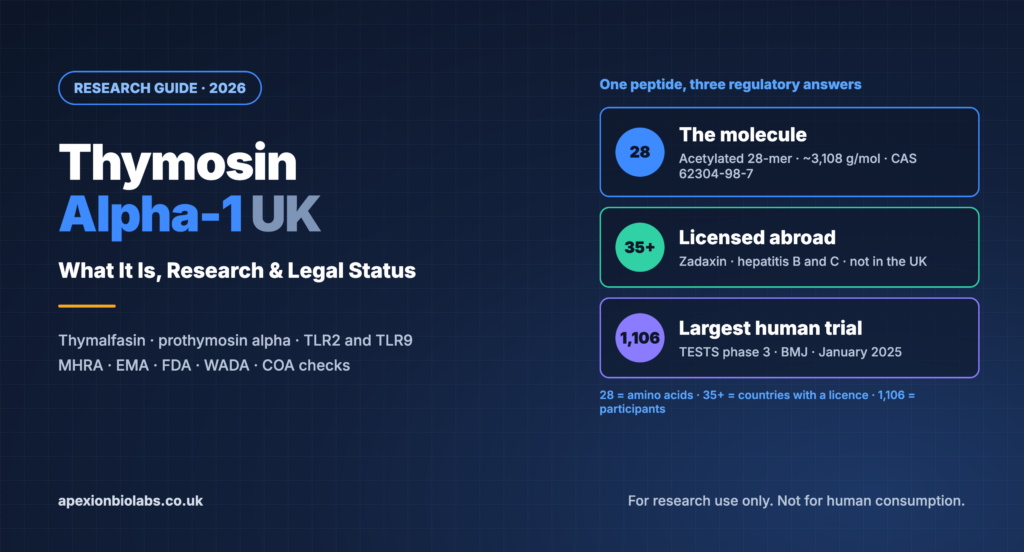
Thymosin Alpha-1 (Tα1, thymalfasin) is a 28-amino-acid peptide first isolated from thymus tissue. It is studied for how it influences immune-cell signalling, including T-cell maturation and dendritic-cell activity. A synthetic version is licensed as a medicine in some countries, though not in the UK, where it is supplied for laboratory research.
- 28 amino acids with an acetyl group at one end, cut from prothymosin alpha
- Studied in cell, animal and human clinical research, including hepatitis, sepsis and vaccine-response trials
- UK: no MHRA licence; supplied as a research material only
The same 28-amino-acid chain can be a prescription medicine in Beijing and a laboratory reagent in Birmingham. That is the quirk a UK researcher meets first with Thymosin Alpha-1: a peptide that carries marketing approval in more than 35 countries for hepatitis B and C, according to a 2020 review in the World Journal of Virology, and none at all here. Anyone searching thymosin alpha 1 UK runs into that double identity straight away, along with four decades of published trials that most short product pages skip.
This guide covers what Tα1 is, how laboratories study its action on immune signalling, how it differs from TB-500, what the human trials have reported (including a phase 3 sepsis trial that read out in 2025 and a Cochrane review current to June 2026), where it is approved, where UK law puts it, and what a batch record should show. Apexion supplies Tα1 strictly for laboratory research use, covered by the Research Use Only notice.
What Is Thymosin Alpha-1?
Thymosin Alpha-1 is a natural 28-amino-acid peptide cut from a larger protein called prothymosin alpha, the product of the PTMA gene. Allan Goldstein’s group at the George Washington University first purified and sequenced it in 1977, working from a calf-thymus preparation they had labelled thymosin fraction 5. The synthetic copy carries the international drug name thymalfasin and the brand name Zadaxin, developed by SciClone Pharmaceuticals.
The thymus is the gland where T cells mature, which is why a peptide pulled out of thymus tissue drew immunology interest from the start. That preparation carried dozens of peptides, and the Greek letters attached to them simply record how far each one travelled on an isoelectric focusing gel, with the acidic ones taking the alpha label. The letters describe a 1970s separation step and nothing about structure, which is where most of the confusion with thymosin beta-4 begins.
One molecule, several labels, all meaning the same chain:
- Tα1, TA1, TA-1: Shorthand used across the research literature.
- Thymalfasin: The INN, or international generic name, assigned to the synthetic peptide.
- Zadaxin: SciClone’s brand name for the licensed product sold outside the UK.
Is Thymosin Alpha-1 a Peptide or a Hormone?
Chemically, the Thymosin Alpha-1 peptide is exactly that: one linear chain of 28 amino acids, no disulfide bonds, with an acetyl cap on the first serine. Papers often call it a thymic peptide hormone because the body makes it and it acts on distant cells, so both descriptions appear in the literature for the same molecule. The Thymosin Alpha-1 specification and COA for a given batch states the measured mass, the HPLC purity figure and the salt form, which together decide how much peptide a milligram of powder actually contains.
Thymosin Alpha-1 at a Glance
| Field | Value |
|---|---|
| Names | Tα1, TA1, thymalfasin (international drug name), Zadaxin (brand) |
| Sequence | Ac-SDAAVDTSSEITTKDLKEKKEVVEEAEN-OH |
| Length | 28 amino acids, acetylated at the N-terminus |
| Formula | C129H215N33O55 (free base) |
| Molecular weight | 3,108.3 g/mol average; 3,106.50 Da monoisotopic |
| CAS | 62304-98-7 |
| UNII / PubChem | W0B22ISQ1C · CID 16130571 |
| Charge character | Strongly acidic: 3 Asp, 6 Glu against 4 Lys; pI near 4.2 |
| Parent protein | Prothymosin alpha, 109 residues, PTMA gene |
| Research form | Lyophilised powder; Apexion supplies a 20mg pre-filled research pen |
| UK status | No MHRA licence; supplied for laboratory research use only |
Those four lysines are the reason salt form comes up again in the verification section: they give the chain somewhere to park acetate counter-ions, each one adding weight on top of the free-base figure.
How Does Thymosin Alpha-1 Work?
Cell and animal research describes Tα1 acting as an agonist at two Toll-like receptors carried by dendritic cells, TLR2 and TLR9, with downstream influence on T-cell maturation and on a Th1-leaning cytokine profile that includes IL-2 and interferon. Direct binding constants are thin on the ground, so most of what is published measures function rather than structure.
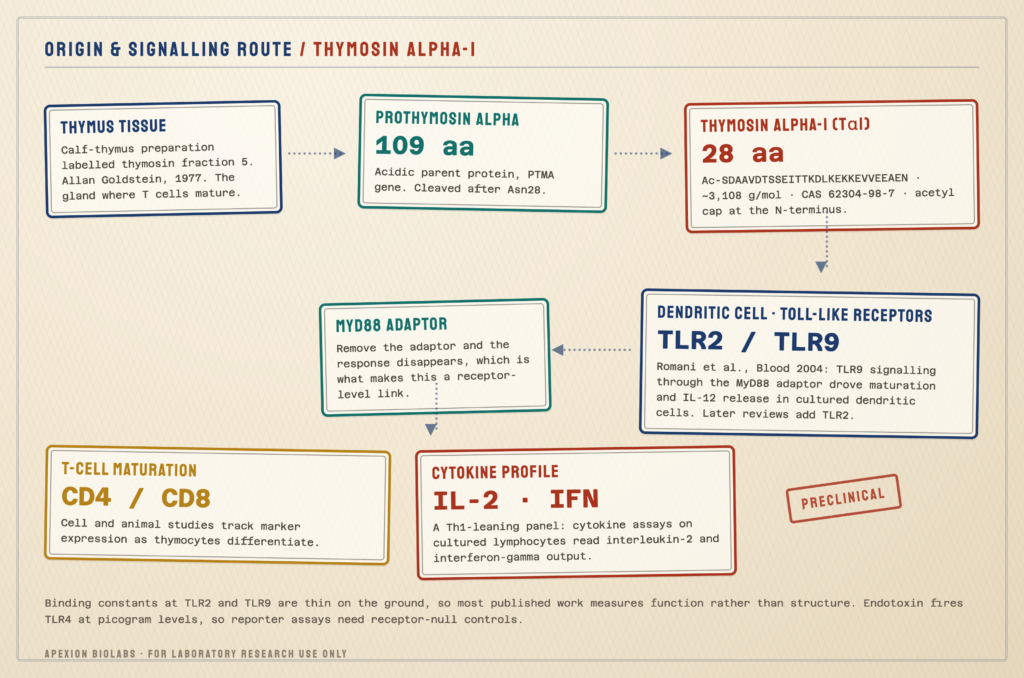
The clearest single experiment came from Luigina Romani’s group at the University of Perugia, publishing in Blood in 2004 (PMID 14982877). Dendritic cells in culture matured and released IL-12 when exposed to the peptide, and the pathway traced back to TLR9 working through the MyD88 adaptor. Remove that adaptor and the response disappears, which is what makes the link a receptor-level one rather than a correlation. Later reviews, including the 2020 World Journal of Virology paper by Dominari and colleagues (PMC7747025), add TLR2 and describe Tα1 as acting “as a toll-like receptor (TLR)-9 and TLR-2 agonist in both myeloid and dendritic cells.”
Three strands of laboratory evidence sit behind the word immunomodulator:
- Dendritic-cell signalling: TLR reporter assays and primary dendritic-cell cultures measure NF-κB or IRF activation, surface markers such as CD80 and CD86, and IL-12 release.
- Thymocyte and T-cell maturation: Cell and animal studies track CD4 and CD8 marker expression as thymocytes differentiate.
- Th1 versus Th2 balance: Cytokine panels on cultured lymphocytes read IL-2 and interferon-gamma output, which is where the Th1 description comes from.
Reviewers reach for “immunomodulator” instead of a single mechanism because the readout changes with the model. Enrico Garaci, Luigina Romani and co-authors put the point plainly in Frontiers in Medicine in June 2024: Tα1 “exhibits multiple actions across various biological systems and processes,” and its development “was based on observed effects on the immune system rather than a specific, known molecular target.” That is unusual for a peptide with this much clinical history, and it shapes how the trial data below reads.
That design detail carries a warning for anyone setting up a reporter assay. Traces of bacterial lipopolysaccharide fire TLR4 at picogram concentrations, which means an apparent peptide signal from an unverified lot may be contamination talking. Pairing each plate with receptor-null cells and a reference ligand for the receptor under test tells the two apart.
Is Thymosin Alpha-1 the Same as TB-500?
No. They come from different proteins and are studied in different fields. Tα1 is the 28-amino-acid piece cut from prothymosin alpha, and immunology is where it appears. TB-500 derives from thymosin beta-4, an unrelated 43-amino-acid actin-binding protein, and belongs to the tissue-repair literature. The shared word “thymosin” is a piece of 1970s lab history.
| Thymosin Alpha-1 | TB-500 | |
|---|---|---|
| Parent protein | Prothymosin alpha (PTMA gene) | Thymosin beta-4 (TMSB4X gene) |
| Length | 28 amino acids | 7 amino acids, Ac-LKKTETQ, taken from positions 17 to 23 of the 43-residue parent |
| Molecular weight | ~3,108 g/mol | ~889 g/mol |
| Research area | Immune signalling, TLR and T-cell work | Actin binding, cell migration, tissue repair |
| Licensed anywhere? | Yes, as thymalfasin in more than 35 countries | No |
| WADA | Not named on the list; see the sport section | Thymosin-β4 and its derivatives are named under S2 |
The mass difference alone separates them on any spectrum, the fastest way to settle a mix-up at the bench. Whether the seven-residue fragment reproduces the whole protein’s in vitro behaviour remains an open question in TB-500 peptide UK research. BPC-157 vs TB-500 is the pairing most repair-study protocols use, and the two differ in parent protein, length and the assays they turn up in.
What Is Thymosin Alpha-1 Used For in Research?
In the laboratory, Tα1 is used to study immune regulation: T-cell development, dendritic-cell signalling, and how both respond to infection and vaccination. Where thymalfasin is licensed abroad, its approved uses centre on chronic hepatitis B and C and on vaccine response in people with weakened immunity. There is no licensed use in the UK.
Each area carries its own evidence level, and keeping them apart is the difference between reading the literature accurately and over-reading it:
- T-cell maturation: Cell and animal studies.
- TLR signalling: Cell studies, mainly dendritic-cell cultures and reporter lines.
- Chronic hepatitis B and C: Human randomised trials, pooled in several meta-analyses.
- Sepsis: Human randomised trials, including one large phase 3.
- Vaccine response in older adults and people on dialysis: Human trials measuring antibody titres.
- COVID-19: Human observational studies from China in 2020, which looked back at existing records.
- Melanoma alongside chemotherapy: One large human randomised trial.
- The ageing immune system: Animal studies and reviews, hypothesis-generating at this stage.
What Does the Research on Thymosin Alpha-1 Show?
Tα1 has been tested in many human trials across four decades, which separates it from most peptides sold as research materials. The findings have been mixed. Several early trials were small, single-country or open-label, and the larger, better-controlled trials that followed have not always confirmed what the earlier work suggested.
Human Clinical Trials
Chronic hepatitis B. This is the longest-running clinical question and the one behind most foreign approvals. A Cochrane review by Naing and colleagues, published in Issue 9 of the Cochrane Database of Systematic Reviews in 2026 with evidence current to June 2026, pooled 10 trials covering 1,349 adults with chronic hepatitis B. The reviewers rated certainty very low for almost every outcome, reporting “little confidence” given how few trials covered the outcomes they set out to assess, how much the findings varied, and how small many of the trials were. Earlier meta-analyses had pointed in different directions: a 2001 pooling of five trials found no biochemical difference against placebo, while a 2009 pooling of eight trials of Tα1 plus lamivudine favoured the combination.
Sepsis. The TESTS trial is the largest test the peptide has had. Published in The BMJ on 15 January 2025, it was a multicentre, double-blind, placebo-controlled phase 3 trial in 1,106 adults aged 18 to 85 meeting sepsis-3 criteria, randomised 1:1. Twenty-eight-day all-cause mortality was 23.4% in the Tα1 arm (127 participants) against 24.1% on placebo (132 participants), a hazard ratio of 0.97 (95% CI 0.76 to 1.24, P=0.82). The authors concluded there was no clear evidence that Tα1 decreased 28-day mortality in this population. An earlier, smaller Chinese trial, ETASS, had reported a mortality difference, which is exactly the pattern the introduction to this section describes.
Melanoma alongside chemotherapy. Maio and colleagues reported a 488-patient open-label randomised trial in the Journal of Clinical Oncology in 2010, with five arms combining dacarbazine with Tα1 at different doses and with interferon alfa. Median overall survival was 9.4 months in the thymosin arms against 6.6 months in the control arm, a hazard ratio of 0.80 with P=.08, short of statistical significance. Adding Tα1 did not add toxicity. The authors judged the signal worth further clinical evaluation.
Vaccine response and COVID-19. Vaccine-response trials measured antibody titres in older adults and in people on dialysis, two groups chosen because they respond to vaccination less strongly. The COVID-19 reports from China in 2020 were observational, drawn from records already collected, so they describe associations rather than cause and effect.
| Research area | Study type | What was reported | Status |
|---|---|---|---|
| T-cell maturation | Cell and animal | Influences thymocyte differentiation | Established in lab models |
| TLR signalling | Cell | TLR9 and MyD88 dependence shown in dendritic cells; TLR2 added by later reviews | Preclinical |
| Chronic hepatitis B | Human RCTs, meta-analyses | 10 trials, 1,349 adults; certainty rated very low (Cochrane, 2026) | Licensed in some countries |
| Sepsis | Human RCT (phase 3) | 23.4% vs 24.1% 28-day mortality; HR 0.97, P=0.82 (TESTS, 2025) | Investigational |
| Vaccine response | Human trials | Antibody titres measured in older adults and dialysis groups | Investigational |
| COVID-19 | Human, records reviewed retrospectively | Associations only, no causal inference | Investigational |
| Melanoma with chemotherapy | Human RCT | Median OS 9.4 vs 6.6 months; HR 0.80, P=.08 (Maio, 2010) | Investigational |
| Ageing immune system | Animal and review | Hypothesis-generating | Preclinical |
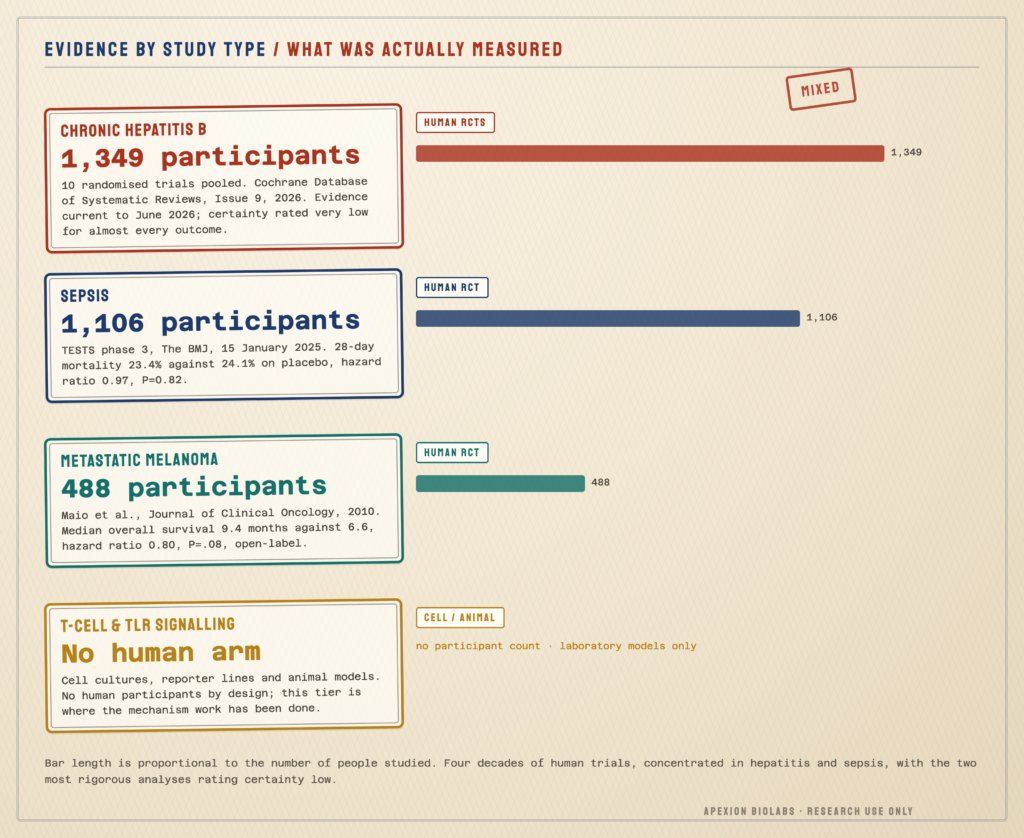
What limits this evidence is study design rather than volume. The strongest human data cluster in hepatitis and sepsis, and in both, the most rigorous analyses rate certainty low. Much of the supporting literature comes from one region, several trials were open-label, and the melanoma and vaccine-response work has not been repeated at scale. That is why regulators in different countries have drawn different conclusions from the same papers.
Is Thymosin Alpha-1 Approved Anywhere?
Yes, in a number of countries. Thymalfasin, marketed as Zadaxin, carries marketing approval mainly across Asia, Latin America and parts of Europe, chiefly for chronic hepatitis B and C and as a vaccine enhancer in people with weakened immunity. Peer-reviewed reviews from 2020 and 2024 both put the figure at more than 35 countries. It carries no licence in the UK, the EU or the US.
| Region | Status (confirmed 7 November 2026) |
|---|---|
| UK (MHRA) | No marketing authorisation; no licensed product |
| EU (EMA) | No EU-wide authorisation. Orphan designation EU/3/02/110, granted to SciClone on 30 July 2002 for hepatocellular carcinoma, status positive |
| US (FDA) | Not approved. Orphan designations granted, including malignant melanoma in 2006. Listed by the FDA among bulk drug substances nominated for compounding but withdrawn |
| China and others | Licensed as Zadaxin, principally for chronic hepatitis B and C |
An orphan designation is a development incentive and not an approval, which is the distinction that gets lost most often when this peptide is written up.
Why Does the FDA Note Concerns?
On its bulk drug substances page, current as of 22 April 2026, the FDA places “Thymosin-alpha 1 (Ta1)” under substances nominated for compounding but withdrawn, stating that compounded drugs containing it “may pose significant risk for immunogenicity” for certain routes of administration, and that the available safety information is inadequate for the agency to understand the scope of any issues. It is not on the agency’s Category 2 table.
Is Thymosin Alpha-1 Legal in the UK?
Buying Thymosin Alpha-1 as a research material is lawful in the UK. It is not a controlled drug under the Misuse of Drugs Act 1971, and the Psychoactive Substances Act 2016 covers substances acting on the central nervous system, which is a different category of compound. What UK law does restrict is the medicine side: with no MHRA marketing authorisation, no one may sell, supply or advertise it for human use, under the Human Medicines Regulations 2012.
That is the line research suppliers work to. The material is sold as a laboratory reagent, labelled for research use, described in terms of its identity and batch record, and never presented for human or veterinary use. The same reasoning decides whether peptides are legal in the UK as a class: the molecule is rarely the restricted thing, the medicinal claim is. Apexion’s Research Use Only notice states the terms this material is supplied under.
Do You Need a Prescription for Thymosin Alpha-1?
The question has no UK answer, because there is no licensed UK product for a prescriber to write against. Prescribing law applies to authorised medicines and to the narrow unlicensed-specials route, neither of which covers material sold as a laboratory research reagent.
Are Peptides Legal in the UK?
Research peptides are generally lawful to buy, own and use in a laboratory setting, with the restrictions falling on medicinal sale and promotion rather than on the molecules themselves.
MHRA, EMA, FDA and WADA positions in this guide were checked against primary sources on 7 November 2026.
Is Thymosin Alpha-1 Banned in Sport?
The WADA Prohibited List names thymosin-β4 and its derivatives, including TB-500, under class S2, which covers peptide hormones, growth factors, related substances and mimetics. Thymosin Alpha-1 is not named on the list, and past anti-doping guidance has treated it as not prohibited.
Two points keep that from being a settled answer. The list is revised annually and takes effect on 1 January, so the current edition is the only version that counts. Section S0 covers substances with no approval from any government health authority for human therapeutic use, and thymalfasin’s approvals in other countries complicate how that section reads. Anyone competing under anti-doping rules should check the current WADA Prohibited List and ask UK Anti-Doping for a written position.
How to Verify Research-Grade Thymosin Alpha-1
Any TA1 peptide listing is only as good as the certificate of analysis for the specific batch in front of you, so start there. A mass-spectrometry figure near 3,108 Da confirms the acetyl group is present, and HPLC purity should arrive with the method spelt out. The classic Tα1 trap is an unacetylated chain, 42 Da lighter than it should be, which a chromatogram on its own will often let through.
Work through the certificate field by field:
- Lot number: It should match the number on the product itself, not just the product name.
- HPLC purity and method: A percentage with the method and column conditions stated.
- LC-MS mass: Near 3,108 Da, with nothing sitting 42 Da below it.
- Named laboratory and test date: Both present, and verifiable with that laboratory.
- Salt form: Each acetate counter-ion adds around 60 g/mol, so the salt decides how much peptide a milligram of powder actually delivers.
- Storage conditions: Stated on the certificate and matching the product label.
Seeing a low content figure beside a high HPLC percentage reads as a contradiction until the salt and water are accounted for, and that pairing is the one most often read as a purity fault when it is nothing of the kind. Learning to read a peptide certificate of analysis field by field is what turns a PDF into evidence, and a lot number that cannot be traced back to the material it arrived with fails the first test when you verify a research peptide batch.
Apexion supplies Tα1 as a 20mg pre-filled research pen prepared to order in the UK, so the batch certificate is issued once that batch has been tested and travels with the order, matched by batch number. A peptide pen vs vial decision also changes what the paperwork can record, since a pen’s batch data covers the filled unit rather than a powder weighed out later. Reconstituted peptide storage and handling for research runs to tighter temperature limits than a sealed pen, because a peptide in solution degrades on a different timescale.
Frequently Asked Questions
Thymalfasin is the International Nonproprietary Name for synthetic Thymosin Alpha-1, the same 28-amino-acid chain found in thymus tissue. SciClone Pharmaceuticals markets it as Zadaxin, and regulatory databases index the free base under UNII W0B22ISQ1C against CAS number 62304-98-7.
The peptide occurs naturally as the first 28 residues of prothymosin alpha, a 109-residue protein encoded by the PTMA gene. Research-grade material is manufactured, most often on solid phase, assembling the acetylated chain residue by residue.
As an endogenous peptide, Tα1 is described in the literature as a signalling molecule associated with thymic function, where T cells mature. Research models report activity at Toll-like receptors on dendritic cells and influence on T-cell differentiation.
No. Thymosin Alpha-1 has no FDA approval in the United States. It has received orphan drug designations there, including for malignant melanoma in 2006, and designation is a development incentive rather than a marketing approval.
They are separate molecules from separate genes. Tα1 is a 28-residue fragment of prothymosin alpha studied in immune signalling. Thymosin beta-4 is a 43-residue protein that binds actin, while TB-500 reproduces just seven of its residues and belongs to tissue-repair work.
No UK product carries an MHRA marketing authorisation. It is supplied here as a laboratory research material, which means it cannot be sold, supplied or advertised for human use.
Concluding
Thymosin Alpha-1 is a 28-amino-acid peptide cut from prothymosin alpha, first pulled out of calf-thymus extract in 1977 and studied ever since at Toll-like receptors and in T-cell maturation. Its clinical record runs longer than almost any peptide sold as research material, with licences in more than 35 countries, orphan designations in the EU and US, and large trials whose findings have been mixed. In the UK, it is a research material with no MHRA licence, supplied for laboratory use only and never for human or veterinary use.
View Thymosin Alpha-1 specifications and batch documentation
Thymosin Alpha-1 is supplied by Apexion Biolabs strictly for laboratory research use. It is not a medicine, supplement or food product, and it is not intended for human or veterinary consumption, therapeutic use or diagnostic use. See the Research Use Only notice.
Sources
- Goldstein AL, Low TL, McAdoo M, et al. Thymosin alpha1: isolation and sequence analysis. Proc Natl Acad Sci USA, 1977. PMID 265536
- Goldstein AL, Goldstein AL. From lab to bedside: emerging clinical applications of thymosin alpha 1. Expert Opin Biol Ther, 2009;9(5):593-608. PMID 19392576
- Romani L, Bistoni F, Gaziano R, et al. Thymosin alpha 1 activates dendritic cells for antifungal Th1 resistance through Toll-like receptor signaling. Blood, 2004. PMID 14982877
- Dominari A, Hathaway D III, Pandav K, et al. Thymosin alpha 1: a comprehensive review of the literature. World J Virol, 2020;9(5):67-78. PMC7747025
- Garaci E, Paci M, Matteucci C, Costantini C, Puccetti P, Romani L. Phenotypic drug discovery: a case for Thymosin Alpha-1. Front Med, 6 June 2024. doi:10.3389/fmed.2024.1388959
- Naing C, Ni H, Aung HH, et al. Thymosin-ɑ1 for people with chronic hepatitis B. Cochrane Database of Systematic Reviews, 2026, Issue 9. CD014610.pub2
- Liu Y, et al. The efficacy and safety of thymosin α1 for sepsis (TESTS): multicentre, double blinded, randomised, placebo controlled, phase 3 trial. BMJ, 15 January 2025. PMID 39814420
- Maio M, Mackiewicz A, Testori A, et al. Large randomized study of thymosin alpha 1, interferon alfa, or both in combination with dacarbazine in patients with metastatic melanoma. J Clin Oncol, 2010;28(10):1780-1787. PMID 20194853
- European Medicines Agency. EU/3/02/110: orphan designation for thymalfasin, 30 July 2002.
- US Food and Drug Administration. Certain bulk drug substances for use in compounding that may present significant safety risks, current as of 22 April 2026.
- World Anti-Doping Agency. Prohibited List, 2026 edition.
- PubChem. Thymosin alpha 1, CID 16130571, National Library of Medicine.