
Dihexa UK: What It Is, Research & Legal Status (2026)
Reviewed by Oscar Reyes, PhD, Synthesis Lead at Apexion BioLabs · Scientific review of the chemistry and analytical content
Quick answer
What is Dihexa?
Dihexa (PNB-0408) is a small, modified fragment of the peptide hormone angiotensin IV, developed at Washington State University. In animal and cell studies, it binds hepatocyte growth factor (HGF) and strengthens HGF/c-Met signalling, a pathway involved in forming connections between neurons. No published human trial has given Dihexa itself, and Dihexa UK supply is for research only: it isn’t licensed as a UK medicine.
- A small molecule derived from a peptide (MW 504.7)
- Direct evidence comes from rat, mouse and cell studies; a prodrug that converts to Dihexa reached Phase 2/3
- UK: research use only, no MHRA licence
Dihexa (PNB-0408) is a lab-made molecule built from angiotensin IV, a fragment of the hormone system that controls blood pressure, and it’s studied for how it strengthens HGF/c-Met signalling in rodent brain cells. It’s usually described as a compound no person has ever received. That’s only half right.
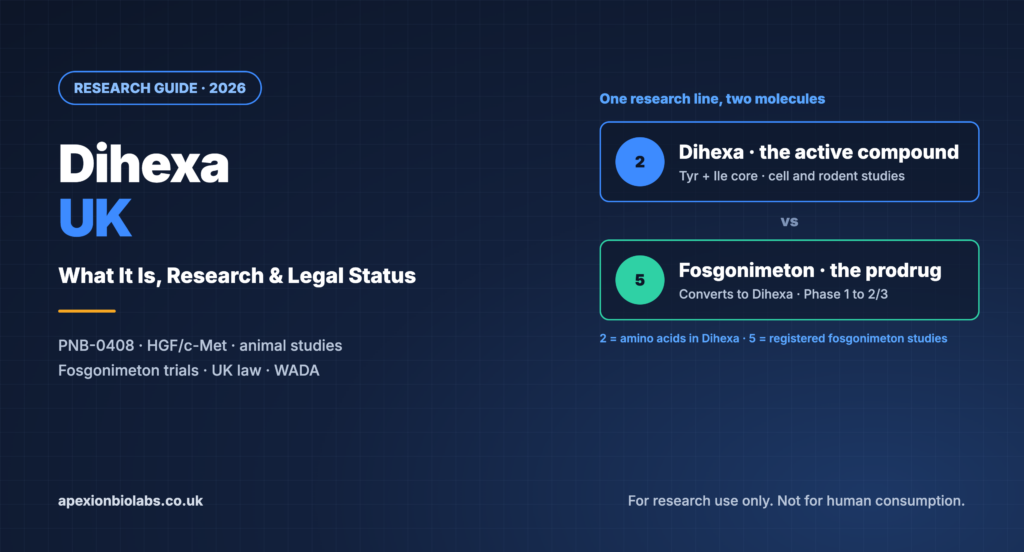
Dihexa itself has no published human trial. But Athira Pharma’s fosgonimeton, a prodrug, is converted into Dihexa after it’s given, and it went through five registered human studies up to Phase 2/3 (Athira 10-K, 2022). For anyone checking Dihexa UK status, that connection, plus a 2025 retraction in the core literature, changes how the research reads.
This guide covers what Dihexa is, how it works in lab models, what the animal studies report, the fosgonimeton trials, the UK legal and sport position, and what a good batch record looks like.
Apexion supplies Dihexa for laboratory research only, and it isn’t intended for people or animals. Treat this article as general information rather than medical advice. Our Research Use Notice sets out the terms.
What Is Dihexa?
Dihexa is a synthetic compound built from angiotensin IV, a small fragment of the body’s angiotensin hormone system. Washington State University (WSU) researchers trimmed and capped it so it would resist enzymes, and in rat studies, it crosses the blood-brain barrier. Its development code is PNB-0408, and its chemical name is N-hexanoic-Tyr-Ile-(6) aminohexanoic amide.
The route there took about two decades:
- Angiotensin IV (AT4) memory work. Joseph Harding and John Wright’s group at WSU spent years studying angiotensin IV, the hexapeptide VYIHPF, in rodent learning tasks. The natural peptide breaks down fast and can’t reach the brain from the bloodstream.
- The stabilised analogue. A 2013 paper in the Journal of Pharmacology and Experimental Therapeutics (JPET) kept the key three-residue core, capped both ends and described the new compound, Dihexa, as a “metabolically stabilized analog” that crossed the blood-brain barrier in rats (McCoy et al., 2013).
- The licence. WSU exclusively licensed its Dihexa patents to the company now called Athira Pharma, formerly M3 Biotechnology (Athira 10-K).
The identity data below is checked against PubChem (CID 129010512):
Dihexa at a glance
| Field | Detail |
|---|---|
| Names | Dihexa, PNB-0408 |
| Chemical name | N-hexanoic-Tyr-Ile-(6) aminohexanoic amide |
| Origin | Modified angiotensin IV fragment (Washington State University) |
| Class | Small molecule derived from a peptide (oligopeptide/peptidomimetic) |
| Formula | C27H44N4O5 (PubChem) |
| Molecular weight | 504.7 g/mol (PubChem) |
| CAS | 1401708-83-5 |
| Target | Binds HGF; enhances HGF/c-Met signalling (cell and animal studies) |
| Research form | Lyophilised powder in reagent catalogues; Apexion supplies 10mg units |
| UK status | Not MHRA-licensed; research use only |
Is Dihexa a Peptide?
Partly, so calling it a Dihexa peptide is only half the story. It contains two amino acids, tyrosine and isoleucine, with a hexanoic acid cap on one end and an aminohexanoic amide on the other, so chemists call it an oligopeptide or peptidomimetic. At 504.7 g/mol, it behaves more like a small-molecule drug, which is why it resists breakdown in rat studies. Apexion supplies it for lab work as Dihexa 10mg, with batch documentation tied to each order.
How Does Dihexa Work?
In cell and animal studies, Dihexa binds HGF and helps it switch on its receptor, c-Met. HGF/c-Met signalling is involved in growing dendritic spines, the small protrusions where neurons connect, and in forming new synapses. The best-known paper on this mechanism was retracted in 2025, so the evidence rests on fewer sources than it once did.
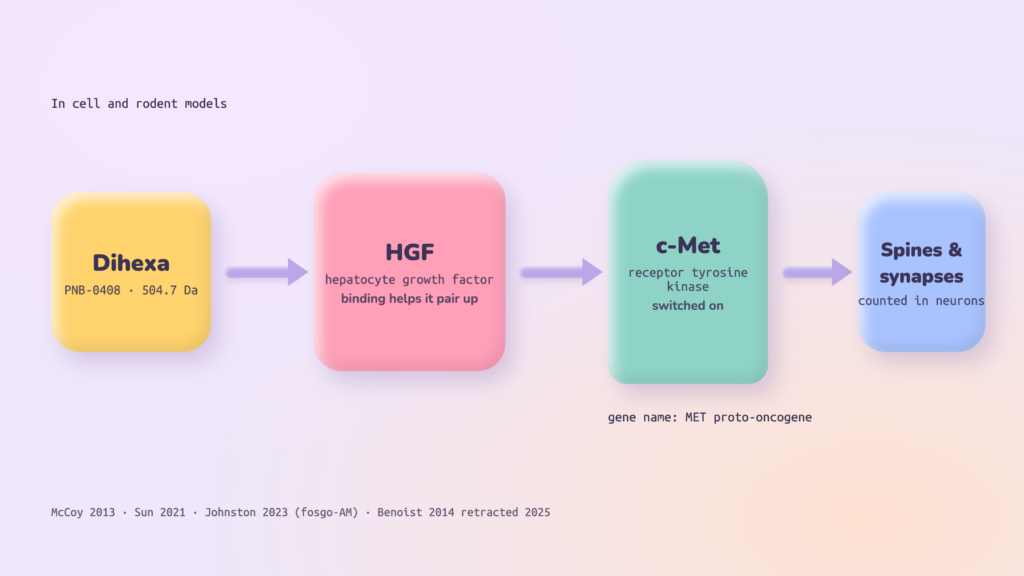
HGF and c-Met in brief. Hepatocyte growth factor was first named for its effect on liver cells, but it’s active in many tissues. Its receptor, c-Met, is a tyrosine kinase that signals growth, movement and survival in development and tissue repair, and in the nervous system it’s studied for its role in neuron growth.
What “synaptogenesis” means here. In cultured rat hippocampal neurons and in the rat hippocampus, researchers counted more dendritic spines and synapses after Dihexa (McCoy et al., 2013). That’s a microscope count of physical structures.
The HGF link and its status. The paper that tied Dihexa’s effects to HGF and c-Met, reporting that blocking HGF or c-Met removed them, was Benoist et al., 2014 in JPET. JPET retracted it in April 2025 (PubMed record). Later support comes from other teams: Sun et al. (2021) reported PI3K/AKT pathway activation in mice, and Athira’s own team described the active metabolite of fosgonimeton as a positive modulator of HGF/MET in rat neurons (Johnston et al., 2023).
A widely repeated claim that Dihexa is “seven orders of magnitude” more potent than BDNF traces back to a single in vitro comparison from the same lab, so it’s left out of this guide.
Is Dihexa a Stimulant?
No. Classic stimulants such as amphetamine act mainly on dopamine and noradrenaline signalling. Dihexa’s proposed mechanism is growth-factor signalling through HGF and c-Met, measured in assays as receptor activation and spine counts. It belongs to a different pharmacological class altogether.
What Is Dihexa Used For in Research?
Dihexa is a tool compound for studying HGF/c-Met signalling in the nervous system: how neurons form and maintain synapses, and how the pathway behaves in rodent models of memory impairment. Researchers also use it to probe angiotensin IV (AT4) pharmacology.
Research areas and the model behind each:
- Spine and synapse formation: cultured rat neurons
- Spatial learning in rats with induced or age-related impairment: animal (rat)
- Alzheimer’s-like mouse models (APP/PS1): animal (mouse)
- Huntington’s-like rat model: animal (rat), reported in 2024
- HGF/c-Met and AT4 pharmacology: cell assays
What Does the Research on Dihexa Show?
All published Dihexa research on the compound itself is in cells and animals. In rats and mice with induced or age-related memory impairment, researchers reported better water-maze performance and more synapses. No human trial of Dihexa has been published, and part of the early literature now carries a retraction or an expression of concern.
| Research area | Study type | What was reported | Source |
|---|---|---|---|
| Synapse/spine formation | Cell (rat neurons) + rat | More spines and synapses | McCoy 2013 (expression of concern, 2021) |
| HGF/c-Met dependence | Cell + animal | Effects blocked by HGF or c-Met blockers | Benoist 2014 (retracted, 2025) |
| Spatial learning (scopolamine model) | Animal (rat) | Better water-maze performance | McCoy 2013 (expression of concern, 2021) |
| Aged rats | Animal (rat) | Better water-maze performance | McCoy 2013 (expression of concern, 2021) |
| Alzheimer’s-like model (APP/PS1) | Animal (mouse) | Water maze, neuron counts, inflammation markers, PI3K/AKT activity | Sun 2021 |
| Huntington’s-like model (3-NP) | Animal (rat) | No protection from induced deficits | Wells 2024 |
| Active metabolite of fosgonimeton | Cell + animal (Athira) | Positive modulation of HGF/MET in rat neurons | Johnston 2023 |
| Long-term safety | None | No long-term study published | PubMed, Nov 2026 |
| Human trials of Dihexa | None | None registered or published | ClinicalTrials.gov, Nov 2026 |
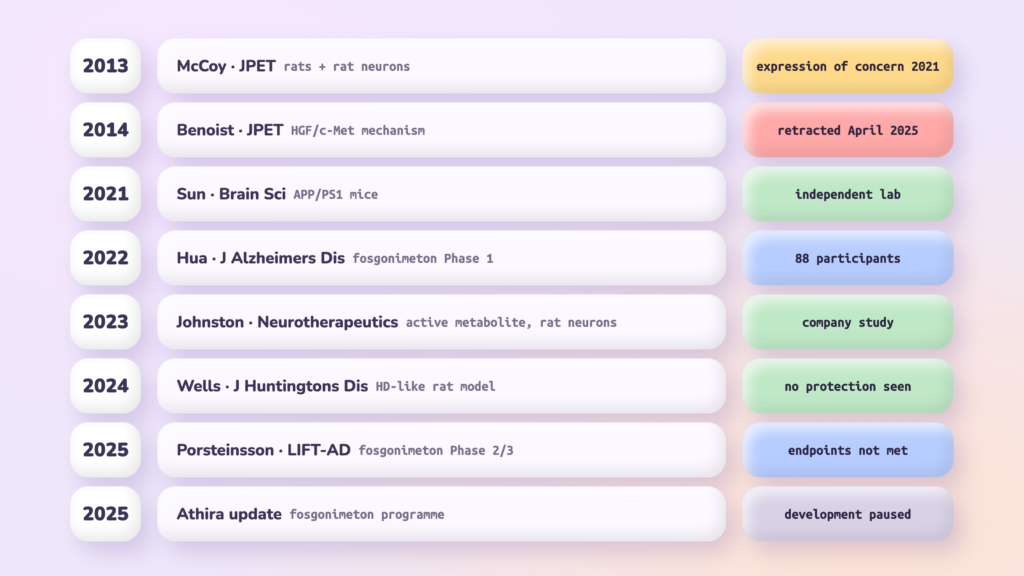
The newest animal paper adds balance. In a Huntington’s-like rat model, a 2024 study reported that PNB-0408 “did not protect rats from the deficits induced by 3-NP neurotoxicity” (Wells et al., 2024). That’s useful data: it shows where the pathway’s effect in models stops.
What the Research Doesn’t Show
The limits are clear from the record:
- No human data on Dihexa as given. There’s no published human pharmacokinetic or safety study of Dihexa itself, and ClinicalTrials.gov lists no trial under Dihexa or PNB-0408 (checked 4 November 2026).
- A thin, partly flagged literature. PubMed indexes under 20 papers mentioning Dihexa. JPET added expressions of concern to both founding WSU papers in 2021 and retracted the 2014 mechanism paper in 2025. Athira’s board review had found altered images in at least four WSU papers from 2011 to 2014, and that WSU’s Dihexa patent “incorporated certain of these altered images” (Athira 10-K).
- Rodent memory tests are models. Water-maze performance in rats doesn’t translate directly to people.
Safety Questions Researchers Have Raised
The open question is long-term c-Met activation. The receptor’s gene is officially named the MET proto-oncogene (NCBI Gene), because overactive MET signalling is studied as a driver of tumour growth in cancer biology. No long-term study of Dihexa has been published, so whether sustained activation causes problems in models hasn’t been tested.
Dihexa vs Fosgonimeton (ATH-1017): Has Anything Like It Been Tested in People?
Dihexa itself hasn’t been given in a published trial. Fosgonimeton (ATH-1017), made by Athira Pharma, is a prodrug that the company’s filings say converts into Dihexa after administration, and it went through human Alzheimer’s trials. Its Phase 2/3 LIFT-AD trial did not meet its primary or secondary endpoints.
| Dihexa (PNB-0408) | Fosgonimeton (ATH-1017) | |
|---|---|---|
| Origin | Washington State University | Athira Pharma (licensed WSU line) |
| Relationship | Active compound | Prodrug converted to Dihexa (Athira 10-K) |
| Mechanism | Binds HGF, enhances c-Met (cell/animal) | Positive modulator of HGF/MET (via its active metabolite) |
| Human trials | None published | Phase 1, 2 and 2/3 (5 registered studies) |
| Outcome | No trial | LIFT-AD missed primary and secondary endpoints (2025) |
| Licensed anywhere | No | No; development paused in 2025 |
The two names describe one research line at different stages. Fosgonimeton was designed to be given once daily in trials, then converted into its active metabolite, which the papers call fosgo-AM or ATH-1001 and Athira’s 10-K identifies as Dihexa. A Phase 1 study in 88 participants measured that metabolite in plasma (Hua et al., 2022). LIFT-AD was published in 2025 (Porsteinsson et al., 2025), and Athira paused fosgonimeton development that year to focus on ATH-1105.
None of this makes Dihexa a tested medicine. The trials studied fosgonimeton, at specific doses and routes, in screened participants, and they don’t describe research-grade Dihexa material.
Is Dihexa Legal in the UK?
The MHRA has never granted Dihexa a marketing authorisation, so it isn’t a licensed medicine. It can’t lawfully be sold or advertised for use in people, and the NHS can’t supply it. It’s absent from the Misuse of Drugs Act 1971 schedules, and no ruling on it under the Psychoactive Substances Act 2016 has been found.
Supply for laboratory research is how Dihexa is legally sold in the UK, which is the basis of our Research Use Only policy.
Is Dihexa a Controlled Drug?
No. You won’t find Dihexa among the substances scheduled under the Misuse of Drugs Act 1971 or the Misuse of Drugs Regulations 2001, so the Home Office doesn’t treat it as controlled.
What About the Psychoactive Substances Act 2016?
The Psychoactive Substances Act 2016 makes it an offence to produce or supply a substance capable of a psychoactive effect, by stimulating or depressing the central nervous system, when it’s likely to be consumed for that effect. Medicines and some other categories are exempt. No court ruling or Home Office statement on Dihexa under the Act has been found.
Is Dihexa Available on the NHS?
No. NHS prescribing requires a licensed medicine, and Dihexa has no licence and no NICE appraisal.
Are Peptides Legal in the UK?
For research, broadly yes. The same presentation test is why most peptides are legal in the UK as laboratory materials while needing a licence for any human use.
UK legal position checked 4 November 2026 against MHRA, legislation.gov.uk and gov.uk.
Is Dihexa Banned in Sport?
The WADA Prohibited List doesn’t mention Dihexa by name. Its S0 section is a catch-all for substances that no other section addresses and that have “no current approval by any governmental regulatory health authority for human therapeutic use”, including drugs in pre-clinical or clinical development, and it applies at all times.
Dihexa has no approval from any regulator. WADA’s 2027 Prohibited List, published in September 2026, applies from 1 January 2027, and UKAD runs anti-doping across UK sport.
How to Verify Research-Grade Dihexa
Check the COA for the specific batch. LC-MS should show a mass of about 505 Da (protonated ion near m/z 505.3), with HPLC purity reported alongside the method used. Dihexa isn’t a natural peptide, so a mass check is the clearest proof the right molecule is in the batch.
A Dihexa COA checklist:
- Lot number: the same on the COA and the container
- HPLC purity: with column, gradient and detection wavelength
- LC-MS mass: consistent with C27H44N4O5
- Named lab and test date for that batch
- Form and quantity per unit as stated by the supplier
- Storage conditions for the batch
Each check goes faster once you know how to read a peptide COA, and the checks used to verify a research peptide batch carry over to Dihexa. Documentation is also the first thing to compare when you choose a UK research peptide supplier. Store Dihexa sealed, cool, dry and away from light.
Frequently Asked Questions
PNB-0408 is Dihexa’s development code, the label used for it in WSU and later company research. Its full chemical name is N-hexanoic-Tyr-Ile-(6) aminohexanoic amide, which spells out the two amino acids and the caps on each end.
No. Angiotensin IV is a natural six-amino-acid peptide (VYIHPF). Dihexa keeps only two of its residues, tyrosine and isoleucine, and adds caps at both ends, which makes it far more stable than the parent hormone fragment in rat studies.
Not directly. No trial of Dihexa itself has been published. Its prodrug, fosgonimeton, was given to volunteers and participants in Phase 1, 2 and 2/3 trials and converts into Dihexa, but those trials tested fosgonimeton itself.
It’s often called one online. Scientifically, it’s an experimental HGF/c-Met compound studied in cell cultures, rats and mice, with no licensed use and no published trial of its own.
No. The MHRA hasn’t licensed it, and no Dihexa or fosgonimeton product has reached approval in the US or Europe.
Kept sealed in a cool, dry, dark place, in line with the batch COA. General lab practice for peptide storage and handling applies to Dihexa too.
Conclusion
Dihexa is an experimental HGF/c-Met compound with a small body of animal research, part of it flagged or retracted, no published trial of its own, and a prodrug that reached Phase 2/3 without meeting its endpoints. It has no licence anywhere, and in the UK it’s a research material only.
Dihexa from Apexion is sold for laboratory work and isn’t intended for people or animals, and this guide is general information for researchers. The specification sheet for Dihexa 10mg is published with the product listing, and each order’s COA is matched by batch number.
Sources
- McCoy AT et al., JPET, 2013 (expression of concern 2021). doi:10.1124/jpet.112.199497
- Benoist CC et al., JPET, 2014 (retracted April 2025). PubMed 25187433
- Sun X et al., Brain Sciences, 2021. PMC8615599
- Wells RG et al., J Huntingtons Dis, 2024. doi:10.3233/JHD-231507
- Wright JW, Harding JW, Prog Neurobiol, 2015. doi:10.1016/j.pneurobio.2014.11.004
- Johnston JL et al., Neurotherapeutics, 2023. PMC10121968
- Hua X et al., J Alzheimers Dis, 2022. PMC9108585
- Porsteinsson AP et al., J Alzheimers Dis Rep, 2025 (LIFT-AD). PMC12701236
- Athira Pharma, Form 10-K for FY2021
- ClinicalTrials.gov: fosgonimeton studies, checked 4 November 2026
- PubChem, Dihexa, CID 129010512; NCBI Gene: MET
- legislation.gov.uk: Misuse of Drugs Act 1971; Psychoactive Substances Act 2016
- WADA Prohibited List; UKAD