
NAD+ UK: Research Overview and Legal Status (2026)
Reviewed by Oscar Reyes, PhD, Synthesis Lead at Apexion BioLabs · Scientific review of the chemistry and analytical content
Quick answer
What is NAD+?
NAD+ (nicotinamide adenine dinucleotide) is a coenzyme made by every living cell. Chemically it’s a dinucleotide and contains no amino acids. Scientists study it for its roles in energy metabolism, DNA repair and the biology of ageing. In the UK you’ll see it sold as a supplement, offered by private clinics and supplied as a material for lab research. It has no UK medicine licence.
- A dinucleotide: two nucleotides linked by phosphates, with no amino acids anywhere in it
- Most of the anti-ageing evidence comes from mice; human trials mainly use its precursors, NR and NMN
- UK status: no MHRA licence, and research material is for lab use only
In the UK, one molecule wears three different labels. NAD+ turns up as a capsule on a pharmacy shelf, as a drip in a private clinic and as a dry powder in a research freezer, and each version answers to its own set of rules. The chemistry underneath never changes, and neither does the evidence.
That evidence is deep in some places and thin in others. Cell and mouse work on NAD+ goes back decades, while human trials mostly test its precursors for a few weeks at a time. To keep the two apart, every result below names where it came from (cells, animals or people) before we reach the age-decline argument, the NMN and NR comparison and the law on each supply route.
Apexion supplies NAD+ for laboratory research only. It’s not for human or veterinary use, and the page gives no medical advice. Our Research Use Only notice lists the full terms.
What Is NAD+?
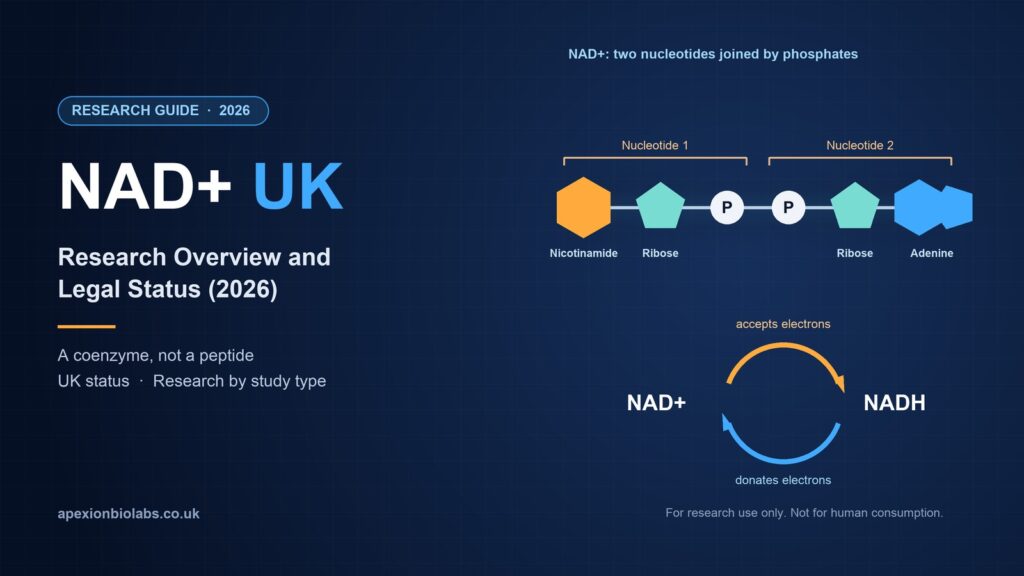
NAD+ is a small helper molecule, or coenzyme, that hundreds of enzymes rely on to complete their reactions. It’s assembled from two nucleotides: one holds a nicotinamide group and the other holds adenine, and two phosphates bridge them. Every cell in every organism makes it.
The story goes back to 1906. The biochemists Harden and Young were studying how yeast juice ferments sugar, and they noticed that boiling part of the extract didn’t destroy a small factor the reaction needed. They called it a “co-ferment”. Working out its full structure took several more decades, and it’s now among the most researched molecules in biochemistry.
Here are the core identity details, checked against PubChem’s NAD+ record:
| Field | Detail |
|---|---|
| Name | Nicotinamide adenine dinucleotide (oxidised form, NAD+) |
| Type | Coenzyme; a dinucleotide |
| Formula | C21H27N7O14P2 |
| Molecular weight | ~663.4 g/mol (free acid) |
| CAS number | 53-84-9 |
| Apexion format | NAD+ 500mg, a pre-filled research pen prepared to order in the UK for laboratory handling |
| UK status | Research material; no MHRA marketing authorisation |
NAD+ vs NADH
NAD+ and NADH are the same compound in two states. The oxidised form, NAD+, is the “empty” one, ready to pick up electrons, and NADH is the “loaded” reduced form carrying them.
The pair works like a shuttle bus. During glycolysis and the Krebs cycle, enzymes strip electrons from sugars and fats and hand them to NAD+, which becomes NADH. NADH then delivers them to Complex I of the mitochondrial electron transport chain and turns back into NAD+. Those electrons power the pumps that make ATP, the cell’s energy currency.
Its sister molecule, NADP+, has an additional phosphate and mainly supports building reactions and antioxidant defences.
Is NAD+ a Peptide?
No. A peptide forms when amino acids hook together via peptide bonds, and NAD+ contains none of them. Its parts are nicotinamide, two ribose sugars, two phosphates and adenine. Chemists group it with ATP and the nucleotides that make up RNA.
So why do UK peptide suppliers list it? It comes down to logistics. NAD+ arrives as a dry research material, is kept cold and dry like peptide stock, and ends up in the labs that study mitochondria alongside peptides including MOTS-c and SS-31. Suppliers simply follow those orders.
| Feature | NAD+ | A peptide (MOTS-c) |
|---|---|---|
| Made from | Two nucleotides | Sixteen amino acids |
| Linkage | Pyrophosphate bridge | Peptide bonds |
| Mass | ~663 g/mol | ~2,175 g/mol |
| Has a sequence? | No | Yes (MRWQEMGYIFYPRKLR) |
| How it’s identified | UV at 260 nm plus mass | Mass plus sequence |
Our MOTS-c vs SS-31 vs NAD+ comparison places the three mitochondrial research compounds next to each other, while the What Is MOTS-c? guide covers the peptide in depth.
What Does NAD+ Do in Cells?
NAD+ has two separate jobs. As a redox cofactor, it ferries electrons and returns to the pool, switching back and forth between its two forms without being used up. As a co-substrate, it’s consumed outright by three enzyme families: sirtuins, PARPs and CD38. Most consumer pages blur the two, yet the difference explains nearly every research question about NAD+.
Job 1, the recyclable carrier. The shuttle described above is a closed loop. A cell can run the same NAD+ molecule through it again and again, so this job barely changes the total amount in the cell. The ratio of NAD+ to NADH does move, though, and it tells researchers how hard the energy machinery is working.
Job 2, the consumable fuel. Here NAD+ is spent:
- Sirtuins (SIRT1 to SIRT7) cleave NAD+ to remove acetyl tags from proteins, a step tied to gene regulation and mitochondrial function in cultured cells and rodents.
- PARPs, PARP1 above all, spend NAD+ assembling poly(ADP-ribose) tags that mark damaged DNA for repair.
- CD38 is an enzyme found on and inside many cell types that degrades NAD+ and generates messenger molecules such as cyclic ADP-ribose.
Every one of these reactions frees a nicotinamide and leaves the original NAD+ gone. A 2014 review by Shin-ichiro Imai and Leonard Guarente in Trends in Cell Biology linked dropping NAD+ supply in animal models with weaker sirtuin activity, which is why consumption drives most ageing research.
How Cells Make NAD+
Since Job 2 keeps draining the pool, cells must keep resupplying it. They use three routes:
- De novo synthesis: a long pathway beginning with tryptophan, an amino acid.
- The Preiss-Handler pathway: a shorter route from nicotinic acid, one form of vitamin B3.
- The salvage pathway: recycles the nicotinamide released by those three enzyme families. The enzyme NAMPT turns nicotinamide into NMN, and NMNAT enzymes turn NMN into NAD+. NR enters the same pathway after NRK enzymes convert it to NMN.
Salvage supplies most of the NAD+ in mammalian cells, according to the 2021 review by Covarrubias and colleagues in Nature Reviews Molecular Cell Biology. That’s also where NR and NMN come in, since both are steps on that route.
What Is NAD+ Studied For?
NAD+ turns up in five main research areas. Each one carries a different weight of evidence, so here’s the model behind each:
- Mitochondria and energy production (cells, animals). Researchers track the NAD+/NADH ratio as a readout of how the electron transport chain is running, and study the separate mitochondrial NAD+ pool used by SIRT3, SIRT4 and SIRT5.
- Sirtuin and PARP signalling, DNA repair (in vitro, animals). Lab work examines how NAD+ supply limits sirtuin activity and how heavy DNA damage drains NAD+ through PARP1.
- Ageing and healthspan (mice, worms). Studies in mice and the worm C. elegans test what happens to ageing markers when NAD+ levels are raised or lowered. A 2018 review by Rajman, Chwalek and Sinclair in Cell Metabolism gathers the in vivo animal evidence for NAD-boosting molecules.
- Metabolic research (mice; human precursor trials). Mouse studies look at NAD+ in muscle, liver and fat tissue. In humans, small trials have given NMN or NR and measured metabolic markers. The 2021 NMN trial by Yoshino and colleagues in Science is the best known, and it tested NMN, a precursor.
- Neurodegeneration and cardiovascular models (preclinical). Cell and rodent models of nerve and heart tissue examine how NAD+ supply relates to mitochondrial stress in those cells.
Labs often study NAD+ beside other mitochondrial compounds, such as the peptides in our SS-31 UK research overview.
Does NAD+ Decline With Age?
It depends on the tissue and the method. Rodent studies consistently report lower NAD+ in several older tissues, and some human tissue studies agree. Human whole-blood measurements tell a different story, and a large 2026 study reported stable levels across age groups. The idea is well supported in mice and still open in people.
The “NAD+ falls with age” claim has deep roots. A 2020 review by McReynolds, Chellappa and Baur in Experimental Gerontology summarised the animal and human data pointing to decline. Part of the explanation comes from mice: a 2016 mouse study led by Camacho-Pereira found that CD38 climbs with age, and CD38-knockout animals held on to their NAD+.
Other researchers asked harder questions. A 2021 review by Peluso and colleagues in Nutrients carried the pointed title “Universal Truth or Confounded Consensus?”, noting that differences in tissue, sampling and measurement method could explain some of the reported drops. Vinten and colleagues, writing in Nature Metabolism in 2025, summed up the human picture:
“Evidence for an age-related decline in NAD+ levels in humans has been consistently observed only in a limited number of studies.”
Vinten et al., Nature Metabolism, 2025
A University of Amsterdam team then published, in June 2026, a multi-cohort study titled “Human whole-blood NAD+ levels do not vary with age or lifestyle interventions”. Blood is mostly red cells with no mitochondria, so whole blood may simply not mirror what happens in muscle, skin or brain. You’ll often see a “50% drop by middle age” figure online. We couldn’t trace it to a primary human study, so we’ve left it out.
NAD+ vs NMN vs NR: How the Molecules Differ
NMN and NR are building-block molecules (precursors) that the salvage pathway turns into NAD+. The order runs NR to NMN to NAD+. They differ in size, in how they reach the inside of a cell and in how much human trial data exists for each. Results from NR or NMN studies describe those molecules and shouldn’t be read as NAD+ data.
| Feature | NAD+ | NMN | NR |
|---|---|---|---|
| Molecular weight | ~663.4 g/mol | ~334.2 g/mol | ~255.3 g/mol (cation); chloride salt ~290.7 |
| Getting into cells | Enters poorly; enzymes on the cell surface (CD38, CD73) break it into smaller pieces first | Debated: often turned into NR before crossing the membrane, with a proposed direct transporter in mouse gut | Taken up by nucleoside transporters, then converted to NMN by NRK1/2 |
| Place in salvage pathway | End product | One step before NAD+ (via NMNAT) | Two steps before NAD+ |
| Human trial data | Very little; small pilot studies | A growing set of small, short trials | The largest set of human trials of the three |
Rachel Pojednic, a nutritional biochemist on the Stanford faculty, summed up the cell-entry problem to NPR in May 2026: NAD+ has “no easy door” into the cell from outside. The 2025 Nature Metabolism review pulls together the human precursor studies published to date and compares their tissue-specific effects.
What Does the Research on NAD+ Actually Show?
The strongest NAD+ data come from cells and animals, where the mechanisms are mapped in detail. Human data come mostly from precursor trials of NR and NMN, which reliably raise blood NAD+ markers but show mixed effects on function. No large controlled trials of intravenous NAD+ have been published.
| Area | Model | What was reported | Evidence level |
|---|---|---|---|
| Sirtuin activity | Animal models (review) | Lower NAD+ tracks with lower sirtuin activity (Imai & Guarente 2014) | Preclinical |
| NAD+ loss with age | Mice | CD38 rises with age; CD38-knockout mice keep NAD+ (Camacho-Pereira 2016) | Animal |
| NAD-boosting molecules | Rodents (review) | Precursors raised tissue NAD+ across many models (Rajman 2018) | Animal |
| NR in adults | 6-week human crossover trial | Blood-cell NAD+ went up with NR (Martens 2018) | Human precursor trial, biomarker |
| NMN in adults | 10-week trial, 25 postmenopausal women | Muscle insulin sensitivity rose vs placebo; other metabolic markers unchanged (Yoshino 2021) | Human precursor trial, small |
| Blood NAD+ and age | Several human cohorts | Whole-blood NAD+ stable with age; increased after NR (Trętowicz 2026) | Human observational + trial |
| IV NAD+ | Humans | Small pilot studies only (NPR, May 2026) | No controlled trials |
Even with those limits, researchers inside the field stay enthusiastic about the science itself. “When you look at the wide breadth of data in the NAD+ sciences, it’s vast and being done by some of the best scientists, truly in the world,” Pojednic told NPR.
Why Is NAD+ Research Debated?
Four questions keep the debate going:
- Mice and humans. Results that look strong in rodents haven’t carried over cleanly into short human trials, and routes and timescales differ between the two.
- The age-decline question. As covered above, tissue and blood data point in different directions.
- Marketing ahead of evidence. NPR’s May 2026 report and a piece in The Conversation both noted that nearly all NAD+ ageing research has come from cells or animals.
- Tumour-cell metabolism. Many tumour cell lines lean heavily on NAMPT and the salvage pathway, as a 2022 review in Cancers describes. That leads some researchers to ask whether raising NAD+ could also support those cells. It remains a theoretical question, untested in controlled studies.
Is NAD+ Legal in the UK?
Yes. NAD+ can be bought, sold and held lawfully in the UK (checked October 2026). It doesn’t appear under the Misuse of Drugs Act, and the MHRA hasn’t granted it a marketing authorisation. That second point carries real weight: no seller can present NAD+ as a treatment for any condition. Which rules apply depends on how it’s supplied.
Three regulatory routes exist:
- Research material. Supplied to labs for in vitro and analytical work, with nothing said about use in people. That’s the route Apexion uses.
- Food supplements. These come under the Food Standards Agency’s novel-food rules. The FSA register lists nicotinamide riboside chloride as an authorised novel food (NOVEL-96) for England, Scotland and Wales. A search of the same register for “nicotinamide” returned no NMN entry when we checked on 17 October 2026.
- Clinic services. Private clinics that offer NAD+ fall under medicines and advertising rules. In February 2025, the Observer reported that the MHRA had taken action against seven clinics, requiring them to remove treatment claims.
So what makes something a medicine in law? The MHRA explains its test in Guidance Note 8, updated in August 2026: the MHRA classes a product as medicinal either by “presentation” (the claims made for it) or by “function” (what it does in the body). For how UK law handles research compounds generally, see our guide to whether peptides are legal in the UK.
Can You Buy NAD+ in the UK?
Yes, through three distinct regulatory categories. Research suppliers sell it into laboratories as a reagent, for lab use only. Supplement retailers sell precursors such as NR as food, within the novel-food rules. Clinics operate under medicines and advertising law. Each category carries its own obligations, and research material belongs to none of the other two. Our Research Use Only notice spells out the conditions for research supply.
Is NAD+ a Licensed Medicine in the UK?
No. A search of the MHRA Products database shows no marketing authorisation for NAD+ (checked October 2026). The Observer’s 2025 report also noted that NAD+ isn’t approved for use on the NHS. With no licence, it can’t be advertised as a treatment for any disease.
Is NAD+ Being Researched in the UK?
Yes, mostly through precursor studies. The NHS Health Research Authority holds a research summary for a Cambridge study, “To study the role of nicotinamide riboside in inducing mitochondrial biogenesis”, with Professor Patrick Chinnery as the contact. It received a favourable ethics opinion in May 2017 (REC reference 17/EE/0120). Its ClinicalTrials.gov record (NCT03432871) lists it as completed.
A second HRA entry, NADMet, describes a University of Birmingham crossover study in healthy older men. It looked at whether NR changes how skeletal muscle handles energy. Both studies tested NR, a precursor, so neither reports on NAD+ itself.
How to Verify Research-Grade NAD+
A batch’s certificate of analysis (COA) is the one document that shows what a specific lot contains. For NAD+, the checks differ from a peptide COA, because there’s nothing like a residue sequence to confirm. Here’s what a solid one shows:
| Check | Look for |
|---|---|
| Lot number | Same lot code as printed on the item received |
| HPLC purity | UV detection at ~260 nm (the adenine ring), with the method stated |
| Identity | Mass spectrometry consistent with ~663.4 |
| Breakdown peaks | Nicotinamide and ADP-ribose listed with amounts |
| Lab and date | An independent lab named, with an analysis date |
| Form | Free acid or sodium salt stated, since this changes the weight |
Red flags include dosing charts, anti-ageing claims, a certificate missing its lot code, and any “NAD+ peptide” listed with an amino-acid sequence. That last one is a giveaway, because NAD+ has no sequence.
Apexion’s research materials carry typical HPLC-verified purity of ≥98%, each batch is tracked, and the NAD+ product page publishes batch results once they’re verified. Our batch verification guide, the quality assurance page and the Quality and Batch Verification hub explain how to check a lot.
How Should NAD+ Be Stored?
Dry NAD+ lasts longest cold, dry and shielded from light. The usual long-term setting is −20 °C. Sigma-Aldrich’s β-NAD product information notes that the powder is highly hygroscopic, meaning it pulls water from the air. Moisture and heat both speed up the break at the nicotinamide-ribose bond.
In solution, NAD+ is far less stable. It degrades fast in alkaline conditions and at raised temperatures, and neutral to slightly acidic solutions hold up best. Phosphate and carbonate buffers also speed up its breakdown, according to the same Sigma data. Our research storage and handling guide goes deeper on cold-chain basics.
Frequently Asked Questions
No. “Vitamin B3” is an umbrella label covering three molecules: nicotinamide, nicotinic acid and NR. Cells use those molecules as raw materials to build NAD+. NAD+ itself is the finished coenzyme, combining the B3 part with ribose sugars, phosphates and adenine.
No. Semaglutide, the active ingredient in Ozempic, is a modified peptide that mimics GLP-1, a hormone released by the gut, and activates its receptor. NAD+ is a dinucleotide coenzyme that works inside cells as an electron carrier and enzyme substrate. The two share no structure and act through unrelated pathways.
Yes. NAD+ occurs naturally in every living cell, from bacteria to humans, and cells make it continuously from tryptophan, nicotinic acid and recycled nicotinamide. Research-grade NAD+ is produced by chemical or enzymatic synthesis and is chemically identical to the natural molecule.
NMN (nicotinamide mononucleotide) is a precursor, about half the size of NAD+. In the salvage pathway, NMNAT enzymes join NMN to an adenine nucleotide to make NAD+. NMN has been tested in small human trials, and those findings apply to NMN itself.
NAD+ doesn’t appear by name on the WADA Prohibited List. Section M2.2 of the 2026 List prohibits intravenous infusions or injections totalling more than 100 mL per 12-hour period, except those legitimately received during hospital treatment, surgery or clinical investigations.
NAD+ goes to the same mitochondrial and metabolism labs that order peptides like MOTS-c or SS-31. It’s supplied as a dry research material with similar cold-storage needs. Suppliers stock it for those labs, even though chemically it’s a nucleotide.
The Bottom Line
To sum up, this dinucleotide coenzyme gets recycled by every cell as an electron carrier and spent as fuel by three enzyme families. Cell and animal research on it runs deep. Human data mostly come from NR and NMN trials, and the age-decline story looks different depending on what’s measured. Selling and holding it is lawful in the UK, no medicine licence exists for it, and the rules depend on how it’s supplied.
For lab work, see the NAD+ 500mg research material and its batch documentation, or browse the full mitochondrial research range.
For laboratory research use only. Not for human or veterinary use. Apexion Biolabs supplies NAD+ as a reagent for in vitro and analytical work. The article gives general information only. It isn’t medical advice and contains no dosing or administration guidance. The Research Use Only notice has the full terms.
Sources
- Harden A, Young WJ (1906). The alcoholic ferment of yeast-juice. Proceedings of the Royal Society B.
- Imai S, Guarente L (2014). Trends in Cell Biology, review of NAD+ and sirtuins.
- Covarrubias AJ et al. (2021). NAD+ metabolism and its roles in cellular processes during ageing. Nature Reviews Molecular Cell Biology.
- Rajman L, Chwalek K, Sinclair DA (2018). Cell Metabolism, review of in vivo evidence for NAD-boosting molecules.
- Camacho-Pereira J et al. (2016). Cell Metabolism, CD38 and age-related NAD+ decline in mice.
- McReynolds MR, Chellappa K, Baur JA (2020). Age-related NAD+ decline. Experimental Gerontology.
- Peluso A et al. (2021). Age-dependent decline of NAD+: universal truth or confounded consensus? Nutrients.
- Trętowicz MM et al. (2026). Human whole-blood NAD+ levels do not vary with age or lifestyle interventions. Nature Metabolism.
- Vinten KT et al. (2025). NAD+ precursor supplementation in human ageing: clinical evidence and challenges. Nature Metabolism.
- Yoshino M et al. (2021). Science, randomised NMN trial.
- Martens CR et al. (2018). Nature Communications, nicotinamide riboside crossover trial.
- PubChem: Nicotinamide adenine dinucleotide (CID 5892).
- MHRA. Guidance Note 8: A guide to what is a medicinal product (August 2026).
- MHRA Products database.
- Food Standards Agency: Nicotinamide riboside chloride, NOVEL-96.
- Health Research Authority: The role of nicotinamide riboside in mitochondrial biogenesis.
- The Observer / The Guardian (23 February 2025). “It’s not ethical and it’s not medical”: how UK rehab clinics are cashing in on NAD+.
- NPR (11 May 2026). Marketers say NAD+ pills and infusions can boost longevity. What’s the evidence?
- World Anti-Doping Agency: 2026 Prohibited List.