
How Long Do Reconstituted Peptides Last? Storage and Handling for Research
Reviewed by Oscar Reyes, PhD, Synthesis Lead at Apexion BioLabs · Scientific review of the chemistry and analytical content
Quick answer
How long do reconstituted peptides last?
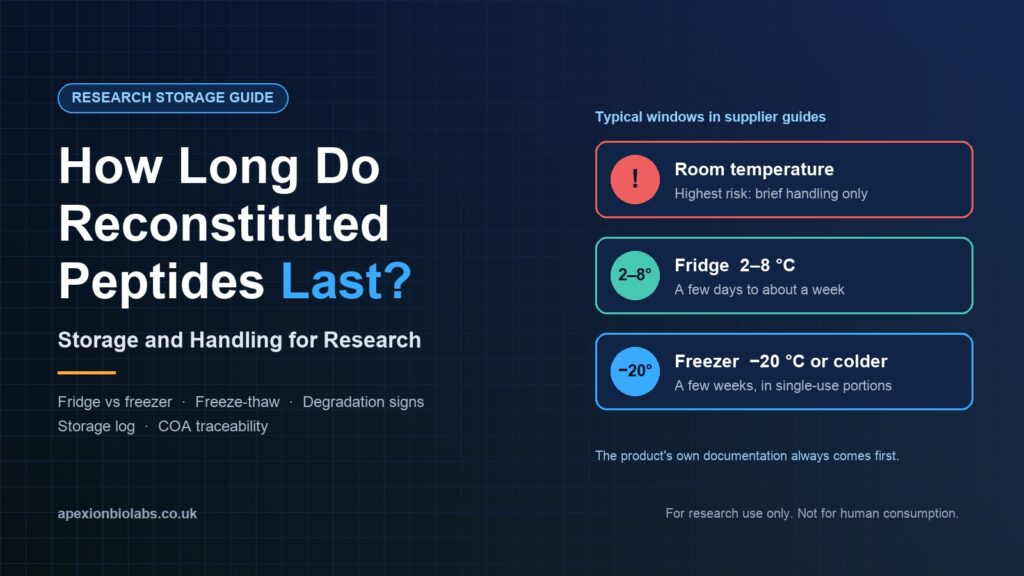
Reconstituted peptides typically last a few days to about a week in the fridge and a few weeks frozen, according to supplier technical guides. The product’s own documentation always takes priority.
- Short term: refrigerated at 2 to 8 °C. Supplier guides give anything from “a few days” (JPT) to “up to a week” (Sigma-Aldrich).
- Longer term: frozen at −20 °C or colder, split into single-use portions. Bachem says frozen solutions “may be kept for a few weeks.”
- Always: protected from light, kept sealed, and frozen and thawed as few times as possible.
- First rule: the product’s own documentation overrides every general figure on this page.
Reconstituted peptides are peptides in solution, and solution is where they break down fastest. Store them cold, dark and sealed, with as few temperature swings as possible. Suppliers’ own technical guides give much shorter windows than the “2 to 4 weeks in the fridge” figures that circulate online, so we’ve pulled every stated figure into one place.
Research use only: all products discussed are supplied strictly for laboratory research and are not for human or veterinary use. Read our research use notice.
Lyophilised vs Reconstituted Peptides: Storage Differences
A lyophilised peptide is freeze-dried into a dry powder or cake. A reconstituted peptide is that same material in solution. Dry peptides mainly fear moisture. Peptides in solution face water-driven chemistry, oxidation and contamination, so their stability window is far shorter. JPT puts it plainly: reconstituted peptides “are much more prone to degradation than their dry or lyophilized counterparts.”
| Lyophilised (dry) | Reconstituted (solution) | |
|---|---|---|
| Form | Freeze-dried powder or cake | Peptide dissolved in a supplied formulation |
| Usual long-term storage | −20 °C or colder; Bachem prefers −50 °C or lower | Frozen at −20 °C or colder, in single-use portions |
| Short-term storage | Fridge at 4 °C (Bachem) | Fridge at 2 to 8 °C for days |
| Typical stability window | Weeks to months at room temperature, sealed and dry (AAPPTEC) | Days in the fridge; a few weeks frozen |
| Main risks | Moisture uptake when the container is opened cold | Hydrolysis, oxidation, deamidation, aggregation, contamination |
That’s why the dry-storage question has a simple answer. Unreconstituted peptides are happiest sealed, dry and frozen, and a fridge works for short spells. Bachem notes that dry peptides “may be shipped at room temperature,” which is why a room-temperature delivery of dry material isn’t a red flag.
Where to Store Reconstituted Peptides: Fridge vs Freezer vs Room Temperature
Store a peptide solution in the fridge at 2 to 8 °C for short-term work over a few days, and freeze it at −20 °C or −80 °C for anything longer. Room temperature is the highest-risk condition. Whichever unit you use, the supplier’s stated condition comes first.
| Condition | Typical lab use | Main risk |
|---|---|---|
| Fridge, 2 to 8 °C | Material in active use over a few days | Slow chemical breakdown over time |
| Freezer, −20 °C | Holding stock for weeks | Damage from repeated freeze-thaw |
| Freezer, −80 °C | Long-term holding of sensitive sequences | Freeze-thaw when portions are taken out |
| Room temperature | Brief handling only | Fastest degradation and contamination risk |
Refrigerated storage (2–8 °C)
The fridge suits solutions you’ll access within days. Sigma-Aldrich states that “peptide solutions are stable for up to a week at 4 °C” in general, and recommends freezing unstable sequences and any solution above pH 8.
Frozen storage (−20 °C and −80 °C)
Freezing slows the chemistry that breaks peptides down. JPT recommends −20 °C or lower for reconstituted peptides and notes that “some peptides may require storage at −80°C to prevent rapid degradation.” Freeze in single-use portions so the stock is thawed once.
Room temperature: why it’s the highest-risk condition
Warmth speeds up every degradation reaction. A common rule of thumb from general chemistry says reaction rates roughly double for every 10 °C rise. It’s an approximation, and real peptides vary, but it explains why a solution left on the bench loses ground fast.
Where in the fridge or freezer
Avoid door shelves, where temperature swings each time the unit opens. Before opening a cold container, let it reach room temperature. Sigma-Aldrich and Bachem both advise this, because cold surfaces pull moisture from the air into the material.
How Long Do Reconstituted Peptides Last?
Reconstituted peptides typically last a few days to about a week in the fridge and a few weeks frozen, according to supplier technical guides from Sigma-Aldrich, Bachem, JPT and AAPPTEC. No supplier we reviewed publishes a general figure longer than that, and the product’s own documentation always takes priority.
Stability ranges reported in technical literature
| Source | Fridge (2 to 8 °C) | Freezer (−20 °C) | Deep freezer (−80 °C) |
|---|---|---|---|
| Sigma-Aldrich | Up to a week, in general | Freeze unstable sequences and solutions above pH 8 | Not stated for solutions |
| Bachem | Advises against storing in solution | A few weeks, aliquoted below −15 °C | Lower temperatures preferred |
| JPT | A few days may be acceptable | −20 °C or lower recommended | Needed for some peptides |
| AAPPTEC | No more than a few days in solution | Freeze for maximum stability | Not stated |
Online forums often quote 2 to 4 weeks in the fridge, and some sites mention a “30-day rule.” Those figures are two to four times longer than any manufacturer guide above. Treat them as reported claims with no published supplier backing.
Why the sequence matters
Some amino acids make a peptide more fragile in solution. Methionine, cysteine and tryptophan oxidise, and asparagine and glutamine deamidate, a reaction that changes the peptide’s chemical structure. Bachem states that “peptides containing Asn, Gln, Met, Cys, and/or Trp have limited shelf lives.” TB-500, described in our BPC-157 vs TB-500 guide as Ac-LKKTETQ, ends in glutamine (Q).
Why the product documentation overrides general ranges
The ranges above describe research peptides in general. Your product’s formulation, container and concentration set its real window. Our own guidance for Apexion materials is a cool, stable environment, typically −20 °C for long-term storage, away from heat and direct light.
What Affects Reconstituted Peptide Stability?
Temperature is the biggest factor, followed by light, container closure and moisture, and how often the material is handled. Each one adds stress, and the stress adds up across a study. The solvent, buffer and pH are part of the product’s formulation, so follow the supplier’s documentation for them.
| Stability factor | Why it matters | Practical control |
|---|---|---|
| Temperature | Warmer conditions speed up degradation | Hold the stated range; store promptly |
| Light | Some sequences degrade under light | Keep in original or amber packaging |
| Container closure | Open containers let in moisture and contaminants | Keep sealed; log any damage |
| Handling frequency | Each access adds time out of storage | Plan access in batches |
| Freeze-thaw | Each cycle adds physical stress | Freeze in single-use portions |
Temperature swings
A steady temperature beats a slightly colder but unstable one. Each swing in and out of the stated range adds stress, so keep stock in a unit that’s opened as rarely as possible and log any alarm or power cut.
Light
JPT advises dark storage or amber vials “to prevent photodegradation.” Keep material in its supplied packaging until you need it.
Container closure and moisture
A sealed container holds the conditions the formulation was designed for. Record any compromised seal as a deviation before the material goes further.
Handling frequency
Plan each session so you take out what you need in one go. Repeated checks add minutes outside cold storage, and those minutes accumulate.
Freeze-Thaw and Aliquoting in the Lab
Every freeze-thaw cycle stresses a peptide solution. JPT reports that “each freeze-thaw cycle can increase the risk of peptide degradation, especially through aggregation,” where peptide molecules clump together. AAPPTEC states that freeze-thaw cycling “will accelerate the degradation of the peptide.”
Labs reduce cycling by splitting stock into single-use working portions, called aliquots, so each portion thaws once. Bachem recommends aliquoting peptide solutions and keeping them frozen below −15 °C. Sigma-Aldrich gives the same advice for any stock sampled repeatedly.
Aliquot only where the product documentation and your laboratory’s procedures allow it. Some formats are designed to be handled as supplied, and splitting them adds transfer steps, labelling risk and a break in batch traceability. Record every aliquot against its parent batch number, with the date and storage location, so each portion stays traceable to its Certificate of Analysis.
Label each portion with the parent batch number, a portion number and the freeze date. Thaw one portion per session at its stated condition, and log any leftover solution as used up or discarded so the stock count stays accurate.
Signs a Peptide Solution May Have Degraded
Visible changes in a peptide solution are a signal to stop and document. Common warning signs are cloudiness, visible particles, sediment, a colour change, and a damaged seal or unreadable label. Each one calls for the same response: quarantine, record and contact the supplier.
- Cloudiness or haze: can indicate aggregation or contamination.
- Particles or sediment: can indicate the peptide has come out of solution.
- Colour change: can indicate oxidation or another chemical change.
- Damaged seal or label: breaks the link between the material and its records.
For any of these, quarantine the material, record a deviation with the date and observation, and contact the supplier with the batch number. Visual checks can’t confirm that a solution is intact, so the decision belongs to your laboratory’s quality process. Photograph the container and label before moving anything. Keep the quarantined material at its stated storage condition, apart from working stock, so it’s available if the supplier asks for more detail or a sample.
What to Do After a Temperature Excursion
A temperature excursion means the material spent time outside its stated range, such as a container left out overnight. Log the time and temperature, quarantine the material, check the supplier’s stability data, and decide through your laboratory’s quality process.
- Record how long the material was out and the highest temperature it reached.
- Move it to quarantine at its stated storage condition.
- Check the product documentation for stability data, and contact the supplier with the batch number.
- Record the outcome in the deviation log and the storage log.
Excursions are common: a door left ajar, a courier delay or a power cut. What matters is a record with times and temperatures, because the decision depends on stability data the supplier holds for that specific formulation. A temperature logger with an alarm makes step one much easier and gives you real numbers in place of an estimate.
Receiving a Reconstituted Peptide Batch
A structured receiving step turns a delivery into a traceable inventory item. Do it before the material joins working stock. Have the storage location ready before you open the parcel, so cold material spends as little time on the bench as possible.
Receipt and verification checklist
- Confirm the product name, format and stated strength.
- Match the batch number on the product to the Certificate of Analysis.
- Check the packaging and primary container are intact.
- Read the supplied storage instructions.
- Record the receipt date, receiver and storage location.
- Note any delay or possible temperature exposure.
- Store the material promptly at its stated condition.
Our guide on how to read a peptide certificate of analysis covers the HPLC, mass and batch detail in full.
Reconstituted Peptide Storage Log Template
A storage log ties a physical item to a batch, a location and a handler. Copy the fields below into your inventory system and adapt them as needed.
| Record field | What to record |
|---|---|
| Internal sample ID | Your laboratory’s unique inventory identifier |
| Product name | The full research-product name |
| Format | Vial or pre-filled research pen |
| Batch or lot number | The exact number on the physical product |
| COA reference | File name, document number or internal location |
| Date received | When the laboratory accepted the product |
| Storage instruction | The product-specific stated condition |
| Storage location | Fridge or freezer unit and shelf |
| Handler | The person responsible for receipt or movement |
| Condition at receipt | Packaging, label and container observations |
| Deviation record | Any excursion, damage or unexpected event |
| Research-protocol reference | Link to the relevant internal study or assay record |
Kept up to date, the log answers what an audit or a repeat experiment will ask: what it is, which batch, where it’s been, and who handled it.
Batch Verification and COA Traceability
Batch verification confirms that the paperwork belongs to the exact material you’re holding. The COA documents the material’s analysis, while the storage log documents its life in your lab, and a complete record needs both. Our quality and batch verification page shows how to check a batch by QR code or batch number.
What to match before research use
- Product name and format
- Batch or lot number
- Stated strength, where provided
- Date of analysis
- HPLC purity and mass identity data, where present
What to do if the batch number doesn’t match
Quarantine the material and contact the supplier with the product and document details. Record the issue in your quality system so the resolution sits alongside the batch record. A mismatch matters because a COA for a different batch tells you nothing about the purity or identity of the material in front of you.
Storing Peptide Pens vs Vials
Pens and vials need the same cold, dark, sealed storage and the same batch records. Pre-filled research pens are handled as supplied and stay in their original packaging. Vials may be split into aliquots where procedures allow. Store pens in their box with the label visible, so the batch number can be read without extra handling. See our peptide pen vs vial guide and our UK peptide pens overview.
Common Storage Mistakes to Avoid
Most storage problems come from a handful of habits. Each one has a simple control.
| Avoidable issue | Better research control |
|---|---|
| Relying on forum storage durations | Follow supplier documentation and your SOP |
| Separating a product from its COA | Keep a lot-to-COA link in the inventory record |
| Storing on fridge door shelves | Use a stable shelf at the back of the unit |
| Opening a cold container straight away | Let it reach room temperature first |
| Thawing the whole stock repeatedly | Freeze single-use portions |
| Ignoring damaged packaging | Quarantine and request verification |
| Leaving an excursion unlogged | Create a deviation record and review it |
Reconstituted Peptide Storage FAQs
Use the fridge at 2 to 8 °C for solutions in active use over a few days. Use the freezer at −20 °C or colder for anything longer, ideally in single-use portions. Supplier guides from JPT and Bachem favour frozen storage for solutions, and the product’s documentation sets the final condition.
Supplier guides give short windows. Sigma-Aldrich says solutions are generally stable for up to a week at 4 °C, while JPT and AAPPTEC say a few days. Online figures of two to four weeks have no published supplier backing. The product’s documentation and sequence set the real limit.
Dry peptides are best kept frozen at −20 °C or colder for long-term storage, sealed and dry. Bachem notes that short-term storage at 4 °C is acceptable and that dry peptides can ship at room temperature. Let cold containers reach room temperature before opening to keep moisture out.
Peptides containing methionine, cysteine or tryptophan are prone to oxidation, and those containing asparagine or glutamine are prone to deamidation. Bachem states that peptides with these residues have limited shelf lives. Labs often store such sequences frozen, protected from air and light.
Warning signs include cloudiness, visible particles, sediment, a colour change, or a damaged seal or label. Visual checks can’t confirm a solution is intact, so any of these signs means quarantining the material, recording a deviation and contacting the supplier with the batch number.
Record how long the material was outside its range and the temperature reached. Quarantine it at its stated condition, check the supplier’s stability data, contact the supplier with the batch number, and decide through the laboratory’s quality process. Log the outcome in the deviation and storage records.
No. The Certificate of Analysis documents a batch’s analytical results, such as HPLC purity and mass identity. Receiving records and the storage log document what happened to the material after it arrived. Full traceability needs both documents, linked by the batch number.
Sources, Research Use and Editorial Review
This guide draws on supplier technical documentation:
- Bachem: Handling and Storage Guidelines for Peptides
- Sigma-Aldrich: Handling and Storage
- JPT: How to Store Peptides
- AAPPTEC: Handling and Storage of Peptides
All Apexion products are supplied for laboratory research use only and are not for human or veterinary consumption. See our research use notice. When you’re ready, browse our research peptides and review the batch documentation for each product.