
Glutathione 500mg: Research Overview and UK Status (2026)
Reviewed by Oscar Reyes, PhD, Synthesis Lead at Apexion BioLabs · Scientific review of the chemistry and analytical content
Quick answer
What is glutathione?
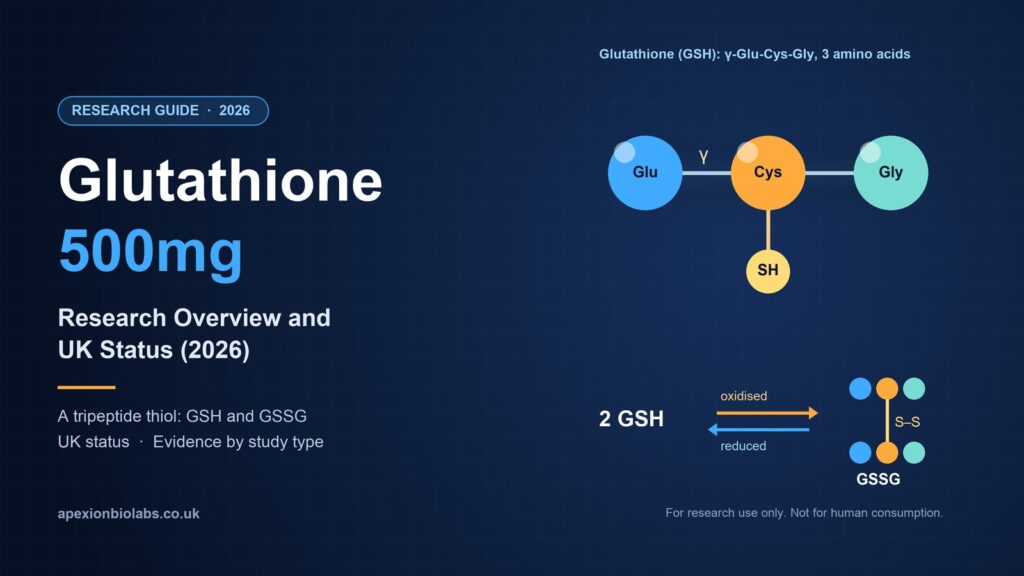
Glutathione is a tripeptide (γ-Glu-Cys-Gly) made inside nearly every cell, and it’s the main thiol antioxidant studied in redox biology. On a research product, “500mg” describes how much glutathione the pen contains. It’s a statement of contents with no usage meaning.
- A true peptide, with an unusual γ-bond holding it together
- Mechanism data come largely from cells and animals; human trials are small and mixed
- UK: no licensed injectable product, and research supply is restricted to lab work
“500mg” might be the most misread figure in this corner of the market. On a supplement tub it comes with serving instructions. On a research pen it only states how much glutathione is inside, and the true amount still depends on purity and how well the material has held up against oxidation.
That oxidation story is where glutathione gets interesting. Its whole job in a cell rests on a single sulfur atom that flips between two forms, and that same chemistry explains its stability, its COA and why regulators on both sides of the Atlantic have been busy with it since 2025. Chemistry comes first below, then the human trials (each tagged by model and route), then the UK rules, sport and storage.
Apexion supplies glutathione to laboratories as a research material. None of it is meant for people or animals, and nothing below is medical or cosmetic advice. Supply terms are listed in our Research Use Only notice.
What Is Glutathione?
Glutathione is a compact molecule that cells assemble from three amino acids: glutamate, cysteine and glycine. Its working end is the sulfur-containing thiol group (-SH) on cysteine, which readily gives up electrons. That makes glutathione the cell’s main buffer against reactive oxygen species and a partner for dozens of enzymes.
The British biochemist Frederick Gowland Hopkins reported it in 1921 in the Biochemical Journal, describing “an autoxidisable constituent of the cell” from yeast and animal tissue. Hopkins later won a Nobel Prize for his vitamin work, and his glutathione paper became a founding text of redox biology. Liver tissue is one of the main sites of glutathione synthesis, and the classic 1983 Annual Review of Biochemistry paper by Alton Meister and Mary Anderson mapped how it’s made and moved between tissues.
| Field | Detail |
|---|---|
| Name | Glutathione, reduced form (GSH) |
| Sequence | γ-Glu-Cys-Gly |
| Formula | C10H17N3O6S |
| Molecular weight | ~307.3 g/mol (PubChem CID 124886) |
| CAS number | 70-18-8 |
| Apexion format | Glutathione 500mg, a pre-filled research pen made to order in the UK for laboratory handling |
| UK status | Research material; oral supplements sold as food; no licensed injectable medicine |
Is Glutathione a Peptide?
Yes. Glutathione is a tripeptide, three amino acids long. One link is unusual, though. Glutamate joins cysteine through its side-chain (gamma) carboxyl group, where most peptides use the alpha carboxyl. That γ-glutamyl bond resists most peptidases, the enzymes that chop ordinary peptides, which helps glutathione last inside cells.
It also differs from most peptides in how it’s made. Cells assemble it with two dedicated enzymes, with no ribosome or genetic code involved:
| Feature | Glutathione | MOTS-c |
|---|---|---|
| Length | 3 amino acids | 16 amino acids |
| Bond type | One γ-glutamyl bond, one standard peptide bond | Standard peptide bonds throughout |
| How cells make it | Two enzymes (GCL, then glutathione synthetase) | The ribosome, from a mitochondrial gene |
| Mass | ~307 g/mol | ~2,175 g/mol |
For a peptide the ribosome does make, read our MOTS-c Peptide UK overview.
What Does “500mg” Mean on a Research Product?
On a research product, “500mg” is the stated quantity of glutathione the pen contains. It says nothing about how the material should be used. To read it properly, it helps to know the difference between net content and gross weight, and how purity and other components change the picture.
- Net content vs gross weight. Net content is the glutathione itself. Gross weight would include the container and anything else in it.
- Purity. HPLC purity gives what fraction of the material is glutathione. At 98% purity, a 500 mg fill holds about 490 mg of GSH, with the rest made up mostly of related compounds such as GSSG.
- Counter-ions and water. Reduced glutathione is usually supplied as the free acid, but trace moisture and any salt form can lower the true glutathione content.
Whatever the label says, the certificate of analysis (COA) for that lot settles what’s actually in it.
Reduced vs Oxidised Glutathione (GSH vs GSSG)
GSH is the reduced form, carrying a free thiol on its cysteine. When two GSH molecules each give up a hydrogen, their sulfur atoms link through a disulfide bond to form GSSG, the oxidised form. The enzyme glutathione reductase reverses this, using NADPH as its electron source.
| Feature | GSH (reduced) | GSSG (oxidised) |
|---|---|---|
| Formula | C10H17N3O6S | C20H32N6O12S2 |
| Molecular weight | ~307.3 g/mol | ~612.6 g/mol |
| CAS number | 70-18-8 | 27025-41-8 |
| Role | Donates electrons; enzyme substrate | Product of oxidation; recycled back to GSH |
GSSG keeps both halves identical, so its mass works out at twice GSH’s minus two hydrogens (2 × 307.3 − 2.0). The balance between the two ranks among the most common readouts in redox research. Cells normally keep most of their glutathione reduced, so a falling GSH:GSSG ratio signals oxidative stress in cell and tissue models, as the 2009 review by Henry Jay Forman and colleagues in Molecular Aspects of Medicine describes. That review also flags a well-known trap: GSH can oxidise during sample handling, which inflates GSSG readings.
S-acetyl glutathione is a third form you may see listed. It has an acetyl cap on the thiol, which researchers study as a way to protect that group until it reaches the cell interior.
How Do Cells Make and Use Glutathione?
Cells make glutathione in two steps. Glutamate-cysteine ligase (GCL) joins glutamate to cysteine, and glutathione synthetase then adds glycine. GCL is the rate-limiting enzyme, and cysteine supply is usually the bottleneck, so the amount of available cysteine largely sets how much glutathione a cell can build.
Once made, glutathione goes to work in several systems, mapped mostly in cultured cells and rodents:
- Glutathione peroxidases use GSH to turn hydrogen peroxide and lipid peroxides into water and alcohols, producing GSSG along the way (in vitro, animal).
- Glutathione S-transferases attach glutathione to reactive compounds so cells can export them (in vitro, animal).
- Vitamin recycling: GSH helps regenerate vitamin C, which in turn restores vitamin E in membranes (in vitro).
- S-glutathionylation: glutathione binds reversibly to cysteines on proteins, switching their activity on or off as a form of redox signalling (in vitro, animal).
Jason Pizzorno’s 2014 editorial in Integrative Medicine gives a readable overview of these roles for non-specialists.
Is Glutathione the Same as NAD+?
No. Glutathione is a tripeptide antioxidant, whereas NAD+ belongs to the nucleotides and shuttles electrons through energy-producing reactions. They connect through NADPH, a phosphorylated relative of NADH, which glutathione reductase uses to turn GSSG back into GSH. The NAD family is covered in our NAD+ UK overview.
Glutathione vs NAC: How the Molecules Differ
NAC (N-acetylcysteine) is cysteine with an acetyl group added. It’s a building block, because cells can remove the acetyl group and feed the cysteine into glutathione synthesis.
| Feature | Glutathione (GSH) | NAC |
|---|---|---|
| Type | Tripeptide | Modified amino acid |
| Molecular weight | ~307.3 g/mol | ~163.2 g/mol |
| Relationship | The end product | Supplies cysteine, the limiting ingredient |
| UK status | Supplement or research material | Licensed medicine in some forms; also sold as a supplement |
What Is Glutathione Studied For?
Five fields account for most glutathione research, and they range from bench assays to brain scans:
- Oxidative stress (in vitro). GSH levels and the GSH:GSSG ratio are standard readouts when cells are exposed to peroxides or other oxidants.
- Liver and toxicology models (animal). Rodent studies track how depleting or supplying glutathione changes how liver tissue handles reactive compounds.
- Ageing and neurodegeneration (human brain imaging, observational). Magnetic resonance spectroscopy can measure glutathione in living brain tissue. A 2015 Biological Psychiatry study by Pravat Mandal and colleagues compared brain glutathione across older-adult groups.
- Tumour drug resistance (in vitro, animal). High glutathione and glutathione S-transferase activity are studied in cell lines that resist certain chemotherapy agents.
- Pigmentation biology (in vitro). In cultured melanocytes, glutathione is studied for how it affects tyrosinase activity and the balance between pigment types. These are cell-culture findings, and only one small human trial in the table below touches this area.
What Does the Research on Glutathione Actually Show?
Ask what glutathione does inside a cell and the literature answers with confidence. Ask what an oral product does in people and the answers get shakier. The human trials are small, mostly use oral products, and mainly measure glutathione levels in blood, with mixed findings across studies. Here’s how the main ones line up:
| Study | Design | Route and population | What was measured | Evidence level |
|---|---|---|---|---|
| Allen & Bradley 2011 | 4-week RCT | Oral, 40 adults | Oxidative stress markers and red-cell GSH; no significant change reported | Human, small |
| Richie 2015 | 6-month RCT | Oral, 54 non-smoking adults | Blood and cell GSH rose versus baseline | Human, modest size |
| Weschawalit 2017 | 12-week RCT | Oral GSH or GSSG, healthy women | Melanin index and other measures; trends versus placebo | Human, small |
| Sinha 2018 | 1-month pilot | Oral liposomal, 12 adults | Blood GSH rose; no control group | Human pilot |
| NCT01550432 | Randomised, placebo-controlled | Oral GSH or NAC vs placebo, 78 enrolled (Stanford) | Inflammation markers; completed, no results posted | Human, registry only |
Taken together, the trials show oral glutathione can raise blood measurements in some designs and not in others. None was large, and most lasted weeks to a few months.
That leaves real limits on what anyone can conclude. A rise in blood glutathione is a biomarker, showing the molecule or its parts reached circulation, and it says nothing on its own about function. The trials also used different product forms, from standard capsules to liposomal liquids, which makes direct comparison hard. Larger and longer studies with matched methods are the next step researchers point to.
Why Oral Bioavailability Is Debated
Enzymes in the gut, especially γ-glutamyl transpeptidase, break glutathione down into its amino acids, so for years researchers assumed little would reach the blood intact. The Allen 2011 trial found no change in red-cell GSH after four weeks. The Richie 2015 trial, which ran for six months, reported rises. Differences in duration, product form and measurement methods are the main explanations researchers give for the disagreement.
Is Glutathione Legal in the UK?
Yes, in two forms. Checked in October 2026, UK law allows glutathione as an oral food supplement and as a lab research material. There’s no UK-licensed injectable glutathione medicine, and UK bodies have described salon and clinic whitening drips as unlicensed.
The key points, as checked in October 2026:
- Injectable products. The MHRA has advised that Tatonil, an injectable glutathione product, lacks a UK marketing authorisation, according to the Joint Council for Cosmetic Practitioners (JCCP). The JCCP adds the MHRA’s position that “cosmetic use is therefore not an admissible special need” for supplying an unlicensed medicine.
- Salon drips. In June 2025, the Chartered Trading Standards Institute responded to a Channel 4 News investigation that found more than 300 UK beauty salons offering glutathione drips, many without medical supervision.
- Presentation. Under the Human Medicines Regulations 2012, explained in MHRA Guidance Note 8 (updated August 2026), claims attached to a product can make it a medicine in law. Research listings therefore stay with identity, purity and storage facts.
For the same rules across other research compounds, see Are Peptides Legal in the UK?
Why Have UK Regulators Warned About Glutathione Drips?
The warnings focus on three findings. First, the products used are unlicensed. Second, many drips are given in beauty settings with no medical oversight. Third, campaigners told Channel 4 that people have reported serious reactions. In the US, the FDA reminded compounders in August 2026 not to use dietary-supplement-grade glutathione for injectable drugs, and the CDC joined the FDA in September 2026 to investigate illnesses linked to such products.
Can You Buy Glutathione for Research in the UK?
Yes. UK suppliers offer glutathione to labs on research-use-only terms for cell-free and cell-based experiments, with no health or cosmetic claims attached. The conditions are set out in our Research Use Only notice.
Is Glutathione Banned in Sport?
The WADA Prohibited List makes no mention of glutathione by name. A separate rule, M2.2 in the 2026 List, bans any intravenous infusion or injection above 100 mL in 12 hours regardless of what it contains, with exceptions for hospital care, surgery and clinical diagnostic investigations. In the UK, the list is enforced by UK Anti-Doping.
How Stable Is Glutathione, and How Should It Be Stored?
Dry glutathione is fairly stable, but in solution GSH oxidises to GSSG. The reaction runs faster at higher pH, at higher temperatures, with trace metals present and with more dissolved oxygen. Sigma-Aldrich’s glutathione product information notes that aqueous solutions readily oxidise in air to GSSG and that a chelating agent, which binds trace metals, extends GSH’s half-life. Sigma also advises against autoclaving, since heat and pressure degrade the compound.
The solid is normally held at −20 °C for the long term, dry and sealed. Keep pens in the fridge and follow the batch sheet. Our research storage and handling guide and Peptide Pen vs Vial cover cold-chain and format differences.
How to Verify Research-Grade Glutathione
A glutathione COA should prove identity, purity and content for the exact lot received. Since GSH turns into GSSG with time and air, the GSSG figure is the most telling line on the report. It forms during manufacture, filling and storage, so comparing GSSG across lots shows how well the material has been handled.
| What to check | Why |
|---|---|
| Lot number | Matches the code printed on the item |
| HPLC purity | Main peak share, with GSSG reported as the main impurity |
| MS identity | [M+H]+ near m/z 308.1 for GSH |
| Net content | Measured glutathione against the 500 mg label |
| Lab and date | An independent lab and a recent analysis date |
Treat whitening claims and dosing charts as a sign the product isn’t research material. On the report itself, a missing lot number or a missing GSSG line should prompt questions before anything else.
Apexion tracks each batch, with HPLC purity typically ≥98%, and posts glutathione results on the product page after verification. The batch verification guide, quality assurance page and Quality and Batch Verification hub show how to check a lot.
Frequently Asked Questions
Yes. Glutathione is a tripeptide of glutamate, cysteine and glycine. Its glutamate links through the side-chain gamma carboxyl, an unusual bond that resists most peptidases. Cells build it with two dedicated enzymes, while most peptides and proteins come off the ribosome.
No. Glutathione is a three-amino-acid antioxidant, and NAD+ is a nucleotide-based coenzyme for energy reactions. Their link is NADPH, a close relative of NADH, which glutathione reductase uses to convert oxidised glutathione back to its reduced form.
GSH is reduced glutathione, a single molecule with a free thiol group (about 307.3 g/mol). GSSG is oxidised glutathione: two GSH molecules joined by a disulfide bond (about 612.6 g/mol). The GSH:GSSG ratio is a standard marker of redox state in cell and tissue research.
NAC (N-acetylcysteine) is a modified form of the amino acid cysteine. Cells can use it as a source of cysteine, the limiting ingredient for making glutathione. Glutathione is the finished tripeptide, roughly twice NAC’s molecular weight.
It’s the stated amount of glutathione in the product and carries no usage meaning. The true glutathione content depends on purity, water and any salt form, so the batch certificate of analysis is the reference for what a specific lot holds.
No. The MHRA has advised that Tatonil, an injectable glutathione product, has no UK marketing authorisation, and no other licensed injectable glutathione is available. UK bodies including the JCCP and the Chartered Trading Standards Institute have raised concerns about unlicensed glutathione drips.
The Bottom Line
Three amino acids, one unusual bond and a sulfur atom that switches between two states: that’s glutathione in a sentence. Cells build it in two enzyme steps and cycle it between GSH and GSSG. Its mechanism is mapped in detail in cells and animals, while human trials are small, mostly oral and mixed. In the UK it’s legal as a supplement and as research material, with no licensed injectable product.
Lab teams can find the Glutathione 500mg specification and batch documentation on the product page.
For laboratory research use only. Not for human or veterinary use. Apexion Biolabs provides glutathione only for bench and analytical research. Nothing in this guide is medical or cosmetic advice, and it includes no dosing or administration details. Full terms: Research Use Only notice.
Sources
- Hopkins FG (1921). On an autoxidisable constituent of the cell. Biochemical Journal.
- Meister A, Anderson ME (1983). Glutathione. Annual Review of Biochemistry.
- Forman HJ, Zhang H, Rinna A (2009). Glutathione: overview of its protective roles, measurement, and biosynthesis. Molecular Aspects of Medicine.
- Pizzorno J (2014). Glutathione! Integrative Medicine.
- PubChem: Glutathione, CID 124886.
- Allen J, Bradley RD (2011). Journal of Alternative and Complementary Medicine, oral glutathione RCT.
- Richie JP et al. (2015). Randomized controlled trial of oral glutathione supplementation on body stores of glutathione. European Journal of Nutrition.
- Sinha R et al. (2018). European Journal of Clinical Nutrition, liposomal glutathione pilot.
- Weschawalit S et al. (2017). Clinical, Cosmetic and Investigational Dermatology, oral GSH and GSSG RCT.
- Mandal PK et al. (2015). Brain glutathione by magnetic resonance spectroscopy. Biological Psychiatry.
- ClinicalTrials.gov: NCT01550432.
- Sigma-Aldrich: L-Glutathione reduced, G4251.
- MHRA Guidance Note 8 (August 2026).
- MHRA Products database.
- Human Medicines Regulations 2012.
- Chartered Trading Standards Institute (June 2025).
- JCCP: Glutathione and unlicensed medicines used in cosmetic procedures.
- US FDA (2026). FDA reminds compounders not to use dietary supplement grade glutathione for injectables.
- US CDC: Adverse events linked to injectable glutathione, current situation.
- World Anti-Doping Agency: 2026 Prohibited List.
- UK Anti-Doping.